What is the University of Milan known for, and is it a public university?
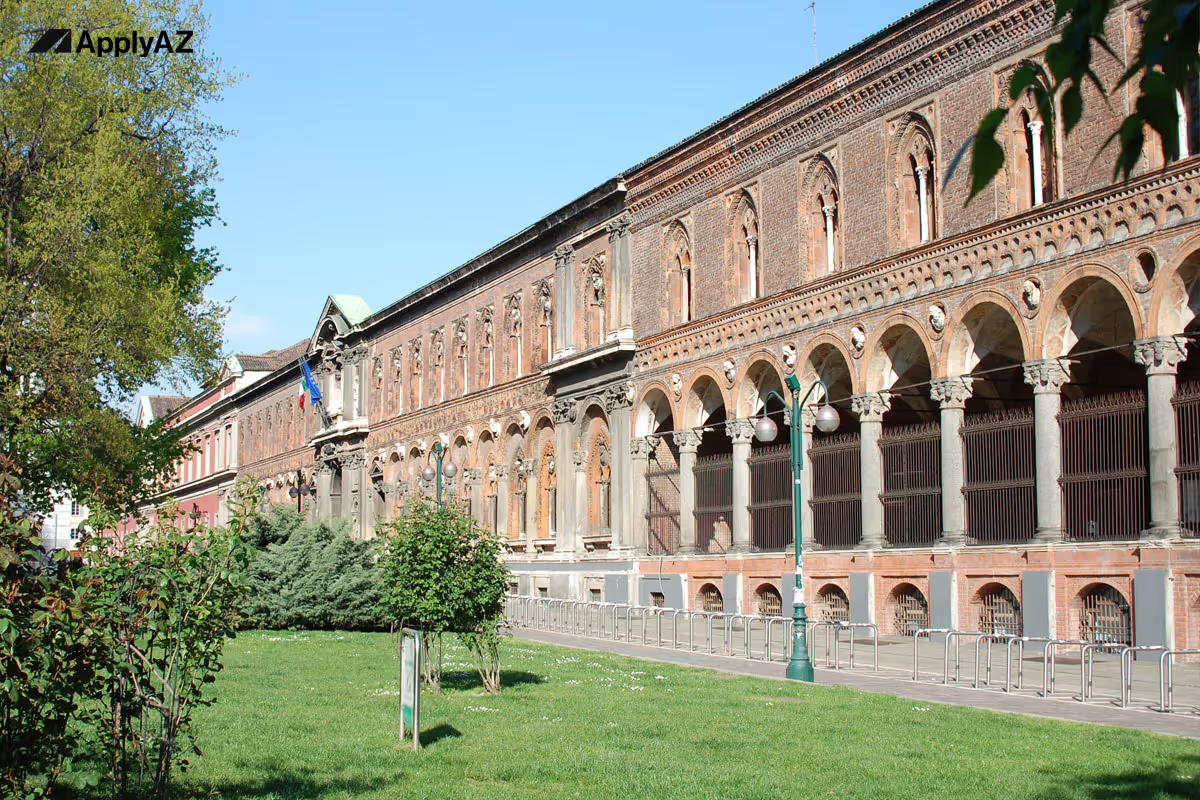
The University of Milan (La Statale) is a public research university in Lombardy, founded in 1924 and the only Italian member of LERU, the League of European Research Universities. It teaches about 65,000 students, around 7% of them international. Its headquarters sit in the former Ca' Granda hospital near the Duomo, with science in the Città Studi district and the new MIND innovation district. Its strongest faculties are Medicine, Pharmacy, Agriculture and Food Science, Veterinary Medicine and the sciences.
Can international students study at the University of Milan in English?
Yes, the University of Milan runs more than 40 English-taught programmes, mostly at master's level, plus English-taught Medicine and Surgery at its International Medical School. Popular English-taught master's degrees include Data Science and Economics, Global Politics and Society, Management of Innovation and Entrepreneurship, Computer Science, Physics, Molecular Biotechnology and Bioinformatics, and Law and Sustainable Development. It also offers more than 20 double degrees with partner universities.
What are the University of Milan's admission requirements?
The University of Milan asks for 12 years of schooling for a bachelor's degree, or a relevant bachelor's for a master's, plus English at B2 level (IELTS 6.0 to 6.5 or equivalent). Master's degrees check for specific credits, some programmes add a GRE, an interview or a motivation letter, and English-taught medicine uses the IMAT. The university does not publish an acceptance rate, and figures online are guesses. Limited-enrolment programmes rank applicants for fixed places, with a separate quota for non-EU students living abroad.
How do you apply to the University of Milan, step by step?
You apply to the University of Milan online through its admissions portal, programme by programme, then pre-enrol on Universitaly once admitted. Master's applications for non-EU students living abroad usually close in spring, and for 2026/27 many programmes closed on 30 April 2026. Open-admission master's programmes check that your previous degree has the required credits, while limited-enrolment programmes rank applicants. Read each admission call early, because deadlines differ between programmes.
- Check the programme's admission call for credits, documents and deadlines.
- Apply online with transcripts, degree certificate, English certificate and CV (many 2026/27 master's deadlines fell on 30 April 2026).
- Pre-enrol on Universitaly once admitted and wait for the university to validate it.
- Apply for your type D visa with the validated summary, proof of funds and accommodation.
- Apply for the regional scholarship through the university's right-to-study office before its summer deadline.
How much does the University of Milan cost for international students?
The University of Milan sets tuition by family income (ISEE), so there is no single fee. Students with a low ISEE are exempt from the university contribution under Italy's no-tax area rules and pay only the regional tax and stamp duty; above that, contributions rise with income up to a maximum set for each programme. International students can use an ISEE parificato, prepared in Italy from translated and legalised family income documents. Without income documents, you pay the maximum contribution.
Can you study at the University of Milan with little or no tuition?
You can study at the University of Milan with little or no tuition only if your family income qualifies and you submit your income documents in time. Tuition is set by family income (ISEE); students from lower-income families can pay little or nothing beyond the regional tax, and a DSU scholarship winner also gets a tuition waiver. In your control: your ISEE parificato and its deadline; students from certain developing countries may also qualify for a reduced flat fee. Not in your control: your family's income and the regional ranking. Skip the income step and you pay the maximum.
Which scholarship covers the University of Milan, and how much is it worth?
The University of Milan manages the Lombardy regional right-to-study (DSU) scholarship for its own students. Winners get a cash grant (the national minimum for off-site students in 2026/27 is €7,171.11), a fee exemption and meal services, with priority for university residences. The family ISEE must be under the regional limit, within the national cap of €28,339.88. The university also offers merit scholarships for international students on English-taught master's programmes, and MAECI and Invest Your Talent in Italy grants.
How good is the University of Milan in the rankings, and do they matter?
The University of Milan is joint 270th in the QS World University Rankings 2027 and 5th among Italy's mega public universities in Censis 2026/27. It is Italy's only LERU member and is strongest in medicine, life sciences, agriculture and pharmacy. Treat rankings as one signal: QS, THE and ARWU mostly measure research and reputation across a whole university, while Censis weighs services, scholarships and employability. For a specific degree, the programme and its entry rules tell you more.
- QS World University Rankings 2027: joint 270th worldwide
- Times Higher Education World University Rankings 2026: 301 to 350 band
- ShanghaiRanking ARWU 2026: 201 to 300 band
- Censis Italian university ranking 2026/27: 5th among Italy's mega public universities (score 85.3)
What is student life like in Milan, and what does it cost to live there?
Student life at the University of Milan means living in Italy's business, fashion and design capital, with a busy international community and excellent transport. The central campus is near the Duomo, while science students spend most of their time in Città Studi and, increasingly, at MIND. Milan is Italy's most expensive student city: most students budget about €1,000 to €1,500 a month, with a shared-flat room at €600 to €900. University residences are limited, so start your housing search early.
How does the University of Milan compare with other universities in Milan?
The University of Milan is the broad research university among Milan's three public universities, strongest in medicine, life sciences, law and political science. Politecnico di Milano is Italy's highest-ranked university in QS 2027 (joint 87th) and leads in engineering, architecture and design. Milano-Bicocca (544th in QS 2027) is younger, with a modern campus and strong economics, psychology, science and medicine. Private universities such as Bocconi and Cattolica charge fixed fees that often run to many thousands of euros a year.
Is the University of Milan a good choice for you?
The University of Milan suits students who want a classic research university in Italy's economic capital, especially in medicine, the life sciences, law or the social sciences. Milan brings internships, company contacts and a strong job market. It suits you less if your budget is tight: Milan is Italy's most expensive city to live in, and university residences are limited. Limited-enrolment programmes and the spring deadlines for non-EU applicants also reward students who plan months ahead.
How can ApplyAZ help with the University of Milan, and when to apply alone?
ApplyAZ helps you apply to the University of Milan as part of a shortlist of 20 to 30 English-taught programmes at Italian public universities. We write your CV and a tailored SOP for each, submit every application and your Universitaly pre-enrolment, file your regional DSU scholarship and prepare your visa file, with a named person owning each stage. We take no university commissions, and strong, organised students can use our roadmap to apply alone. See how ApplyAZ works or check your eligibility.