

Bachelor in Economics: Behavior, Data and Policy at University of Milan
Three-year English-taught economics bachelor at the University of Milan built around behavioural economics, experiments, econometrics and machine learning, with 15 places for non-EU visa applicants in 2026/27.
Bachelor
3 years
Milan
English
University of Milan



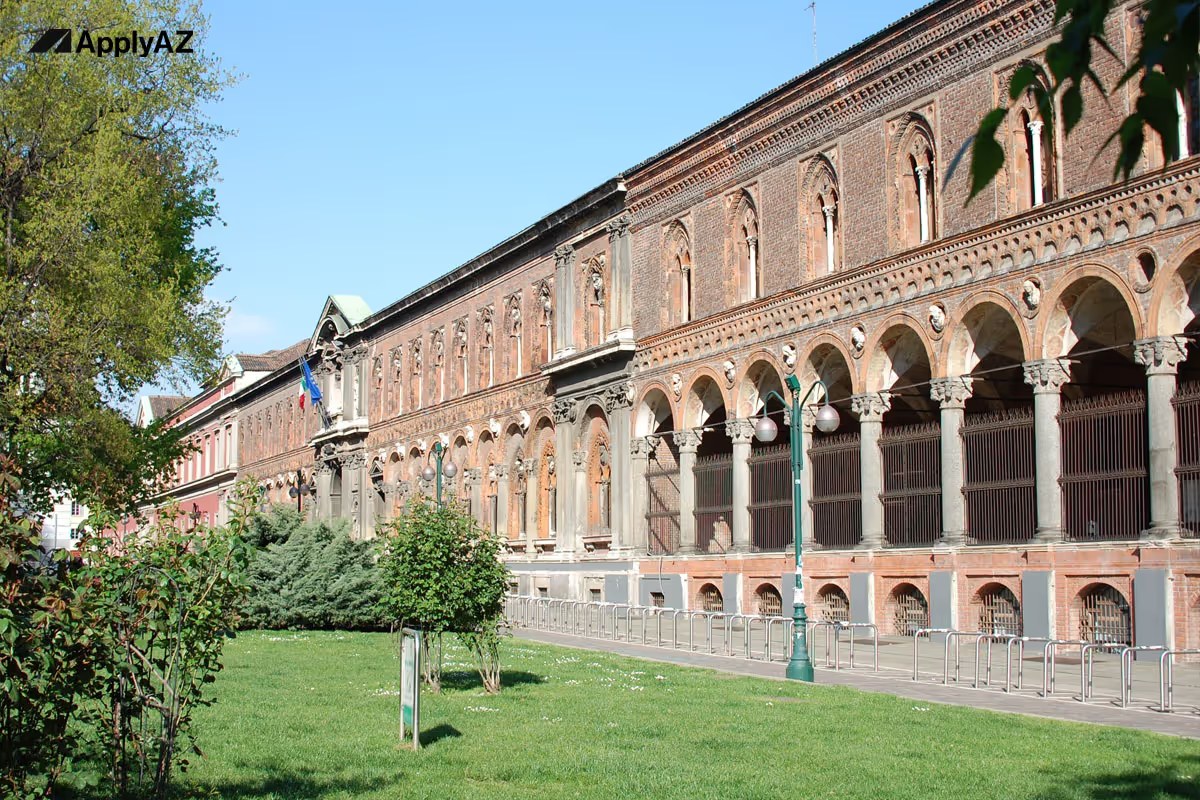
Economics: Behavior, Data and Policy is a three-year, 180 ECTS bachelor (class L-33-R) taught in English at the University of Milan. It combines economic theory with behavioural economics, experiments and data analysis. Entry is limited, with the CEnT-S test, and non-EU students with family income abroad pay a fixed fee by country group.
Entry requirements
- A secondary school qualification obtained after at least 12 years of schooling, with basic skills in language comprehension, logic and mathematics.
- English at B2 level (CEFR), shown by a certificate from the last three years, a school diploma taught in English or the university placement test.
- The CEnT-S online or in-person test by CISIA (€55): only the Mathematics and Reasoning on texts and data sections count, 15 questions each.
- Non-EU applicants living abroad upload their documents on apply.unimi.it and compete in a separate ranking for 15 reserved places (2026/27).
- On enrolment: your legalised diploma with an Italian translation and a CIMEA statement of comparability or a declaration of value.
About the programme
Economics: Behavior, Data and Policy is a three-year bachelor's degree in class L-33-R (economics), taught entirely in English and in person in Milan by the Department of Economics, Management and Quantitative Methods. It aims to give a solid grounding in economic theory and its quantitative and statistical tools, together with the behavioural mechanisms that drive the decisions of people and firms in markets.
Entry is limited: for 2026/27 there were 100 places plus 15 for non-EU applicants living abroad who need a visa. The degree suits school leavers who like mathematics and data and want to understand how economic policy, consumer choices and markets work in practice.
What you will study
The first year covers the foundations in economics, mathematics, statistics, coding and law. The second adds econometrics, experimental methods and policy evaluation, and the third focuses on behaviour, marketing and machine learning. Units in the 2026/27 study plan include:
- Microeconomics and Mathematics (12 ECTS each, first year)
- Probability and Statistics and Coding (first year)
- Data Protection and Consumer Law (first year)
- Econometrics and Experimental Economics (second year)
- Causal Inference and Policy Evaluation (second year)
- Behavioral Economics (third year)
- Machine Learning for Economics (third year)
- Consumer Behavior and Marketing Strategy (third year)
How the programme is taught
Some exams must be taken in order: Microeconomics comes before Behavioral Economics, Public Economics and Experimental Economics, and Mathematics and Probability and Statistics come before Econometrics. Besides lectures, you take 12 ECTS of elective courses or laboratories and 6 ECTS of other activities, which can include an internship, before a 3 ECTS final exam. The department has exchange agreements with European universities, including partners in the United Kingdom and Switzerland.
Career paths
The official profiles place graduates in companies and in public and private organisations that need people who can collect, check and interpret economic data. They include:
- Data technician: supports experimental research and economic, social and demographic surveys, with data quality control and statistical processing
- Market analyst: studies consumer reactions and market conditions and helps define marketing strategies
- Operative and strategic marketing technician
Fees and scholarships
For fees the degree sits in Area B. Students whose family income and assets are abroad pay a fixed second instalment by country group: for 2026/27, €256 a year in Group A, which covers countries like India, Pakistan and Nigeria, €1,164 in Group B and €4,101.12 in Group C, on top of a first instalment from €146. The University of Milan runs the Lombardy regional DSU scholarship, and full winners pay no fees, which means zero euro tuition for eligible students.
How to apply from outside the EU
Selection uses the CEnT-S, the English-language test run by CISIA (€55), taken online or at a test centre. Only the Mathematics and Reasoning on texts and data sections count, and visa applicants have their own ranking for the 15 reserved places. For 2026/27 the admission window ran from 12 March to 6 July 2026, with documents uploaded on apply.unimi.it; the 2027/28 call was not yet out in September 2026.
If admitted, you submit the Universitaly pre-enrolment (by 31 July for 2026/27), apply for a type D study visa with B2 English and, by 30 November, provide a CIMEA statement or a declaration of value for your diploma.
How ApplyAZ helps
If this programme fits your goals, ApplyAZ can include it in a shortlist of 20 to 30 English-taught programmes at Italian public universities. We write your CV and a tailored statement of purpose, submit your applications and Universitaly pre-enrolment, file your DSU scholarship application and prepare your visa file, with a named person on each stage. The university decides admission, the region decides the scholarship and the consulate decides the visa. See how ApplyAZ works or check your eligibility.
Questions and answers
Is the degree taught in English?
Yes. It is taught entirely in English, and B2 English is needed before you can sit exams, shown by a certificate from the last three years, a school diploma taught in English or the university placement test.
Which admission test do I need?
The CEnT-S by CISIA, taken online or in person, with a €55 fee. Only the Mathematics and Reasoning on texts and data sections count, 15 questions each, and a low mathematics score brings an extra learning requirement.
How many places are there for non-EU students?
For 2026/27 there were 15 places for non-EU applicants living abroad who need a visa, ranked separately, and 100 places for other candidates.
What will I study?
Microeconomics, mathematics, statistics and coding in the first year, then econometrics, experimental economics and policy evaluation, and finally behavioural economics, machine learning for economics and consumer behaviour.
How much are the fees?
For 2026/27, students with family income abroad pay a fixed second instalment by country group, from €256 a year in Group A, plus a first instalment from €146. Full winners of the regional DSU scholarship pay no fees.
What jobs do graduates do?
The university lists data technician roles in research and surveys, market analyst roles in consumer and market research, and operative or strategic marketing roles in companies and public or private organisations.
Similar programmes
More programmes in this city

They began right where you are

