

Master in Computational Social and Political Science at University of Milan
Two-year English-taught master at the University of Milan that trains computational social scientists and policy analysts in statistics, R and Python programming, text analytics, machine learning, network analysis and causal inference.
Master
2 years
Milan
English
University of Milan



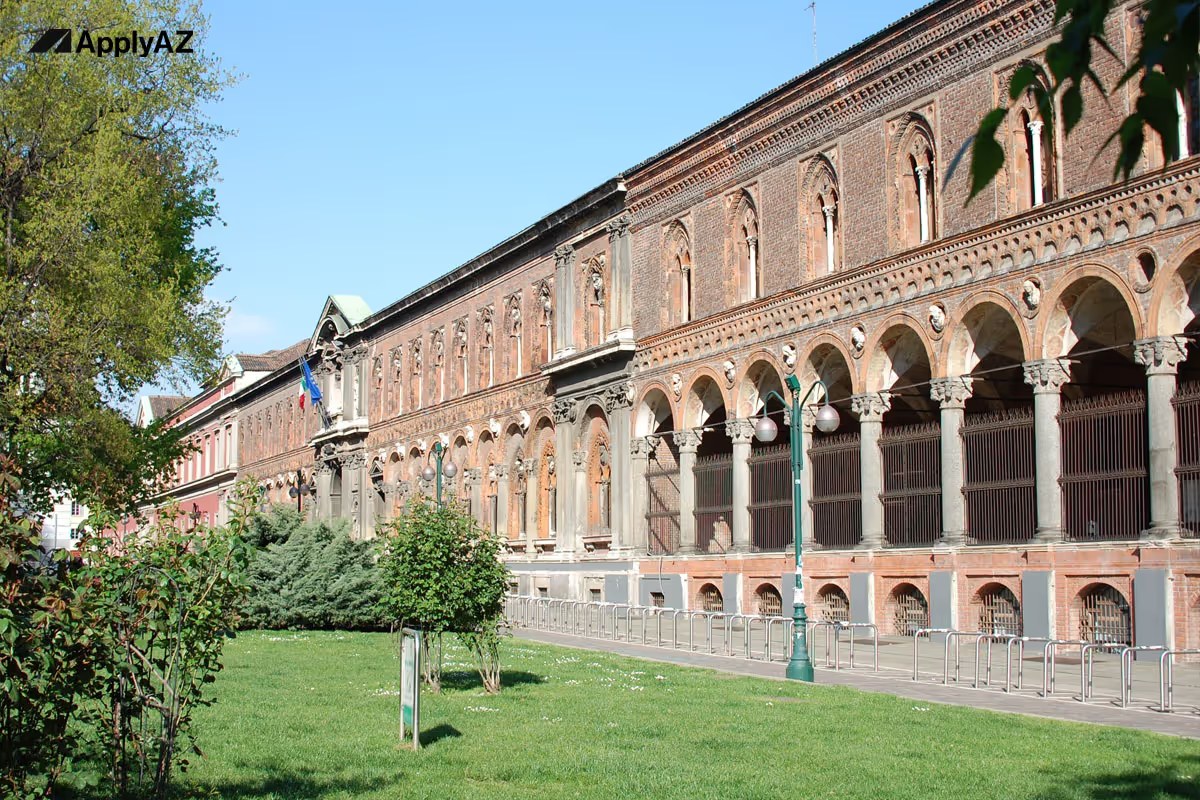
Computational Social and Political Science is a two-year, 120 ECTS interclass master (LM-62-R/LM-88-R) taught entirely in English by the University of Milan in Milan. It applies statistics, programming and machine learning to social and political questions. Entry is limited, and non-EU students with family income abroad pay a fixed fee by country group.
Entry requirements
- A bachelor's degree with at least 30 ECTS in computer science, mathematics, applied physics or statistics and/or in political science and sociology, including at least 12 ECTS in political science or sociology and 9 ECTS in statistics.
- English at B2 level or higher (CEFR): a certificate issued in the last three years, a University of Milan SLAM certificate from the last four years or the SLAM entry test.
- For non-EU visa applicants: an evaluation of your CV followed by an online video interview on your skills and fit with the programme.
- For other candidates: a remote written test in English on basic statistics, sociology and political science.
- An application on apply.unimi.it with a €30 fee; for 2026/27 there were 35 places plus 10 for non-EU students living abroad.
About the programme
Computational Social and Political Science is a two-year interclass master's degree in classes LM-62-R (political science) and LM-88-R (sociology and social research), taught entirely in English by the Department of Social and Political Sciences of the University of Milan. Teaching is in person in Milan, with lectures, exercises and lab sessions.
The degree teaches you to explain political and social phenomena with evidence, joining hypothesis-driven social science with the inductive methods of data science. You learn statistical modelling, programming in R and Python, text analysis, machine learning and network science, and apply them to elections, public opinion, policy and social behaviour. It suits graduates in political science, sociology, economics, statistics or computer science who enjoy both theory and data.
What you will study
The year is split into trimesters. Most units are compulsory, with one 6 ECTS elective in each year, which can be a lab-based course. Core units include:
- Foundations of Statistical Modelling (9 ECTS)
- Programming for Social Data Science
- Research Design and Experimental Methods (12 ECTS)
- Survey Methods for Public Opinion Research (9 ECTS)
- Data Governance: Ethical and Legal Issues
- Text Analytics, Machine Learning and Large Language Models (12 ECTS)
- Social Network Analysis
- Causal Inference in Social and Political Science and Agent-Based Modelling
How the programme is taught
Attendance is not required but strongly recommended. The second year includes a 9 ECTS internship with a company, public body, government organisation or research centre; students without Italian at A2 level do a 6 ECTS internship plus 3 ECTS of Italian. The degree ends with a 15 ECTS thesis, an original piece of research defended in public. Erasmus+ offers three to twelve months of study or traineeship abroad, and the university's 4EU+ alliance adds further options.
Career paths
The programme trains two profiles. A computational social scientist designs data collection, analyses social data and presents trends and causal findings. A computational analyst for public policy studies elections, political movements and public opinion and builds predictive models. Outlets named by the university include:
- Social media, HR and consulting firms
- Market research and polling companies
- Government agencies and public administration
- Think tanks, political consulting and political parties
- Research centres, NGOs and international agencies
Fees and scholarships
The degree sits in fee Area B of the 2026/27 regulation. Students whose family income and assets are abroad pay a fixed second instalment by country group: €256 in Group A, covering countries like India, Pakistan and Ghana, €1,164 in Group B and €4,101.12 in Group C, with a first instalment of €146 at enrolment. Full winners of the Lombardy DSU scholarship, run by the university, pay no second instalment, which means zero euro tuition for eligible students.
How to apply from outside the EU
Entry is limited: for 2026/27 there were 35 places plus 10 for non-EU students living abroad. Visa applicants do not sit the written test. They applied on apply.unimi.it from 24 March to 29 May 2026 with a €30 fee, and the board assessed their CV and held an online video interview, sending results by 11 June and asking admitted students to enrol by 18 June. The 2027/28 call was not yet out in September 2026.
You then complete Universitaly pre-enrolment by 31 July and apply for a type D study visa with B2 English.
How ApplyAZ helps
If this programme fits your goals, ApplyAZ can include it in a shortlist of 20 to 30 English-taught programmes at Italian public universities. We write your CV and a tailored statement of purpose, submit your applications and Universitaly pre-enrolment, file your DSU scholarship application and prepare your visa file, with a named person on each stage. The university decides admission, the region decides the scholarship and the consulate decides the visa. See how ApplyAZ works or check your eligibility.
Questions and answers
Is this master taught in English?
Yes, it is entirely taught in English. You need English at B2 level or higher, shown by a certificate from the last three years, a University of Milan SLAM certificate or the SLAM entry test.
What bachelor's background do I need?
A bachelor's degree with at least 30 ECTS in computer science, mathematics, statistics or physics and in political science and sociology, including at least 12 ECTS in political science or sociology and 9 in statistics.
Is there an entrance test?
Yes for most candidates: a remote written test in English on statistics, sociology and political science. Non-EU visa applicants are assessed instead on their CV and an online video interview.
How many places are there?
For 2026/27 there were 35 places plus 10 reserved for non-EU students living abroad. Visa applicants applied from 24 March to 29 May 2026 and received results by 11 June.
How much are the fees?
For 2026/27, students with family income abroad pay a fixed second instalment by country group, from €256 a year in Group A, plus a first instalment of €146. Full DSU scholarship winners pay no second instalment.
What jobs does it lead to?
Graduates work as computational social scientists or computational policy analysts in consulting, market research and polling, public administration, think tanks, political consulting, research centres, NGOs and international agencies.
Similar programmes
More programmes in this city

They began right where you are

