

Master in Environmental and Food Economics at University of Milan
Two-year English-taught economics master at the University of Milan on climate, energy, natural resources and sustainable food systems, with two curricula, a Copenhagen double degree track and an online interview for admission.
Master
2 years
Milan
English
University of Milan


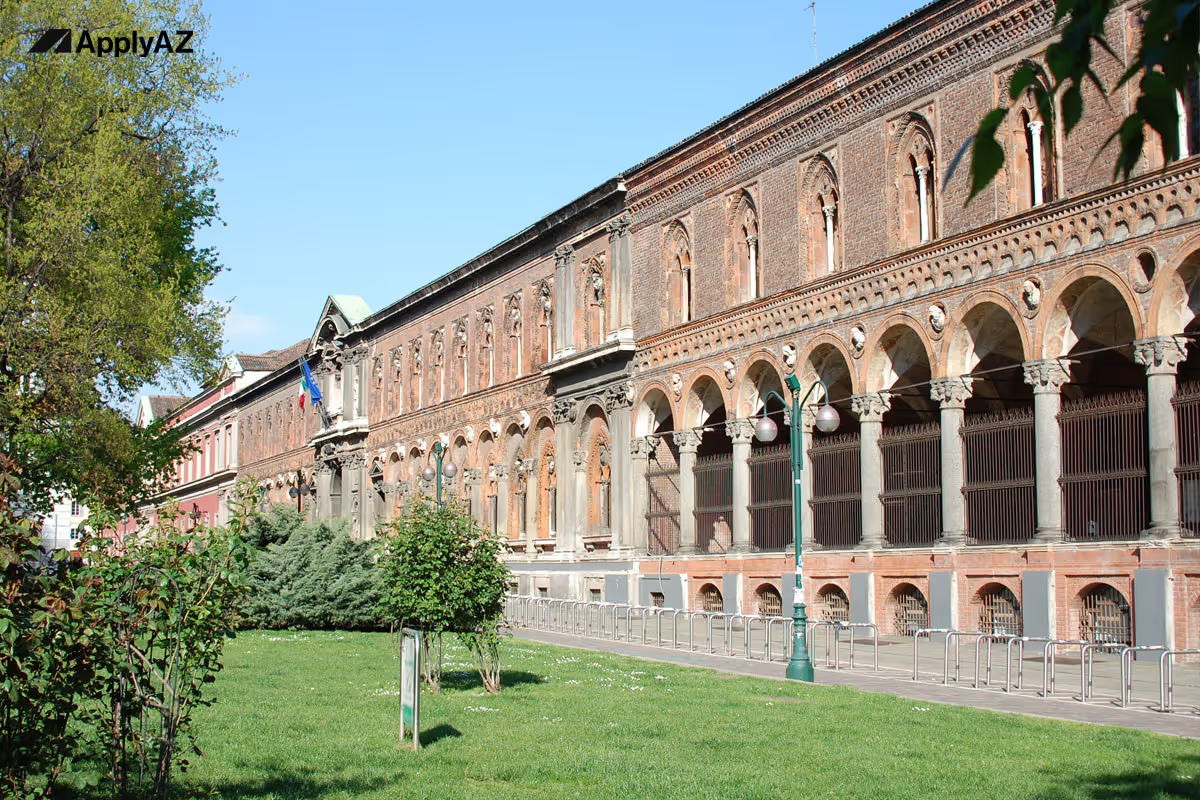
Environmental and Food Economics is a two-year, 120 ECTS master's degree (class LM-76-R) taught in English at the University of Milan's Città Studi campus. Entry needs a related bachelor's with at least 6 credits each in maths and statistics, economics and management, plus English at B2 or English-taught previous studies, and an online interview. Full regional scholarship winners pay no second instalment, so it can be tuition-free for eligible students.
Entry requirements
Detailed entry requirements
Milan's Environmental and Food Economics master asks for a bachelor's in a related field with at least 90 credits in the listed subject areas and at least 6 credits each in maths and statistics, economics and management. You also need English at B2 or English-taught previous studies, and an online interview in English. Reviewed 8 October 2026. [1]
Degree and credit requirements
The programme is open to Italian three-year graduates in a long list of classes, including economics (L-33), business economics (L-18), statistics (L-41), political science (L-36), agricultural and food sciences (L-25 and L-26), environmental sciences (L-32), engineering (L-7, L-8 and L-9), computer science (L-31), mathematics (L-35) and physics (L-30). Graduates of other fields and holders of foreign degrees can be admitted after a favourable decision by the Didactic Committee or a committee it appoints. Foreign qualifications must meet requirements equivalent to the Italian ones. [2]
- At least 90 ECTS across these areas: mathematics, physics and statistics; business administration, economics and management; agricultural, biological, chemical and geological sciences; architecture and engineering; computer science; law; and social sciences.
- At least 6 ECTS in mathematics and statistics (MAT/01 to 09, SECS-S/06).
- At least 6 ECTS in economics or agricultural economics (AGR/01, SECS-P/01 to 06, ING-IND/35).
- At least 6 ECTS in management (AGR/01, SECS-P/07 to 11, ING-IND/35).
If you lack one of the 6-credit minimums, you can make it up through crash courses that start at the end of August. They are open only to admitted students and are not compulsory. [2]
What this means for your transcript
Credits on a foreign transcript are not the same unit as Italian CFU, and the committee looks at the subjects behind them. As a guide, based on the rule above:
- Usually a fit: a BA or B.Sc. in Economics, a B.Com or BBA with maths or statistics, or a B.Sc. in Agriculture that includes agricultural economics, statistics and farm management.
- Check carefully: a B.Tech, B.E. or BCA, which usually covers maths and the 90-credit total but needs economics and management courses, and a BA in Political Science, Sociology or Geography, or a B.Sc. in Mathematics, Statistics or Physics, which can miss one of the 6-credit blocks.
- Often short: a humanities degree, such as a BA in English or another language, with no maths, economics or management courses.
To show the expected level, the programme points to Varian's Intermediate Microeconomics and to Haeussler, Paul and Wood's Introductory Mathematical Analysis for Business, Economics, and the Life and Social Sciences. [2]
English
You meet the requirement if English is your mother tongue, or if your high-school diploma or your bachelor's degree was taught in English. Otherwise you need English at CEFR B2 or higher, and the certificate must be uploaded with the online application. [2] Certificates must be B2 or higher and obtained within the last three years, or two years for TOEFL. Non-EU visa applicants must also show B2 in the language of instruction, which is English here. [4]
On the university's list, B2 corresponds to IELTS 5.5 to 6.5, TOEFL iBT 72 to 94, PTE Academic 59 to 75 or Cambridge B2 First. [7]
Selection and interview
The programme rules set no written entrance test. The admission board reviews your academic record and invites applicants who meet the requirements to an online interview in English on their background, knowledge, competencies and skills in the core areas of the programme. For 2026/27, interviews ran between February and September 2026. [2] The admission notice also lets the board ask for an interview, a written test or both, in person or remotely. [1]
For 2026/27, 30 places were reserved for non-EU students resident abroad. [2]
2026/27 deadlines
For 2026/27, non-EU candidates applying for a visa had to apply between 22 January and 30 April 2026. Other candidates could apply until 30 October 2026. Applications not completed by the same deadline were excluded. [1]
Applicants still finishing their bachelor's could apply if they graduated, and met the curricular requirements, by 31 December 2026. Admitted students had to enrol by 15 January 2027. [1][2] The 2027/28 admission notice sets the next dates.
Documents and non-EU steps
Applicants with foreign qualifications apply on the university's platform for international students. You upload your degree certificate (in Italian, English, French, German or Spanish), a Diploma Supplement or a transcript showing courses, marks, ECTS and the grading system, and a passport or other valid ID. [1] Translations must be official, issued by your university or by a certified or sworn translator. [4]
Admitted non-EU visa applicants complete Universitaly pre-enrolment, which closed on 31 July 2026 for 2026/27. By 30 November 2026 they also had to provide a statement of comparability from an ENIC-NARIC centre such as CIMEA, or a declaration of value. [1]
Sources and verification
Checked by the ApplyAZ admissions team against the university's official documents listed below. Entry rules can change with each new call, and we re-check them before every application.
- University of Milan. Admission notice for the Master's degree programme in Environmental and Food Economics (class LM-76 R), academic year 2026/27. Reviewed 8 October 2026.
- University of Milan. Programme description (manifesto), Master's degree in Environmental and Food Economics (LM-76 R), students enrolling in 2026/27. Reviewed 8 October 2026.
- University of Milan, Environmental and Food Economics course page: language of instruction, access, department and 2026/27 admission dates. Reviewed 8 October 2026.
- University of Milan, international admissions platform. Environmental and Food Economics course page: applicant categories, fee, documents and English proof. Reviewed 8 October 2026.
- University of Milan. Regulation on tuition and fees, academic year 2026/27, with the annex on country groups. Reviewed 8 October 2026.
- University of Milan. Fees for academic year 2026/27. Reviewed 8 October 2026.
- University of Milan. Accepted English language certificates, list updated June 2025. Reviewed 8 October 2026.
About the programme
Environmental and Food Economics is a two-year master's degree in class LM-76-R (economics for the environment and culture), taught entirely in English. [3]
It is run by the Department of Environmental Science and Policy within the Faculty of Agricultural and Food Sciences, at the Città Studi campus in Via Celoria 2, Milan. [2][3]
The programme gives in-depth tools to promote sustainable economic development, manage natural resources such as water, soil and energy sources, and guide policy choices in the energy, agricultural and food sectors.
It suits graduates in economics, agricultural or environmental sciences and related fields who want to work on climate, energy or food policy and markets.
What you will study
The first year is common to both curricula and covers microeconomics, law, management, mathematics, the agrifood sector and econometrics. In the second year you follow Economics of Climate and Energy or Economics and Management of Sustainable Food System. Units include: [2]
- Microeconomics and Environment (12 ECTS)
- Management for Innovation and Sustainability (12 ECTS)
- Economics and Politics of Agrifood Sector (12 ECTS)
- Statistics, Econometrics and Applications
- Energy Economics and Applied Climate Economics (climate and energy curriculum)
- Global and Climate Change Economics
- Economics of Food Global Value Chain (food system curriculum)
- Life Cycle Assessment: Theory and Applications
How the programme is taught
Second-year electives include Advanced Causal Inference and Policy Evaluation, Time Series and Forecasting and Food and Environmental History, and a 3 ECTS slot can be a Python or R course, a language or an internship. [2]
With the universities of Copenhagen, Heidelberg, Prague and Warsaw, Milan also runs the M3EP programme in European Environmental Economics and Policy. Ten students a year follow its Copenhagen-Milan track, spend the first year in Copenhagen and earn a double degree, with a separate admission process. [2]
The final exam is worth 21 ECTS: an original thesis written and discussed in English. Erasmus+ offers study periods at universities in countries such as France, Finland, Germany, the Netherlands and Spain, plus traineeships abroad, for up to 12 months in total. [2]
Career paths
The official profiles depend on the curriculum. Climate and energy graduates are prepared for government agencies, international organisations such as UNEP, the World Bank and FAO, NGOs and consulting firms.
Food system graduates target agri-food companies, multinationals, producer organisations and institutions such as FAO, the OECD and the European Commission. Roles named include:
- Climate change analyst
- Environmental economist
- Sustainability consultant
- Supply chain manager in the food sector
- Market analyst for the food industry
- Sustainability coordinator
Fees and scholarships
Environmental and Food Economics falls in fee Area B. [5]
For students enrolling in 2026/27 whose household income and assets are abroad, fees are set by country group, and Group A includes countries like India, Iran and Nigeria. [5]
Full regional DSU scholarship winners, selected by the university under Lombardy's rules, pay no second instalment, so this programme can be tuition-free for eligible students. [5]
How to apply from outside the EU
Applicants who meet the requirements are invited to an online admission interview in English. [2] We register you on apply.unimi.it as a non-EU visa applicant and upload your degree certificate, Diploma Supplement or transcript, passport and English proof before the deadline. [1]
For 2026/27, applications opened on 22 January 2026 and the deadline for visa applicants was 30 April 2026 (the general deadline was 30 October 2026). Thirty places were reserved for non-EU students resident abroad. The 2027/28 admission notice sets the next dates. [1][2]
After admission, we submit your Universitaly pre-enrolment (by 31 July 2026 for 2026/27), and you apply for your study visa. Your degree must then be backed by a statement of comparability from an ENIC-NARIC centre such as CIMEA or a declaration of value (by 30 November 2026 for that year). [1]
How ApplyAZ helps
ApplyAZ is an Italy-based consultancy that works only with public universities. We can include this programme in a shortlist of 20 to 30 English-taught programmes that fit your profile, so your plan never rests on a single application.
For eligible students who start with us, a named person owns each stage, from A to Z:
- We check your transcript against Milan's entry rules for this programme.
- We write your CV and a tailored statement of purpose.
- We prepare and submit your online application on the international platform, supporting documents and Universitaly pre-enrolment.
- We help you declare your family income for reduced fees and file your University of Milan DSU scholarship application at the right time and in the right format.
- We prepare your visa file.
With operations in all 20 Italian regions, we follow each region's scholarship rules and deadlines as they change. The university decides admission, the region decides the scholarship and the consulate decides the visa, so no one can promise an outcome. You pay in milestones, and every service you pay for is either delivered or its fee is refunded (terms apply).
Programmes at Italian public universities can be tuition-free for eligible students. Check if you are eligible and book a one-to-one consultation session with one of our Italy experts, or see how ApplyAZ works.
Questions and answers
What bachelor's degree do I need for Environmental and Food Economics at Milan?
A bachelor's in a related field such as economics, statistics, agricultural, food or environmental sciences, engineering or computer science, with at least 90 credits in the listed areas and at least 6 credits each in maths and statistics, economics or agricultural economics, and management. A committee assesses foreign degrees. [2]
Which curricula can I choose?
Two: Economics of Climate and Energy, and Economics and Management of Sustainable Food Systems. The first year is common to all students, and the curricula differ in the second year, with courses such as Energy Economics or Economics of Food Global Value Chain. [2]
Is there an entrance exam?
The programme rules set no written test. The admission board reviews your record and invites applicants who meet the requirements to an online interview in English on their background and the core areas. For 2026/27 the admission notice also allowed the board to set a written test. [1][2]
What English level is required? Do I need IELTS?
Not always. You need no certificate if English is your mother tongue or your school diploma or bachelor's was taught in English. Otherwise you need B2 from a certificate obtained within three years, such as IELTS 5.5 or above. [2][4][7]
When is the deadline for non-EU students?
For 2026/27, non-EU candidates applying for a visa had to apply between 22 January and 30 April 2026 and complete Universitaly pre-enrolment by 31 July 2026. Thirty places were reserved for non-EU students resident abroad. The 2027/28 admission notice sets the next dates. [1][2]
Can I apply before I graduate?
Yes. For 2026/27, you could apply if you expected to graduate, and meet the curricular requirements, by 31 December 2026. Admitted students missing a 6-credit minimum could make it up through optional crash courses from the end of August. [1][2]
I have a B.Tech or a B.Sc. in Agriculture. Can I apply?
Possibly. A B.Sc. in Agriculture often covers maths, agricultural economics and farm management. A B.Tech usually covers maths and the 90-credit total but needs economics and management courses. A committee assesses foreign degrees, and admitted students can make up a missing 6-credit block through crash courses. [2]
What jobs do graduates get?
The university lists climate change analyst, environmental economist, sustainability consultant, supply chain manager, market analyst and sustainability coordinator, in government agencies, international organisations such as UNEP, FAO and the World Bank, NGOs, consultancies and agri-food companies. [2]
Can someone handle my whole application to Environmental and Food Economics at Milan?
Yes. ApplyAZ, an Italy-based consultancy that works only with public universities, checks your transcript against Milan's rules for this programme, handles the application and Universitaly pre-enrolment, helps you file the University of Milan DSU scholarship application at the right time and in the right format, and prepares your visa file, for eligible students. Start by checking your eligibility.
I'm applying from India. What is the route into Environmental and Food Economics?
A recognised Indian bachelor's in economics, commerce, agriculture, environmental science or engineering can meet the rule if it has at least 6 credits each in maths and statistics, economics and management. A bachelor's taught in English can count as your English proof. The steps are the online application, an online interview in English, admission and Universitaly pre-enrolment. [2][4] Indian students apply for the type D study visa at the Italian embassy or consulate that covers their state, such as New Delhi, Mumbai or Bengaluru.
Is the route different from Pakistan, Bangladesh or Sri Lanka?
No. The academic rules for Environmental and Food Economics are the same whatever your nationality. Applicants from Pakistan, Bangladesh and Sri Lanka follow the same steps as India: online application, an online interview in English, admission and Universitaly pre-enrolment, then a type D study visa from the Italian mission for their country of residence. Read our guide for students in Dhaka.
I live in the UAE, Saudi Arabia, Qatar, Kuwait, Oman or Bahrain. Where do I apply for the visa?
At the Italian embassy or consulate responsible for the country where you legally live, after Universitaly pre-enrolment. The academic rules for Environmental and Food Economics are the same whatever your nationality, and Gulf residents follow the same steps: online application, an online interview in English, admission and Universitaly pre-enrolment. Read our guides for Dubai, Riyadh and Doha.
I studied or live in London, New York, Toronto, Vancouver, Singapore or Kuala Lumpur. What is the route?
The academic rules for Environmental and Food Economics are the same whatever your nationality, and your degree is assessed like any other foreign qualification. Non-EU applicants who live abroad follow the same route: online application, an online interview in English, admission and Universitaly pre-enrolment, then a type D study visa from the Italian mission for where they live. Read our guides for students in London, New York, Toronto, Vancouver, Singapore and Kuala Lumpur.
More English-taught programmes at this university
Other public universities in this city

They began right where you are

