

Bachelor in International Politics, Law and Economics at University of Milan
Three-year English-taught L-36-R bachelor at the University of Milan in politics, law, economics, sociology and history, with IPE and IPL tracks. Entry is through the CEnT-S test, with 25 places for non-EU visa applicants in 2026/27.
Bachelor
3 years
Milan
English
University of Milan



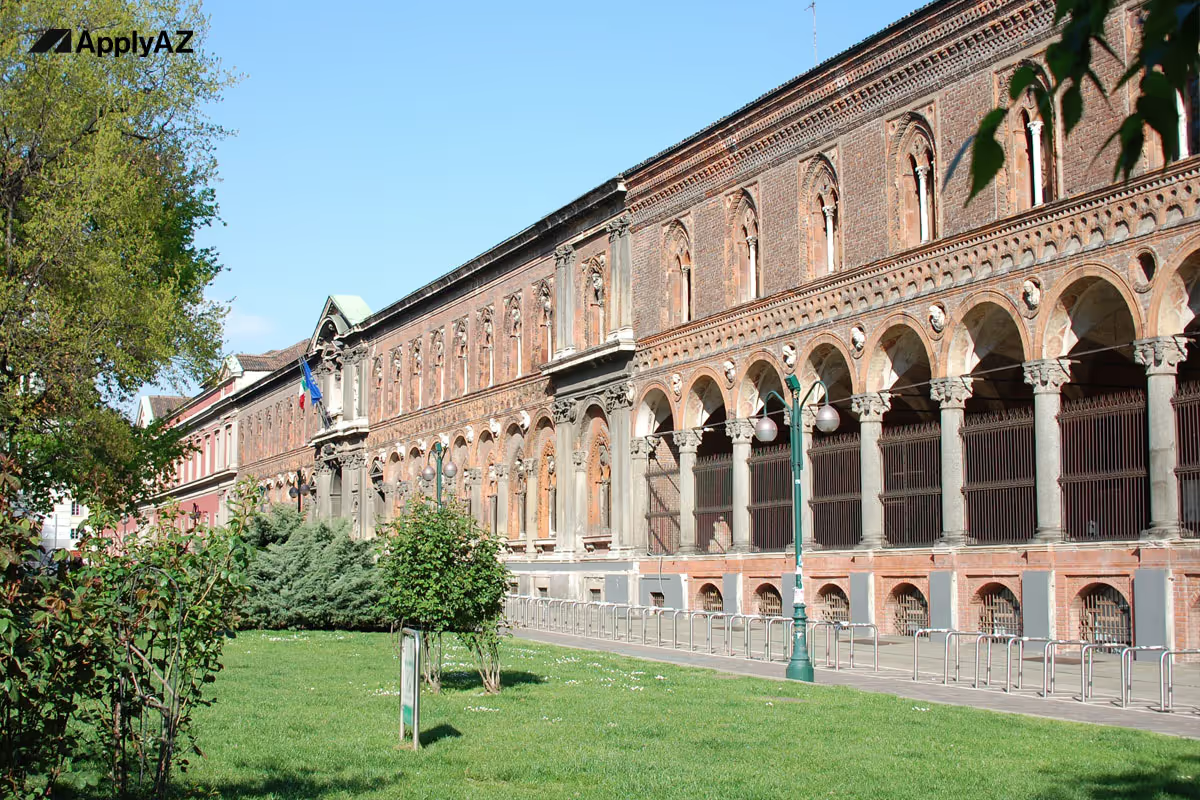
International Politics, Law and Economics (IPLE) is a three-year, 180 ECTS bachelor's degree (class L-36-R) taught in English at the University of Milan. Entry needs a school diploma after at least 12 years of schooling, a ranked place through the CEnT-S test, with 25 places for non-EU visa applicants in 2026/27, and English at B2. Regional scholarship winners pay no second instalment, so it can be tuition-free for eligible students.
Entry requirements
Detailed entry requirements
IPLE at the University of Milan asks for an upper secondary school diploma, or a foreign equivalent after at least 12 years of schooling, a ranked place through the CEnT-S admission test, and English at B2. Reviewed 8 October 2026. [1]
School-leaving requirement
You need an upper secondary school diploma, or an equivalent qualification obtained abroad after at least 12 years of schooling. The programme expects basic skills in language comprehension, logic and mathematics, and a sound knowledge of English. [2]
If your school system is shorter than 12 years, you also need a university enrolment certificate with a transcript, or equivalent documents. If your country requires a certificate of academic eligibility, you need that too. [1]
What this means for your school results
Places are ranked on your CEnT-S score, so your school results mainly need to show the right length of schooling. As a guide, based on the rule above:
- Usually a fit: an Indian Class 12 (CBSE, ISC or a state board), a Pakistani HSSC, a Bangladeshi HSC or A levels, completed after 12 years of schooling.
- Check carefully: a qualification from a system with fewer than 12 years of schooling, which also needs a university enrolment certificate and transcript.
- Often short: Class 10, O levels or a polytechnic diploma on their own, since they do not complete 12 years of schooling.
The ranking uses the test's Mathematics section, so solid maths preparation matters whatever your stream. [1]
English
English at CEFR B2. You can show it with a recognised certificate at B2 or higher obtained within the three years before submission, a secondary school diploma taught in English, or the University Language Centre (SLAM) placement test in October of your first year. Students who fail the placement test attend a SLAM course. You must meet the English requirement before sitting any exam. [1][2]
Students without an Italian school diploma or degree must also reach Italian at A2 before completing the programme, through a certificate or a SLAM test and course. [2]
Admission test: CEnT-S
Entry is limited. For 2026/27 there were 125 places plus 25 for non-EU applicants living abroad who need a visa. Selection uses the CEnT-S, the CISIA English test, with 55 multiple-choice questions: Mathematics (15), Reasoning on texts and data (15), Biology (10), Chemistry (10) and Physics (5). [1]
- Each correct answer earns 1 point, each wrong answer loses 0.25 and a blank answer scores 0.
- Only Mathematics and Reasoning on texts and data count for the ranking. Ties go to the higher Reasoning score, then to the younger candidate.
- Admitted students who score below 9 normalised points in Mathematics get additional learning requirements (OFA) and must pass a Mathematics test in their first year before sitting second- and third-year exams.
- You register for the test with CISIA. For 2026/27, the test had to be taken between 1 November 2025 and 30 June 2026.
2026/27 deadlines
These dates come from the 2026/27 call, and the 2027/28 call sets new ones. The admission application window ran from 12 March to 6 July 2026. Visa applicants were ranked on a separate list for the 25 reserved places and had to submit Universitaly pre-enrolment by 31 July 2026. The ranking was published on 9 July 2026, with enrolment from 9 to 22 July 2026. Documents for foreign qualifications were due by 30 November 2026. [1]
The selection for non-EU applicants living abroad is open both to students in their final year of secondary school and to those who already hold a diploma. [2]
Documents and non-EU steps
Non-EU applicants living abroad apply through the University of Milan's international applications portal and upload their documents there. To enrol with a foreign qualification you need: [1]
- Your secondary school diploma, legalised or apostilled unless exempt, with an official Italian translation unless it is in English, French, German or Spanish
- A certificate of academic eligibility, if your country requires one
- A Statement of Comparability from CIMEA or another ENIC-NARIC centre, or a declaration of value from the Italian embassy
- An Italian tax code and, for non-EU citizens, proof of a residence permit application or a valid permit
Missing documents by the deadline lead to cancelled enrolment, unless you show reasons beyond your control. [1]
Sources and verification
Checked by the ApplyAZ admissions team against the university's official documents listed below. Entry rules can change with each new call, and we re-check them before every application.
- University of Milan. Call for applications, Bachelor's degree in International Politics, Law and Economics (IPLE), class L-36 R, academic year 2026/27. Reviewed 8 October 2026.
- University of Milan. Programme description, Bachelor's degree in International Politics, Law and Economics (IPLE), class L-36 R, academic year 2026/27. Reviewed 8 October 2026.
About the programme
International Politics, Law and Economics (IPLE) is a three-year bachelor's degree in class L-36-R, taught entirely in English by the University of Milan's Faculty of Political, Economic and Social Sciences in Via Conservatorio 7, in central Milan. Three departments run it together: International, Legal, Historical and Political Studies; Economics, Management and Quantitative Methods; and Social and Political Sciences.
Entry is limited: for 2026/27 there were 125 places plus 25 for non-EU applicants who need a visa. The degree suits school leavers who want to understand how states, markets and international institutions work, and who are as comfortable with mathematics and data as with reading and writing.
What you will study
The first year is mostly a common core taught in trimesters, mixing contemporary history, political theory, political science, public law, comparative social systems and microeconomics. You follow one of two tracks from the start: International Politics and Economics (IPE), which stresses quantitative analysis and economic policy and adds Mathematics in the first year, or International Politics and Law (IPL), which focuses on international relations and international law and adds History of International Relations in the first year. [2] Units in the 2026/27 study plan include:
- Public Law and Political Science (first year)
- Microeconomics (first year) and Mathematics (IPE, first year)
- International Law and International Relations (second year, both tracks)
- International Macroeconomics (second year)
- Econometrics and Polimetrics (IPE track)
- EU Law and War Studies (IPL track)
- Public Economics and Models in Political Analysis (IPE, third year)
- International Human Rights Law or International Trade Law (IPL options)
How the programme is taught
The plan also includes a 3 ECTS workshop or internship, 12 ECTS of electives, 3 ECTS of additional language skills in French, German, Italian or Spanish, and a 6 ECTS final essay written in English. Students without an Italian school diploma or degree must reach Italian at A2 before completing the programme. [2] Erasmus+ agreements cover universities in France, Germany, Spain and Central and Eastern Europe, with extra-European exchanges that include Argentina, China and Japan. A double degree with the Université de Pau et des Pays de l'Adour (UPPA) adds a semester in Pau, taught in English and partly in French, and awards both degrees.
Career paths
The university's professional profiles point to international, public and corporate roles that need political, legal and economic analysis together. Employers it names include national and regional administrations, international organisations, NGOs, research institutions, multinational companies and local authorities. Profiles include:
- Administrative officer at diplomatic and consular missions or international organisations
- Commercial relations officer handling foreign trade for public and private companies
- International relations specialist for governments, companies and NGOs
- Policy analyst supporting an organisation's strategy
- Public administration officer evaluating national and local policies
Fees and scholarships
IPLE sits in the university's fee Area B. Students whose family income and assets are abroad pay a fixed second instalment by country group, and countries like India, Nepal, Nigeria and Pakistan are in Group A, the lowest fee group. The University of Milan runs the Lombardy regional DSU scholarship; full winners pay no second instalment, so this programme can be tuition-free for eligible students.
How to apply from outside the EU
Non-EU applicants living abroad register on apply.unimi.it as visa applicants and sit the CEnT-S, the English-language test run by CISIA. For 2026/27 the admission window ran from 12 March to 6 July 2026, and visa applicants had a separate ranking for their 25 places, based only on the Mathematics and Reasoning on texts and data sections. The 2027/28 call is not yet published. [1]
After admission we complete Universitaly pre-enrolment, which for 2026/27 was due by 31 July 2026, and you apply for a type D study visa. For 2026/27, enrolment documents had to be complete by 30 November 2026, including your legalised or apostilled diploma and a CIMEA Statement of Comparability or a declaration of value. [1]
How ApplyAZ helps
ApplyAZ is an Italy-based consultancy that works only with public universities. We can include this programme in a shortlist of 20 to 30 English-taught programmes that fit your profile, so your plan never rests on a single application.
For eligible students who start with us, a named person owns each stage, from A to Z:
- We check your school results against the University of Milan's entry rules for this programme.
- We write your CV and a tailored statement of purpose.
- We prepare and submit your application on the international portal, CEnT-S registration and Universitaly pre-enrolment.
- We help you declare your family income for reduced fees and file your University of Milan DSU scholarship application at the right time and in the right format.
- We prepare your visa file.
With operations in all 20 Italian regions, we follow each region's scholarship rules and deadlines as they change. The university decides admission, the region decides the scholarship and the consulate decides the visa, so no one can promise an outcome. You pay in milestones, and every service you pay for is either delivered or its fee is refunded (terms apply).
Programmes at Italian public universities can be tuition-free for eligible students. Check if you are eligible and book a one-to-one consultation session with one of our Italy experts, or see how ApplyAZ works.
Questions and answers
What school results do I need for IPLE at the University of Milan?
An upper secondary school diploma, or an equivalent foreign qualification obtained after at least 12 years of schooling. Places are ranked on your CEnT-S admission test score, and you also need English at B2. [1][2]
Which admission test do I need?
The CEnT-S, an online English-language test run by CISIA. The ranking uses only the Mathematics and Reasoning on texts and data sections, with 1 point per correct answer and minus 0.25 per wrong answer. [1]
What English level is required? Do I need IELTS?
English at CEFR B2. A recognised certificate from the last three years, a school diploma taught in English, or the university placement test in October all count. You must meet it before sitting any exam. [1][2]
When is the deadline for non-EU students?
For 2026/27, the admission window ran from 12 March to 6 July 2026, and visa applicants had to submit Universitaly pre-enrolment by 31 July 2026. The 2027/28 call is not yet published, and we track it for eligible students. [1]
How many places are there for non-EU students?
For 2026/27 there were 125 places plus 25 reserved for non-EU citizens living abroad who need a visa. Visa applicants sit the same test but are ranked on a separate list. [1]
I have Class 12 in Commerce or Humanities. Can I apply?
Yes, if your diploma completes 12 years of schooling. The rules do not name required school subjects, but basic logic and maths skills are expected and the ranking uses the CEnT-S Mathematics section, so solid maths preparation matters. [1][2]
Can I apply before I finish school?
Yes. The selection for non-EU applicants living abroad is open both to students in their final year of secondary school and to those who already hold a diploma. [2]
What can I do after graduating?
The university lists roles such as administrative officer at embassies and international organisations, trade relations officer, international relations specialist, policy analyst and public administration officer, in governments, NGOs, research bodies and multinational companies. [2]
Can someone handle my whole application to IPLE at the University of Milan?
Yes. ApplyAZ, an Italy-based consultancy that works only with public universities, checks your school results against the University of Milan's rules for this programme, handles the application and Universitaly pre-enrolment, helps you file the University of Milan DSU scholarship application at the right time and in the right format, and prepares your visa file, for eligible students. Start by checking your eligibility.
I'm applying from India. What is the route into IPLE?
An Indian Class 12 certificate from CBSE, ISC or a state board completes 12 years of schooling, so it can meet the entry rule. Your place depends on your CEnT-S score, and you need English at B2. The steps are the online application, the CEnT-S test and Universitaly pre-enrolment. [1][2] Indian students apply for the type D study visa at the Italian embassy or consulate that covers their state, such as New Delhi, Mumbai or Bengaluru.
Is the route different from Pakistan, Bangladesh or Sri Lanka?
No. The academic rules for IPLE are the same whatever your nationality. Applicants from Pakistan, Bangladesh and Sri Lanka follow the same steps as India: online application, the CEnT-S test and Universitaly pre-enrolment, then a type D study visa from the Italian mission for their country of residence. Read our guide for students in Dhaka.
I live in the UAE, Saudi Arabia, Qatar, Kuwait, Oman or Bahrain. Where do I apply for the visa?
At the Italian embassy or consulate responsible for the country where you legally live, after Universitaly pre-enrolment. The academic rules for IPLE are the same whatever your nationality, and Gulf residents follow the same steps: online application, the CEnT-S test and Universitaly pre-enrolment. Read our guides for Dubai, Riyadh and Doha.
I studied or live in London, New York, Toronto, Vancouver, Singapore or Kuala Lumpur. What is the route?
The academic rules for IPLE are the same whatever your nationality, and your school results are assessed like any other foreign qualification. Non-EU applicants who live abroad follow the same route: online application, the CEnT-S test and Universitaly pre-enrolment, then a type D study visa from the Italian mission for where they live. Read our guides for students in London, New York, Toronto, Vancouver, Singapore and Kuala Lumpur.
More English-taught programmes at this university
Other public universities in this city

They began right where you are

