

Scholarships in Italy for Indian Students
Find the scholarship route that fits your course and family, then prepare the correct application and budget.

No commitment
Less than 2 minutes
Limited intake, 1:1 support
international students trusted us
universities only, where study can be tuition-free for eligible students
English-taught programmes
Italian regions covered
Indian students have several scholarship routes in Italy, but there is no single application or universal eligibility score. Start with your course, family finances and the current call. Then compare the regional DSU route with government and university awards.
For eligible students, study at an Italian public university can be tuition-free. That does not mean a scholarship application pays every arrival cost or guarantees a bed. The university decides admission, the scholarship body decides the award and the consulate decides the visa.
Which scholarship route fits your situation?
| Route | What to investigate | Where to start |
|---|---|---|
| Regional DSU scholarship | Your family’s income and assets, eligible course, regional documents, services and credits | Find the body for your university. |
| MAECI government scholarship | Citizenship, eligible study type, age and language evidence, then competitive selection | Current MAECI call explained. |
| Invest Your Talent in Italy (IYT) | Eligible country and listed postgraduate course, completed qualification and programme requirements | Current IYT rules. |
| University award | The individual award’s programme, application and acceptance conditions | The university’s own current scholarship notice. |
A family with modest finances should investigate DSU early. A strong academic profile may also fit a merit award, but that does not remove the need to compare deadlines and funding restrictions. University awards are individual calls; do not assume a scholarship advertised by one department covers every course.
Current calls: what has closed and what to prepare next
Checked on 3 October 2026: the MAECI 2026/27 application deadline was 26 March 2026; the Embassy of Italy in New Delhi now links its final ranking. The IYT 2026/27 window closed on 11 May 2026, and India is in that call's eligible-country list. See the Embassy's scholarship page and official IYT call.
DSU deadlines differ by body and category. For example, Toscana's ordinary degree-course window has closed, while its doctoral and specialisation window has a different deadline. Do not treat a later doctoral deadline as an extension for a new master's applicant.
We have not verified a published 2027/28 MAECI or IYT call on the official pages checked. Prepare your documents and shortlist now, then confirm next year's actual rules when its call appears. A past opening date is not a future deadline.
Eligibility: avoid these three assumptions
There is no universal 65% or 6.5 CGPA scholarship threshold. University admission, merit selection and DSU financial assessment are separate checks. Use the requirement in the actual course or award notice.
English evidence is not always an IELTS-only rule. MAECI's current language provisions include alternatives for specified applicants. Your university can have its own requirements, so an accepted scholarship document does not automatically satisfy admission. Read both sets before paying for a test or relying on a medium-of-instruction letter.
You do not always need completed enrolment before applying for DSU. Toscana's official FAQ allows application before enrolment or an admission test. Other bodies set their own conditions. Record admission and scholarship deadlines separately so that waiting for one result does not make you miss the other.
Prepare the Indian family file for the right body
For a foreign-family assessment, identify the precise documents, reference year and legalisation or translation route required by your body's call. Family composition, income, property and financial assets may all matter. An income certificate alone is not automatically a complete file.
Use our ISEE parificato guide to understand the regional differences. Some routes use a CAF; others assess the foreign documents directly. Do not order a generic “Italy scholarship package” before confirming which route your university uses.
- Match your university to its DSU body.
- Record the academic year, category and relevant deadline.
- List each required certificate and its reference year.
- Check who may issue it and how it must be translated and legalised.
- Record whether submission means an upload, assessment, original shipment or a combination.
- Keep private copies and evidence of final submission.
A family change or income in more than one country can change the required evidence. Explain the situation accurately; do not substitute an affidavit or a blank entry for a document the call requires.
Applying for several awards is different from holding them together
Before preparing several applications, check their application restrictions and what happens if you win more than one. The 2026/27 MAECI call, Article 12 excludes other Italian public scholarships, including regional DSU. The current IYT call also has an incompatibility clause covering public benefits and regional awards.
Make a comparison sheet with the net cash, services, tuition treatment, acceptance deadline and any renunciation rule. Do not describe two separately administered awards as stackable simply because they use different portals. If a restriction is unclear, get an answer from the awarding body before accepting funding.
How to apply without losing track
Use one timeline with separate rows for university admission, scholarship application, original-document dispatch, results, acceptance, enrolment and the visa file. The correct portal depends on the route: regional service for DSU, Study in Italy for MAECI, the IYT portal for IYT and the university's published process for its own award.
Confirm final transmission, then keep the submitted receipt and follow the official status. Do not stop checking messages once the application is sent. A ranking or award can come with subsequent obligations.
Build a budget before relying on an award
Compare the money you can access with the bills due before scholarship payment. Tuition relief, meals and a housing service are useful benefits, but they are not all cash in your bank account. A planned award should not be your only way to pay an arrival deposit.
Use our study-cost guide and visa financial-proof guide. A cash-flow plan and the consulate's evidence requirements are related checks with different purposes.
How ApplyAZ supports the route
We are an independent, Italy-based consultancy focused on public-university routes. We check the academic fit, plan university applications and Universitaly pre-enrolment, prepare scholarship paperwork with eligible students and organise the visa file. Where a portal requires your own account and submission, it remains in your name.
We explain the paid scope before you commit. Our service and refund terms are separate from the award itself: we do not promise that a government, regional body, university or consulate will approve an application. Read how we work alongside the terms for your chosen service.
Frequently asked questions
Can Indian students apply for scholarships in Italy?
Yes, where the current call covers their citizenship, course and circumstances. DSU, MAECI, IYT and university awards have separate eligibility and application rules.
Do I need admission before applying for DSU?
Do not assume so. DSU Toscana’s official FAQ allows an application before enrolment or an admission test. Check your own body’s call and deadline.
Is IELTS always compulsory for MAECI?
No. The current call has language-evidence rules that include alternatives in specified circumstances. The university may impose separate requirements.
Can I receive MAECI and DSU together?
The 2026/27 MAECI call excludes other Italian public scholarships, including regional right-to-study awards. Check incompatibility before accepting funding.
Does a scholarship make the whole year free?
Do not budget on that assumption. Compare confirmed cash, services, tuition rules and payment timing with your actual costs.
Your next step
Check your eligibility first. If you are eligible, you book a one-to-one consultation with one of our Italy experts, and from there we take care of everything.
Sources and checks
Official sources checked on 3 October 2026. The planning checklists and worked examples are ApplyAZ guidance; they do not replace a university or scholarship call.
Hear from students who took this route
Hear directly from ApplyAZ students about the support they valued on their route to English-taught study in Italy.
- Janani Vijay: Master’s at University of Bologna. Support students and families can count on.
- Rakesh Goud Bongoni: Master’s in Agri-Food Sustainability at University of Pavia. Patient, honest advice on course choices.
- Nithya Dharmapuri: Master’s at IULM University, Milan. A considered exception: IULM and DSU support.
Explore all student stories and videos.
Further reading
Where they're studying now
Students who started exactly where you are
English-taught programmes that can be tuition-free for eligible students, and the DSU grant landing in their account every year. The funding mechanics are identical at every Italian public university: the same ISEE Parificato, the same regional bando, the same ranking. Only the authority and the dates change.




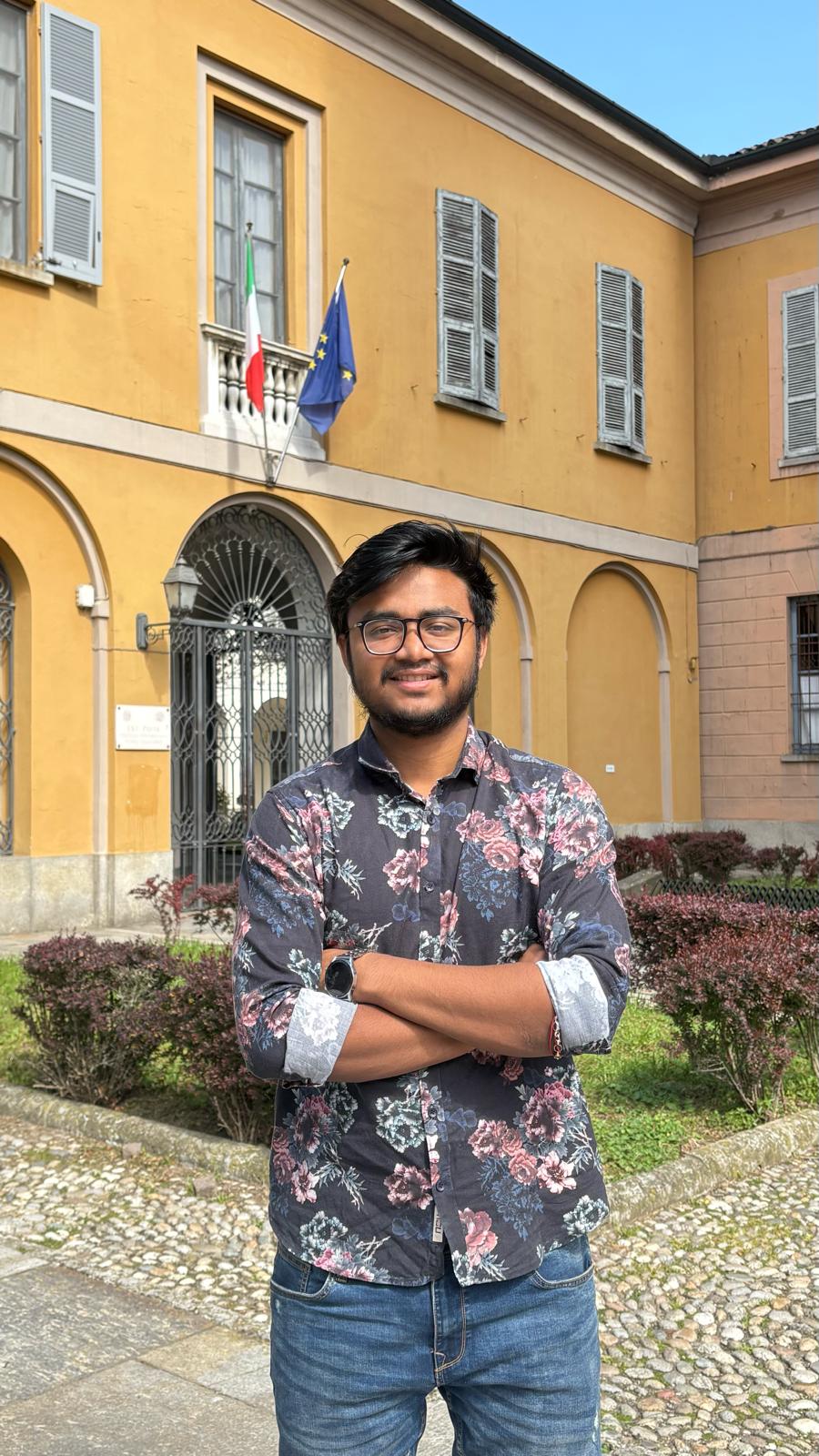

They began right where you are
Now they're studying at Italian public universities, where a degree can be tuition-free for eligible students, with DSU scholarships of up to about €8,250 a year for students living away from home, depending on the region.

