

Master in Safety Assessment of Xenobiotics and Biotechnological Products at University of Milan
Two-year English-taught master at the University of Milan that trains risk assessors in toxicology, chemical regulation and exposure science, with blended teaching, compulsory labs in Milan and a 29 ECTS thesis.
Master
2 years
Milan
English
University of Milan


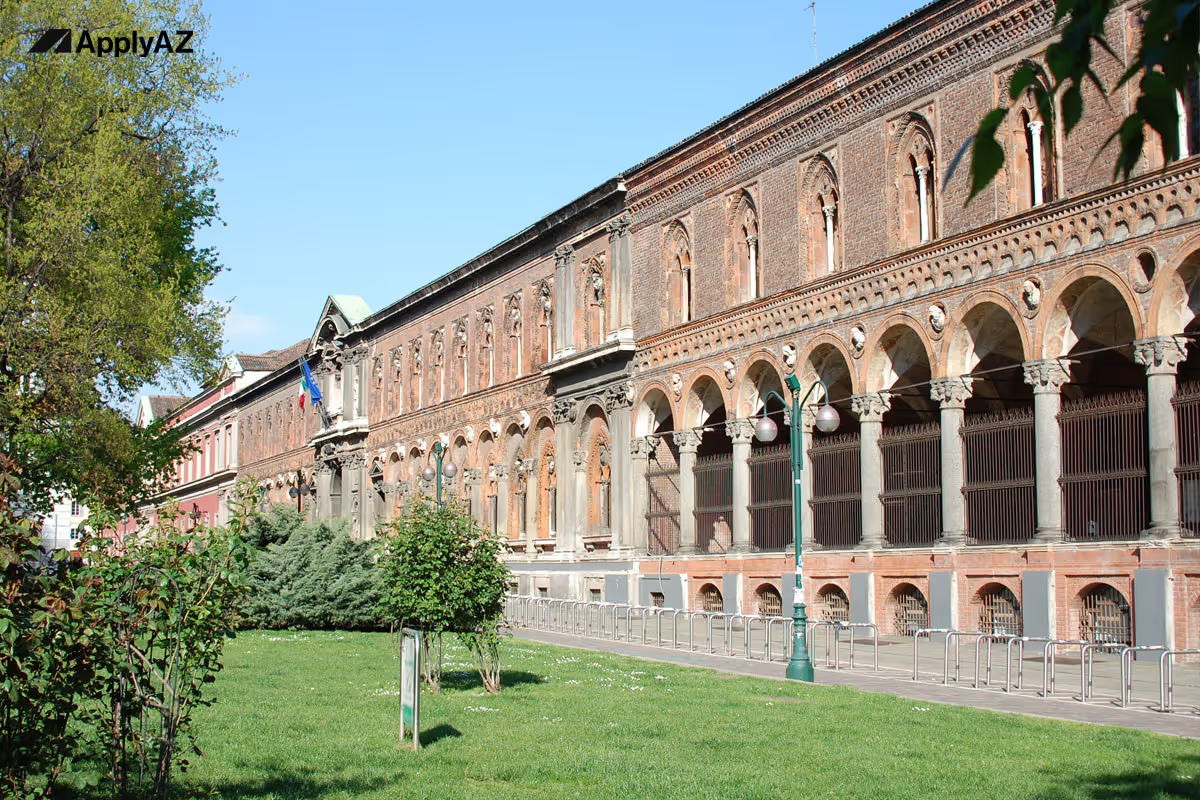
Safety Assessment of Xenobiotics and Biotechnological Products is a two-year, 120 ECTS master (class LM-9-R) taught in English by the University of Milan at Città Studi, in blended mode with compulsory labs. It trains risk assessors for chemicals and biotech products. Non-EU students with family income abroad pay a fixed fee by country group.
Entry requirements
- A bachelor's degree in biotechnology (class L-2) or pharmaceutical sciences (L-29), or an equivalent foreign degree.
- Graduates from other fields need at least 9 ECTS in chemistry, 5 ECTS in physiology, 12 ECTS in biochemistry, molecular or applied biology and 6 ECTS in pharmacology or toxicology.
- English at B2 level (CEFR), verified during the admission interview.
- A remote interview in English with the admission board, which checks your background knowledge.
- An application on apply.unimi.it with a €30 fee; at enrolment, a legalised degree with a CIMEA statement of comparability or a declaration of value.
About the programme
Safety Assessment of Xenobiotics and Biotechnological Products is a two-year master's degree in class LM-9-R (medical, veterinary and pharmaceutical biotechnology), taught in English by the Department of Pharmacological and Biomolecular Sciences of the University of Milan. It trains specialists who assess the risks of chemicals and biotechnological products for human health and the environment, following European and international criteria.
Teaching is blended. For each course, up to half of the teaching can be delivered online, and a third of that online share is live. Lectures take place in university classrooms and lab sessions in the School of Pharmacy labs, both on the Città Studi campus in Milan. Lab attendance is compulsory, while lecture attendance is recommended. The programme is certified under standard UNI EN 16736 and AICQ SICEV regulation RG 06-1 for the training of risk assessors.
What you will study
The first year builds the biology, chemistry and toxicology base; the second year turns to exposure, regulation and full risk assessment. Units in the 2026/27 study plan include:
- Organ Physiopathology and Histopathology (10 ECTS)
- Biotechnology and Pharmacotoxicology (10 ECTS)
- Methods of Analysis of Chemicals in Water, Air, Biological Fluids, Tissues, Food
- Regulatory Aspects in Toxicology
- Bioremediation
- In Silico Methods in Toxicology
- Databases and Exposure Scenarios
- System Toxicity and Risk Assessment
How the programme is taught
The second year centres on a 29 ECTS thesis built on an internship at an academic, private or governmental body working on health risk assessment; you need 51 ECTS before the internship starts. The final exam combines the written thesis, an oral defence and a risk assessment case study. An optional 8 ECTS Laboratory of Risk Assessment lets you deepen your thesis topic, and the thesis or internship can be carried out abroad through Erasmus+. International students can earn 3 elective credits in Italian at A2 level.
Career paths
The university prepares graduates to work as risk assessors in public and private organisations, as researchers in public and private institutes, and as quality certifiers. Sectors named on the degree page include:
- Pharmaceutical and biotechnology companies
- Contract research organisations
- Food, chemical and cosmetic industries
- Public administration and environmental or health agencies
- Regulatory consulting firms
- Universities and research centres
Fees and scholarships
This degree sits in fee Area B of the University of Milan's 2026/27 fee regulation. If your family lives and earns abroad, the second instalment is fixed by country group: €256 a year in Group A, which covers countries like India, Nigeria and Bangladesh, €1,164 in Group B and €4,101.12 in Group C. The first instalment starts at €146. Full winners of the Lombardy regional DSU scholarship, which the university runs, pay no second instalment: zero euro tuition for eligible students.
How to apply from outside the EU
All candidates have a remote interview in English with the admission board, which checks your knowledge and your English. For 2026/27, non-EU applicants who need a visa applied on apply.unimi.it from 22 January to 30 April 2026, paying a €30 fee. The 2027/28 notice had not been published by September 2026.
Once admitted, you complete the Universitaly pre-enrolment (by 31 July for 2026/27) and apply for a type D study visa, showing English at B2. At enrolment you need your legalised degree with a CIMEA statement of comparability or a declaration of value.
How ApplyAZ helps
If this programme fits your goals, ApplyAZ can include it in a shortlist of 20 to 30 English-taught programmes at Italian public universities. We write your CV and a tailored statement of purpose, submit your applications and Universitaly pre-enrolment, file your DSU scholarship application and prepare your visa file, with a named person on each stage. The university decides admission, the region decides the scholarship and the consulate decides the visa. See how ApplyAZ works or check your eligibility.
Questions and answers
Is this master taught in English and in person?
It is taught in English in blended mode. Up to half of each course can be delivered online, but laboratory work in the School of Pharmacy labs at Città Studi, Milan, is compulsory, and lecture attendance is recommended.
What bachelor's background do I need?
A degree in biotechnology or pharmaceutical sciences, or another degree with at least 9 ECTS in chemistry, 5 in physiology, 12 in biochemistry, molecular or applied biology and 6 in pharmacology or toxicology.
Is there an entrance test?
There is no written test. The admission board reviews your academic record and holds a remote interview in English to check your background knowledge and B2 level English.
When can I apply for 2027/28?
The 2027/28 notice was not yet published in September 2026. For 2026/27, non-EU visa applicants applied on apply.unimi.it from 22 January to 30 April 2026, with a €30 fee.
How much are the fees?
For 2026/27, students whose family income is abroad pay a fixed second instalment by country group, from €256 a year in Group A, plus a first instalment from €146. Full winners of the regional DSU scholarship pay no second instalment.
What jobs can graduates do?
The university names risk assessor in public and private organisations, researcher and quality certifier, in pharmaceutical and biotech companies, contract research organisations, food and chemical industries, public agencies and consulting.
Similar programmes
More programmes in this city

They began right where you are

