
Contents
If you are an Indian student planning to study in Italy, the visa process can feel confusing at first. There are new terms everywhere: Universitaly, CIMEA, DSU, ISEE parificato, VFS Global. None of these are complicated once someone explains them in plain language, which is exactly what this guide does.
This guide walks you through the full shape of the process, step by step, so you know what is coming and what each term actually means. It does not replace personal guidance, because every student's case is different. But it will make you far less confused than you are right now.
What is the Italy student visa process for Indian students?
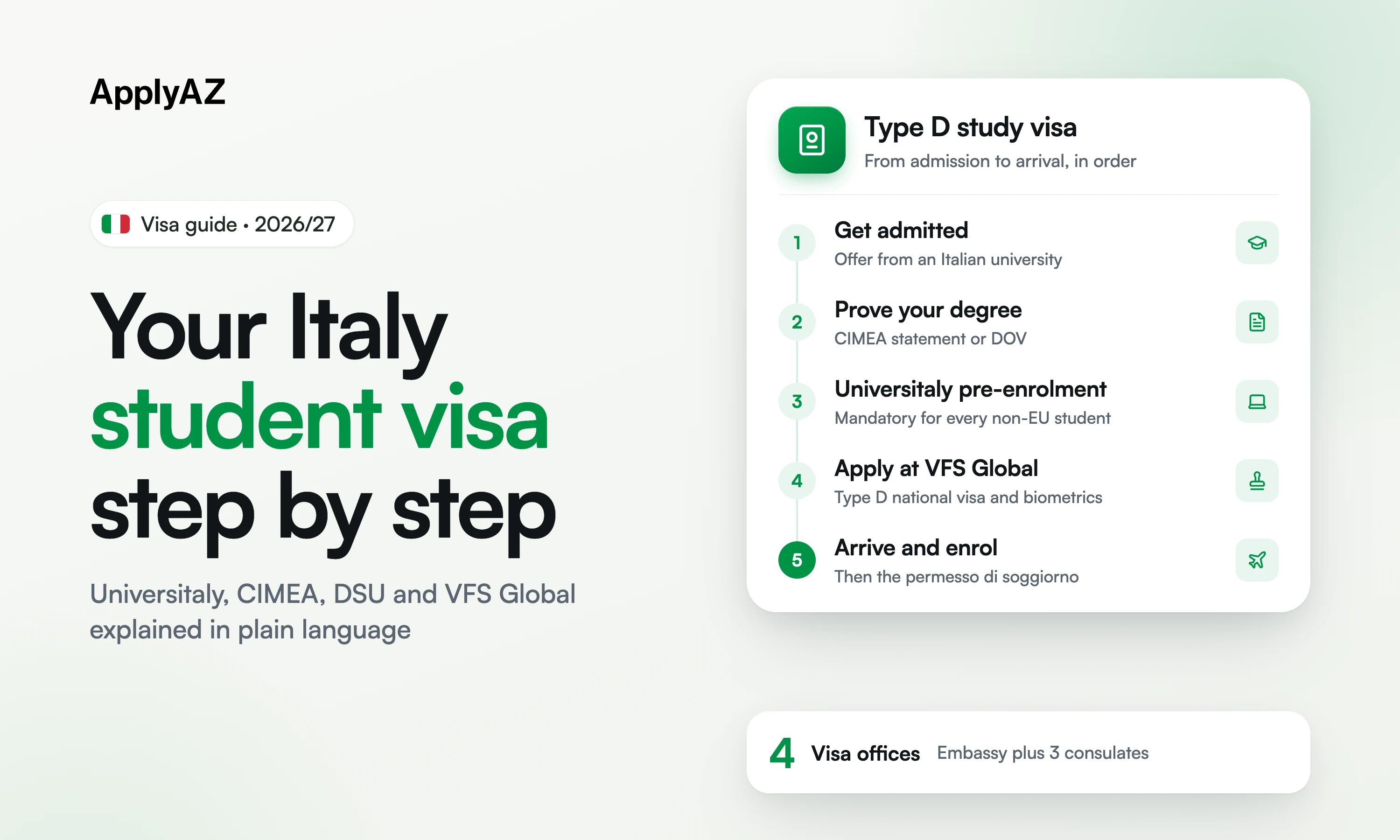
The Italy student visa process has four main stages: getting admitted to an Italian university, completing pre-enrolment on the Universitaly portal, applying for your Type D national visa through VFS Global, and travelling to Italy for final enrolment. Each stage depends on the one before it, so the order matters.
Most Indian students underestimate how much of the process happens online, before you ever visit a visa centre. Universitaly pre-enrolment, in particular, has to be done correctly and on time, or your visa application cannot move forward at all.
Find your Italian visa office in India
Four Italian offices in India handle study visas: the Embassy of Italy in New Delhi and the Consulates General in Mumbai, Bengaluru and Kolkata. Two rules decide which one handles you. The study visa goes to the office for the state where you live. The DOV (declaration of value, dichiarazione di valore) goes to the office for the state that issued your degree or school certificate, so one student can deal with two offices, and we plan both files together from the start.
| Office | States covered | Where to apply (VFS centres) | Page |
|---|---|---|---|
| Embassy of Italy, New Delhi | Delhi, Haryana, Himachal Pradesh, Jammu and Kashmir, Punjab, Rajasthan, Uttarakhand, Uttar Pradesh and Chandigarh | VFS New Delhi, Chandigarh and Jalandhar | New Delhi visa and DOV checklist |
| Consulate General of Italy, Mumbai | Chhattisgarh, Madhya Pradesh, Goa, Gujarat, Kerala, Maharashtra, Daman and Diu, Dadra and Nagar Haveli | VFS Mumbai, Pune, Ahmedabad and Kochi | Mumbai study visa requirements |
| Consulate General of Italy, Bengaluru | Karnataka, Tamil Nadu, Telangana, Andhra Pradesh and Puducherry | VFS Bengaluru, Chennai and Hyderabad | Italy visa in Bengaluru, 2026/27 |
| Consulate General of Italy, Kolkata | West Bengal, Odisha, Bihar, Jharkhand, Assam, Arunachal Pradesh, Manipur, Meghalaya, Mizoram, Nagaland, Tripura, Sikkim, Andaman and Nicobar Islands | VFS Kolkata and Bhubaneswar | Page coming once its 2026/27 DOV checklist for India is published |
Source: the Visas pages of the Embassy of Italy in New Delhi, the Consulates General in Mumbai and Bengaluru, and the Consulate General in Kolkata. Verified on 28 September 2026.
Example: a student living in Lucknow, Uttar Pradesh, with a Bachelor degree from a university in Maharashtra applies for the visa through a VFS centre under the Embassy in New Delhi, and the DOV for that degree comes from the Consulate General in Mumbai.
Which visa do Indian students need for Italy?
Indian students studying in Italy for a course longer than 90 days need a Type D long-stay national visa, not a short-stay Schengen visa. It is submitted at a VFS Global centre, which collects the application and biometrics for the Embassy of Italy or the Consulate General for your state; that office decides the visa.
A Type D visa is not a tourist visa with a longer sticker. It is tied to your university admission: the visa checklists ask for proof of admission, usually the Universitaly pre-enrolment summary. Once you arrive in Italy, this visa is followed by a residence permit, or permesso di soggiorno.
What is the Universitaly portal and why do you need it?
The Universitaly portal is the official Italian government website where every non-EU student must complete pre-enrolment before applying for a study visa. It is mandatory, not optional, and it is where your university confirms your admission to the Italian system.
Think of Universitaly as the bridge between your Italian university offer and your visa application. Without a completed pre-enrolment on this portal, the visa file is incomplete: the New Delhi, Mumbai and Bengaluru checklists ask for the pre-enrolment summary downloaded from Universitaly as proof of admission. Many delays Indian students face come from small errors at this exact step, like mismatched personal details between the university offer letter and the Universitaly profile. For eligible students, we handle the pre-enrolment.
How do you prove your Indian degree is valid for an Italian university?
Indian students accompany their qualification with either a CIMEA statement of comparability and verification or a DOV, whichever the Italian university asks for. The Ministry of University and Research circular for 2026/27 and 2027/28 (Part II, Section 3) accepts either, and the visa checklists ask for a copy only if the university requires one.
CIMEA (Italy's centre for qualification recognition) issues statements that place an Indian qualification against European qualification levels and verify that it was awarded; ApplyAZ prepares and files these requests for eligible students. A DOV comes from the Italian office for the state that issued your degree, on a request filed in person. Some universities accept either, some insist on one specific option. Getting this wrong is one of the most common and most costly mistakes we see, which is why we always confirm the exact requirement with your specific university before either is started. How the two compare: DOV or CIMEA for an Italian university. How the DOV works at each office: the DOV guide for Indian degrees.
What is the ISEE parificato and why does it matter for your costs?
The ISEE parificato (the income statement for families outside Italy) is the assessment of family income and assets that Italy's regional DSU bodies use to decide who qualifies for a DSU scholarship. It is not a formality. Each call sets an ISEE limit and an ISPE (the assets indicator) limit, and the figure decides whether a student is eligible.
Depending on the call, the ISEE parificato is calculated by a CAF (tax assistance centre) or by the body itself, from family documents issued in India. Two students at the same university, with the same course, can end up with very different support, purely because of how their family documents were prepared. For eligible students, we prepare and check those documents. The documents and rules at each of the 16 bodies we cover: ISEE parificato and family documents, body by body.
What is the DSU scholarship and can it lower your costs?
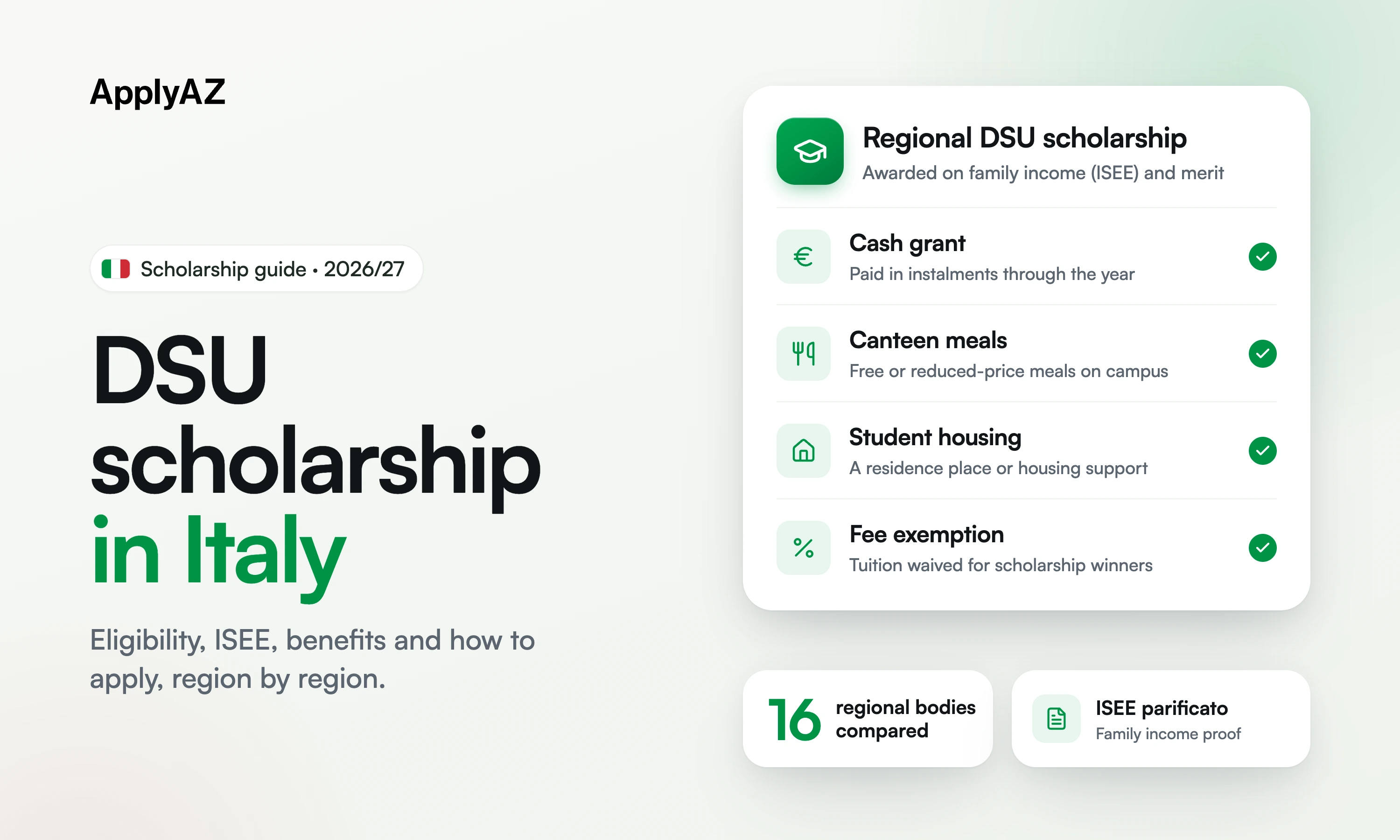
The DSU scholarship is a regional, income-based scholarship in Italy. Depending on the region's bando (official call), it pays a yearly cash grant and can add a bed, meals or a tuition exemption, so in several regions study can be tuition-free for eligible students. The exact benefit depends on which Italian region your university is in.
The regional bodies that run it, such as EDISU Piemonte, ER.GO and DiSCo Lazio, are one of the biggest reasons Italy is affordable for many Indian students. But eligibility and the application timing both matter, and scholarship applications run on a separate track from your visa application. For the visa funds, the ministry circular says that a DSU application, or meeting its eligibility requirements, cannot be counted without an explicit scholarship certificate. Limits, grants and deadlines for every call we cover: DSU scholarship in Italy for 2026/27, region by region.
What documents do Indian students generally need for the visa?
The New Delhi and Mumbai checklists for 2026/27 list 10 items: passport, application form, proof of admission with the Universitaly summary, attested and apostilled degree certificates and transcripts (apostille: the Ministry of External Affairs certification), proof of at least 10,179.85 EUR, medical insurance, a one-way flight booking, 30 days of accommodation, B2 language proof and a recommended covering letter.
This is a general list, not a checklist to complete on your own. Bengaluru's checklist lists 12 items in its own order. Document requirements shift based on where you live in India and which Italian institution you are joining, and small mismatches between documents are one of the most common causes of visa delay. A name written differently on the passport and on another document, for example, needs a one and the same certificate, attested and apostilled. For eligible students, we build the file in that office's order and check every document against its checklist; each office's full list is on its page in the table above.
How much money do Indian students need to show for an Italy student visa?
At least 10,179.85 EUR a year, about INR 11,19,666 at the FBIL reference rate of 18 Sep 2026. The figure comes from the Ministry of University and Research circular for international students, 2026/27 and 2027/28, Part II, Section 2(a), and the New Delhi, Mumbai and Bengaluru checklists state the same minimum.
The offices want 6 months of original bank statements stamped and signed by the branch manager, proof of income such as 2 years of tax returns, and extra money for the flight on top of the minimum. A sponsor living in India must be a relative up to the 4th degree, and an education loan counts only if it is deposited and visible on the statements. For eligible students, we check the statements, stamps and income proof against the circular and the office's checklist. The full rule, office by office: Italy student visa financial proof for 2026/27.
How long does the Italy student visa process take?
The New Delhi, Mumbai and Bengaluru checklists state that a study visa takes up to 90 days to process. Bachelor and Master applications for 2026/27 are not accepted after 30 Nov 2026, and for 2027/28 after 31 Oct 2027. These deadlines do not apply to PhD, specialisation courses, Erasmus programmes, single courses or foundation courses.
Waiting until the last minute is the single biggest avoidable risk in this entire process. Universitaly confirmation, document attestation, a DOV if the university asks for one, and the VFS Global appointment each take real time, and they do not run in parallel by default unless they are planned carefully. We plan every file backwards from those dates.
Where do Indian students apply for the Type D student visa?
Indian students apply for the Italy Type D student visa at a VFS Global visa application centre under the Italian office for the state where they live; the office table above shows which centres serve which states. VFS collects the application and biometrics for the Embassy or Consulate General, and the Embassy or Consulate General decides the visa.
The student books the appointment with their own email and phone number and attends in person. The New Delhi and Bengaluru checklists say every applicant must book the student visa appointment with their own personal email ID and contact number, and both discourage agents. We do not book or attend the appointment for you: for eligible students, we prepare the whole file, check every document against that office's checklist and get you ready for the appointment.
What are common mistakes Indian students make with the Italy visa?
The most common mistakes are starting the process too late, using the wrong recognition document (CIMEA versus DOV), mismatched personal details across the university offer, Universitaly profile and visa documents, and counting a DSU application towards the visa funds before there is a scholarship certificate. Each of these is a small error that causes weeks of delay.
Most of these mistakes are avoidable, but only if you know they exist before you make them. That is the real value of having someone who has been through this process check your specific case: for eligible students, we check every document against the office's checklist before the appointment.
Frequently asked questions
Do Indian students need a visa to study in Italy?
Yes. Any course longer than 90 days requires a Type D long-stay national visa, submitted through a VFS Global centre under the Italian office for the state where you live.
Is the Universitaly portal mandatory for all Indian students?
Yes. Every non-EU student must complete pre-enrolment on the Universitaly portal before a Type D student visa can be processed.
What is the difference between CIMEA and a Declaration of Value?
Both accompany your Indian qualification for Italian university admission, but they come from different bodies: CIMEA issues a statement of comparability and verification, and the Italian office for the state that issued the degree issues the DOV. The university decides which it asks for, and we find out before either is started.
How much does an Italian public university cost for Indian students?
Each public university sets its own fees. Several regional DSU calls add a tuition exemption, so in those regions study can be tuition-free for eligible students, while others, such as the Tuscany and Marche calls, do not cover tuition.
Can students from countries like India get a scholarship to study in Italy?
Yes, through the regional DSU scholarship, which is income-based. Depending on the region's call, it pays a cash grant and can add a bed, meals or a tuition exemption.
Does applying for a DSU scholarship affect the visa application?
The scholarship and the visa run on separate tracks. For the visa funds, the ministry circular says a DSU application, or meeting its eligibility requirements, cannot be counted without an explicit scholarship certificate. We plan both tracks together for eligible students.
How early should Indian students start the Italy visa process?
Well before the deadline: Bachelor and Master visa applications for 2026/27 are not accepted after 30 Nov 2026 (31 Oct 2027 for 2027/28), and processing takes up to 90 days. Universitaly confirmation, document attestation and a DOV, if the university asks for one, come first, so we plan every file backwards from those dates.
Can I study in Italy in English without knowing Italian?
Yes, many Italian universities offer English-taught programmes, particularly at the master's level, and Italian language ability is not always required for admission. For an English-taught course, the visa checklists ask for B2-level English certification or an equivalent medium of instruction declaration from the previous institution.
What happens after I land in Italy on a student visa?
The Type D visa is followed by a residence permit, or permesso di soggiorno, applied for after arrival in Italy. Several DSU calls also ask for the residence permit, or its receipt, during the year.
Do all Italian universities accept the same documents for Indian applicants?
No. Requirements vary by university and by course, which is why a generic checklist can be misleading for your specific situation.
Is VFS Global the only way to apply for an Italy student visa from India?
Yes. Study visa applications from India go through VFS Global centres, which collect the application and biometrics for the Embassy of Italy or the Consulate General for your state. The Embassy or Consulate General decides the visa.
What is the biggest reason Indian student visa applications get delayed?
Mismatched details across the university offer, Universitaly profile, and visa documents, along with late Universitaly pre-enrolment, are the two most common causes.
Every student's document requirements, scholarship eligibility, and timeline depend on their specific university, course, and city. This guide covers the process in general terms. Check your eligibility first. If you are eligible, you book a one to one consultation with one of our Italy experts, and from there we take care of everything.
Not sure what your specific visa checklist looks like?