

Master in Quantitative Biology at University of Milan
Two-year English-taught master at the University of Milan at the meeting point of biology and physics, with biophysics, imaging, spectroscopy, Python, modelling and AI units and a thesis internship of at least nine months.
Master
2 years
Milan
English
University of Milan


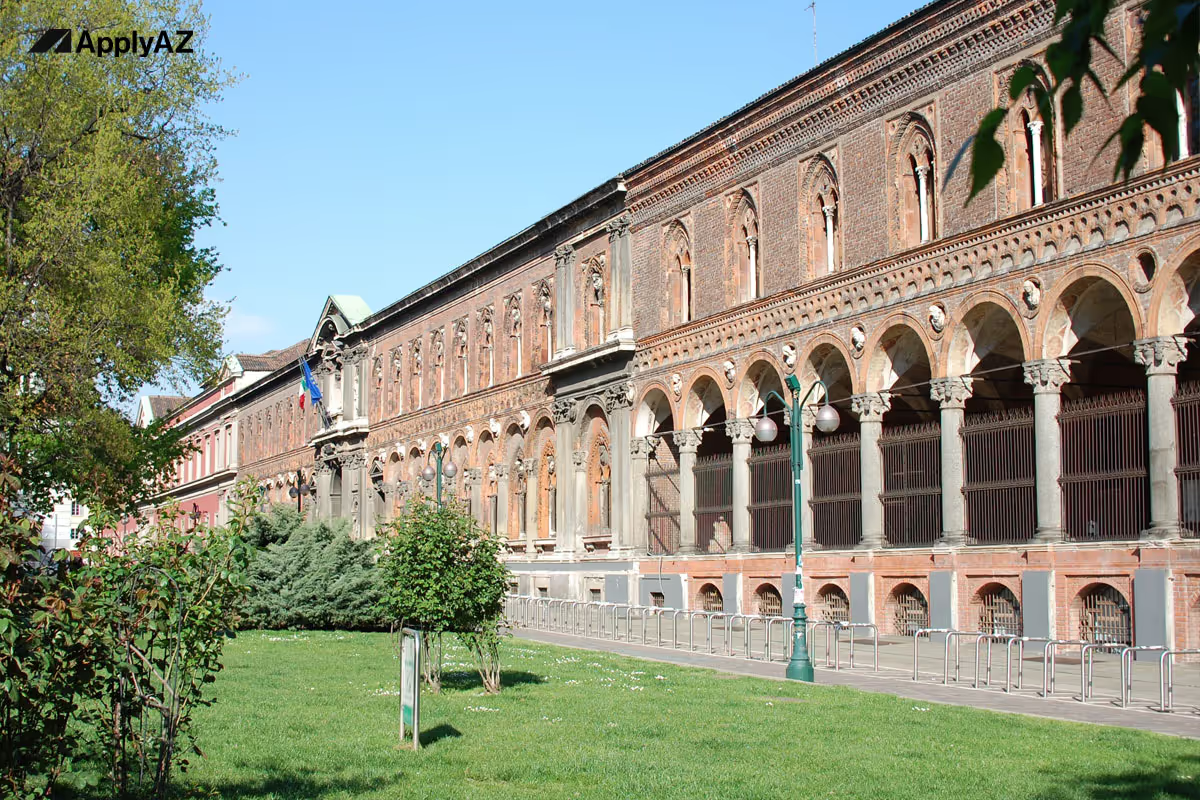
Quantitative Biology is a two-year, 120 ECTS master (class LM-8-R) taught in English by the University of Milan at Città Studi, Milan. It joins biology with physics, mathematics and computing, and ends with a lab thesis of at least nine months. Non-EU students with family income abroad pay a fixed fee by country group.
Entry requirements
- A bachelor's degree in a science, engineering or quantitative field, such as biology, biotechnology, chemistry, physics, mathematics, computer science, statistics, economics, pharmacy or information, civil or environmental engineering.
- At least 12 credits in biological subjects such as genetics, physiology, biochemistry, molecular biology or microbiology.
- English at B2 level (CEFR); without a certificate you can still be admitted if your English at the interview is clearly good.
- An online interview on the topics of your bachelor's degree and on your English, scored with your academic record (up to 50 points each); you need 60 out of 100.
- An application on apply.unimi.it with a €30 fee; 25 places reserved for non-EU students living abroad.
About the programme
Quantitative Biology is a two-year master's degree in class LM-8-R (industrial biotechnology), taught in English by the Department of Biosciences of the University of Milan. Classes run in person on the Città Studi campus in Milan, at Via Celoria 26, Via Celoria 20 and Via Golgi 19.
The programme trains graduates to work where biology meets physics. It combines biology, chemistry, physics, mathematics and computer science to study living systems with quantitative tools, with applications in protein engineering, metabolic engineering, drug discovery and synthetic biology. Because it accepts graduates from many science and engineering fields, it suits physicists, chemists, engineers and computer scientists moving into the life sciences as well as biologists who want stronger quantitative skills.
What you will study
The first year is fully compulsory. The second year adds Artificial Intelligence in Quantitative Biology, one or more options such as Non Linear Dynamics in Quantitative Biology, Structural Bioinformatics, Synthetic Biology, Introduction to Logic or Cell Population Dynamics, and 12 free-choice ECTS. First-year units include:
- Principle of Spectroscopy and Applications to Quantitative Biology (10 ECTS)
- Cell Biophysics
- Imaging in Living Cells
- Mathematical Modeling for Biology
- Programming in Python
- Advanced Molecular Biology (9 ECTS)
- Integrated Structural Biology
- Molecular Biophysics
How the programme is taught
Teaching mixes lectures, classroom exercises and lab practicals. Attendance is compulsory, and you need at least 75% attendance to sit an exam. The thesis is worth 33 ECTS and is based on an original experimental project carried out during an internship of at least nine months in a research laboratory, at the university or elsewhere with prior approval; the dissertation is written in English. A further 3 ECTS can come from Italian language, seminars, workshops or a short lab internship. Through Erasmus+ you can take exams or do thesis work abroad.
Career paths
The university describes two main profiles: product scientist or bio-nanotechnologist, who runs lab procedures on high-tech instruments and writes code to analyse biological data, and junior research scientist in biotechnology or biophysics, who designs and runs experiments independently. Employers include:
- Bio-nanotechnology start-ups
- Pharmaceutical and biotechnology companies
- Public and private research institutes
- Companies developing scientific instruments
Fees and scholarships
Quantitative Biology is in Area B of the 2026/27 fee regulation. Non-EU students whose family lives and earns abroad pay a second instalment fixed by country group rather than by income: €256 a year in Group A, which includes countries like India and Bangladesh, €1,164 in Group B and €4,101.12 in Group C. A first instalment of at least €146 applies to everyone. Full winners of the regional DSU scholarship, which the University of Milan runs for Lombardy, pay no second instalment: zero euro tuition for eligible students.
How to apply from outside the EU
Selection combines your academic record and an online interview on the subjects of your bachelor's degree and your English, each worth up to 50 points; the pass mark is 60 out of 100. Twenty-five places are reserved for non-EU students living abroad. For 2026/27, visa applicants applied on apply.unimi.it from 22 January to 30 April 2026 with a €30 fee. The 2027/28 notice was not yet published in September 2026.
Once admitted, you complete Universitaly pre-enrolment (31 July for 2026/27), apply for a type D study visa with B2 English and obtain a CIMEA statement or declaration of value.
How ApplyAZ helps
If this programme fits your goals, ApplyAZ can include it in a shortlist of 20 to 30 English-taught programmes at Italian public universities. We write your CV and a tailored statement of purpose, submit your applications and Universitaly pre-enrolment, file your DSU scholarship application and prepare your visa file, with a named person on each stage. The university decides admission, the region decides the scholarship and the consulate decides the visa. See how ApplyAZ works or check your eligibility.
Questions and answers
Is Quantitative Biology taught in English?
Yes, the whole degree is in English and the dissertation is written in English. You need English at B2 level, although you can be admitted without a certificate if your English at the interview is clearly good.
Can I apply with a physics, engineering or computer science degree?
Yes. Accepted bachelor's classes include physics, mathematics, computer science, chemistry, statistics and several engineering fields, as well as biology and biotechnology, provided you have at least 12 credits in biological subjects.
How are students selected?
Through your academic record and an online interview on your bachelor's subjects and your English, each worth up to 50 points. You need at least 60 out of 100.
Is attendance compulsory?
Yes. Attendance at lectures and practical courses is compulsory, and you need at least 75% attendance to be admitted to exams. The thesis involves at least nine months in a research lab.
How much are the fees?
For 2026/27, students with family income abroad pay a fixed second instalment by country group, from €256 a year in Group A, plus a first instalment from €146. Full DSU scholarship winners pay no second instalment.
What jobs do graduates do?
The university names product scientist or bio-nanotechnologist and junior research scientist in biotechnology or biophysics, in start-ups, pharmaceutical and biotech companies, research institutes and scientific instrument makers.
Similar programmes
More programmes in this city

They began right where you are

