

Master in Computer Science at University of Milan
Two-year computer science master at the University of Milan, taught in Italian and English, where students can build an entirely English-taught study plan across AI, data, systems, multimedia and theory units.
Master
2 years
Milan
Multiple
University of Milan


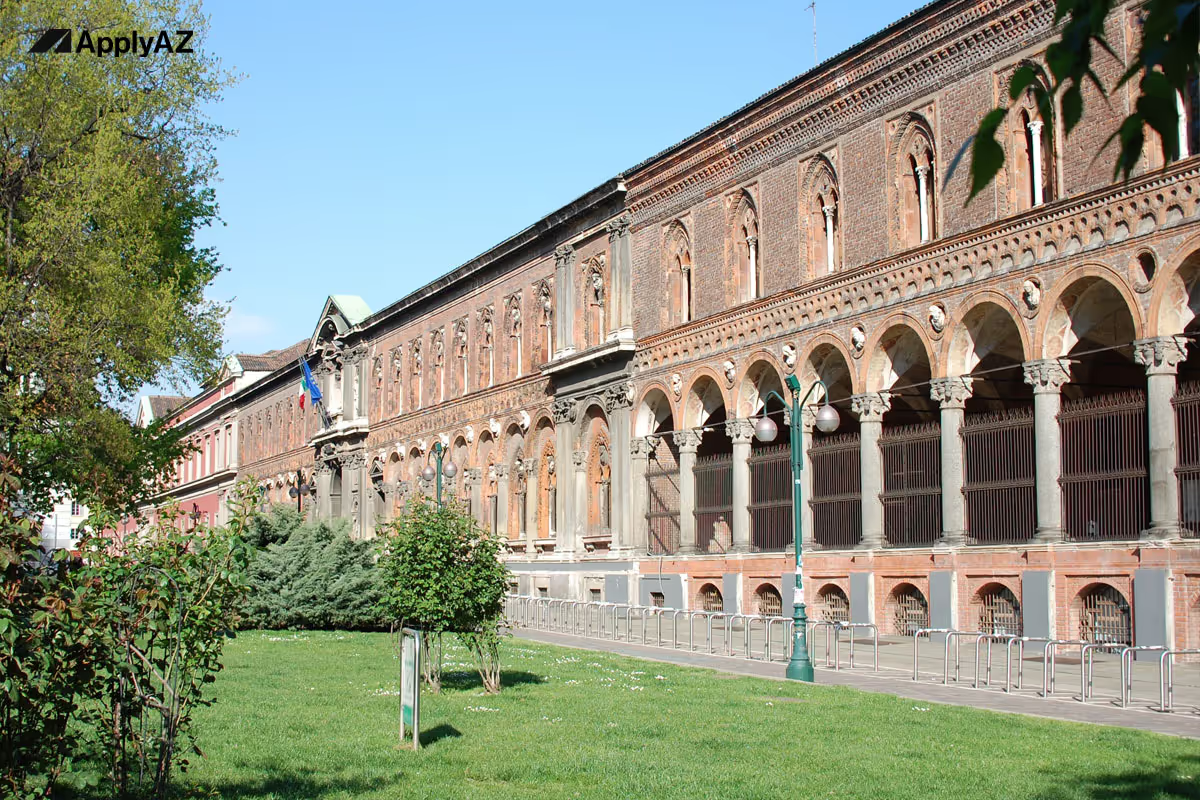
The Master in Computer Science at the University of Milan is a two-year, 120 ECTS degree (class LM-18) taught in Italian and English, with an entirely English-taught study plan open to students who choose English units. Classes are in Milan. Non-EU students with family income abroad pay a fixed fee by country group.
Entry requirements
- A bachelor's degree in computer science (class L-31), or another degree with at least 48 credits in computer science or computer engineering and 12 credits in mathematics.
- International applicants need a first-cycle degree as close as possible to these requirements, in fields related to computer science or mathematics.
- Selection on your academic record: degree certificate with grade, list of exams with grades and credits, and course syllabi. An interview is held only if your preparation needs checking.
- No set language level for admission, but non-EU visa applicants must show B2 in English or Italian, and all students must prove English at B2 to graduate.
- An application on apply.unimi.it with a €30 fee; at enrolment, a legalised degree with a CIMEA statement of comparability or a declaration of value.
About the programme
Computer Science is a two-year master's degree in class LM-18, run by the Department of Computer Science "Giovanni degli Antoni" of the University of Milan, with teaching based at Via Celoria 18 in Milan. The degree is taught in Italian and English, and the university's admissions portal states that you can opt for an entirely English-taught curriculum. In practice, you build that English-taught study plan by choosing English units, which run in all three teaching periods.
The programme gives advanced training in the theory and methods of computer science and in its applied areas, including artificial intelligence, machine learning, data analysis, distributed systems and human-computer interaction. It suits graduates in computer science, or in close fields with a strong programming and mathematics base, who want freedom to shape their own specialisation.
What you will study
You choose 54 ECTS of core units and 12 ECTS of related units, grouped into four pillars: Artificial Intelligence, Data Analytics and Big Data; Computing Systems in Industry, Business and Medicine; Interaction and Multimedia; and Algorithms, Software and Theory. Taking at least 36 ECTS in one pillar gives you a clear focus. Units listed as taught in English in the 2026/27 plan include:
- Artificial Intelligence
- Natural Language Processing
- Statistical Methods for Machine Learning
- Algorithms for Massive Datasets
- Cloud Computing Technologies
- Distributed and Pervasive Systems
- Reinforcement Learning
- Mathematical Logic and Advanced Multivariate Statistics (related units)
How the programme is taught
The year runs in three four-month periods, and attendance is strongly recommended for courses and labs. Beyond the chosen units, the plan includes 12 ECTS of free-choice credits, a compulsory 3 ECTS English B2 proficiency activity and a final thesis worth 39 ECTS, which can be written and defended in English or Italian under a supervisor. Erasmus+ exchanges are open with more than 50 partner universities across Europe, typically for about five months and 30 ECTS.
Career paths
Graduates work as computer science and technology experts. The university also notes that the degree gives access to the regulated profession of information engineer in Italy. Outlets named on the degree page include:
- Research groups in universities and public or private institutes, including PhD programmes
- High-tech companies developing software and networks
- Finance, banking and insurance
- IT management in healthcare, public administration and logistics
- Digital communication and data-driven industries
Fees and scholarships
Computer Science is in fee Area B for 2026/27. A student whose family income and assets are abroad pays a fixed second instalment set by country group: €256 in Group A, which includes countries like India, Pakistan and Nigeria, €1,164 in Group B and €4,101.12 in Group C, on top of a first instalment from €146. The university runs the Lombardy regional DSU scholarship, and full winners pay no second instalment, which means zero euro tuition for eligible students.
How to apply from outside the EU
Admission is open, with no entrance test: the board reviews your degree, exams and course syllabi, and may call you for an interview. For 2026/27, non-EU visa applicants applied on apply.unimi.it between 22 January and 30 April 2026, with a €30 fee; the 2027/28 dates were not yet out in September 2026.
After conditional admission, you complete Universitaly pre-enrolment (31 July for 2026/27) and request a type D study visa, for which you must show B2 English. Your degree needs a CIMEA statement of comparability or a declaration of value.
How ApplyAZ helps
If this programme fits your goals, ApplyAZ can include it in a shortlist of 20 to 30 English-taught programmes at Italian public universities. We write your CV and a tailored statement of purpose, submit your applications and Universitaly pre-enrolment, file your DSU scholarship application and prepare your visa file, with a named person on each stage. The university decides admission, the region decides the scholarship and the consulate decides the visa. See how ApplyAZ works or check your eligibility.
Questions and answers
Can I take this master entirely in English?
Yes. The degree is taught in Italian and English, and the university states that you can opt for an entirely English-taught curriculum by choosing English units. The thesis can also be written in English.
What bachelor's background do I need?
A computer science degree, or another degree with at least 48 credits in computer science or computer engineering and 12 in mathematics. International applicants need a first-cycle degree as close as possible to this profile.
Is there an entrance test?
No. The admission board evaluates your academic record from your degree certificate, exam list and course syllabi, and holds an interview only if your preparation needs checking.
What English level do I need?
There is no set level for admission, but non-EU visa applicants must show B2 in the language of instruction, and every student must prove English at B2 before graduating.
How much are the fees?
For 2026/27, students with family income abroad pay a fixed second instalment by country group, from €256 a year in Group A, plus a first instalment from €146. Full regional DSU scholarship winners pay no second instalment.
What jobs do graduates do?
Graduates work as computer science and technology experts in research, software and network companies, finance and insurance, healthcare and public administration IT, and data-driven industries, or continue to a PhD.
Similar programmes
More programmes in this city

They began right where you are

