

Study Finance in Italy 2027/28: English-Taught Programmes, Universities and Fees
14 English-taught finance, banking and accounting degrees at 11 public universities, with entry credits, QS 2026 ranks and 2026/27 fees.

No commitment
Less than 2 minutes
Limited intake, 1:1 support
international students trusted us
universities only, where study can be tuition-free for eligible students
English-taught programmes
Italian regions covered
Written by İrem Yılmaz, Student Experience Lead. Reviewed by Reeya Sharma, Student Success and Partnerships. Published 28 September 2026. Updated 28 September 2026.
In short
- Short answer: our catalogue lists 14 English-taught finance programmes for 2027/28 at 11 Italian public universities: 12 two-year master's and 2 three-year bachelor's in quantitative finance, banking, insurance, risk and accounting.
- Ranked names: in the QS World University Rankings by Subject 2026 for Accounting and Finance, the University of Bologna is the highest-ranked public university in Italy at 98 (tied). Private universities are left out of this guide.
- Cost: a finance degree at a public university can be tuition-free for eligible students through the regional DSU grant. Without it, Bologna charged a family with income in India €1,357.04 for a 2026/27 master's year. That is about ₹1.48 lakh at the ECB rate of 25 September 2026 (€1 = ₹109.2605).
- Entry: master's programmes want quantitative credits. Bologna's Quantitative Finance asks graduates from other fields for 24 ECTS across maths, statistics, economics and business, and no finance master's in our catalogue makes GMAT or GRE compulsory.
- ApplyAZ, an independent study-in-Italy consultancy with offices in Milan and India, works only with Italian public universities and takes no commission from them. For eligible students, we handle the applications, Universitaly pre-enrolment, the DSU scholarship application and the visa file.
Start with a quick eligibility check. If you qualify, you book a one-to-one consultation with one of our Italy experts, and from there we take care of everything.
Finance in Italy 2027/28: key facts
| Topic | Finance at an Italian public university |
|---|---|
| Programmes in our catalogue | 14 English-taught (12 master's, 2 bachelor's) at 11 public universities, counted on 28 September 2026. |
| Degree types | Laurea magistrale: 2 years, 120 ECTS, mostly in class LM-16 (finance). Laurea: 3 years, 180 ECTS, in class L-33 (economics). |
| Highest-ranked public university | University of Bologna, 98 (tied), QS World University Rankings by Subject 2026, Accounting and Finance. |
| Entry to a master's | A first-cycle degree at EQF level 6 (MUR circular 2026/27 and 2027/28), with maths, statistics and economics credits. |
| Tests | No compulsory GMAT or GRE at master's level; both bachelor's (Bologna and Turin) rank applicants on the SAT. |
| English | Most programmes ask for English at B2, the level the consulate checks for the visa (MUR circular, Part II, p. 18). |
| Fees, 2026/27, household abroad | Turin €656 plus any course contribution (about ₹71,700); Bologna €1,157.04 (bachelor's) or €1,357.04 (master's); Padua Computational Finance €3,198 (about ₹3.49 lakh). |
| DSU grant, 2026/27 | National minimum €7,171.11 (about ₹7.84 lakh) for a student living away from home. |
| Intake | Autumn 2027 only; Padua's first 2027/28 call runs from 15 September to 15 November 2026. |
| Visa | Application by 31 October 2027 for 2027/28; funds of €10,179.85 a year (about ₹11.12 lakh). |
Which English-taught finance programmes can you study in Italy?
Fourteen, in our catalogue on 28 September 2026: 12 master's and 2 bachelor's at 11 public universities, three of them at Bologna. Each is listed on Universitaly as taught only in English. The condition is fit: many are quantitative, so a commerce graduate without maths credits should read the entry section before shortlisting.
How we chose them: we read every programme title in our catalogue and list here each English-only degree whose title names finance, banking, insurance or accounting. Degrees whose titles also name economics or management appear in those guides too. Urbino's Economics, Management and Finance is not in this table, because its English-taught curriculum is International Economics and Business.
Our catalogue also holds 5 finance degrees listed with more than one teaching language, among them Siena's Finance and Sapienza's Finance and Insurance. They are left out here because part of the teaching is not in English.
| Programme | University | Level | Entry test or selection | Intake |
|---|---|---|---|---|
| Economics and Finance | University of Bologna | Bachelor's, 3 years | SAT General test, ranked for limited places (40 for non-EU applicants living abroad, 2026/27) | Autumn 2027 (calendar pending). |
| Economics and Finance with Data Science | University of Turin | Bachelor's, 3 years | SAT (College Board), ranked for a limited number of places | Autumn 2027 (calendar pending). |
| Accounting, Governance and Sustainability | University of Bergamo | Master's, 2 years | None, selection on CV and an interview | Autumn 2027 (calendar pending). |
| Greening Energy Market and Finance | University of Bologna | Master's, 2 years | None: open access, with requirements and preparation checked as set in the admission notice | Autumn 2027 (calendar pending). |
| Quantitative Finance | University of Bologna | Master's, 2 years | None: open access, with requirements and preparation checked as set in the admission notice | Autumn 2027 (calendar pending). |
| Finance and Insurance | University of Calabria | Master's, 2 years | Selection rules set in the 2027/28 call (pending) | Autumn 2027 (call pending). |
| Finance and Risk Management | University of Florence | Master's, 2 years | None, selection on CV and grades | Autumn 2027 (calendar pending). |
| Economics and Finance | University of Naples Federico II | Master's, 2 years | Selection rules set in the 2027/28 call (pending) | Autumn 2027 (call pending). |
| Computational Finance | University of Padua | Master's, 2 years | None, selection on CV and grades | October 2027. |
| Finance | University of Pavia | Master's, 2 years | None, selection on CV and grades (GMAT or GRE optional) | Autumn 2027 (calendar pending). |
| Quantitative Finance and Data Science for Economics | University of Perugia | Master's, 2 years | None, selection on CV and grades | Autumn 2027 (calendar pending). |
| Finance and Banking | University of Rome Tor Vergata | Master's, 2 years | Selection rules set in the 2027/28 call (pending) | Autumn 2027 (call pending). |
| International Accounting and Management | University of Siena | Master's, 2 years | None if your grade meets the threshold, otherwise a written test | Autumn 2027 (calendar pending). |
| Quantitative Finance and Insurance | University of Turin | Master's, 2 years | Admission test set by the university (minimum requirements checked) | Autumn 2027 (calendar pending). |
Source: ApplyAZ catalogue of English-only programmes (language as listed on Universitaly), counted on 28 September 2026. Selection rules come from each programme's latest call; 2027/28 calls are still being published.
Which Italian public universities are best for finance?
Bologna leads the public universities: it is 98 (tied) worldwide for Accounting and Finance in the QS World University Rankings by Subject 2026. If a ranked name matters to you, note that eight public universities appear in that table, and 4 of them run an English-taught finance programme in our catalogue.
| University | QS by Subject 2026, Accounting and Finance | English-taught finance programmes in our catalogue |
|---|---|---|
| University of Bologna | 98 (tied) | 3. |
| Polytechnic University of Milan | 101 to 150 | 0. |
| Sapienza University of Rome | 201 to 250 | 0. |
| University of Padua | 201 to 250 | 1. |
| Ca’ Foscari University of Venice | 251 to 300 | 0. |
| University of Naples Federico II | 251 to 300 | 1. |
| University of Pisa | 301 to 375 | 0. |
| University of Rome Tor Vergata | 301 to 375 | 1. |
Private universities ranked in this subject are left out, in line with our public-only rule. Politecnico di Milano ranks in the 101 to 150 band but has no English-only finance degree in our catalogue. Pavia, Turin, Florence, Bergamo, Siena, Calabria and Perugia are not ranked for this subject, yet together they run most of the programmes in the table above.
Where do finance graduates in Italy work?
Mostly in private firms, with banks and insurers a large share. AlmaLaurea's 2026 report (survey year 2025) shows 18.4% of employed economics-group master's graduates in credit and insurance five years after graduating. AlmaLaurea groups finance with economics and business, so there is no finance-only figure to quote.
| Two-year master's, economics group (AlmaLaurea, survey 2025) | 1 year after graduating (2024 graduates) | 5 years after graduating (2020 graduates) |
|---|---|---|
| Employment rate | 86.3% | 96.3%. |
| Average net monthly pay | €1,581 (about ₹1.73 lakh) | €2,006 (about ₹2.19 lakh). |
| Working in credit and insurance | 17.0% | 18.4%. |
| Working in consulting | 28.6% | 22.8%. |
| Working in industry | 17.0% | 18.0%. |
| Working in the public sector | 9.3% | 11.8%. |
| Working outside Italy | 4.6% | 5.7%. |
Source: AlmaLaurea, Esiti occupazionali della laurea, survey 2025, 1 year and 5 years, two-year laurea magistrale, economics group.
The universities name the sectors themselves. Padua says its Computational Finance prepares graduates for roles in the financial, insurance and energy-market sectors. Pavia aims its Finance degree at highly qualified jobs in the financial sector at international level.
Bologna presents its Economics and Finance bachelor's as training for junior economists and junior financial analysts. While studying, a study permit lets you work up to 20 hours a week and 1,040 hours a year, as the Ministry of Foreign Affairs states.
What do you need to get into a finance master's in Italy?
A bachelor's with enough maths and statistics. Bologna's Quantitative Finance, for example, admits graduates from other degree classes who hold 24 ECTS across maths, probability, statistics, economics and business, including at least 10 in maths. Nationally, the MUR circular sets the floor: a first-cycle title at EQF level 6.
| Programme | What the rule asks | Source |
|---|---|---|
| Quantitative Finance, Bologna | A degree in statistics (L-41) or economics (L-33), or 24 ECTS in maths, probability, statistics, economics and business with at least 6 in probability and statistics and 10 in maths. The committee scores merit (45 points), coherence (50) and English (5); 60 out of 100 is the pass mark. English at B2. | Bologna, how to enrol. |
| Finance, Pavia | Not restricted access. Graduates of engineering and science classes (L-8, L-9, L-30, L-31, L-35, L-41) are advised to take the Economic Models course; others are advised to take Real Analysis. | Pavia, Finance. |
| Computational Finance, Padua | Open admission with requirements, assessed on CV and grades. The programme mixes economics, computer science, maths and statistics. | Padua, Computational Finance. |
| Economics and Finance with Data Science, Turin | Class XII route; a fixed quota of places with an admission test (SAT), including 50 places for non-European applicants living abroad. | Turin, course page. |
Most programmes also ask for English at B2, the level the consulate checks for the visa (MUR circular 2026/27 and 2027/28, Part II, p. 18). We read each call against your transcript, credit by credit, before we suggest a programme.
Do finance master's in Italy ask for GMAT or GRE?
No, not as a rule: of the 12 finance master's in our catalogue, only Pavia's Finance mentions GMAT or GRE, and there it is optional. Bologna's committee scores academic merit and the fit of your degree instead. The condition is a strong transcript, because grades and quantitative credits carry the decision.
A good GMAT or GRE score can still help a borderline file where it is accepted. We tell you whether a test is worth your time for each programme on your shortlist, and we skip it where it adds nothing.
Want a finance shortlist built around your own transcript? Check your eligibility, then book a consultation with one of our Italy experts, and we handle every application from there.
How much does a finance degree cost at an Italian public university?
From €656 to €3,198 a year in 2026/27 at the three universities below, for a family whose income is in India, before any DSU award. Turin's figure is its lowest GDP-band contribution of €500 plus the €156 first instalment, and course contributions can be added. Each figure comes from the university's own 2026/27 fee rules.
| University and programmes | Yearly fee, 2026/27, family income abroad | In INR | How it is built |
|---|---|---|---|
| Bologna: Economics and Finance (bachelor's) | €1,157.04 | about ₹1.26 lakh | €1,000 reduced fixed fee plus €157.04, for non-OECD citizens with income only abroad, declared through ER.GO. |
| Bologna: Quantitative Finance; Greening Energy Market and Finance | €1,357.04 | about ₹1.48 lakh | €1,200 plus €157.04 for a second-cycle fresher. |
| Turin: Economics and Finance with Data Science (bachelor's); Quantitative Finance and Insurance (master's) | €656 plus any course contribution | about ₹71,700 | €500 contribution for residents of countries with GDP per capita PPP up to €26,000, such as India, requested by 20 November 2026, plus the €156 first instalment. |
| Padua: Computational Finance | €3,198 | about ₹3.49 lakh | €2,990 fixed fee for Group B (School of Science) plus €192 regional fee and €16 stamp duty. |
Sources: University of Bologna, reduced fixed fee 2026/27; University of Turin, fees for international students 2026/27; University of Padua, Call for Student Fees and Exemptions 2026/27, Tables 1 and 4. The 2027/28 fee rules are pending and usually appear in the summer before the year starts.
Living costs come on top of fees. Our cost of studying in Italy guide sets out rent and food by city.
Can a finance student get the DSU scholarship?
Yes, if the family's ISEE parificato falls under the region's limit and you keep up your credits. For 2026/27 the Ministry set the minimum grant for a student living away from home at €7,171.11 (MUR decree 175 of 10 February 2026). A two-year laurea magistrale qualifies; a one-year master universitario does not.
Each region runs its own call, so Bologna's finance students apply to ER.GO in Emilia-Romagna and Padua's to the University of Padua DSU office. Our DSU scholarship guide compares every region, and we prepare the ISEE parificato file and the application for you.
Can you study finance in Italy after Class XII?
Yes, at two universities in our catalogue. Bologna's Economics and Finance and Turin's Economics and Finance with Data Science are three-year English-taught bachelor's open to Class XII graduates with 12 years of schooling, the MUR circular's minimum. Both limit places and rank applicants on the SAT.
Bologna uses the SAT General test and kept 40 places for non-EU applicants living abroad in 2026/27. Our guides to studying in Italy after 12th and the BBA in Italy cover the wider choice of business and economics bachelor's.
Quantitative finance, banking or accounting: which master's fits you?
Choose by your bachelor's. Graduates with maths, statistics or engineering credits fit the 4 quantitative and computational master's; commerce and business graduates usually fit the 2 accounting degrees at Bergamo and Siena. The other 6 cover finance, risk, banking and insurance, as listed in our catalogue.
| Track | Programmes in our catalogue | Suits |
|---|---|---|
| Quantitative and computational | Computational Finance (Padua), Quantitative Finance (Bologna), Quantitative Finance and Insurance (Turin), Quantitative Finance and Data Science for Economics (Perugia) | BSc maths, statistics, physics or BTech graduates. |
| Finance, risk, banking and insurance | Finance and Risk Management (Florence), Greening Energy Market and Finance (Bologna), Finance (Pavia), Finance and Insurance (Calabria), Finance and Banking (Rome Tor Vergata), Economics and Finance (Naples Federico II) | BCom, BBA, economics or engineering graduates with some maths. |
| Accounting | Accounting, Governance and Sustainability (Bergamo), International Accounting and Management (Siena) | BCom and BBA graduates heading for audit or reporting. |
If you want general management rather than finance, our guide to business and management in Italy lists those degrees. Policy and theory-heavy courses sit in our guide to studying economics in Italy.
When do you apply for a finance degree starting in 2027?
Now, for some programmes. Padua opened its first 2027/28 call for applicants with foreign qualifications on 15 September 2026 and closes it on 15 November 2026. Most other 2027/28 calls are still pending, and the visa application must reach the consulate by 31 October 2027 under the MUR circular.
Courses start in autumn: Padua begins at the end of September or early October and states that direct enrolment in the second semester is not available. We track each call on your shortlist and file every application before it closes.
Reality check
Who decides what: the university decides admission, including whether your credits count. The region decides the DSU grant. The consulate decides the visa, and Universitaly states that a validated pre-enrolment is no promise of a visa or even an appointment.
What we handle. For eligible students we build a shortlist of English-taught programmes at public universities, match your credits to each call and file the applications. We also complete Universitaly pre-enrolment, prepare the DSU application and assemble the visa file, with a named person for each stage.
Usual pitfalls and what they cost.
- Applying to a quantitative master's without the maths credits: the committee rejects the file and the year is lost.
- Missing the regional DSU window: the grant, at least €7,171.11 for a student living away from home in 2026/27, is gone for that year.
- Choosing a programme listed with more than one teaching language: some required courses may be taught in Italian.
- Filing the visa late: applications for 2027/28 after 31 October 2027 are not accepted, which means a deferred start.
Check your eligibility today. If you are eligible, you book a one-to-one consultation with one of our Italy experts, and we take care of everything after that.
Frequently asked questions
Can a BCom graduate study finance in Italy?
Often, yes: banking, risk and accounting master's suit commerce graduates. Quantitative programmes want maths: Bologna's Quantitative Finance asks for 24 ECTS in maths, statistics, economics and business, at least 10 of them in maths. We compare your marksheet with each call before we suggest a programme, so you apply only where your credits count.
Is there a one-year finance master's at an Italian public university?
Not among the degrees in this guide: each master's here is a two-year laurea magistrale of 120 ECTS. Bologna says its one-year professional masters do not give access to PhD programmes, and regional DSU calls such as Tuscany's cover degree courses, not these masters. Our one-year masters guide explains the trade-off.
How many English-taught finance programmes does Bologna offer?
Three in our catalogue: the Economics and Finance bachelor's, and the Quantitative Finance and Greening Energy Market and Finance master's. Bologna is also the highest-ranked public university in Italy for Accounting and Finance, at 98 (tied) in the QS World University Rankings by Subject 2026. Its fees for non-OECD citizens start at €1,157.04.
Can I work part-time while studying finance in Italy?
Yes, within limits. The Ministry of Foreign Affairs says a study permit lets you work part-time up to 20 hours a week, and up to 1,040 hours across the year. Study remains your main activity, so plan any job around lectures and exam sessions, and never count on wages for the visa funds.
Can I stay in Italy after a finance master's to look for a job?
Yes. Graduates of an Italian degree whose study permit is ending can ask for a permit to look for work or start a business. The integration portal of the Ministry of Labour gives its length as 9 to 12 months, for work consistent with the degree completed.
Do I need Italian for a finance degree taught in English?
Not for your classes: every programme in this guide is listed as English-only, and most ask for English at B2. Some Italian still helps with daily life and with finding an internship in Italy, so plan to learn the basics during your first year.
Does ApplyAZ apply to private finance schools in Italy?
No: we work only with Italian public universities and take no commission from any university, public or private. That is why this guide leaves out private universities, even where they rank highly. Students and families pay our fees step by step, as our How ApplyAZ Gets Paid page explains.
Sources
- QS World University Rankings by Subject 2026, Accounting and Finance, Italy filter (published 25 March 2026), verified 28 September 2026.
- AlmaLaurea, Esiti occupazionali della laurea, survey year 2025 (Rapporto 2026), laurea magistrale, economics group, 1 year after graduating, verified 28 September 2026.
- AlmaLaurea, same survey, 5 years after graduating, verified 28 September 2026.
- MUR circular on international students, valid for 2026/27 and 2027/28 (EQF level 6 access; B2 at the visa stage, Part II, p. 18), verified 28 September 2026.
- Universitaly, international students page: visa deadlines 30 November 2026 and 31 October 2027, verified 28 September 2026.
- MUR Decreto Direttoriale 175 of 10 February 2026: minimum DSU grants for 2026/27, verified 28 September 2026.
- University of Bologna, reduced fixed fee for non-OECD citizens, 2026/27, verified 28 September 2026.
- University of Padua, Call for Student Fees and Exemptions 2026/27, Tables 1 and 4, verified 28 September 2026.
- University of Padua, admission of international students, 2027/28 first call, verified 28 September 2026.
- University of Bologna, Quantitative Finance, programme enrolment requirements, 2026/27, verified 28 September 2026.
- University of Pavia, Finance, programme page, 2026/27, verified 28 September 2026.
- University of Padua, Computational Finance, programme page, verified 28 September 2026.
- University of Bologna, Economics and Finance, programme page, verified 28 September 2026.
- University of Bologna, Economics and Finance, how to enrol: SAT General test and 40 non-EU places, 2026/27, verified 28 September 2026.
- University of Turin, Economics and Finance with Data Science, course page: SAT and 50 places for non-European applicants living abroad, verified 28 September 2026.
- University of Turin, tuition fees for international students, 2026/27, verified 28 September 2026.
- Ministry of Foreign Affairs, Study in Italy FAQ: work on a study permit, verified 28 September 2026.
- Ministry of Labour integration portal, permit to look for work after graduating (7 July 2023), verified 28 September 2026.
- European Central Bank, euro reference rate for INR, 25 September 2026, verified 28 September 2026.
INR figures use the ECB euro reference rate of 25 September 2026: €1 = ₹109.2605.
Ready to see which of these finance programmes fit your degree? Check your eligibility, book your consultation, and we take care of everything from there.
Where they're studying now
Students who started exactly where you are
English-taught programmes that can be tuition-free for eligible students, and the DSU grant landing in their account every year. The funding mechanics are identical at every Italian public university: the same ISEE Parificato, the same regional bando, the same ranking. Only the authority and the dates change.





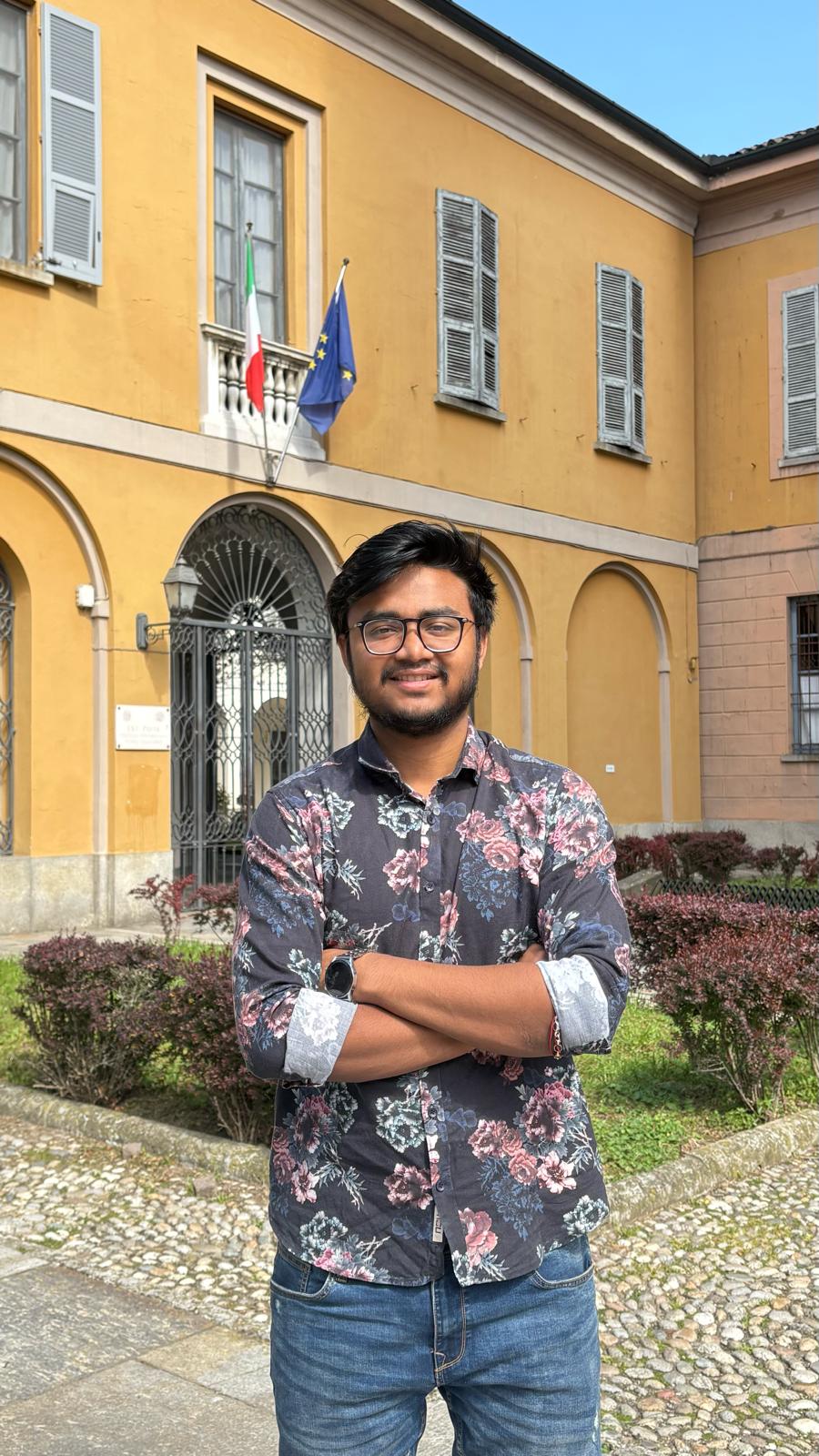

They began right where you are
Now they're studying at Italian public universities, where a degree can be tuition-free for eligible students, with DSU scholarships of up to about €8,250 a year for students living away from home, depending on the region.

