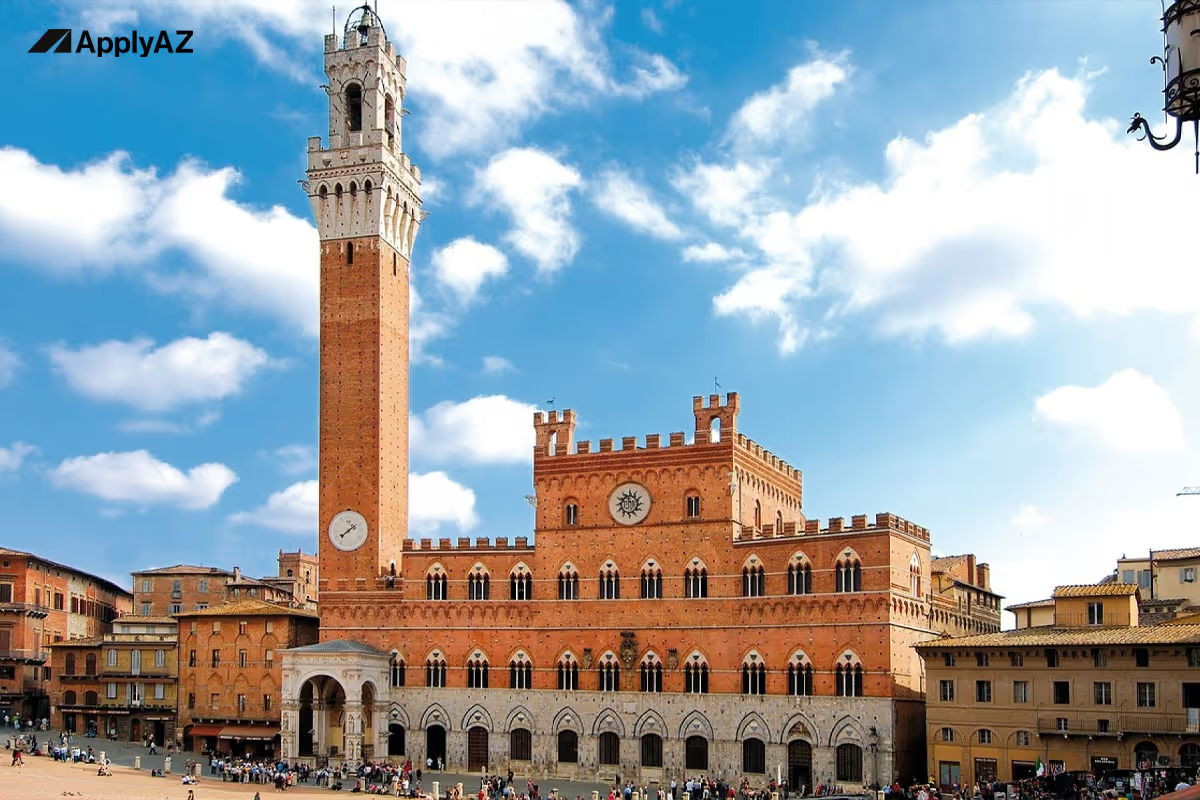
Where things stand: 28 September 2026
The 2027/28 calls are not published yet; for 2026/27, Siena took applications from non-EU students needing a visa until 6 May 2026 for most programmes (30 April for Biotech Engineering for Health, 8 May for Genetic Counsellors). Every figure below, including the 2026/27 fee rules, was verified on 28 September 2026 against the official source linked beside it; rupees use the FBIL reference rate of 21 September 2026, €1 = ₹109.90.
University of Siena at a glance
- Public university: The University of Siena is a state university in Siena, Tuscany, founded in 1240, with 14,833 students enrolled in 2024/25, 1,490 of them international.
- Teaching in English: 18 English-taught programmes on ApplyAZ: 2 bachelor's, 15 master's and 1 single-cycle.
- Fees for 2026/27: from €156 (₹17,000) in the no-tax area for Italian ISEE holders to €2,406 (₹2.6 lakh) at the top band for humanities and social sciences (derived), while students with income abroad pay by country coefficient, €656 (₹72,000) a year for India. Study can be tuition-free for eligible students through a DSU scholarship from DSU Toscana.
- Rankings: Joint 572nd in the QS World University Rankings 2027 (16th among Italian public universities) and in the 351 to 400 band in THE 2026.
- ApplyAZ: ApplyAZ, with offices in Milan and India, works only with Italian public universities and takes care of the whole process for eligible students from countries like India: university checks, applications, Universitaly pre-enrolment, the DSU scholarship and the visa file.
Want to know which Siena programmes fit your profile? Check your eligibility first; for eligible students, we handle every step from the shortlist to the visa.
Check your eligibility| Key fact | University of Siena | Source (verified 28 September 2026) |
|---|
| Type | Public (state) university, on MUR's list of 61 | MUR, Università statali |
| Founded | 1240 (the date of its first known document, a decree of 26 December 1240) | Siena, history |
| City and region | Siena, Tuscany | Siena website |
| Students, 2024/25 | 14,833 enrolled; 1,490 international (school diploma from abroad); 2,369 first-year students | Ustat, MUR |
| QS World University Rankings 2027 | =572 in the world; 16th among Italian public universities | QS, 18 June 2026 |
| THE World University Rankings 2026 | 351 to 400 | THE, Italy table |
| QS by Subject 2026 | 4 subjects in the top 200; best: Classics and Ancient History, in the 51 to 150 band | QS, 25 March 2026 |
| English-taught programmes on ApplyAZ | 18: 2 bachelor's, 15 master's, 1 single-cycle | Our own listings, 28 September 2026 |
| Yearly fees, 2026/27 | €156 (₹17,000) to €2,406 (₹2.6 lakh) for humanities and social sciences (derived); students with income abroad pay by country coefficient, €656 (₹72,000) for India (derived) | Regolamento contribuzione 2026/2027 |
| DSU scholarship body | DSU Toscana; family ISEE limit €27,000 (₹29.7 lakh) | Our DSU Toscana page |
| Entry tests used | CEnT-S by CISIA, IMAT | Siena, admission tests and the tests table below |
| Non-EU application windows | One winter intake for non-EU applicants needing a visa, to 6 May 2026 for 2026/27 (30 April for Biotech Engineering for Health, 8 May for Genetic Counsellors). Applications go through apply.unisi.it, then Universitaly, and we file both for eligible students. The 2027/28 calls are not out yet | Siena admissions |
Which programmes does the University of Siena teach in English?
The University of Siena has 18 English-taught programmes on ApplyAZ for the next intake: 2 bachelor's, 15 master's and 1 single-cycle degree, so most are two-year master's. Each programme page sets out its entry test, intake and requirements. The table lists them all by level, with the test each one uses.
Source: our own programme listings, counted on 28 September 2026; the counts match the programme list further down this page, and our full programme list covers every public university. Degrees with an English-taught curriculum are included. The 2027/28 calls are not out yet, so each programme page adds its deadline when the call is published, and we track every call on your shortlist.
How much does the University of Siena cost in 2026/27?
The University of Siena costs from €156 (₹17,000) a year in the no-tax area for Italian ISEE holders to €2,406 (₹2.6 lakh) at the top band for humanities in 2026/27. Income abroad is charged by a country coefficient with a €500 floor, €656 (₹72,000) in total for India, and study can be tuition-free for eligible students with a DSU scholarship.
| Who pays what, 2026/27 | Yearly total | How it is set |
|---|
| ISEE up to €22,000, first-year or regular student (Group 1) | €156 (₹17,000) | Contribution €0; only the regional tax and stamp duty, €140 and €16 (derived: the regulation does not print them) |
| ISEE €22,001 to €22,500, Group 1 | €278 (₹31,000) | First paying band: €122 for humanities and social sciences (€124 science and technology, €126 health), plus €156 (derived) |
| Top band, ISEE above €100,000 or none, humanities and social sciences | €2,406 (₹2.6 lakh) | €2,250 maximum contribution for Group 1, plus €156 (derived) |
| Top band, health courses | €2,846 (₹3.1 lakh) | €2,690 maximum for Group 1, plus €156 (derived); science and technology courses €2,470, or €2,626 (₹2.9 lakh) in total |
| Income abroad, coefficient method (India) | €656 (₹72,000) | Top-band contribution times the country coefficient, never below €500; India's 0.0653 gives €146.93, so €500 plus €156 (derived) |
| Dentistry and Dental Prosthodontics (English) | By formula | A reduced table (Table B) up to an ISEE of €30,000; above that, or with no ISEE, the Table A amount for health courses plus €1,650 (₹1.8 lakh); with income abroad, the €500 minimum plus €1,650, so €2,306 (₹2.5 lakh) in total for India (derived) |
Students with less merit (Groups 2 and 3) pay more at every band, up to €2,952 (₹3.2 lakh) plus €156 at the top. Anyone with a non-conforming ISEE pays the maximum. Siena's regulation adds the regional tax and stamp duty at the amount set by law without printing it, so our totals use Tuscany's €140 regional tax and the €16 stamp duty (derived).
Source: Regolamento contribuzione 2026/2027. Rupees use the FBIL reference rate of 21 September 2026, €1 = ₹109.90.
Siena accepts no ISEE parificato. Students with income or assets abroad pay the top-band contribution multiplied by the coefficient of their country of citizenship, based on GDP per head at purchasing power, with a €500 (₹55,000) floor, and countries not on the list pay €500 (Regolamento 2026/27, Article 4 and Table C). Source: Siena, student fees page.
Worked example: Siena does not accept an ISEE parificato: India's country coefficient of 0.0653 times the top-band contribution gives €146.93, below the €500 floor. So a first-year student from India pays €656 (₹72,000) a year with the regional tax and stamp duty (derived), whatever the family's income, or €2,306 (₹2.5 lakh) in English-taught Dentistry, which adds €1,650 under Article 4 (derived). We prepare the DSU Toscana application and the family documents with the student, who submits them.
How do non-EU students apply to the University of Siena?
Non-EU students living abroad apply to the University of Siena programme by programme, then pre-enrol on Universitaly so the consulate can issue a study visa. The windows below are the 2026/27 ones, and the 2027/28 calls are not published yet. The university decides admission, and the consulate decides the visa.
| Step | Where | When |
|---|
| 1. Programme application | apply.unisi.it | Economics and Management (bachelor's): The winter intake, until 6 May 2026, for non-EU applicants needing a visa; the summer intake was not open to them (2026/27) |
| 2. Selection and offer | The programme's admission board | After each round closes, per the call |
| 3. Universitaly pre-enrolment | Universitaly | After the offer, by the date in the programme's call; at Siena it follows the Letter of Eligibility, within 14 days of the offer in the Biotech Engineering for Health call |
| 4. Study visa | Italian consulate in your country | By 30 November 2026 for 2026/27 and by 31 October 2027 for 2027/28; the consulate asks for at least €10,179.85 (₹11.2 lakh) a year for living costs |
| 5. Enrolment in Italy | Siena's student office | On arrival, with the passport and the original qualification documents |
| Programme (example) | Application windows | Intake | Source |
|---|
| Economics and Management (bachelor's) | The winter intake, until 6 May 2026, for non-EU applicants needing a visa; the summer intake was not open to them | 2026/27 | Call |
| Biotech Engineering for Health (bachelor's) | Until 30 Apr 2026 for non-EU visa applicants; 30 places for non-EU applicants | 2026/27 | Call |
| International Accounting and Management (master's) | Until 6 May 2026 for visa applicants; to 30 Sep 2026 for applicants who need no visa | 2026/27 | Call |
| Genetic Counsellors (master's) | Until 31 Mar 2026, then 1 Apr to 8 May 2026, for non-EU visa applicants; the third selection was not open to them | 2026/27 | Call |
Sources: Economics and Management (bachelor's), Biotech Engineering for Health (bachelor's), International Accounting and Management (master's), Genetic Counsellors (master's); Universitaly; Consulate General of Italy in Kolkata, visa checklist. For eligible students, we handle each of these steps, from the programme applications to the visa file.
Want us to handle your Siena applications? Check your eligibility first; for eligible students, we file each programme application, the Universitaly pre-enrolment and the visa file.
Check your eligibilityWhich entry tests and language levels does the University of Siena ask for?
The University of Siena uses CEnT-S by CISIA and IMAT, depending on the programme. English-taught degrees usually ask for B2 English, and Italian-taught degrees for B2 Italian. The test for each programme is in the table above and in its call.
| Test or route | Used for | Source |
|---|
| CEnT-S by CISIA | Biotech Engineering for Health (English bachelor's): minimum score 8, then an interview for non-EU applicants | Admissions page |
| IMAT | Dentistry and Dental Prosthodontics taught in English: test on 29 September 2026 (MUR Decree 1005, art. 2), with 5 places for non-EU applicants living abroad and 30 for EU and Italy-resident candidates in 2026/27 (Table B) | Admissions page |
| No entry test | Economics and Management (English bachelor's): a check of prior knowledge after enrolment instead (a route, not an entry test) | Admissions page |
| Document evaluation, online test or interview | English-taught master's such as International Accounting and Management (a route, not an entry test) | Admissions page |
| UniSi online English interview | Applicants without an accepted English certificate, as proof of B2 (a route, not an entry test) | Admissions page |
The table sets out what two 2026/27 calls ask for at each degree level.
| Degree level (example call, 2026/27) | Entry route | English | At application | At enrolment |
|---|
| Bachelor's (Biotech Engineering for Health) | CEnT-S (Mathematics, Reasoning on texts and data, Physics, Biology, Chemistry), minimum score 8, then an interview for non-EU applicants (minimum 15) | B2 or higher (CEFR) | ID document, CV, school diploma and English certificate, unless exempt | Universitaly visa procedure within 14 days of the offer; enrolment by the deadline for the selection round, the latest being 3 November 2026 |
| Master's (International Accounting and Management) | Document evaluation; a remote online test or an interview may be set | B2 minimum (CEFR) | Copies of the entry qualification, in English or Italian, on apply.unisi.it | Universitaly pre-enrolment after admission and the Letter of Eligibility |
Sources: Biotech Engineering for Health and International Accounting and Management calls. We prepare these documents with you; our DOV guide and Italy study visa guide cover the qualification and visa papers.
English: B2 minimum, shown by an accepted international certificate, a language-centre certificate from an Italian university, citizenship of an English-speaking country, a qualification taught in English or UniSi's online English interview. Proof can vary by programme: Economics and Management asks for a recognised certificate and does not accept a medium-of-instruction statement. Source.
Italian: B2 or higher for Italian-taught degrees, checked by an online test in the Apply Unisi evaluation unless exempt; CELI, CILS, CERT.IT and CEDILS certificates are accepted (2025/26 notice). Source. We match each programme on your shortlist to its test and handle the registration and application steps for eligible students.
How does the University of Siena rank?
The University of Siena is joint 572nd in the QS World University Rankings 2027, 16th among Italian public universities, and in the 351 to 400 band in the THE World University Rankings 2026. In QS by Subject 2026 it has 4 subjects in the world's top 200, with Classics and Ancient History and Dentistry in the 51 to 150 band.
| Ranking and edition | Rank | Italy | Source |
|---|
| QS World University Rankings 2027 | =572 (world) | 16th among Italian public universities | QS |
| THE World University Rankings 2026 | 351 to 400 | | THE |
| QS by Subject 2026: Classics and Ancient History | 51 to 150 (world) | | QS |
| QS by Subject 2026: Dentistry | 51 to 150 (world) | | QS |
| QS by Subject 2026: Archaeology | 101 to 150 (world) | | QS |
| QS by Subject 2026: Anthropology | 101 to 200 (world) | | QS |
Sources: QS World University Rankings 2027, published 18 June 2026, THE World University Rankings 2026 and QS World University Rankings by Subject 2026. The Italy position counts the Italian public universities QS ranks; "=" marks a joint rank.
Do graduates of the University of Siena find work?
Yes, most do. Among Siena's master's graduates of 2024, 79.2% were in work about a year later, with mean net pay of €1,419 (₹1.6 lakh) a month, according to AlmaLaurea. Five years after graduating, 95.5% of the 2020 master's graduates were in work, earning €1,844 (₹2.0 lakh) a month on average.
| Degree level | In work after 1 year | In work after 5 years | Net pay a month, 1 year | Net pay a month, 5 years | AlmaLaurea |
|---|
| Master's (two-year) | 79.2% | 95.5% | €1,419 (₹1.6 lakh) | €1,844 (₹2.0 lakh) | Data |
| Single-cycle (for example Medicine, Law) | 82.9% | 96.3% | €1,725 (₹1.9 lakh) | €2,018 (₹2.2 lakh) | Data |
Source: AlmaLaurea, XXVIII survey of graduate outcomes (Rapporto 2026, June 2026): 2024 graduates at 1 year and 2020 graduates at 5 years. AlmaLaurea counts anyone in paid work, including paid training, as employed.
Which DSU scholarship covers the University of Siena?
Siena students apply for the regional DSU scholarship through DSU Toscana. For 2026/27 the family ISEE limit is €27,000 (₹29.7 lakh), and the top grant for a student living away from home is €3,338 (₹3.7 lakh) in cash plus housing. Winners are also exempt from the university's yearly contribution, so study can be tuition-free for eligible students.
| DSU 2026/27 | DSU Toscana |
|---|
| Family ISEE limit | €27,000 (₹29.7 lakh) |
| Family ISPE (assets) limit | €60,000 (₹65.9 lakh) |
| Grant for a student living away from home | €3,338 a year in cash (₹3.7 lakh) with a family ISEE up to €13,500, falling to €1,060 (₹1.2 lakh) near the €27,000 limit; a residence bed, valued at €3,150 (₹3.5 lakh), and two meals a day come on top and are not deducted |
| What it includes | Cash in two halves; two meals a day for students living away from home and one for others; a residence bed with no rent, or a rent contribution of up to €3,150 a year if no bed is available; exemption from the €140 regional tax. The call does not cover university fees, but Florence, Pisa and Siena exempt winners and eligible students under their own fee rules |
| Application window | 20 July to 7 September 2026, 13:00 Italian time (closed) |
| Foreign income documents | Originals issued in 2026, legalised or apostilled and translated into Italian, posted by 7 September 2026; DSU Toscana assesses them itself and uses no ISEE parificato |
| First payment | Bachelor's and single-cycle winners in the 4 November 2026 ranking: 20% by 10 November and 30% in December 2026. Master's: 50% in December 2026 |
| Credits to keep the grant | Bachelor's and single-cycle: 20 credits by 10 August 2027 (18 for Medicine). Master's: 15 credits. The same minimum by 30 November 2027 avoids repaying the cash received |
Source: DSU Toscana call for 2026/27. Our DSU Toscana guide covers the scholarship in full, our DSU scholarship guide compares the regions, and we prepare the application and the family documents with the student, who submits them, since DSU Toscana has authorised no agency to submit applications.
Siena also runs its own Siena International Excellence Scholarships: for 2026/27, five awards of €6,000 (₹6.6 lakh) a year gross, renewable for a second year, for international applicants to specific English-taught master's (2026/27 scholarship page; that call has closed). Amounts and dates change each year, so we check each new call for the programmes on your shortlist.
Two national schemes are open to international students too: our guides to the MAECI scholarship and Invest Your Talent in Italy explain who can apply.
What does it cost to live in Siena?
For the study visa, the consulate asks you to show at least €10,179.85 (₹11.2 lakh) a year for living costs in Siena or any other Italian city. That is a floor, not a full budget: rent is the biggest cost, and a DSU residence place is much cheaper than a private room.
| Cost | Amount | Source |
|---|
| Visa minimum for living costs | €10,179.85 a year (about ₹11.2 lakh) | Kolkata consulate checklist, item 6 |
| Private single room | About €351 a month on average (about ₹39,000), August 2026 | Immobiliare.it Insights, 3 August 2026 |
| DSU Toscana residence place | No rent for scholarship winners living away from home who are given a bed; a €262.50 (₹29,000) non-interest deposit is paid on assignment | DSU Toscana, residence places 2026/27 |
| Yearly urban bus pass, Siena | €120 (₹13,000) under 26 or €170 (₹19,000) over 26, valid for a year from the month of purchase (2025/26 agreement) | UniSi, urban public transport |
| Monthly budget including rent | From about €800 a month (about ₹88,000), the University of Siena's estimate | Our Siena city guide |
Our Siena city guide covers housing, transport and daily costs in detail.
How does the University of Siena compare with similar universities?
The table compares the University of Siena with five similar public universities: the universities of Florence, Pisa, Perugia, Trento and Tuscia. It sets out their QS 2027 rank, English-taught programmes and yearly fees; the University of Tuscia is a smaller alternative in Lazio, with 13 English-taught programmes.
| University | City | QS 2027 | English-taught programmes on ApplyAZ | Yearly fees (lowest to highest) |
|---|
| University of Siena (this page) | Siena | =572 | 18 | €156 to €2,406 (₹17,000 to ₹2.6 lakh), up to €2,846 (₹3.1 lakh) for health courses (derived) |
| University of Florence | Florence | =409 | 10 | €156 to €2,900 (₹17,000 to ₹3.2 lakh), 2025/26 table, unchanged for 2026/27 |
| University of Pisa | Pisa | 341 | 20 | €156 to €3,056 (₹17,000 to ₹3.4 lakh) |
| University of Perugia | Perugia | 1001 to 1200 | 12 | €156 to €2,096 (₹17,000 to ₹2.3 lakh) |
| University of Trento | Trento | =438 | 27 | €146 to €2,384 (₹16,000 to ₹2.6 lakh), 2025/26, EU students; non-EU students by admission score |
| University of Tuscia | Viterbo | 851 to 900 | 13 | €156 to €2,350 (₹17,000 to ₹2.6 lakh), 2025/26 |
Sources: QS World University Rankings 2027, our own programme listings and each university's fee rules, linked on its page. Where a university sets a flat or country-group fee for families with income abroad, its page gives that fee. Our list of all 61 public universities compares every one, our best universities in Italy page sets out QS 2027 and THE side by side, and the A to Z directory lists every university.
Reality check
- Places are capped for visa applicants. For 2026/27, Economics and Management had 150 non-EU visa places, Biotech Engineering for Health 30 non-EU places and English Dentistry 5.
- There is one window. Applications from students needing a visa closed on 6 May 2026 for most programmes (30 April for Biotech Engineering for Health, 8 May for Genetic Counsellors), and the summer intake was not open to them.
- Family papers do not lower the fee. Siena accepts no ISEE parificato, so a student from India pays €656 (₹72,000) a year, or €2,306 (₹2.5 lakh) in English-taught Dentistry, but DSU Toscana still needs legalised family originals.
- Italian still matters. Italian-taught degrees ask for B2, checked by an online test unless the student is exempt, and daily life needs it too.
What we handle: the shortlist, the fee route, the income documents, the programme applications, the Universitaly pre-enrolment, the visa file and the DSU Toscana application, prepared with you. The university decides admission, DSU Toscana decides the DSU scholarship and the consulate decides the visa.
How does ApplyAZ handle applications to the University of Siena?
For eligible students, we take care of the whole application to the University of Siena. We shortlist programmes against your profile and their entry tests, prepare the documents and the family's income papers, file each programme application, complete Universitaly pre-enrolment, handle the visa file and prepare the DSU Toscana application with you.
We work only with Italian public universities, and we do not promise outcomes: the university decides admission, DSU Toscana decides the DSU scholarship and the consulate decides the visa.
Check your eligibility first. Eligible students book a one-to-one consultation with one of our Italy experts.
Check your eligibilityFrequently asked questions
Is the University of Siena a public university?
Yes. The University of Siena is a state university on the Ministry of University and Research's list of 61 public universities, and its first known document is a decree of 26 December 1240. It had 14,833 students in 2024/25, 1,490 of them international, and its fees follow family income, or a country coefficient for students with income abroad.
How much does the University of Siena cost in 2026/27?
In 2026/27 the University of Siena charges no contribution to first-year and regular students with a family ISEE up to €22,000, who pay €156 (₹17,000) in regional tax and stamp duty. The top band costs €2,406 (₹2.6 lakh) for humanities and social sciences, and up to €2,846 (₹3.1 lakh) for health courses.
Can study at the University of Siena be tuition-free for eligible students?
Yes. Siena fully exempts DSU Toscana scholarship winners, and students ranked eligible, from its contributions, so study can be tuition-free for eligible students. The 2026/27 family limits are an ISEE of €27,000 and an ISPE of €60,000, and the cash grant away from home reaches €3,338 (₹3.7 lakh), plus a bed and meals.
What does a student from India pay at the University of Siena?
Siena does not accept an ISEE parificato, so it multiplies the top-band contribution by India's country coefficient of 0.0653. The result is below the €500 floor, so a first-year student from India pays €656 (₹72,000) a year with the regional tax and stamp duty, whatever the family's income. English-taught Dentistry adds €1,650, for €2,306 (₹2.5 lakh).
How many programmes does the University of Siena teach in English?
We list 18 English-taught programmes at the University of Siena for the next intake: 2 bachelor's, Economics and Management and Biotech Engineering for Health, 15 master's and a single-cycle degree in Dentistry and Dental Prosthodontics. Most master's check your degree and documents, sometimes with an online test or interview.
Which entry tests does the University of Siena use?
The University of Siena uses CISIA's CEnT-S for some programmes, such as Biotech Engineering for Health, where non-EU applicants also have an interview. Economics and Management has no entry test, only a check after enrolment, and English-taught Dentistry uses the IMAT. We match each programme on your shortlist to its test and handle the registration.
Does the University of Siena teach Dentistry in English?
Yes. Siena teaches Dentistry and Dental Prosthodontics in English as a six-year single-cycle degree, with entry through the IMAT on 29 September 2026. MUR Decree 1005 gives it 5 places for non-EU applicants living abroad and 30 for EU and Italy-resident candidates in 2026/27, and lists no English Medicine course at Siena.
What is the University of Siena's world ranking?
The University of Siena is joint 572nd in the QS World University Rankings 2027, 16th among Italian public universities, and in the 351 to 400 band in the THE World University Rankings 2026. In QS by Subject 2026 it has 4 subjects in the world top 200, including Classics and Ancient History and Dentistry in the 51 to 150 band.
When do applications open at the University of Siena?
For 2026/27, Siena took applications from non-EU students needing a visa in one winter intake, which closed on 6 May 2026 for most bachelor's and master's degrees, on 30 April for Biotech Engineering for Health and on 8 May for Genetic Counsellors. The summer intake was not open to them. We track the 2027/28 calls for your shortlist.
How does ApplyAZ help with a University of Siena application?
For eligible students, we take care of everything: the shortlist, each apply.unisi.it application, the Letter of Eligibility and Universitaly pre-enrolment, the DSU Toscana file, which the student submits, and the visa file. The university decides admission, DSU Toscana the scholarship and the consulate the visa. Start by checking your eligibility at go.applyaz.com.
Sources
- MUR, Università statali
- Ustat, University of Siena, 2024/25
- Siena, history and the Siena website
- Regolamento contribuzione 2026/2027 and student fees page, Siena, 2026/27
- Biotech Engineering for Health (bachelor's) and Economics and Management (bachelor's) calls, 2026/27; admission tests, English requirement and Italian language requirement
- QS World University Rankings 2027, QS by Subject 2026 and THE World University Rankings 2026
- AlmaLaurea, master's data and single-cycle data, Rapporto 2026
- Siena International Excellence Scholarships, 2026/27 (Siena's own scholarships)
- DSU Toscana call 2026/27
- Immobiliare.it Insights, 3 August 2026, DSU Toscana, residence places 2026/27, UniSi, urban public transport, our Siena city guide
- Dentistry and Dental Prosthodontics apply page (undated), the Economics and Management enrolment page and the International Accounting and Management apply page, 2026/27
- MUR Decree 1005 of 6 August 2026 and its Table B, 2026/27
- Universitaly, Kolkata consulate visa checklist and the FBIL reference rate, 21 September 2026
- Also cited above: Siena admissions
- All sources verified 28 September 2026. Written by İrem Yılmaz, Student Experience Lead; reviewed by Reeya Sharma. First published 1 June 2025; last updated and verified 28 September 2026.
Check your eligibility first. If you are eligible, you book a one-to-one consultation with one of our Italy experts, and from there we take care of everything.
Check your eligibility