

Bachelor in Economics and Finance with Data Science at University of Turin
Three-year English-taught economics bachelor in Turin that combines microeconomics, macroeconomics, econometrics and finance with statistics, programming and data science, with SAT-based admission to a limited number of places.
Bachelor
3 years
Turin
English
University of Turin



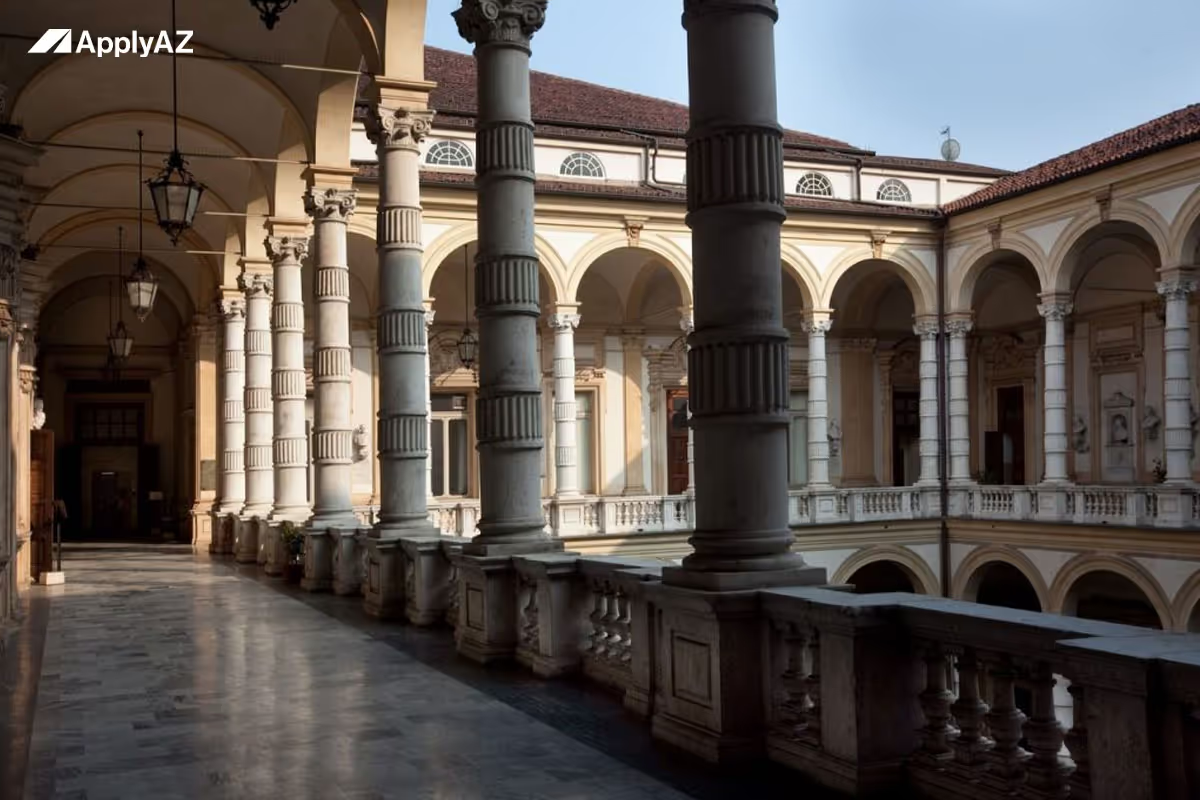
Economics and Finance with Data Science is a three-year, 180 ECTS bachelor's degree (class L-33-R) taught entirely in English at the University of Turin. Places are limited and admission is based on the SAT. Students residing abroad pay a fixed contribution of €500 to €1,500 a year by country, with zero euro tuition for eligible students.
Entry requirements
- A secondary school diploma obtained after at least 12 years of schooling that gives access to university in your country, with proof of authenticity.
- A SAT (College Board) score: every candidate must sit the SAT before applying, and places are limited.
- An advanced level of English, since the SAT and all teaching are in English.
- Solid mathematics: students whose initial preparation shows gaps are assigned an additional mathematics requirement (OFA) to clear in the first year.
- An online application on Apply@UniTo with the €60 fee, which covers up to two programmes.
About the programme
Economics and Finance with Data Science is a three-year bachelor's degree in class L-33-R, economics, worth 180 ECTS. It is taught entirely in English, with conventional in-person teaching in Turin, by the Department of Economic-Social and Mathematical-Statistical Sciences (ESOMAS). Access is programmed, so the number of places is limited.
The degree offers a rigorous study of economics and finance combined with data science and its applications. Its stated aim is to give students the analytical and programming skills needed for careers as economists, economic policy experts, business leaders and researchers. It suits school leavers who enjoy mathematics and want to work with economic and financial data.
What you will study
The first two years build a common base in mathematics, statistics, micro and macroeconomics, accounting and law, then add econometrics, probability and computer science for economics. In the third year a 12 ECTS data science unit is compulsory, and electives let you lean towards an economic, economic-financial or economic-statistical profile. Units in the 2026/27 study plan include:
- Mathematics for Economics I (12 ECTS) and II (9 ECTS)
- Microeconomics (12 ECTS) and Macroeconomics (12 ECTS)
- Statistics (12 ECTS) and Probability and Statistics (6 ECTS)
- Econometrics (9 ECTS)
- Computer Science for Economics (6 ECTS)
- Financial and Business Accounting (9 ECTS)
- Data Science, Management and Programming Module (12 ECTS)
- Third-year electives such as Corporate Finance, Financial Economics, Monetary Economics, and Applied Econometrics and Statistics
How the programme is taught
Teaching is in person, and law is covered through Private Law, Public Law and Business Law. In the third year you pick two electives from a group that includes international economics, labour economics, development and growth, and games, strategies and markets, plus one course in finance, managerial economics or policy making. The degree ends with a 3 ECTS final examination. Through the UNITA European university alliance you can also add credits from blended intensive programmes, mobility windows and language courses such as French, Spanish, Portuguese and Romanian.
Career paths
The university's course page points to careers in insurance, finance and credit management, consulting, economic journalism, social and economic research, international business, public administration, service companies and think tanks. The professional profiles it lists are:
- Financial consultant
- Insurance agent
- Controller
- Treasury officer
- Stock market operator
- Statistician
- Banking technician
Graduates can also move on to a master's degree. At UniTo, ESOMAS also runs English-taught master's degrees in Economics and in Quantitative Finance and Insurance.
Fees and scholarships
UniTo's additional contributions page lists no extra fee for this degree. For 2026/27, students residing abroad pay a fixed yearly contribution set by the GDP per capita of their country of residence, from €500 to €1,500 within the standard length of the degree, plus €156 for regional tax and stamp duty. Students from the particularly poor countries on the ministry's list pay only the €156. EDISU Piemonte scholarship winners are refunded and pay no further instalments, which means zero euro tuition for eligible students.
How to apply from outside the EU
Book the SAT early: every candidate must sit it before applying, and UniTo's admission procedure counts the score of the last test taken, not the best one. For 2026/27 the degree reserved 50 places for non-EU applicants residing abroad, who applied on Apply@UniTo (a €60 fee covers up to two programmes) during the bachelor's call from 19 February to 15 April 2026. Your diploma needs proof of authenticity, such as legalisation, an apostille or an ENIC-NARIC statement of verification; a CIMEA statement is optional but useful.
Admitted students complete the Universitaly pre-enrolment (by 15 July 2026 for 2026/27) and apply for a study visa, which the Italian consulate decides.
How ApplyAZ helps
If this programme fits your goals, ApplyAZ can include it in a shortlist of 20 to 30 English-taught programmes at Italian public universities. We write your CV and a tailored statement of purpose, submit your applications and Universitaly pre-enrolment, file your DSU scholarship application and prepare your visa file, with a named person on each stage. The university decides admission, the region decides the scholarship and the consulate decides the visa. See how ApplyAZ works or check your eligibility.
Questions and answers
Is Economics and Finance with Data Science taught in English?
Yes. The whole degree is taught in English, in person in Turin, and the university asks for an advanced level of English. The SAT you take for admission is also in English.
Do I need the SAT?
Yes. Every candidate must sit the SAT (College Board) before applying, and places are limited. UniTo's admission procedure counts the score of the last SAT you took, not your best score.
How many places are there for non-EU students?
For 2026/27 the degree had 50 places for non-EU applicants residing abroad, who applied on Apply@UniTo from 19 February to 15 April 2026. The 2027/28 calendar was not yet published in September 2026.
What school background do I need?
A secondary school diploma after at least 12 years of schooling that gives access to university in your country. The degree assumes solid mathematics, and students with gaps must clear an additional mathematics requirement in the first year.
How much are the fees?
For 2026/27, students residing abroad pay €500 to €1,500 a year depending on their country's GDP per capita, plus €156 in regional tax and stamp duty. EDISU Piemonte scholarship winners have their fees refunded.
What jobs can graduates do?
The university lists profiles such as financial consultant, controller, stock market operator, statistician and banking technician, in sectors from insurance, finance and consulting to economic research, public administration and think tanks.
Similar programmes
More programmes in this city

They began right where you are

