Is Siena a good place to study for international students?
Siena is a good choice for international students who want a small, walkable Tuscan city with two public universities and low living costs. It has about 53,000 residents (2026) and a historic centre on the UNESCO World Heritage list since 1995, less than 2 km across, so you can cross it on foot in about 20 minutes. It suits students who want a close student community and everyday Italian life, less so those who want big-city nightlife.
Which universities are in Siena, and which are public?
Siena has two public universities: the University of Siena, a broad research university founded in 1240, and the University for Foreigners of Siena, a small specialist university for Italian language and culture. Both are covered by the same DSU Toscana scholarship call. The University of Siena teaches many degrees in English, while the University for Foreigners teaches in Italian. ApplyAZ works only with public universities like these two, and no university pays us.
What can you study in English in Siena?
In Siena, the University of Siena teaches 19 degree courses in English for 2026/27: two bachelor's, Economics and Management and Biotech Engineering for Health, 16 master's and a six-year degree in Dentistry and Dental Prosthodontics. Master's fields include economics, finance, international studies, AI and automation engineering, applied mathematics, medical biotechnologies and chemistry. The University for Foreigners teaches in Italian. See our English-taught programmes.
How much does it cost to live in Siena as a student?
Living in Siena as a student costs from about €800 a month, according to the University of Siena's own estimate. A room in a shared student flat costs €300 to €450 a month, and single rooms averaged €351 in August 2026, among the lowest of Italy's main university cities (Immobiliare.it Insights). Eating daily in university canteens costs €240 to €360 a month, and the student bus pass costs just €120 a year for under-26s.
- Room in a shared flat: €300 to €450 a month (University of Siena)
- Single room average: €351 a month (Immobiliare.it Insights, August 2026)
- University residence room: €200 to €400 a month (University of Siena)
- Canteen meals: €240 to €360 a month (University of Siena)
- Utilities about €100 a month; bus pass €120 a year under 26 (2025/26)
- Monthly total: from about €800 (University of Siena estimate)
How do you find student housing in Siena?
In Siena, DSU Toscana offers 1,200 residence places for 2026/27, and off-site scholarship winners get a free place where one is available, or a rent contribution of up to €3,150 a year if not. Everyone else rents privately, usually a room in a shared flat, where the University of Siena quotes €300 to €450 a month. Its international admissions site lists accommodation options. Start looking in early summer, because demand peaks before autumn lectures.
Which scholarship covers students in Siena, and how much is it worth?
Students at both Siena universities apply to DSU Toscana, the Tuscan right-to-study agency. For 2026/27 the limits were an ISEE of €27,000 and an ISPE of €60,000, and applications ran from 20 July to 7 September 2026. Winners get a cash grant, free canteen meals, a free residence place if off-site, and exemption from university fees. Italy's national minimum grant for off-site students in 2026/27 is €7,171.11 a year. Tuition is otherwise set by income.
How do you get to Siena and get around once you are there?
Siena has no airport of its own: Pisa airport is about 110 minutes away by bus, and Florence airport links by shuttle to Santa Maria Novella station. From Florence, the rapid bus takes about 1 hour 15 minutes and trains about 1 hour 25 to 45 minutes. Inside the walls, Siena is best on foot, since the centre is under 2 km across. Autolinee Toscane's annual urban pass cost students €120 under 26 or €170 over 26 in 2025/26.
What is student life like in Siena?
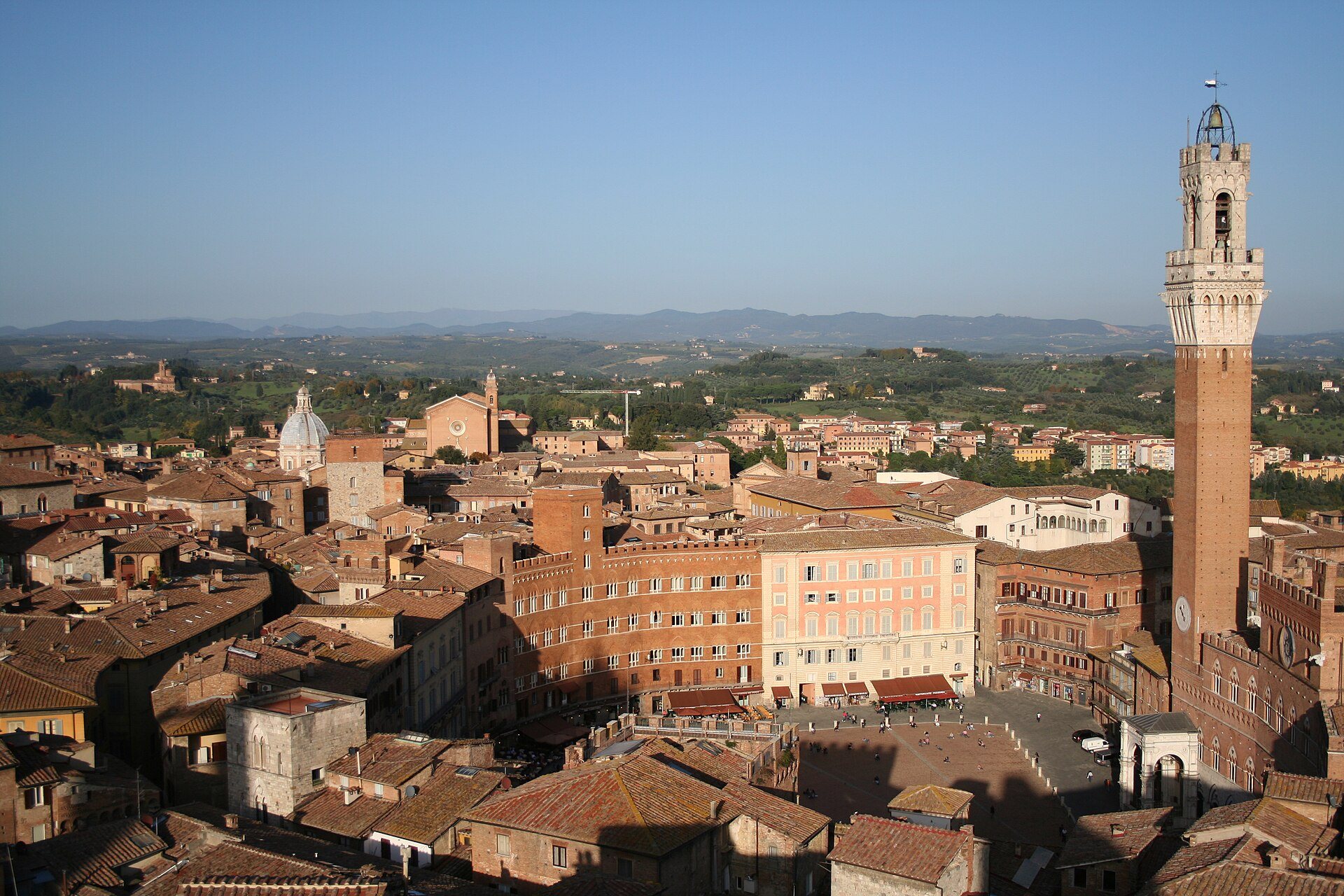
Student life in Siena revolves around Piazza del Campo, the 17 contrade, or city wards, and the Palio horse race, run on 2 July and 16 August each year. Students from both universities share bars, libraries and DSU canteens in a compact city, and international students of Italian are part of daily life. The streets are steep, so walking is the main exercise. Florence is close enough for day trips, and evenings in Siena are relaxed rather than loud.
What should you sort out in your first weeks in Siena?
Your first weeks in Siena are mostly paperwork, and the city's small size makes it quicker than in big cities. Non-EU students must request a permesso di soggiorno within 8 working days of arrival, using the post office kit. You also need a codice fiscale, health cover and your DSU Toscana or residence confirmation. For the discounted bus pass, pay your tuition first, then register on the Autolinee Toscane website, and allow about 15 days.
- Request your permesso di soggiorno within 8 working days, using the post office kit
- Get your codice fiscale (Italian tax code) if you do not already have one
- Arrange health cover: SSN registration or private health insurance
- Confirm your DSU Toscana scholarship and residence place
- Pay tuition, then register for the €120 student bus pass on at-bus.it
Can you work part-time while studying in Siena?
Yes, non-EU students in Siena can work part-time on a study permit, up to 20 hours a week and 1,040 hours a year. Siena is a small city, so jobs are fewer than in Florence or Milan, and most are in tourism, hospitality and retail, where Italian is usually expected. The universities also offer paid part-time student collaborations, often called 150-hour jobs, through internal calls. Plan your budget without counting on a job at first.
How does Siena compare with other Italian student cities?
Siena is one of the cheapest university cities in central Italy: single rooms averaged €351 in August 2026, against €627 in Florence, €615 in Rome and €704 in Milan (Immobiliare.it Insights). It is small and slow-paced, with about 53,000 residents, so it suits students who want a close community and focus. Florence offers more choice and Pisa is known for computing and engineering, but both cost more to live in than Siena.
How can ApplyAZ help you study in Siena?
ApplyAZ can add the University of Siena to a shortlist of 20 to 30 English-taught programmes at public universities. We take no university commissions. We write your CV and tailored SOPs, submit applications and Universitaly pre-enrolment, file your DSU Toscana scholarship and prepare your visa file, with a named person on each stage. The University for Foreigners teaches in Italian, so fluent speakers may apply alone with our roadmap. Next step: see how ApplyAZ works or check your eligibility.