

Master in Communications Engineering at Polytechnic University of Turin
Two-year English-taught LM-27 master at Politecnico di Torino in wireless, optical, satellite and computer networks, signal processing and machine learning for networking, taught through projects and labs. Entry needs 100 subject credits and English at B2.
Master
2 years
Turin
English
Polytechnic University of Turin



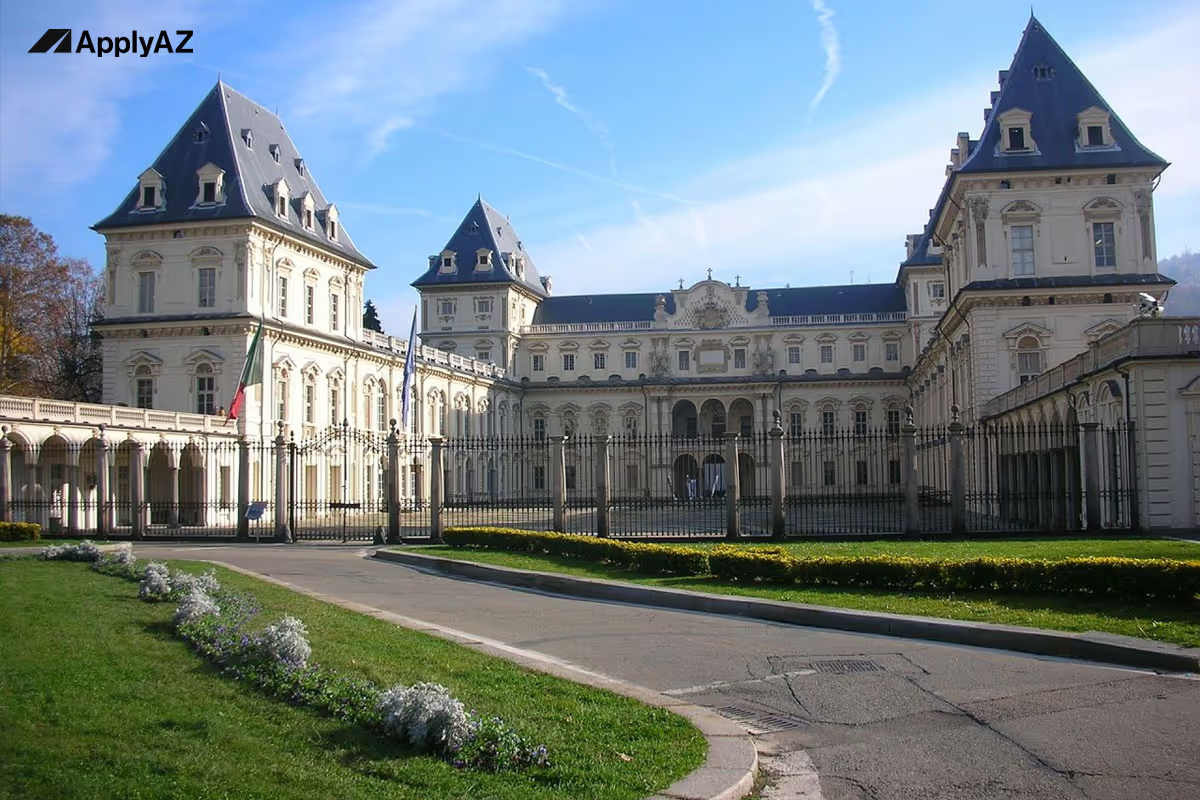
Communications Engineering is a two-year, 120 ECTS master's degree (class LM-27) taught in English at Politecnico di Torino in Turin. Entry needs a bachelor's with at least 40 credits in maths, physics and computing and 60 more in information engineering and related subjects, your course syllabus and English at B2, with IELTS 5.5 as the minimum. Fees follow family income, so it can be tuition-free for eligible students.
Entry requirements
Detailed entry requirements
Communications Engineering asks for a bachelor's degree or recognised foreign equivalent with at least 40 credits in maths, physics and computing and 60 more in information engineering, maths, statistics and related subjects, a suitable academic record checked by the programme's professors, your course syllabus, and English at B2 with IELTS 5.5 as the listed minimum. Reviewed 8 October 2026. [1]
Degree and credit requirement
You need a bachelor's degree or three-year university diploma, or a foreign academic qualification from an accredited or recognised university, earned after at least 15 years of total education, counting primary school, secondary school and university. [1]
Your previous studies must include: [1]
- At least 40 credits in physics (FIS/01, FIS/03), computer science and computer engineering (INF/01, ING-INF/05), and mathematics: algebra, geometry, mathematical analysis, probability and numerical analysis (MAT/02, MAT/03, MAT/05, MAT/06, MAT/08).
- At least 60 credits in information engineering, covering electronics, electromagnetic fields, telecommunications, automatic control, computer engineering, bioengineering and electronic measurements (ING-INF/01 to ING-INF/07), computer science (INF/01), mathematical analysis, probability, numerical analysis and operations research (MAT/05, MAT/06, MAT/08, MAT/09), statistics (SECS-S/01), chemistry fundamentals (CHIM/07), and technical physics, applied mechanics, mechanical design, electrical engineering and electrical power systems (ING-IND/10, 13, 14, 31 and 33).
Credits in sectors shared by both groups count first towards the 40-credit group, and one course can count partly towards each group. The programme lead decides on gaps of up to 10 credits; a larger gap needs final approval from the Collegio Coordinator or Vice Coordinator. Missing credits must be made up before enrolment, through single courses for gaps of up to 60 credits, or by enrolling in a bachelor's programme with credit transfer for larger gaps. [1]
PoliTo's 2026/27 course table recommends a background in any field of engineering, computer science, mathematics or physics. Students in a five or six-year single-cycle degree who have not graduated need at least 15 years of total education, 3 of them at university, and at least 180 ECTS. Preparatory or foundation years do not count. [1][3]
What this means for your transcript
As a guide, based on the rule above:
- Usually a fit: a B.Tech or B.E. in Electronics and Communication, Electronics and Telecommunication, Electrical and Electronics, Computer Science or IT, where maths, physics and computing sit alongside electronics, telecoms or computer engineering subjects.
- Check carefully: a B.Sc. in Physics, Mathematics or Computer Science, or a BCA. These often fill the 40-credit group but can fall short of 60 further credits in information engineering, computing, maths or statistics. A B.Tech in Mechanical or Civil Engineering also needs a careful count of its electrical, electronics and computing credits.
- Often short: a B.Com, BBA or BA, which rarely include these subject areas.
The programme's professors assess how well your previous studies fit the degree, and the syllabus of your courses is a required upload, so a full and clear syllabus matters for this programme. [1][3]
English
Certified English at CEFR level B2 or higher, with IELTS 5.5 as the listed minimum for this programme. Other certificates are accepted under PoliTo's certificate table, and no Italian is required for admission. [1][2][3]
- Exemption: a qualification earned after an English-medium path at a school or university in India, Pakistan, Bangladesh, Sri Lanka, Malaysia, Singapore and other listed countries, or a qualification from the US, UK, Ireland, Australia, New Zealand or another country on the university's list, replaces the certificate. You upload an official statement that English was the medium of instruction. [2]
- Sharing scores: TOEFL and TOEIC results are sent with code C285, and Cambridge results are shared online with your Candidate ID. [2]
Selection
For applicants with a foreign qualification, the regulations set no admission test. The Recruitment and Admissions Unit first checks your requirements and documents, then professors from the programme, appointed by the Collegio Coordinator, assess your academic performance and how well your previous studies fit the degree on Apply@polito. [1][2]
- Syllabus: required for Communications Engineering. [3]
- Optional extra: you can upload one extra document, such as a GRE score report, a recommendation or motivation letter, or proof of relevant training or work. [2]
The oral interview described in the regulations applies only to some applicants from Italian universities whose grade average falls below the set threshold. [1]
The result is eligible, a conditional offer (eligible, but you still need to finish your bachelor's), or not eligible. A not-eligible decision on curricular or academic grounds rules out every PoliTo master's for that year. A positive evaluation is valid only for the academic year you apply for, and deferrals are not possible. [1][2]
2026/27 deadlines
For 2026/27, the first call for foreign qualifications ran from 19 December 2025 to 13 February 2026, with results on 15 April 2026. The second call ran from 18 March to 20 April 2026, with results on 22 June 2026. [2]
Eligible non-EU applicants living abroad were asked to complete Universitaly pre-enrolment by 30 June 2026 (first call) or 15 July 2026 (second call). Online enrolment ran from 31 July to 5 October 2026, and the type D visa had to be uploaded by 30 November 2026. A third call, from 3 to 17 November 2026, is reserved for EU applicants and non-EU applicants living in Italy. The 2027/28 calendar is not yet published. [2]
Documents and non-EU steps
You apply online on Apply@polito with one application per call, choosing up to two master's programmes in order of preference. [2]
- Required uploads: passport, CV, bachelor's degree certificate or an official document with your expected graduation date, an official transcript showing the grading and credit systems, the syllabus of your courses, and your English certificate or exemption statement. [2][3]
- Syllabus source: issued by your university. PoliTo does not accept documents downloaded from the website of an accreditation authority, such as HEC in Pakistan. [2]
- Format: documents on letterhead, stamped and signed, or digitally signed and verifiable online. Documents not in Italian, English, French or Spanish are merged with an official English or Italian translation. [2]
- No changes after submission: incomplete applications are rejected and cannot be resubmitted in the same academic year. [2]
- For enrolment: a declaration of value, CIMEA statement of comparability or Diploma Supplement, plus the type D study visa and an Italian fiscal code. [2]
Non-EU applicants living abroad then complete Universitaly pre-enrolment, which PoliTo validates only once you are eligible and have uploaded your bachelor's degree. [2]
Sources and verification
Checked by the ApplyAZ admissions team against the university's official documents listed below. Entry rules can change with each new call, and we re-check them before every application.
- Politecnico di Torino, Department of Electronics and Telecommunications. Academic regulations, Master's degree in Communications Engineering (LM-27), academic year 2026/27, issued by Rector's Decree no. 525 of 28 May 2026. Reviewed 8 October 2026.
- Politecnico di Torino, Admissions and Enrolment. Applicants with a non-Italian qualification, Master's degree programmes, academic year 2026/27. Reviewed 8 October 2026.
- Politecnico di Torino. Course-specific requirements for Master's degree programmes, applicants with a non-Italian qualification, academic year 2026/27, updated 19 December 2025. Reviewed 8 October 2026.
- Politecnico di Torino, Communications Engineering programme pages: overview, apply information and programme curriculum, academic year 2026/27. Reviewed 8 October 2026.
About the programme
Communications Engineering is a two-year, 120 ECTS master's degree (laurea magistrale, class LM-27 Telecommunications Engineering) taught in English at Politecnico di Torino's main campus in Turin. It is run by the Department of Electronics and Telecommunications within the Collegio of Electronic, Telecommunications and Physics Engineering, and admission is uncapped, subject to an evaluation of your requirements. [4]
The programme teaches you to design and operate modern communication systems, including satellite and radio links, fibre optic networks, computer networks and wireless networks. You also learn to build and use tools such as communication system simulators and machine learning, and to process signals, images and video. [4] The 2026/27 regulations describe a degree aimed at design and research that combines telecommunications, computer science and information engineering, preparing graduates for highly competitive companies, industrial or public research centres, or a PhD. [1]
What you will study
The main learning areas are digital transmission and information theory, optical fibre and radio communication systems, multimedia signal processing, telematic networks and large distributed systems, stochastic modelling and simulation, applied electronics and electromagnetics, and architectures and protocols for complex systems. [1]
The first year of the 2026/27 study plan includes: [4]
- Signal, image and video processing and learning (12 CFU)
- Machine learning for networking (8 CFU)
- Project: Software-defined communication systems (9 CFU)
- Communication systems (6 CFU)
- Computer network design and control (6 CFU)
- Information and communication theory (6 CFU)
- Optical fiber communications (6 CFU)
- Wireless access electromagnetics (6 CFU)
In the second year you take Project: Applied communication systems and IoT (9 CFU) and choose from options that include 5G and next-generation mobile computing, Applied information security and cryptography, Introduction to space systems, Advanced wireless communications and coding, Satellite navigation systems, Open optical networks, a signal processing lab in optical or wireless transmission, an Internet performance and troubleshooting lab, a cloud computing and data centre design lab, and Operational research. [4]
How the programme is taught
All classes are taught in English. The programme uses a project-based approach on top of laboratory activities and practical classes in every course, and design, practical and laboratory work make up at least 55% of the credits. [1][4]
The degree ends with a thesis based on research, design or advanced development, carried out at Politecnico or at a company or organisation in Italy or abroad. Part of the thesis credits are earned through the two project courses. The 2026/27 study plan offers a 20 CFU thesis, or a 12 CFU internship with an 8 CFU thesis. The thesis and its public defence are in English. [1][4]
Career paths
The 2026/27 regulations list six professional profiles: [1]
- Network and telematic services engineer: designing and developing network equipment, multimedia content delivery and Internet applications, including the use of AI tools to design and control telecommunication systems.
- Technical pre-sales specialist: technical support, customer requirements and specifications for companies that sell telecoms hardware, firmware or software.
- Network and equipment manager: running, upgrading and securing networks for telecom operators and service providers, and for banks, public administrations and large companies with complex internal networks.
- Freelance engineer or consultant: advising companies and public bodies, and contributing to international standards and patents.
- ICT researcher: research and development at fixed, mobile and broadcast operators, equipment makers, universities and public research centres.
- Telecommunications device designer: hardware, firmware and software for satellites, radio links, mobile systems and fibre networks.
Fees and scholarships
Politecnico di Torino sets tuition in its yearly fee regulations, and students can apply for a reduction based on family income, using an ISEE parificato when the family lives abroad. EDISU Piemonte, the regional body for the right to study, runs the regional scholarship and university housing, and international students can apply through its annual call. EDISU decides awards.
How to apply from outside the EU
Non-EU applicants living abroad apply through PoliTo's general calls for foreign qualifications on Apply@polito, choosing up to two master's programmes in one application. Communications Engineering requires the syllabus of your bachelor's courses. [2][3]
For 2026/27 the first call ran from 19 December 2025 to 13 February 2026 and the second from 18 March to 20 April 2026. The 2027/28 calendar is not yet published. [2]
After a positive evaluation, and once your bachelor's degree is documented, we submit your Universitaly pre-enrolment. You then apply for a type D study visa and enrol with a declaration of value, CIMEA statement of comparability or Diploma Supplement. [2]
How ApplyAZ helps
ApplyAZ is an Italy-based consultancy that works only with public universities. We can include this programme in a shortlist of 20 to 30 English-taught programmes that fit your profile, so your plan never rests on a single application.
For eligible students who start with us, a named person owns each stage, from A to Z:
- We check your transcript against PoliTo's entry rules for this programme.
- We write your CV and a tailored statement of purpose.
- We prepare and submit your Apply@polito application, supporting documents and Universitaly pre-enrolment.
- We help you declare your family income for reduced fees and file your EDISU Piemonte scholarship application at the right time and in the right format.
- We prepare your visa file.
With operations in all 20 Italian regions, we follow each region's scholarship rules and deadlines as they change. The university decides admission, the region decides the scholarship and the consulate decides the visa, so no one can promise an outcome. You pay in milestones, and every service you pay for is either delivered or its fee is refunded (terms apply).
Programmes at Italian public universities can be tuition-free for eligible students. Check if you are eligible and book a one-to-one consultation session with one of our Italy experts, or see how ApplyAZ works.
Questions and answers
What bachelor's degree do I need for Communications Engineering at PoliTo?
A bachelor's or recognised foreign degree earned after at least 15 years of education, with at least 40 credits in maths, physics and computing and 60 more in information engineering, maths, statistics or related subjects. PoliTo recommends a background in engineering, computer science, mathematics or physics. [1][3]
Is there an entrance test?
No admission test for applicants with a foreign qualification. Professors on the programme assess your academic record and how well your previous studies fit the degree, and you must upload the syllabus of your bachelor's courses. [1][3]
What English level is required? Do I need IELTS?
English at B2 or higher, with IELTS 5.5 as the listed minimum. A qualification earned through English in India, Pakistan, Bangladesh, Sri Lanka and other listed countries can replace the certificate, with an official medium-of-instruction statement. [1][2][3]
When is the deadline for non-EU students?
For 2026/27, the general calls for foreign qualifications ran from 19 December 2025 to 13 February 2026 and from 18 March to 20 April 2026. The 2027/28 calendar is not yet published. [2]
Can I apply before I graduate?
Yes. You upload an official document with your expected graduation date and can receive a conditional offer. PoliTo validates Universitaly pre-enrolment only once your degree is uploaded, and for 2026/27 enrolment closed on 5 October 2026. [2]
I have a BCA or a B.Sc. in Physics. Can I apply?
Possibly. Physics is on the recommended list and usually covers maths and physics, but it can lack the 60 credits in information engineering, computing or statistics. A BCA usually covers computing but can be light on maths and physics. Gaps above 10 credits need the Collegio Coordinator's approval and are made up before enrolment. [1][3]
What will I learn to design?
Modern communication systems, including satellite and radio links, fibre optic networks, computer networks and wireless networks. You also use communication system simulators and machine learning, and process signals, images and video, through projects, labs and practical classes in every course. [4]
What jobs do graduates do?
The regulations list network and telematic services engineer, network manager, technical pre-sales specialist, consultant, ICT researcher and telecommunications device designer, with employers ranging from operators and equipment makers to research centres, banks and public administrations. [1]
Can someone handle my whole application to Communications Engineering at PoliTo?
Yes. ApplyAZ, an Italy-based consultancy that works only with public universities, checks your transcript against PoliTo's rules for this programme, handles the application and Universitaly pre-enrolment, helps you file the EDISU Piemonte scholarship application at the right time and in the right format, and prepares your visa file, for eligible students. Start by checking your eligibility.
I'm applying from India. What is the route into Communications Engineering?
A recognised Indian bachelor's, such as a B.Tech or B.E. in Electronics and Communication, Electrical or Computer Science, can meet the rule if it includes at least 40 credits in maths, physics and computing and 60 more in information engineering, maths, statistics or related subjects. You also need English at B2 and your course syllabus. The steps are the Apply@polito application, confirmation of eligibility and Universitaly pre-enrolment. [1][3] Indian students apply for the type D study visa at the Italian embassy or consulate that covers their state, such as New Delhi, Mumbai or Bengaluru.
Is the route different from Pakistan, Bangladesh or Sri Lanka?
No. The academic rules for Communications Engineering are the same whatever your nationality. Applicants from Pakistan, Bangladesh and Sri Lanka follow the same steps as India: Apply@polito application in a general call, confirmation of eligibility and Universitaly pre-enrolment, then a type D study visa from the Italian mission for their country of residence. Read our guide for students in Dhaka.
I live in the UAE, Saudi Arabia, Qatar, Kuwait, Oman or Bahrain. Where do I apply for the visa?
At the Italian embassy or consulate responsible for the country where you legally live, after Universitaly pre-enrolment. The academic rules for Communications Engineering are the same whatever your nationality, and Gulf residents follow the same steps: Apply@polito application in a general call, confirmation of eligibility and Universitaly pre-enrolment. Read our guides for Dubai, Riyadh and Doha.
I studied or live in London, New York, Toronto, Vancouver, Singapore or Kuala Lumpur. What is the route?
The academic rules for Communications Engineering are the same whatever your nationality, and your degree is assessed like any other foreign qualification. Non-EU applicants who live abroad follow the same route: Apply@polito application in a general call, confirmation of eligibility and Universitaly pre-enrolment, then a type D study visa from the Italian mission for where they live. Read our guides for students in London, New York, Toronto, Vancouver, Singapore and Kuala Lumpur.
More English-taught programmes at this university
Other public universities in this city

They began right where you are

