

Master in Viticulture and Enology Sciences at University of Turin
Two-year interuniversity wine master based in Asti with an English-taught International curriculum: grapevine science, enology, wine microbiology and wine marketing in year 1, then electives, training work and a thesis, possibly abroad.
Master
2 years
Turin
Multiple
University of Turin



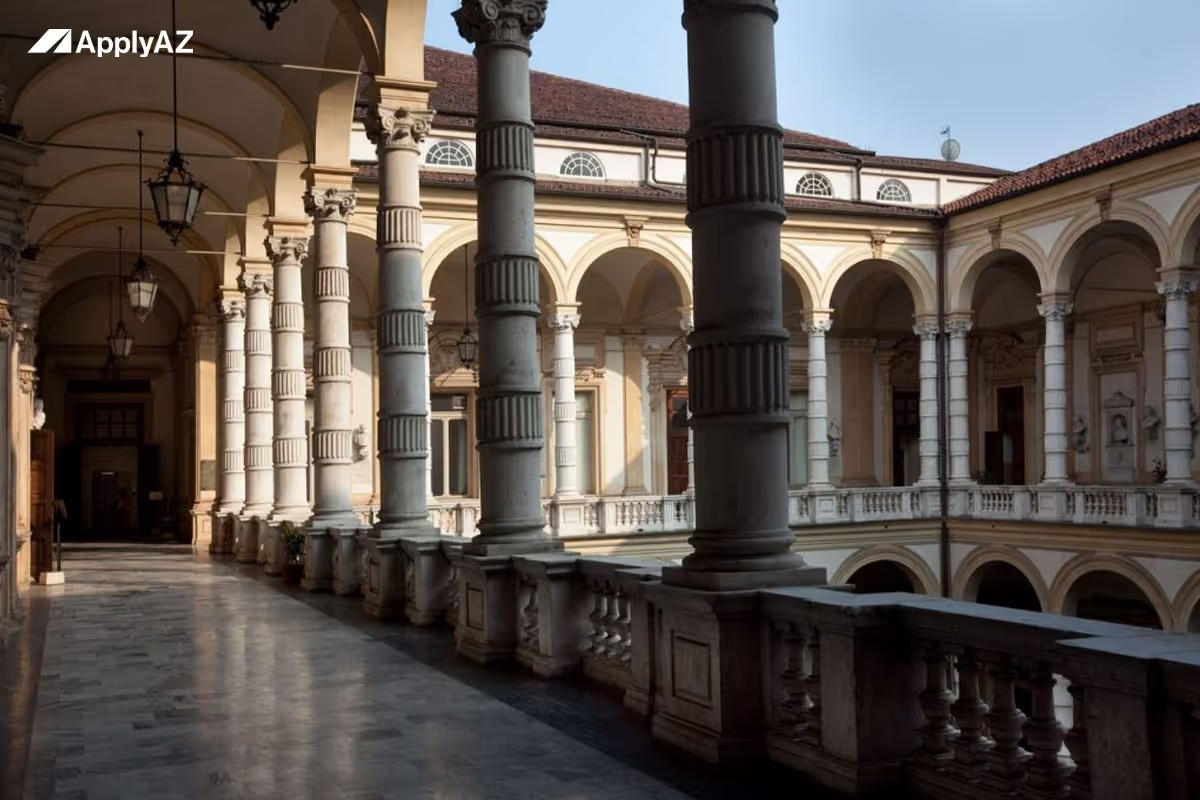
Viticulture and Enology Sciences is a two-year, 120 ECTS master's degree (class LM-70-R) at the University of Turin, based in Asti, whose International curriculum is taught in English. Year 1 is in Asti; year 2 can be spent at partner universities in Italy or in the EMaVE network abroad. Students residing abroad pay €500 to €1,500 a year by country.
Entry requirements
- A bachelor's degree, normally in agricultural or food sciences (Italian classes L-25 or L-26) or an equivalent foreign qualification; graduates from other fields can ask for an assessment.
- At least 30 credits in the agricultural science sectors listed in the course regulations.
- English at B2 level or higher, written and spoken, and good computer skills (word processing, spreadsheets, databases, presentations).
- An interview on the core subjects in the course syllabus, in Italian or English, in person or online, with at most two attempts a year.
- An Apply@UniTo application (€60) with CV, motivation letter, degree and transcript.
About the programme
Viticulture and Enology Sciences (Scienze Viticole ed Enologiche) is an international interuniversity master's degree in class LM-70-R, food science and technology, worth 120 ECTS. It is run by the University of Turin's Department of Agricultural, Forest and Food Sciences (DISAFA) with its seat in Asti, and access is open after an interview.
The degree has two curricula. The Fondamentale curriculum, taught in Italian and English, is mainly for graduates in viticulture and enology. The International curriculum is delivered in English and is aimed mainly at graduates from other fields and at foreign graduates. The degree trains managers for the global wine market, combining theory with practical experience in research centres and wineries.
What you will study
In the first year all students attend classes together in Asti. The International curriculum's first year is fully set, covering the vine, the wine and its market. Units in the 2026/27 study plan include:
- Enology and Wine Chemistry (12 ECTS)
- Grapevine Protection (10 ECTS)
- Wine Marketing and European and Comparative Wine Law (10 ECTS)
- Viticulture and Vineyard Management (8 ECTS)
- Wine Microbiology (8 ECTS)
- Grapevine Physiology (6 ECTS) and Experimental Methodology (6 ECTS)
- Second-year electives such as Enology and Consumption of Sparkling Wine, Sustainable Viticulture, Grape Biotech and Earth Observation and GIS for Precision Viticulture
How the programme is taught
The second year is built from 30 ECTS of electives, 5 ECTS of training work and a 25 ECTS final exam. Students choose courses at the partner universities in Italy (Turin, Milan, Palermo, Foggia and Sassari, plus Padua, Udine, Verona and Bolzano) or spend the year at a partner of the European EMaVE network, such as L'Institut Agro Montpellier, Hochschule Geisenheim University, the Universidad Politécnica de Madrid or the University of Lisbon's Instituto Superior de Agronomia. Spending the second year with a foreign partner can in some cases lead to a double degree.
Career paths
The course page links the degree to the professions of agronomist and oenologist. The programme website says graduates can:
- Manage and optimise production processes in vineyards and wineries
- Direct research and development projects
- Manage and promote the quality and safety of grape and wine products
- Coordinate complex activities across the wine sector
- Carry out quality and hygiene controls
Fees and scholarships
This degree carries no extra contribution. For 2026/27, students residing abroad pay a fixed yearly contribution of €500 to €1,500, set by the GDP per capita of their country of residence, plus €156 in regional tax and stamp duty; residents of the ministry's particularly poor countries pay only the €156. An EDISU Piemonte scholarship is the route to zero euro tuition for eligible students, as winners and eligible students do not pay the tuition instalments.
How to apply from outside the EU
Your preparation is checked in an interview on the syllabus subjects, held in Italian or English by at least three lecturers, in person or online. Applicants who lack some requirements may be asked to pass single courses before enrolling. Non-EU applicants living abroad apply on Apply@UniTo (€60, up to two programmes) with a CV, motivation letter, degree and transcript; for 2026/27 the master's call ran from 25 November 2025 to 29 January 2026.
After admission, the Universitaly pre-enrolment (15 July 2026 for 2026/27) supports your study visa application; the consulate decides.
How ApplyAZ helps
If this programme fits your goals, ApplyAZ can include it in a shortlist of 20 to 30 English-taught programmes at Italian public universities. We write your CV and a tailored statement of purpose, submit your applications and Universitaly pre-enrolment, file your DSU scholarship application and prepare your visa file, with a named person on each stage. The university decides admission, the region decides the scholarship and the consulate decides the visa. See how ApplyAZ works or check your eligibility.
Questions and answers
Is Viticulture and Enology Sciences taught in English?
Its International curriculum is delivered in English and is aimed mainly at graduates from other fields and foreign graduates. The Fondamentale curriculum mixes Italian and English. You need English at B2 level, written and spoken.
Where is the programme taught?
The first year is taught in Asti, where all students attend classes together. In the second year you choose courses at partner universities in Italy or spend the year at a partner of the European EMaVE network.
Can I get a double degree?
Spending the second year with a foreign EMaVE partner, such as Montpellier, Geisenheim, Madrid or Lisbon, can in some cases lead to a double degree: that of the partner's country and the Italian one.
What background do I need?
A bachelor's degree, normally in agricultural or food sciences, with at least 30 credits in the agricultural sectors listed in the regulations. Graduates from other fields can apply for an assessment of their preparation.
Is there an entrance test?
There is an interview on the core subjects in the course syllabus, in Italian or English, held in person or online. You can take it at most twice in each academic year.
How much are the fees?
For 2026/27 students residing abroad pay €500 to €1,500 a year by country of residence, plus €156 in regional tax and stamp duty. EDISU Piemonte scholarship winners and eligible students do not pay the tuition instalments.
Similar programmes
More programmes in this city

They began right where you are

