

Master in Philosophy at University of Turin
Two-year philosophy master in Turin whose Philosophy curriculum is taught entirely in English, with logic and rationality, the history of philosophy, theoretical electives from epistemology to aesthetics, and a 30 ECTS thesis.
Master
2 years
Turin
Multiple
University of Turin



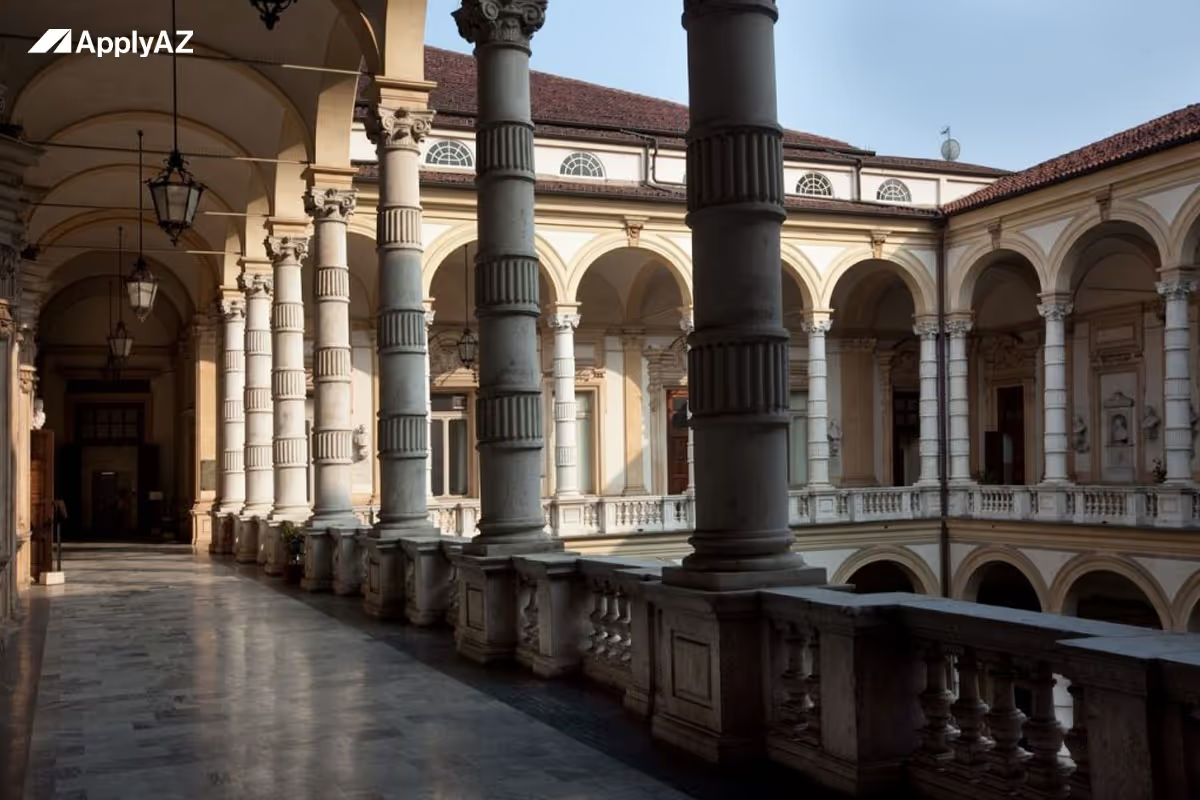
The Master in Philosophy at the University of Turin is a two-year, 120 ECTS degree (class LM-78-R) whose curriculum called Philosophy is taught entirely in English in Turin. It centres on theoretical philosophy, logic and the history of philosophy. Students residing abroad pay €500 to €1,500 a year by country, with zero euro tuition for eligible students.
Entry requirements
- A three-year bachelor's degree or an equivalent foreign qualification.
- At least 60 credits in philosophy, of which at least 18 in the history of philosophy; up to 6 credits can come from related fields.
- For the English Philosophy curriculum, a pass in the course's own English language test.
- An interview, in person or online, on your philosophical preparation; only Italian L-5 philosophy graduates with at least 75/110 are admitted without it.
- For foreign degrees, a check through UniTo's international procedure; the course regulations say this includes knowledge of Italian, so confirm with the course how it applies to the English curriculum.
- An Apply@UniTo application (€60) with CV, motivation letter, degree and transcript.
About the programme
Philosophy (Filosofia) is a two-year master's degree in class LM-78-R, philosophical sciences, worth 120 ECTS and run by the Department of Philosophy and Education Sciences in Turin. Access is open, subject to a check of your requirements. The degree has several curricula: the one called Philosophy is taught entirely in English, while the others are taught in Italian.
The English curriculum focuses mainly, though not only, on theoretical disciplines and aims at a preparation of international standard, especially for students who want to continue into academic research. It suits philosophy graduates with a solid grounding in the history of philosophy who want to work in logic, epistemology, the philosophy of mind and language, or ethics.
What you will study
The first year combines a large logic course and the history of philosophy with a choice among theoretical courses, plus electives outside philosophy and a language unit in academic English or Italian. The second year adds more history of philosophy, further philosophy electives and the thesis. Units in the 2026/27 study plan of the Philosophy curriculum include:
- Logic and Rationality (12 ECTS, year 1)
- History of Philosophy I and II (6 ECTS each)
- Epistemology, and Formal Epistemology and Philosophy of Science
- Mind & Language, Philosophy of Language and Philosophy of Perception
- Aesthetics, and Mind and Art
- Bioethics, Continental Philosophy and Theoretical Philosophy
- Thesis (30 ECTS, year 2)
How the programme is taught
The course gives a lot of space to writing: written exams and reports during the course train you to build and present arguments on paper, while seminars work on oral argument and presentation, and lectures expect active participation. Assessment combines written and oral exams. The thesis, worth a quarter of the degree, is a written dissertation whose length depends on the topic and which must meet scientific and communication standards.
Career paths
The university's course page lists these professional outlets for graduates:
- Teaching philosophical subjects
- Research in Italy and abroad, usually through a PhD
- Philosophical and bioethical consulting, and business ethics
- Cultural institutions, media and publishing
- Historical and cultural communication, including journalism
- Libraries, archives, museums and science history exhibitions
- Applied ethics and work where philosophy meets cognitive science and artificial intelligence
Fees and scholarships
No extra contribution applies to Philosophy. For 2026/27, if you reside abroad your yearly contribution is fixed by the GDP per capita of your country of residence, from €500 to €1,500, plus €156 for regional tax and stamp duty. Residents of countries on the ministry's list of particularly poor countries pay only the €156. Students who win or are eligible for an EDISU Piemonte scholarship have the tuition instalments waived, so there is zero euro tuition for eligible students.
How to apply from outside the EU
Before applying, check that your transcript shows at least 60 credits in philosophy, 18 of them in its history. Non-EU applicants living abroad apply on Apply@UniTo, paying €60 for up to two programmes, with a CV, a motivation letter in English or Italian, and the degree and transcript with proof of authenticity. For 2026/27 the master's call ran from 25 November 2025 to 29 January 2026. The course then holds an interview and an English test, with dates published on its website.
Once admitted, complete the Universitaly pre-enrolment (by 15 July 2026 for 2026/27) and apply for a study visa; the consulate decides.
How ApplyAZ helps
If this programme fits your goals, ApplyAZ can include it in a shortlist of 20 to 30 English-taught programmes at Italian public universities. We write your CV and a tailored statement of purpose, submit your applications and Universitaly pre-enrolment, file your DSU scholarship application and prepare your visa file, with a named person on each stage. The university decides admission, the region decides the scholarship and the consulate decides the visa. See how ApplyAZ works or check your eligibility.
Questions and answers
Is the Master in Philosophy taught in English?
Only its curriculum called Philosophy is taught entirely in English. The degree's other curricula are taught in Italian, so choose the Philosophy curriculum when you apply. You also need to pass the course's English test.
What background do I need?
A bachelor's degree with at least 60 credits in philosophy, including at least 18 in the history of philosophy. Up to 6 credits can come from related fields such as ecology, computer science or Asian philosophies.
Is there an entrance test?
Applicants to the English curriculum sit the course's English language test. Unless you are an Italian philosophy graduate with at least 75/110, you also have an interview, in person or online, on your philosophical preparation.
What will I study?
Logic and Rationality, the history of philosophy, and a choice of theoretical courses such as epistemology, philosophy of mind and language, perception, aesthetics and bioethics. The second year centres on a 30 ECTS thesis.
How much are the fees?
For 2026/27 students residing abroad pay €500 to €1,500 a year by country of residence, plus €156 in regional tax and stamp duty. EDISU Piemonte scholarship winners and eligible students do not pay the tuition instalments.
When do non-EU students apply?
For 2026/27 the Apply@UniTo master's call for applicants living abroad ran from 25 November 2025 to 29 January 2026. The 2027/28 dates were not yet published in September 2026.
Similar programmes
More programmes in this city

They began right where you are

