

Master in Architecture for Heritage at Polytechnic University of Turin
Two-year LM-4 architecture master at Politecnico di Torino, taught in English or Italian, on the conservation, restoration, reuse and management of built heritage through four thematic semesters and design ateliers. Entry needs an architecture bachelor's, a portfolio and English at B2.
Master
2 years
Turin
English
Polytechnic University of Turin


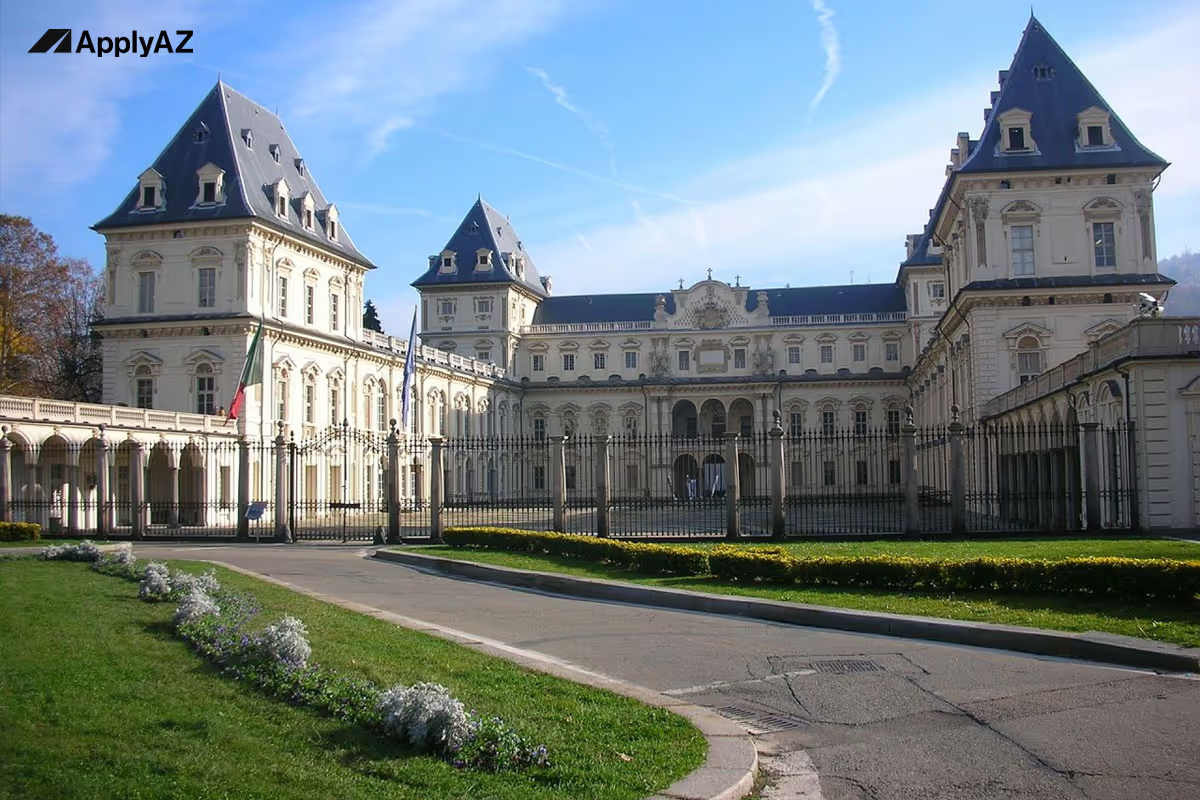
Architecture for Heritage is a two-year, 120 ECTS master's degree (class LM-4) at Politecnico di Torino, taught in English or Italian at the Castello del Valentino campus in Turin. Entry needs a bachelor's in architecture with the core architecture training set by EU rules, a portfolio, course descriptions and English at B2, such as IELTS 5.5. There is no entrance test.
Entry requirements
Detailed entry requirements
PoliTo's Architecture for Heritage master asks for a bachelor's in architecture (Italian class L-17) or a suitable foreign degree with the core architecture training set by EU rules, at least 15 years of total education, a portfolio and course descriptions, and English at B2, such as IELTS 5.5. An Academic Committee assesses your record, and there is no entrance test. Reviewed 8 October 2026. [1]
Degree and background
The 2026/27 regulations set these curricular requirements: [1]
- Degree: an Italian degree in class L-17 (architecture) or the former class 4, another three-year degree or university diploma, or a foreign qualification recognised as suitable.
- Core architecture training: the core educational activities in the class L-17 table. This rule has no exceptions, because the degree trains architects under EU Directive 2005/36/EC.
- Total education: for a foreign degree, an academic title from an accredited or recognised university after at least 15 years of schooling and university in total.
Missing curricular credits must be made up before the merit assessment: through single courses if the gap is 60 credits or less, or by enrolling in a bachelor's with credit recognition if it is larger. [1]
The degree's course structure record, closed in March 2026, also lists, as a fundamental requirement, having passed the national admission test for a degree directly intended to train architects. [2] For applicants with a foreign degree, PoliTo recommends a background in architecture. [4]
What this means for your transcript
The committee looks at the subjects in your transcript and course descriptions, not just the title of your degree. As a guide, based on the rules above:
- Usually a fit: a B.Arch from India, Pakistan, Bangladesh or Sri Lanka with design studios, history of architecture, restoration, structures, representation and planning, and at least 15 years of total education.
- Check carefully: a bachelor's in architectural studies, interior architecture or architectural technology, where the core architecture subjects of class L-17 need to be shown in your transcript and course descriptions.
- Often short: a B.Tech in Civil Engineering, a B.Planning, a B.Des, or a degree in art history, archaeology or conservation science without architectural design. These lack the core architecture training, and a gap above 60 credits means a bachelor's route first.
Portfolio and course descriptions
The portfolio and the syllabus (course descriptions) are both required for this programme. [4] The portfolio guidelines ask for: [6]
- Format: a horizontal A3 PDF of 10 to 15 pages, in Italian or English, at 200 dpi or more and no larger than 20 MB together with the CV.
- Content: an index, a short Europass-style Curriculum Studiorum of up to 3,500 characters, and up to five selected outcomes: at least two architectural projects from design ateliers, the work of at least one course and one other experience, such as a workshop, elective or internship.
- For each project: concept sketches, final drawings and a written explanation, with the location, year and semester, whether it was academic or professional, and your own contribution to group work.
- Individual work: the portfolio must be your own and fit this programme, so it cannot be the same if you apply to two programmes.
Course descriptions must be issued by your university. Links or documents taken from accreditation bodies, such as HEC in Pakistan, are not accepted. [3]
English
You need English at CEFR B2 or above. [1][3] For the English edition, PoliTo lists IELTS 5.5 as the minimum, and its accepted certificates include TOEFL iBT 72 (or 4 for tests taken after 21 January 2026), PTE Academic 59 and a Cambridge English Scale score of 160. [4][8]
You are exempt if your qualification comes from the United States, the United Kingdom, Ireland, Australia or New Zealand, or from an English-medium path at a school or university in a listed country, which includes India, Pakistan, Bangladesh, Sri Lanka, Malaysia and Singapore. The proof is an official statement of the medium of instruction. [3]
The Italian edition also needs Italian at B2; the English edition does not. [3][4]
Selection
There is no entrance test and no cap on places. [5] For a foreign degree, the Recruitment and Admissions Unit first checks that you meet the requirements and uploaded every document, then an Academic Committee assesses your academic performance and curricular background. [3]
A positive outcome is valid only for the academic year you applied for, and deferrals are not possible. If you are judged not suitable, you cannot be admitted to any master's programme that year. [1][3] Optional documents can make the application more competitive: a GRE General Test, a recommendation or motivation letter, and proof of relevant training, internships or work. [3]
Applicants with Italian degrees from other universities need a weighted average of at least 24/30 and a merit assessment of grades and portfolio. [1]
2026/27 deadlines
These dates come from the 2026/27 calls for applicants with a non-Italian qualification. The 2027/28 calls are not yet published and will set the new dates. [3]
- 1st call: 19 December 2025 to 13 February 2026 at 2 p.m., extended from 29 January, with results by 15 April 2026.
- 2nd call: 18 March to 20 April 2026 at 2 p.m., after extensions, with results by 22 June 2026.
- Universitaly pre-enrolment: indicative dates of 30 June 2026 after the first call and 15 July 2026 after the second.
- Online enrolment: 31 July to 5 October 2026.
A third call in November is only for EU applicants and non-EU applicants living in Italy, and it does not include the architecture master's programmes. Architecture master's programmes admit new students in the first teaching period only. [1][3]
Documents and non-EU steps
The application on Apply@polito needs your passport, CV, bachelor's degree or an official document with your expected graduation date, an official transcript with the grading and credit systems, course descriptions, portfolio and English certificate. You can choose up to two programmes in one application, which cannot be changed after submission, and incomplete applications are rejected. [3]
If you have not graduated yet, an eligible result becomes a conditional offer until you complete your bachelor's. Students on a five or six-year degree who have not graduated need at least 15 years of total education, including three at university, and 180 ECTS. [1][3]
Eligible applicants pre-enrol on Universitaly for the type D study visa. To enrol, you upload your passport, visa, Italian tax code, degree and transcript (with an official Italian translation unless they are in English, French or Spanish) and a declaration of value, CIMEA statement or Diploma Supplement. For 2026/27, documents were due by 5 October 2026 and the visa by 30 November 2026. [3]
Sources and verification
Checked by the ApplyAZ admissions team against the university's official documents listed below. Entry rules can change with each new call, and we re-check them before every application.
- Politecnico di Torino, Department of Architecture and Design. Academic regulations, master's degree programme in Architecture for Heritage (Architettura per il Patrimonio, class LM-4 R), academic year 2026/27. Reviewed 8 October 2026.
- Politecnico di Torino. Course structure record (ordinamento didattico, RAD), master's degree in Architecture for Heritage, class LM-4 R, closed 2 March 2026. Reviewed 8 October 2026.
- Politecnico di Torino. Admissions to master's degree programmes for applicants with a non-Italian qualification, academic year 2026/27. Reviewed 8 October 2026.
- Politecnico di Torino. Course-specific requirements for master's degree programmes, academic year 2026/27. Reviewed 8 October 2026.
- Politecnico di Torino. Architecture for Heritage programme pages (overview, programme details and after graduation), academic year 2026/27. Reviewed 8 October 2026.
- Politecnico di Torino. Portfolio guidelines for Architecture Construction City, Architecture for Sustainability and Architecture for Heritage, undated. Reviewed 8 October 2026.
- Politecnico di Torino. Tuition fees page, academic year 2026/27. Reviewed 8 October 2026.
- Politecnico di Torino, Language Centre. Table of certificates and minimum requirements for B2 English, adopted 23 September 2019, updated January 2026. Reviewed 8 October 2026.
About the programme
Architecture for Heritage (Architettura per il Patrimonio) is a two-year, 120 ECTS master's degree in class LM-4, architecture and architectural engineering, at Politecnico di Torino. It is run by the Department of Architecture and Design and taught at the Castello del Valentino campus in Turin. [1][2][5]
Every course is offered in both Italian and English, so you can take the whole degree in English. The programme trains architects for the conservation, enhancement, management and promotion of architectural and landscape heritage, and it follows EU Directive 2005/36/EC on the education of architects. PoliTo describes its graduates as European-recognised architects. [1][2][5]
What you will study
The degree is organised in four thematic semesters: [1][5]
- Design and heritage (semester 1): introductory seminars, including one on the knowledge and active protection of heritage, a course on restoration methodology, and an atelier on regenerating and enhancing heritage that brings in urban planning and economic valuation.
- Design and conservation (semester 2): a restoration atelier with building physics and materials science for diagnostics, an integrated course on point clouds and H-BIM, and a laboratory on the construction and structural consolidation of historic architecture.
- Design and innovation (semester 3): the history of modern and contemporary architecture and two parallel ateliers, one on the adaptive reuse of buildings and one on the use and management of cultural sites, with attention to museums.
- In-depth study (semester 4): the thesis, worth 20 credits, which can be a complex design project or a research work.
Optional and elective courses, workshops and university Challenges complete the plan, and you can take some optional courses from other master's programmes. [1][5]
How the programme is taught
Teaching combines single-subject and integrated courses, ateliers, workshops, seminars and study visits. The ateliers work on real case studies with lecturers from several disciplines, so you practise the architect's role in design, site management and the coordination of multidisciplinary teams. [1][5]
You can study abroad through Erasmus+ exchanges and double degrees, and add an optional curricular internship in Italy or abroad. The thesis can be written and discussed in Italian or English. [1][5]
Career paths
The degree prepares architects who can manage projects on existing buildings and heritage sites at different scales. Graduates can: [1][5]
- Work as freelance architects after the Italian State Examination and registration in section A of the Register of Architects
- Work in design studios and in companies producing goods and services
- Hold technical, cultural and management roles in local and national heritage bodies, such as the Soprintendenze and regional offices
- Continue to a second-level specialising master's, a PhD or a postgraduate school
- Teach in Italian middle and high schools, as the degree qualifies for school recruitment under current rules
Fees and scholarships
Politecnico di Torino sets tuition under its yearly Tuition Fee Regulations, and students can request a reduction based on family income through an ISEE or ISEE Parificato. [7] Eligible students, including international students, can apply to EDISU Piemonte, the regional right-to-study body, for a scholarship; EDISU decides awards through its annual call.
How to apply from outside the EU
Applicants with a non-Italian degree apply on Apply@polito in one of two calls, choosing up to two master's programmes, and upload a CV, transcript, course descriptions, portfolio and English certificate. Architecture master's programmes admit new students in the first teaching period only. [1][3]
For 2026/27, the first call closed on 13 February 2026 and the second on 20 April 2026, after extensions. Eligible applicants then complete Universitaly pre-enrolment, apply for a type D study visa and enrol online, uploading a declaration of value, CIMEA statement or Diploma Supplement for their degree. [3] The 2027/28 calls are not yet published and will set the new dates.
How ApplyAZ helps
ApplyAZ is an Italy-based consultancy that works only with public universities. We can include this programme in a shortlist of 20 to 30 English-taught programmes that fit your profile, so your plan never rests on a single application.
For eligible students who start with us, a named person owns each stage, from A to Z:
- We check your transcript against PoliTo's entry rules for this programme.
- We write your CV and a tailored statement of purpose.
- We prepare and submit your Apply@polito application with your transcript, course descriptions, portfolio and English certificate, and Universitaly pre-enrolment.
- We help you declare your family income for reduced fees and file your EDISU Piemonte scholarship application at the right time and in the right format.
- We prepare your visa file.
With operations in all 20 Italian regions, we follow each region's scholarship rules and deadlines as they change. The university decides admission, the region decides the scholarship and the consulate decides the visa, so no one can promise an outcome. You pay in milestones, and every service you pay for is either delivered or its fee is refunded (terms apply).
Programmes at Italian public universities can be tuition-free for eligible students. Check if you are eligible and book a one-to-one consultation session with one of our Italy experts, or see how ApplyAZ works.
Questions and answers
What bachelor's degree do I need for Architecture for Heritage at PoliTo?
A bachelor's in architecture, class L-17 in Italy, or a foreign degree recognised as suitable, with the core architecture training set by EU rules and at least 15 years of total education. PoliTo recommends an architecture background, and gaps in core subjects must be made up before the assessment. [1][4]
Is there an entrance exam?
No. There is no entrance test and no cap on places. For a foreign degree, an Academic Committee assesses your academic performance and curricular background from your transcript, course descriptions and portfolio. [3][4][5]
Do I need a portfolio?
Yes, together with course descriptions. The portfolio is a horizontal A3 PDF of 10 to 15 pages in Italian or English, with at least two atelier projects, one course outcome and one other experience, up to 20 MB with your CV. [4][6]
What English level is required? Do I need IELTS?
English at B2, with IELTS 5.5 listed as the minimum for the English edition. TOEFL iBT 72, PTE Academic 59 and a Cambridge English Scale score of 160 also qualify. An English-medium degree from a listed country, including India, Pakistan, Bangladesh and Sri Lanka, gives an exemption. [3][4][8]
When is the deadline for non-EU students?
For 2026/27, the first call closed on 13 February 2026 and the second on 20 April 2026, after extensions, with results by 15 April and 22 June. The 2027/28 calls are not yet published. Architecture programmes admit new students in the first teaching period only. [1][3]
Can I apply before I graduate?
Yes. You upload an official university document with your expected graduation date, and an eligible result becomes a conditional offer until you finish. You must hold the degree to enrol, and the offer is valid only for that academic year. [3]
I have a B.Tech in Civil Engineering or a degree in art history. Can I apply?
Often not. The programme trains architects under EU rules, so it requires the core architecture training of an L-17 degree. Gaps of up to 60 credits can be made up through single courses before the assessment; larger gaps mean a bachelor's route first. [1]
Can I study the whole degree in English?
Yes. Every course is offered in both Italian and English, and the thesis can be written and discussed in either language. The English edition needs English at B2 only, while the Italian edition also needs Italian at B2. [1][3][4]
Can someone handle my whole application to Architecture for Heritage at PoliTo?
Yes. ApplyAZ, an Italy-based consultancy that works only with public universities, checks your transcript against PoliTo's rules for this programme, handles the application and Universitaly pre-enrolment, helps you file the EDISU Piemonte scholarship application at the right time and in the right format, and prepares your visa file, for eligible students. Start by checking your eligibility.
I'm applying from India. What is the route into Architecture for Heritage?
A B.Arch from India can meet the rule if it covers the core architecture subjects of an Italian L-17 degree, and you need at least 15 years of total education. You also submit a portfolio and course descriptions, with English at B2 or an English-medium exemption. The steps are the Apply@polito application, the Academic Committee's assessment and Universitaly pre-enrolment. [1][3][4] Indian students apply for the type D study visa at the Italian embassy or consulate that covers their state, such as New Delhi, Mumbai or Bengaluru.
Is the route different from Pakistan, Bangladesh or Sri Lanka?
No. The academic rules for Architecture for Heritage are the same whatever your nationality. Applicants from Pakistan, Bangladesh and Sri Lanka follow the same steps as India: Apply@polito application in the first or second call, the Academic Committee's assessment and Universitaly pre-enrolment, then a type D study visa from the Italian mission for their country of residence. Read our guide for students in Dhaka.
I live in the UAE, Saudi Arabia, Qatar, Kuwait, Oman or Bahrain. Where do I apply for the visa?
At the Italian embassy or consulate responsible for the country where you legally live, after Universitaly pre-enrolment. The academic rules for Architecture for Heritage are the same whatever your nationality, and Gulf residents follow the same steps: Apply@polito application in the first or second call, the Academic Committee's assessment and Universitaly pre-enrolment. Read our guides for Dubai, Riyadh and Doha.
I studied or live in London, New York, Toronto, Vancouver, Singapore or Kuala Lumpur. What is the route?
The academic rules for Architecture for Heritage are the same whatever your nationality, and your degree is assessed like any other foreign qualification. Non-EU applicants who live abroad follow the same route: Apply@polito application in the first or second call, the Academic Committee's assessment and Universitaly pre-enrolment, then a type D study visa from the Italian mission for where they live. Read our guides for students in London, New York, Toronto, Vancouver, Singapore and Kuala Lumpur.
More English-taught programmes at this university
Other public universities in this city

They began right where you are

