

Master in Architecture Construction City at Polytechnic University of Turin
Two-year LM-4 architecture master at Politecnico di Torino with an English edition, on how architecture designs and directs the transformation of cities and territories, joining humanities with technical and scientific subjects.
Master
2 years
Turin
Multiple
Polytechnic University of Turin



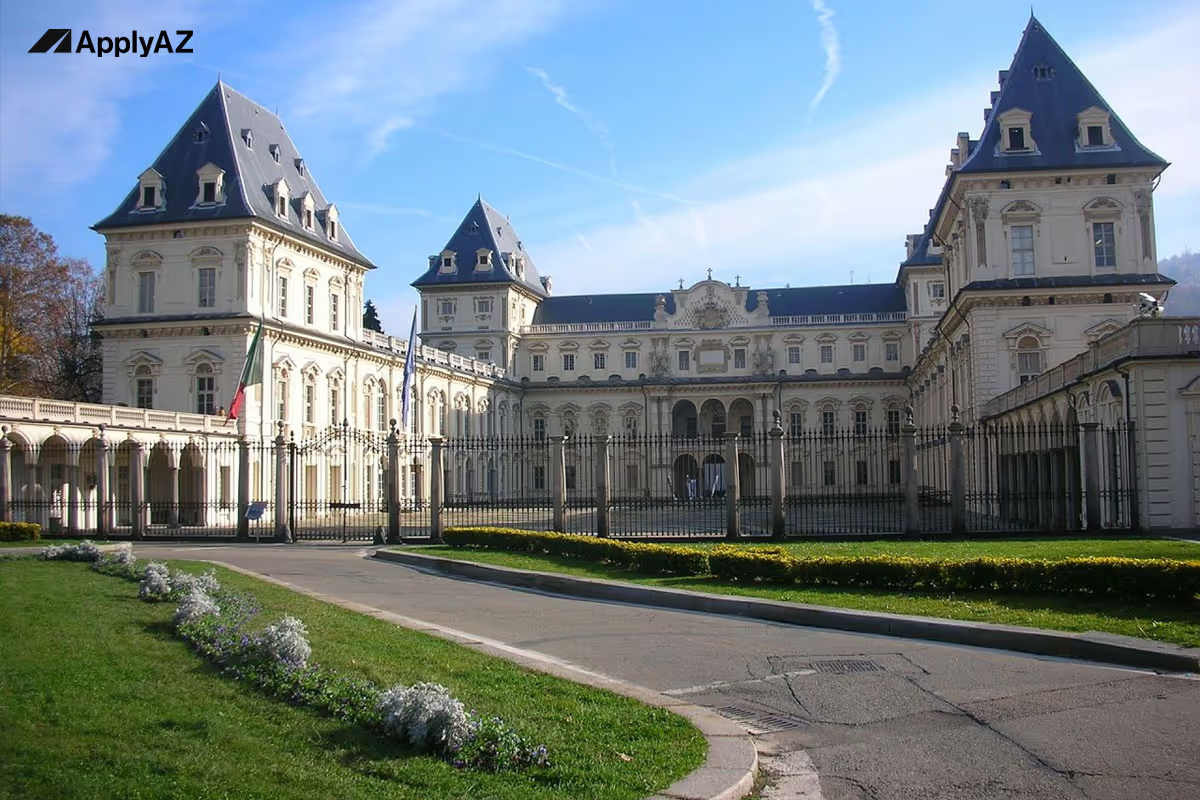
The Master in Architecture Construction City at Politecnico di Torino is a two-year, 120 ECTS degree in class LM-4 at the Castello del Valentino campus in Turin, with an English edition. It focuses on how architecture shapes cities and territories. Tuition depends on citizenship or residence, with reductions based on family income.
Entry requirements
Detailed entry requirements
This section covers the English edition of Architecture Construction City, alongside clearly labelled rules for other editions and Italian qualifications. The latest reviewed foreign-qualification procedure is for 2026/27; no 2027/28 calendar is supplied in those current sources. Sources were reviewed on 6 October 2026.
Architecture background, syllabus and portfolio
Architecture is the recommended undergraduate background in the current foreign-qualification table. Both the syllabus and the programme-specific portfolio are required. The combined table heading is “Syllabus / Portfolio/Summary”: its “Both required” entry means the syllabus and portfolio category, rather than establishing a separate universal portfolio-plus-summary document. We follow the actual application tasks. [1, 2, 6]
You need university-issued course descriptions explaining the content of courses already studied, and we map them for the committee. University website PDF syllabi are accepted when the source can be verified; the central guidance does not accept a syllabus obtained directly from an accrediting agency website instead of your university. A transcript alone does not replace these required course descriptions. [1]
What the architecture portfolio must contain
The currently linked portfolio guidance requires strictly individual production, clear presentation and a programme-specific selection of work. If applying to two programmes, do not submit an identical portfolio for both. Academic work can be supplemented with relevant professional experience; identify your personal contribution to group projects. The final document can be in English or Italian. [6]
- Begin with an index and a brief Curriculum Studiorum using the Europass template, explaining acquired skills and relevant competitions, professional collaborations, trips, exchanges, workshops or other experience. Select no more than five learning outcomes. [6]
- Include at least two architectural projects from previous Design Units/Ateliers; outcomes from at least one other previously attended course; and one experience from supplementary/elective study, workshops, extracurricular activity or internship. Work from student mobility can be included. [6]
- For architectural projects show concept sketches, final drawings and a written explanation of the design concept, solution, references and objectives. [6]
- Identify each project’s name/location, whether academic or professional, the working group and your individual contribution, the year/semester of bachelor’s study, and the academic year in which the work was completed. Put full name and contact details on the cover. [6]
- The editing guidance recommends horizontal A3, 10-15 pages, images at least 200 dpi, a Curriculum Studiorum of at most 3,500 characters and portfolio text of at most 10,000 characters, both excluding spaces. The combined CV and portfolio must not exceed 20 MB. Prioritise quality and readability on screen. [6]
Foreign qualification: recognition and academic assessment
You need a bachelor’s degree at EQF level 6, or an accepted equivalent, corresponding to an Italian Laurea, awarded by an accredited foreign university and permitting entry to second-cycle study at EQF level 7. The university assesses curricular relevance and academic performance; neither a recognised award nor the recommended degree-field label alone establishes eligibility. [1, 2]
The equivalent-qualification route can include a student in a five- or six-year integrated foreign degree who has not yet graduated, provided they have at least 15 total years of education, including at least three university years, and at least 180 ECTS or equivalent. Preparatory/pre-university years are excluded from the university-year and credit calculation. This specific route is distinct from a general waiver of the first-degree requirement. [1]
The Recruitment and Admissions Unit checks basic requirements and complete documents; the Academic Committee then evaluates subject background and academic performance. An eligible or conditional offer is valid only for the application year, with no deferral. The foreign-qualification page does not publish one universal numerical GPA cutoff for this programme. [1]
English B2 and the correct teaching edition
The English edition requires English B2 or higher. The course-specific row gives IELTS 5.5 as the minimum. An Italian or partly Italian/English edition requires Italian B2 as well as English B2. Select the edition matching your application and evidence; English-only eligibility does not transfer to an Italian edition. [1, 2]
The current linked B2 equivalence table accepts IELTS Academic or General Training 5.5; PTE Academic 59; TOEFL iBT 72 before the January 2026 scale change and total 4 on the new scale after it; Cambridge English Scale 160 on listed examinations; or all four TOEIC minima: Listening 400, Reading 385, Speaking 160 and Writing 150. Older Cambridge examinations use the table’s historical scoring rules. The university accepts the listed tests on paper, computer or online where applicable, and applicable part retakes. [3]
The table’s wording is “before” and “after” 21 January 2026 for TOEFL. If your test date is exactly 21 January, we use the scale shown on your score report and confirm its acceptance with admissions. For TOEFL/TOEIC share results with university code C285; for Cambridge enable results sharing and provide the Candidate ID. [1, 3]
Documented English-medium exemptions
The university lists exemption for an IB Diploma entirely taught in English except foreign languages, and a qualifying European School award whose first study language is English. It also lists recognised school/university qualifications awarded by the United States, United Kingdom, Ireland, Australia, New Zealand and other countries on the university's list, subject to the published qualification-recognition conditions. [1]
A separate route covers a recognised qualification completed through English-medium study at a school or university located in one of the university’s specified countries. Relevant examples include India, Pakistan, Bangladesh, Sri Lanka, Malaysia and Singapore; Ghana, Kenya, Nigeria, South Africa and other listed African systems; Cyprus and Malta; and specified Caribbean/Pacific countries. This is a defined country-and-qualification policy, not an unrestricted waiver for every English-medium degree worldwide. [1]
Upload an official institutional statement on headed paper documenting English as the medium of instruction for the exemption claimed. For applicants requiring a study visa, we also check the diplomatic representation’s language-evidence requirements, which can differ from the university’s exemption. [1]
Complete application documents and acceptable formats
- Passport, or an eligible EU identity document; residence permit for non-EU citizens living in Italy; and a CV. Identity documents must use the Latin alphabet or have an official Italian/English translation. [1]
- Bachelor’s award, or the university’s official document stating expected graduation if pending; an official, current transcript listing every completed examination, grades, GPA/CGPA and grading/credit systems. Supply a registrar’s declaration if those systems are absent. Scan both sides where applicable. [1]
- The language certificate or documented exemption, and every programme-specific item. Degree documents must be issued on institutional headed paper and stamped/signed; digital signatures must be verifiable through a QR code or verification link. [1]
- Italian, English, French and Spanish academic documents are accepted at application. For another language, combine the original and official English/Italian translation into a single uploaded file. PDF is recommended; JPEG/PNG are accepted for initial uploads. No hard-copy mailing is required at this stage. [1]
- A Declaration of Value or CIMEA Comparability can be provided if already available and is part of final-enrolment qualification verification. GRE, recommendations, a motivation letter, relevant training/internships or work evidence may be optional supporting material. The central checklist does not impose a universal two-reference requirement. [1]
Apply once, rank up to two programmes and pay the application fee
Use Apply@PoliTO, enter personal details exactly as in your passport, and select up to two programmes in preference order within one call. After submission you cannot modify the application or add a second choice. We confirm successful submission in the Save and Submit section. An incomplete application is rejected and cannot be resubmitted in the same academic year. [1]
We track evaluation results in the applicant account. A conditional admission offer can require completion of the bachelor’s degree. If basic requirements or the academic/curricular assessment fail, the published rules limit further applications in the same academic year; supply all required evidence accurately before submitting. [1]
Final enrolment, qualification evidence and visa stages
The foreign-qualification first-semester enrolment window for 2026/27 was 31 July-5 October 2026, so it has closed at the review date. The latest enrolment PDF requires academic-document verification by 11 November. Personal identity verification in person is required by 3 December 2026. A student number or payment alone does not complete enrolment. [1, 4]
Final records include the qualifying bachelor’s award and transcript, applicable translations, passport/eligible ID, language evidence, Italian fiscal code and the applicable residence permit or type-D study visa. Accepted comparison evidence includes a Declaration of Value, CIMEA Comparability, an eligible Diploma Supplement or an ARDI Correspondence statement; additional verification, including CIMEA Verification, can be requested. Keep originals available for authenticity and identity checks. [1, 4]
The updated 17 September 2026 guidelines permit specified missing documents under conditional enrolment. The type-D visa must be uploaded by 30 November 2026; an unresolved visa absence by 1 February 2027 cancels enrolment. Fiscal code and qualification-comparison documents must be supplied by 30 June 2027 to avoid service restrictions. The residence-permit deadline is 24 February 2028 under these conditional-enrolment rules; absence or refusal can cancel enrolment. These extensions are for missing documents after authorised enrolment, not a new application or payment window. [4]
Non-EU applicants abroad needing a study visa must pre-enrol on Universitaly after eligibility and completion of the first-level degree, then obtain the visa from the competent diplomatic representation. The university describes 30 June 2026 for first-call and 15 July for second-call pre-enrolment as indicative early-submission dates and states that the portal remains open. Embassy requirements and visa decisions remain separate from university eligibility. [1]
2026/27 foreign-qualification application calls
The first call opened 19 December 2025 and closed at 14:00 Italian time on 13 February 2026 after extension; results were scheduled for 15 April. The second opened 18 March and ultimately closed at 14:00 on 20 April 2026 after a technical extension; results were scheduled for 22 June. Both application windows have passed. [1]
The November third call listed for engineering and specified design/planning degrees does not include Architecture Construction City. The reviewed sources do not publish a confirmed 2027/28 window. [1]
Separate 2026/27 Italian-qualification route: academic score and portfolio evaluation
The Italian-qualification architecture page for applicants from other universities requires a weighted examination average of at least 24/30, calculated after removing the worst 28 credits and without rounding, plus a portfolio. Its evaluation awards up to 20 points for examination average and 40 for portfolio; a positive assessment requires at least 36/60. These are the numerical rules of that route, not a universal GPA conversion printed in the foreign-qualification page. [7]
Portfolio assessment considers programme consistency, originality, quality, argument, graphics and discipline-specific language. Architecture Construction City criteria include architectural layout, structural/technological conception, representation at different scales, historical-critical language, technical physics, urban planning, multidimensional urban interpretation, and real-estate/valuation methods. [7]
Curricular eligibility requires the relevant L-17/former class 4 or another recognised suitable qualification and coverage of compulsory L-17 architecture activities. Assessed gaps can require assigned single courses before portfolio merit evaluation; the page describes integrations up to 60 ECTS for other classes. The stated graduation date for this 2026/27 route is 30 September 2026. Applicants already graduating at Politecnico follow their separate institutional rules. [7]
Sources and verification
- Politecnico di Torino, Applicants with a non-Italian qualification: Master’s degree programmes, 2026/27 current guidance; reviewed 6 October 2026.
- Politecnico di Torino, A.Y. 2026/2027 Course-specific requirements, last updated 19 December 2025, programme row currently linked from the foreign-qualification admission page.
- Politecnico di Torino, Table of certificates and minimum requirements for B2 English, current linked table including the January 2026 TOEFL scale change; reviewed 6 October 2026. The printed footer retains the 22 December 2022 revision reference.
- Politecnico di Torino, Enrolment Guidelines for Master’s Degree Programs: Applicants with Foreign Qualifications, 2026/27, updated 17 September 2026.
- Politecnico di Torino, Architecture Construction City, current programme overview with 2026/27 course information; reviewed 6 October 2026.
- Politecnico di Torino, Portfolio required for Architecture Construction City, Architecture for Sustainability and Architecture for Heritage, currently linked guidance; reviewed 6 October 2026. Publication date is not printed.
- Politecnico di Torino, Requirements for applicants from other universities: Architecture Area, Italian-qualification route, 2026/27.
About the programme
Architecture Construction City is a two-year, 120 ECTS master's degree in class LM-4 (Architecture and Architectural Engineering) at Politecnico di Torino, based at the Castello del Valentino campus in Turin.
The degree runs in Italian and English, and its English edition is open to applicants with English only. Access is uncapped, subject to an evaluation of your admission requirements.
The programme starts from the idea that architecture designs and directs the complex transformations of cities and territories.
It aims at a full understanding of the cultural, environmental, technical and procedural issues behind contemporary projects, and suits architecture graduates interested in the city and in how buildings fit into urban and natural landscapes.
What you will study
The English edition gives future architects a broad preparation in both the humanities and technical and scientific subjects. The detailed course list is published in the university's course catalogue; the programme page highlights these areas:
- Cultural issues behind contemporary architectural projects
- Environmental issues in contemporary projects
- Technical and procedural issues in contemporary projects
- Architectural design that fits the natural and urban landscape
- Coordination of urban and territorial transformation processes
How the programme is taught
The programme page mentions innovative learning activities, international exchanges and projects. Politecnico treats study abroad as a key part of its graduates' growth and offers short and long mobility periods with European and worldwide partners.
You can also complete your training with an internship, before or after graduating.
Career paths
The degree trains architects who can develop solutions that fit harmoniously into their surroundings, respecting the natural and urban landscape, and who can coordinate the transformation of cities and territories. The programme page does not publish a separate list of career outlets.
Fees and scholarships
Fees at Politecnico di Torino depend on citizenship or residence, with reductions available according to family income; the university fixes the amounts in its yearly fee rules.
International students may apply to EDISU Piemonte, the regional right-to-study body, for a scholarship and a place in university housing.
When your family lives abroad, we help you submit the foreign income and asset documents so that EDISU can assess you through an ISEE parificato.
How to apply from outside the EU
Apply through Apply@PoliTO with the recognised academic qualification, full transcript and required language and programme-specific evidence. The detailed entry section gives the 2026/27 assessment, document checklist and application windows, and distinguishes foreign qualifications from Italian-degree rules. [1-5]
How ApplyAZ helps
ApplyAZ is an Italy-based consultancy that works only with public universities. We can include this programme in a shortlist of 20 to 30 English-taught programmes that fit your profile, so your plan never rests on a single application.
For eligible students who start with us, a named person owns each stage, from A to Z:
- We check your transcript against PoliTo's entry rules for this programme.
- We write your CV and a tailored statement of purpose.
- We prepare and submit your Apply@PoliTO application and Universitaly pre-enrolment.
- We help you declare your family income for reduced fees and file your EDISU Piemonte scholarship application at the right time and in the right format.
- We prepare your visa file.
With operations in all 20 Italian regions, we follow each region's scholarship rules and deadlines as they change. The university decides admission, the region decides the scholarship and the consulate decides the visa, so no one can promise an outcome. You pay in milestones, and every service you pay for is either delivered or its fee is refunded (terms apply).
Programmes at Italian public universities can be tuition-free for eligible students. Check if you are eligible and book a one-to-one consultation session with one of our Italy experts, or see how ApplyAZ works.
Questions and answers
Which documents are specific to this programme?
The currently linked foreign-qualification table requires both your university course syllabus/descriptions and an architecture portfolio, alongside the standard academic, identity and language records. It does not establish a separate universal summary document in addition to the portfolio.
How large can the portfolio be?
The combined CV and portfolio must not exceed 20 MB. The guidance recommends 10-15 horizontal A3 pages, images at least 200 dpi and up to five selected learning outcomes, with specified text limits.
What work should the portfolio show?
At least two architecture projects, outcomes from another attended course and one relevant supplementary or extracurricular experience. Include sketches, final drawings, explanations and project details, and identify your own contribution to any group work.
What English level is required?
English B2. The English edition lists IELTS 5.5; current equivalents include PTE Academic 59, TOEFL iBT 72 on the old scale or total 4 on the new scale, and listed Cambridge scores of 160. Documented exemptions are available.
Does the November 2026 call include this course?
No. The published third call is limited to engineering and specified design/planning programmes and does not list Architecture Construction City. Its foreign-qualification first and second application calls closed in February and April 2026.
Is 24/30 the rule for every foreign applicant?
The published 24/30 average and 36/60 portfolio/academic evaluation belong to the separate Italian-qualification route for applicants from other universities. Foreign qualifications use the international administrative and Academic Committee assessment; no universal GPA conversion is printed there.
Can someone handle my whole application to Architecture Construction City at PoliTo?
Yes. ApplyAZ, an Italy-based consultancy that works only with public universities, checks your transcript against PoliTo's rules for this programme, handles the application and Universitaly pre-enrolment, helps you file the EDISU Piemonte scholarship application at the right time and in the right format, and prepares your visa file, for eligible students. Start by checking your eligibility.
I'm applying from India. What is the route into Architecture Construction City?
Indian applicants need a bachelor's degree at EQF level 6 from an accredited university, corresponding to an Italian Laurea, with architecture as the recommended background [1]. You also need university-issued course descriptions [1] and an individual architecture portfolio [6]. English-medium study at a recognised Indian institution can exempt you from an English test with an official statement [1]. We submit your Apply@PoliTO application and Universitaly pre-enrolment. Indian students apply for the type D study visa at the Italian embassy or consulate that covers their state, such as New Delhi, Mumbai or Bengaluru.
Is the route different from Pakistan, Bangladesh or Sri Lanka?
No. The academic rules for Architecture Construction City are the same whatever your nationality. Applicants from Pakistan, Bangladesh and Sri Lanka follow the same steps as India: Apply@PoliTO application, academic assessment and Universitaly pre-enrolment, then a type D study visa from the Italian mission for their country of residence. Read our guide for students in Dhaka.
I live in the UAE, Saudi Arabia, Qatar, Kuwait, Oman or Bahrain. Where do I apply for the visa?
At the Italian embassy or consulate responsible for the country where you legally live, after Universitaly pre-enrolment. The academic rules for Architecture Construction City are the same whatever your nationality, and Gulf residents follow the same steps: Apply@PoliTO application, academic assessment and Universitaly pre-enrolment. Read our guides for Dubai, Riyadh and Doha.
I studied or live in London, New York, Toronto, Vancouver, Singapore or Kuala Lumpur. What is the route?
The academic rules for Architecture Construction City are the same whatever your nationality, and your degree is assessed like any other foreign qualification. Non-EU applicants who live abroad follow the same route: Apply@PoliTO application, academic assessment and Universitaly pre-enrolment, then a type D study visa from the Italian mission for where they live. Read our guides for students in London, New York, Toronto, Vancouver, Singapore and Kuala Lumpur.
More English-taught programmes at this university
Other public universities in this city

They began right where you are

