

Master in Sustainable Chemistry and Technologies at Ca’ Foscari University of Venice
Two-year LM-54-R chemistry master at Ca' Foscari's Mestre campus whose English-taught Biomolecular Chemistry curriculum covers bioorganic, bioinorganic and analytical chemistry, industrial biotechnology and green chemistry, with a third of the degree in laboratories. Entry needs 60 subject credits, a 70% CGPA and English at B2.
Master
2 years
Venice
Multiple
Ca’ Foscari University of Venice


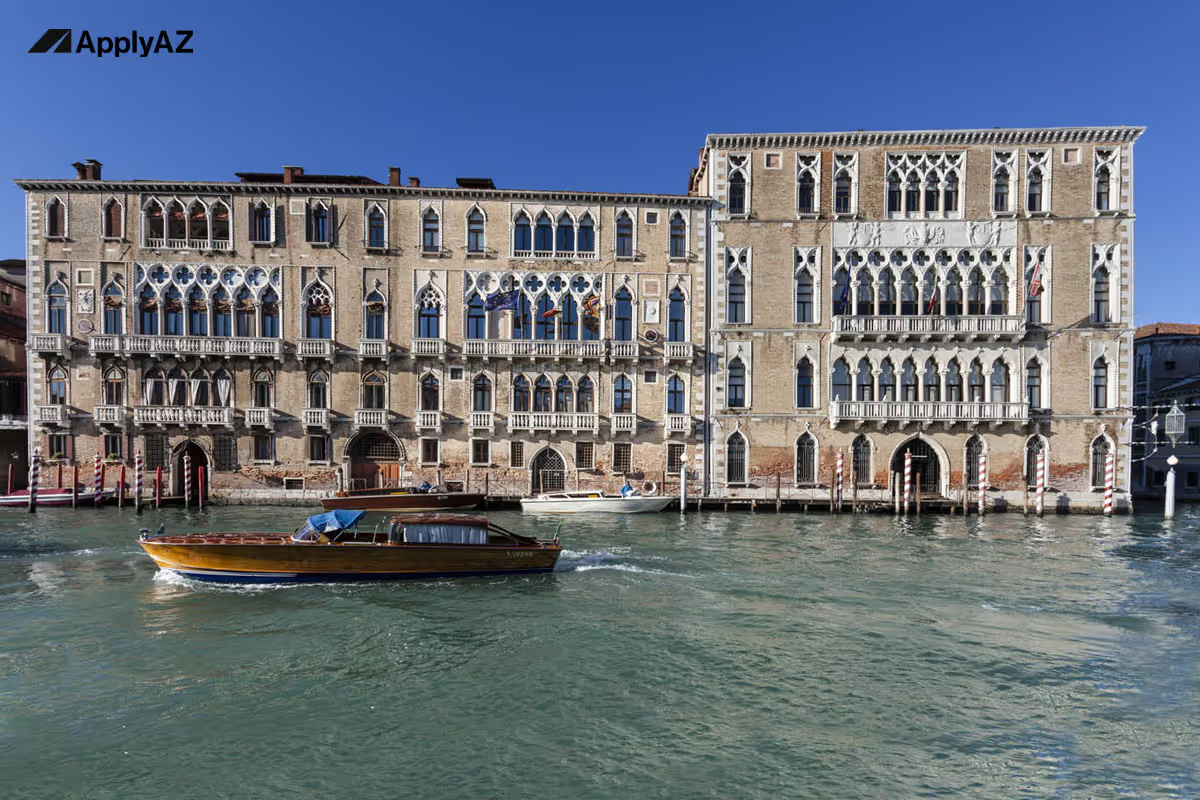
Sustainable Chemistry and Technologies is a two-year, 120 ECTS master's degree (class LM-54-R) at Ca' Foscari University of Venice, on its Mestre science campus. Its Biomolecular Chemistry curriculum is taught in English. Entry needs a three-year bachelor's with at least 60 credits in chemistry-related fields, physics or maths, a CGPA of at least 70% and English at B2. There is no entrance test.
Entry requirements
Detailed entry requirements
Ca' Foscari's Sustainable Chemistry and Technologies master has open admission with an individual assessment. You need a bachelor's degree of at least three years with at least 60 credits in the listed fields, a minimum CGPA of 70% and English at B2 for the English-taught Biomolecular Chemistry curriculum. Reviewed 8 October 2026. [1]
Degree and credit requirements
You need a bachelor's degree of at least three years (180 ECTS or equivalent) from an accredited institution, which gives access to further study in its own country. [3]
A degree in class L-27 (Chemical Sciences and Technologies) meets the curricular requirements. Graduates in other fields need at least 60 ECTS in the listed fields: [1][2]
- At least 48 ECTS in chemistry, biochemistry, molecular biology, materials science and technology, or chemical plants.
- At least 12 ECTS in physics or mathematics.
Missing credits must be completed before enrolment. [2]
You also need a minimum CGPA of 70%. Your grades are measured on your university's own numerical scale if it has one, and otherwise converted proportionally to a percentage. [1]
What this means for your transcript
Ca' Foscari counts one ECTS credit as about 25 hours of work, and for countries outside the Bologna Process the Teaching Committee uses this to check your subjects, not just your total. For India, Ca' Foscari accepts an honours bachelor's of at least three years, a professional bachelor's of at least four years, or a pass or general bachelor's followed by a postgraduate bachelor's or a two-year master's. Pakistan and Bangladesh follow similar rules, and Sri Lanka needs an honours or special degree of at least four years. Transcripts for all years are needed. [3]
As a guide, based on the rule above:
- Usually a fit: a B.Sc. (Honours) in Chemistry or Biochemistry, or a four-year B.Tech or B.E. in Chemical Engineering with solid chemistry and maths.
- Check carefully: a B.Sc. in Biotechnology, Microbiology or Life Sciences, a B.Pharm, or a B.Tech in Biotechnology or Materials. These can reach 48 credits in chemistry, biochemistry or molecular biology, but the total and the 12 credits in physics or maths need checking.
- Often short: a three-year pass or general B.Sc. without a postgraduate degree, which does not meet the rule for India, and a BCA, B.Com, BBA or BA, which rarely include chemistry.
Your university's grading scale belongs in your file, since your CGPA is checked against the 70% minimum. [1][3]
English
The Biomolecular Chemistry curriculum is taught in English and needs English at CEFR level B2, which is mandatory for enrolment. You can apply without a certificate, but you must provide one, or qualify for one of Ca' Foscari's exemption categories, by the enrolment deadline. Ca' Foscari runs no English test during admission. [1][2]
The Chemistry and Industrial Chemistry curricula are taught in Italian. Non-Italian students on the English-taught curriculum earn 3 credits in Italian before graduating, unless they already have Italian at B1. [2]
Assessment
There is no entrance test. The Teaching Committee checks your credits and CGPA and reviews your transcript, your CV and a motivation letter written for this programme. [1]
The programme's admission page says personal preparation is generally met by a degree in class L-27, or equivalent, with a final mark of at least 85/110. Otherwise the committee reviews your academic record and may ask for an interview. [2]
Deadlines
Ca' Foscari runs several admission rounds each year, and the rounds open to you depend on your citizenship. For 2026/27, applications opened on 17 December 2025, Universitaly pre-enrolment for non-EU applicants closed on 30 September 2026, and visa students had until 18 December 2026 to complete enrolment. [3]
The 2027/28 admission rules on the portal are provisional, and the 2027/28 rounds are not yet published. [1]
Documents and non-EU steps
You apply on Ca' Foscari's online platform and one application covers up to two programmes. You upload a transcript of records for every year of your bachelor's, or a provisional transcript if you are still studying, with professional translations into English or Italian where needed, your university's grading scale, a CV and a motivation letter. [1][3]
With a letter of enrolment eligibility, we complete Universitaly pre-enrolment, you apply for a study visa and you upload the visa to your application. [3]
To complete enrolment you need your degree certificate and transcript, the visa, your English certificate and one of these: a CIMEA Statement of Comparability, a declaration of value, an ARDI statement of correspondence with a CIMEA Statement of Verification, or a Diploma Supplement from a country in the European Higher Education Area. [3]
Sources and verification
Checked by the ApplyAZ admissions team against the university's official documents listed below. Entry rules can change with each new call, and we re-check them before every application.
- Ca' Foscari University of Venice, international admissions page for the master's in Sustainable Chemistry and Technologies, Biomolecular Chemistry curriculum, provisional rules for academic year 2027/28. Reviewed 8 October 2026.
- Ca' Foscari University of Venice, Sustainable Chemistry and Technologies programme page, Presentation and Admission and enrolment pages, academic year 2026/27. Reviewed 8 October 2026.
- Ca' Foscari University of Venice, Preliminary evaluation of international qualifications, Entry requirements for applicants with an international qualification, Pre-enrolment and visa application, and Enrolment for non-EU students who require a visa, academic year 2026/27. Reviewed 8 October 2026.
- Ca' Foscari University of Venice, Tuition fees for non-EU students, academic year 2026/27. Reviewed 8 October 2026.
- Ca' Foscari University of Venice, International Office. Call for applications for double degree programmes, Annex A, academic year 2025/26. Reviewed 8 October 2026.
About the programme
Sustainable Chemistry and Technologies is a two-year master's degree in class LM-54-R (Chemistry), taught at Ca' Foscari's Scientific Campus in Venice Mestre. [2]
The degree is Italian and English: of its three curricula, Biomolecular Chemistry is taught entirely in English, while Chemistry and Industrial Chemistry are taught in Italian. [2]
It carries 120 ECTS, admission is open subject to an assessment of each applicant, and attendance is not compulsory except for laboratories. [2]
The degree builds expertise in sustainable and green chemistry and technology alongside biomolecular and biotechnological research. Students study how matter is transformed, learn new synthesis techniques and apply them to environmental and social problems.
The English curriculum suits graduates in chemistry, biochemistry, molecular biology or materials science who want to work where chemistry meets biology.
What you will study
Biomolecular Chemistry draws on the biomolecular and biotechnological side of the degree, within its wider themes of green chemical processes, nanomaterials, energy sources and environmentally sustainable production. First-year units in the 2026/27 timetable for this curriculum include:
- Bioorganic Chemistry
- Analytical Techniques for Biomolecules
- Bioinorganic Chemistry and Photo(bio)chemistry
- Advanced Inorganic Chemistry
- Quantum Chemistry
- Biobased Organic Chemistry for the Circular Economy
- Industrial Biotechnology
- Neurochemistry
How the programme is taught
About one third of the programme is active learning in teaching laboratories and in the experimental research placement for the dissertation. [2]
The degree includes a curricular internship, with opportunities in industry and abroad, and ends with a final thesis. A double degree is offered with Tashkent Institute of Chemical Technology, and exchanges run through Erasmus+ and the Overseas programme. [2] In the 2025/26 double degree call, students on the Biomolecular Chemistry curriculum could spend the second semester of their first year at the Tashkent institute. [5]
Non-Italian students on the English-taught curriculum earn 3 ECTS in Italian before graduating, unless they already have Italian at B1. [2]
Career paths
Graduates can continue to a PhD or, after the state examination, seek registration with the Italian professional association of chemists. The university lists work in: [2]
- Chemical, pharmaceutical and manufacturing industries
- Food, textiles, paper, tanning and electroplating
- Biotechnology and environmental remediation
- Energy resource management and advanced materials
- Industrial consultancy and workplace safety
- Research laboratories for food, the environment, cultural heritage and healthcare
Fees and scholarships
Tuition for non-EU students is a flat yearly amount that depends on citizenship.
Students who hold the Veneto regional scholarship, which Ca' Foscari manages for the region, pay only the regional tax and stamp duty as their first instalment. [4] The scholarship exempts eligible students from fees, so this programme can be tuition-free for eligible students.
How to apply from outside the EU
On apply.unive.it, we choose the Biomolecular Chemistry curriculum and upload your transcript, CV and a motivation letter written for this degree.
The Teaching Committee checks your 48 ECTS in chemistry and related fields, your 12 in physics or mathematics and a CGPA of at least 70%; there is no entrance test. One application covers up to two ranked programmes. [1][3]
For 2026/27, Ca' Foscari began accepting applications on 17 December 2025, with rounds set by citizenship. The 2027/28 admission rules on the portal are provisional, and the 2027/28 rounds are not yet published. [1][3]
A letter of enrolment eligibility opens the way to Universitaly pre-enrolment, which for 2026/27 closed on 30 September 2026, and a type D study visa. For 2026/27, visa students had until 18 December 2026 to complete enrolment. At enrolment you need a CIMEA Statement of Comparability, a declaration of value, an ARDI statement of correspondence with a CIMEA Statement of Verification, or a Diploma Supplement from a country in the European Higher Education Area. [3]
Compare related master's programmes
If you are exploring chemistry and materials science, compare the curriculum and entry requirements on these programme pages before choosing your shortlist.
- Master in Sustainable Industrial Chemistry at University of Milan
- Master in Science and Technology of Bio and Nanomaterials at Ca’ Foscari University of Venice
How ApplyAZ helps
ApplyAZ is an Italy-based consultancy that works only with public universities. We can include this programme in a shortlist of 20 to 30 English-taught programmes that fit your profile, so your plan never rests on a single application.
For eligible students who start with us, a named person owns each stage, from A to Z:
- We check your transcript against Ca' Foscari's entry rules for this programme.
- We write your CV and a tailored statement of purpose.
- We prepare and submit your online application with your transcript, CV and motivation letter, and Universitaly pre-enrolment.
- We help you declare your family income for reduced fees and file your regional DSU scholarship application at the right time and in the right format.
- We prepare your visa file.
With operations in all 20 Italian regions, we follow each region's scholarship rules and deadlines as they change. The university decides admission, the region decides the scholarship and the consulate decides the visa, so no one can promise an outcome. You pay in milestones, and every service you pay for is either delivered or its fee is refunded (terms apply).
Programmes at Italian public universities can be tuition-free for eligible students. Check if you are eligible and book a one-to-one consultation session with one of our Italy experts, or see how ApplyAZ works.
Questions and answers
What bachelor's degree do I need for Sustainable Chemistry at Ca' Foscari?
A bachelor's of at least three years. A chemistry degree in class L-27 meets the rule. Otherwise you need at least 60 ECTS in the listed fields: 48 in chemistry, biochemistry, molecular biology, materials science or chemical plants and 12 in physics or maths, plus a CGPA of at least 70%. [1][2]
Is the Master in Sustainable Chemistry and Technologies taught in English?
Partly. The Biomolecular Chemistry curriculum is taught entirely in English and needs English at B2. The Chemistry and Industrial Chemistry curricula are taught in Italian. [2]
Is there an entrance test?
No. Admission is open, and the Teaching Committee assesses your credits, CGPA, transcript, CV and motivation letter. The programme's admission page says the committee may ask for an interview when your record needs a closer look. [1][2]
What English level is required? Do I need IELTS?
English at CEFR B2, mandatory for enrolment. You can apply without a certificate, but you must provide one, or qualify for an exemption, by the enrolment deadline. Ca' Foscari does not test English during admission, and we check which proof of B2 your file can use. [1][2]
When is the deadline for non-EU students?
Rounds depend on your citizenship. For 2026/27, applications opened on 17 December 2025, Universitaly pre-enrolment closed on 30 September 2026 and visa students had to enrol by 18 December 2026. The 2027/28 rules are provisional and the rounds are not yet published. [1][3]
Can I apply before I graduate?
Yes. If you are still studying, you upload a provisional transcript and give your weighted average instead of a final mark. You need the final degree and one of the accepted comparability documents to complete enrolment. [2][3]
I have a three-year B.Sc. or a B.Pharm from India. Can I apply?
Possibly. For India, Ca' Foscari asks for an honours bachelor's of at least three years, a professional bachelor's of at least four years, or a pass degree plus a postgraduate degree. Your transcript also needs 48 ECTS in chemistry-related fields and 12 in physics or maths, which we check course by course. [1][3]
What careers does it lead to?
Graduates work in chemical, pharmaceutical and manufacturing industries, biotechnology, environmental remediation, energy and advanced materials, consultancy and research laboratories. Others continue to a PhD or register with the Italian professional association of chemists after the state examination. [2]
Can someone handle my whole application to Sustainable Chemistry and Technologies at Ca' Foscari?
Yes. ApplyAZ, an Italy-based consultancy that works only with public universities, checks your transcript against Ca' Foscari's rules for this programme, handles the application and Universitaly pre-enrolment, helps you file the regional DSU scholarship application at the right time and in the right format, and prepares your visa file, for eligible students. Start by checking your eligibility.
I'm applying from India. What is the route into Sustainable Chemistry and Technologies?
For India, Ca' Foscari asks for an honours bachelor's of at least three years, a professional bachelor's of at least four years, or a pass degree plus a postgraduate degree. You need 48 credits in chemistry-related fields, 12 in physics or maths, a CGPA of at least 70% and English at B2. The steps are the application, the academic assessment, the eligibility letter and Universitaly pre-enrolment. [1][3] Indian students apply for the type D study visa at the Italian embassy or consulate that covers their state, such as New Delhi, Mumbai or Bengaluru.
Is the route different from Pakistan, Bangladesh or Sri Lanka?
No. The academic rules for Sustainable Chemistry and Technologies are the same whatever your nationality. Applicants from Pakistan, Bangladesh and Sri Lanka follow the same steps as India: online application, the academic assessment, a letter of enrolment eligibility and Universitaly pre-enrolment, then a type D study visa from the Italian mission for their country of residence. Read our guide for students in Dhaka.
I live in the UAE, Saudi Arabia, Qatar, Kuwait, Oman or Bahrain. Where do I apply for the visa?
At the Italian embassy or consulate responsible for the country where you legally live, after Universitaly pre-enrolment. The academic rules for Sustainable Chemistry and Technologies are the same whatever your nationality, and Gulf residents follow the same steps: online application, the academic assessment, a letter of enrolment eligibility and Universitaly pre-enrolment. Read our guides for Dubai, Riyadh and Doha.
I studied or live in London, New York, Toronto, Vancouver, Singapore or Kuala Lumpur. What is the route?
The academic rules for Sustainable Chemistry and Technologies are the same whatever your nationality, and your degree is assessed like any other foreign qualification. Non-EU applicants who live abroad follow the same route: online application, the academic assessment, a letter of enrolment eligibility and Universitaly pre-enrolment, then a type D study visa from the Italian mission for where they live. Read our guides for students in London, New York, Toronto, Vancouver, Singapore and Kuala Lumpur.
More English-taught programmes at this university
Other public universities in this city

They began right where you are

