

Master in Renewable Energy Engineering in Coastal Environment at Iuav University of Venice
Two-year English-taught LM-35 master's at Iuav University of Venice, run with CNR-ISMAR, on renewable energy from water, coastal infrastructure, environmental modelling and maritime spatial planning.
Master
2 years
Venice
English
Iuav University of Venice


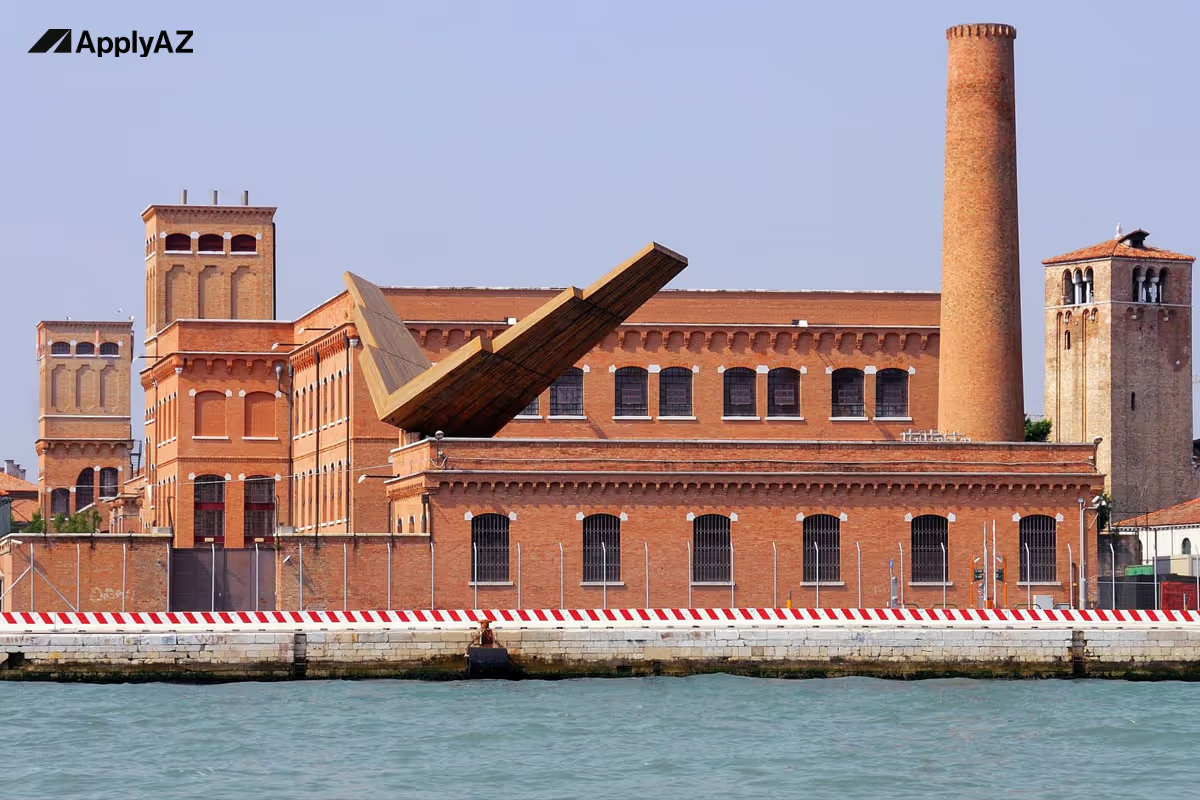
Renewable Energy Engineering in Coastal Environment is a two-year, 120 ECTS environmental engineering master's (LM-35) taught in English at Iuav University of Venice with CNR-ISMAR. It covers marine renewables, coastal infrastructure and environmental modelling. Fees depend on family income, so it can be tuition-free for eligible students.
Entry requirements
- A bachelor's degree in civil and environmental engineering (Italian class L-7, or L-8 under the older system), or another degree, including a foreign one, with at least 90 ECTS in the fields Iuav lists: 30 in basic maths and sciences and 60 in engineering fields.
- A committee checks that your background fits the course after applications close.
- English at B2 (CEFR), shown with a certificate.
- Selection on 100 points: degree (up to 30), graduation grade (up to 20) and a video (up to 50), with at least 60 to qualify.
- Diploma or enrolment certificate, transcript or diploma supplement, translations into Italian or English, and a €30 application fee.
About the programme
Renewable Energy Engineering in Coastal Environment is a two-year laurea magistrale in environmental engineering (class LM-35) at Iuav University of Venice, run by the Department of Design Cultures and coordinated by Massimiliano Scarpa. It is taught in English and carries 120 ECTS.
The course trains engineers to protect coastal environments and to manage the design of infrastructure and plants that meet sustainable development goals. It is run with the Institute of Marine Sciences (ISMAR) of Italy's National Research Council (CNR), also based in Venice, which brings experiments and research-grade calculation and simulation tools into teaching. It suits engineering graduates with a solid maths and science base who want to work on renewable energy, water and coastal protection.
What you will study
Many units are grouped into integrated laboratories with a practical outcome. The 2026/27 study plan includes:
- Water as a renewable energy source
- In-shore infrastructures and renewable energies
- Infrastructures for sustainable development in coastal environments
- Hydrology and marine fluid dynamics
- Calculus and machine learning for environmental modeling
- Modeling and planning for energy efficiency, noise control and lighting
- Water supply, drainage and treatment in coastal areas, and structural design and risk analysis
- Chemistry and processes of coastal environments, ecology and environmental assessment, environmental laws and economics, and digital tools for maritime spatial planning
How the programme is taught
Attendance of at least 70% of lesson hours is required. Students visit coastal and marine sites around Venice and carry out experimental work linked to their courses. The plan includes a 6 ECTS internship with a public or private body, in-house at Iuav or abroad, and a 9 ECTS final examination. Iuav's exchange network offers study periods abroad.
Career paths
According to the teaching regulation, graduates are prepared to:
- Conceive and coordinate renewable energy plants, such as solar, small and medium hydro, wind and wave energy
- Design and certify low-impact water supply chains for civil and agricultural use
- Carry out ecological modelling and environmental impact certification
- Design coastal landscapes and plan large-scale coastal interventions
- Lead research and development teams in companies in the sector
Fees and scholarships
For 2026/27 Iuav offers five Study@Iuav fee waivers for this master. All degrees share one fee scale: a maximum €2,806.18 university contribution plus €192 regional tax and €16 stamp duty, lowered by ISEE, and fully waived up to an ISEE of €26,000 if merit rules are met. Income abroad means an ISEE parificato or a €500 or €1,000 flat rate. Adding the Veneto regional DSU scholarship, the course can be tuition-free for eligible students.
How to apply from outside the EU
This master had 40 places for non-EU applicants living abroad in 2026/27; EU applicants and residents in Italy had open access. Applications go through the Iuav Online Desk with your documents and a video, plus a €30 PagoPA fee. The 2026/27 rounds for non-EU applicants closed on 23 February and 6 July 2026.
After admission you pay a pre-enrolment fee, pre-enrol on Universitaly and apply for a type D study visa. The 2027/28 call has not been published yet.
How ApplyAZ helps
If this programme fits your goals, ApplyAZ can include it in a shortlist of 20 to 30 English-taught programmes at Italian public universities. We write your CV and a tailored statement of purpose, submit your applications and Universitaly pre-enrolment, file your DSU scholarship application and prepare your visa file, with a named person on each stage. The university decides admission, the region decides the scholarship and the consulate decides the visa. See how ApplyAZ works or check your eligibility.
Questions and answers
Is this master taught in English?
Yes. The whole course is taught in English in Venice, and you need English at B2 level shown with a certificate.
Who runs the course with Iuav?
Iuav runs it in collaboration with the Institute of Marine Sciences (ISMAR) of Italy's National Research Council (CNR) in Venice, which adds experiments and simulation tools to the teaching.
Which bachelor's degrees are accepted?
Civil and environmental engineering degrees (Italian class L-7, or L-8 under the older system) give direct access. Other degrees need at least 90 ECTS in listed fields: 30 in basic sciences and 60 in engineering subjects.
How are applicants selected?
There is no written test. A committee scores your degree (up to 30 points), graduation grade (up to 20) and a video (up to 50), and you need 60 points.
When is the deadline for 2027/28?
The 2027/28 call is not out yet. For 2026/27 non-EU applicants could apply by 23 February or by 6 July 2026, paying a €30 fee.
What careers does it lead to?
Graduates can design renewable energy plants such as hydro, wind, solar and wave energy, plan coastal interventions, work on water supply and environmental impact, or lead R&D in energy companies.
Similar programmes
More programmes in this city

They began right where you are

