

Master in Science and Technology of Bio and Nanomaterials at Ca’ Foscari University of Venice
Two-year English-taught materials science master at Ca' Foscari's Mestre campus on making, characterising and applying nanomaterials and biomaterials, with compulsory laboratories and a research thesis. Entry needs a related degree or 60 credits with maths, chemistry and physics, and English at B2.
Master
2 years
Venice
English
Ca’ Foscari University of Venice


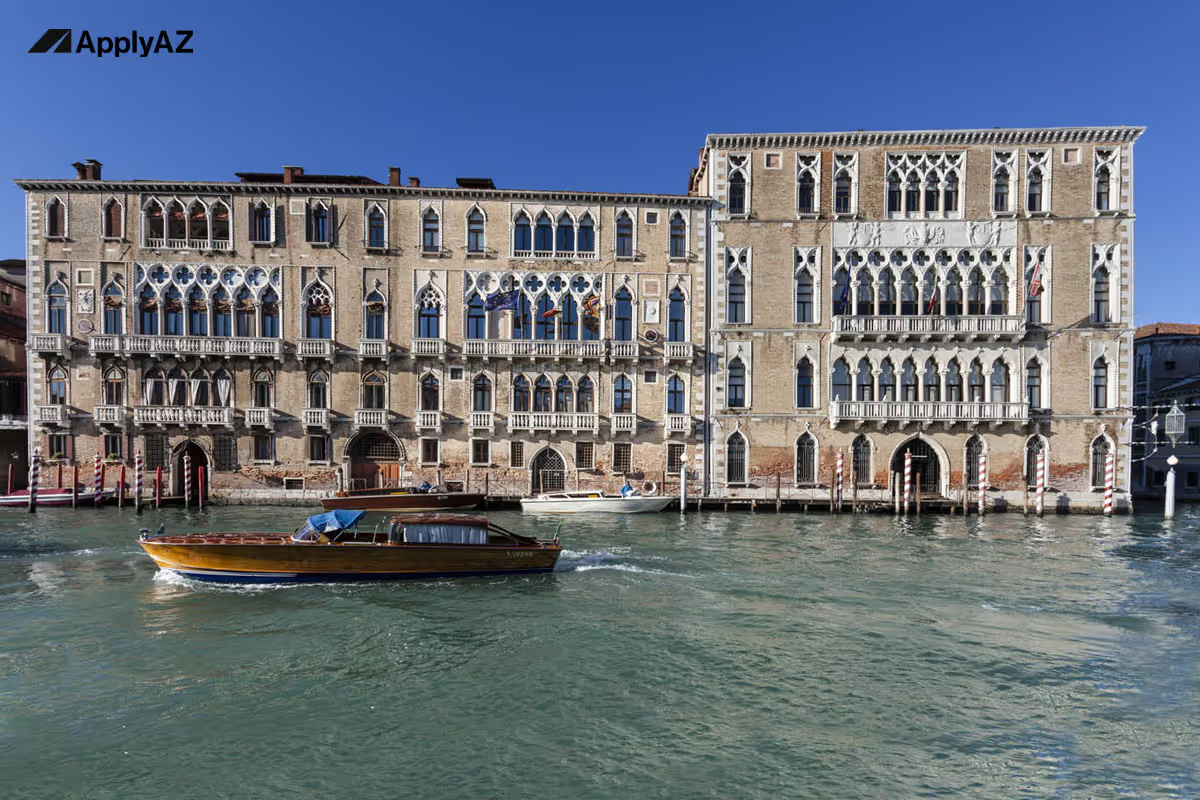
Science and Technology of Bio and Nanomaterials is a two-year, 120 ECTS master's degree (class LM Sc.Mat.) taught in English at Ca' Foscari University of Venice, on its Mestre science campus. Entry needs a related science or engineering bachelor's, or 60 credits with at least 9 in maths, 20 in chemistry and 20 in physics, a 70% CGPA and certified English at B2. There is no entrance test.
Entry requirements
Detailed entry requirements
Ca' Foscari's Bio and Nanomaterials master has open admission with an individual assessment. You need a bachelor's of at least three years in a related science or engineering field, or one with at least 60 credits in the listed fields (at least 9 in maths, 20 in chemistry and 20 in physics), a minimum CGPA of 70% under the provisional 2027/28 rules, and certified English at B2 by enrolment. These rules come from the teaching regulations in force from 2025/26. Reviewed 8 October 2026. [1]
Degree and credit requirements
You need a bachelor's degree. With a foreign qualification, it must be a degree of at least three years, and the Teaching Committee pre-evaluates your studies. [1]
Graduates in Italian classes L-Sc.Mat. (materials science), L-2 (biotechnology), L-9 (industrial engineering), L-27 (chemistry), L-30 (physics) or L-43 (heritage conservation technologies), or with a foreign qualification recognised as suitable, meet the curricular requirements. Graduates in other fields need: [1]
- At least 60 CFU in the listed sectors: chemistry, mathematics, physics, information engineering, computer science, set areas of biology (biochemistry, molecular and applied biology, genetics and microbiology) and set areas of industrial engineering (including fluid dynamics, energy systems, technical physics, metallurgy, materials science, applied physical chemistry, electrical engineering and industrial bioengineering).
- Within them, at least 9 CFU in mathematics, 20 in chemistry and 20 in physics.
The provisional 2027/28 rules on the admissions portal keep the 60-credit rule, or its equivalent of no less than one third of your coursework, with the same minimums in maths, chemistry and physics. [2]
Minimum grade
Your personal preparation must be checked, partly through a minimum degree grade. [1] Under the provisional 2027/28 rules, the minimum CGPA is 70%. Your grades are converted to a percentage using your university's grading scale, or proportionally if it has no numerical scale. [2]
What this means for your transcript
For degrees from countries outside the Bologna Process, the Teaching Committee checks your subjects using the ECTS workload, where one credit is about 25 hours of work. [3] As a guide, based on the rule above:
- Usually a fit: a B.Sc. in Chemistry or Physics with maths, a B.Sc. with Physics, Chemistry and Maths, or a B.Tech or B.E. in Chemical, Materials or Metallurgical Engineering with chemistry and physics in the first years.
- Check carefully: a B.Sc. in Biotechnology or Biology, or a B.Tech in Mechanical, Electrical or Electronics Engineering. These often reach 60 credits in the listed fields but can fall short of 20 credits in chemistry or 20 in physics.
- Often short: a BCA or B.Sc. in Computer Science, where computing and maths count but chemistry and physics are usually missing, and a B.Com, BBA or BA.
English
Certified English at B2 or higher, which you must hold by enrolment. [1] You can apply without a certificate, but you need one, or one of Ca' Foscari's recognised exemptions, to complete enrolment. Ca' Foscari does not test English during admission. [2]
Assessment
There is no entrance test, and admission is open. The Teaching Committee checks that you meet the curricular requirements and assesses your transcript and CV, together with a motivation letter written for this programme. [1][2]
Deadlines
Ca' Foscari sets admission rounds by applicant category, with separate rounds for applicants who need a study visa. The 2027/28 rules on the portal are provisional, and the 2027/28 rounds are not yet published. [2]
For 2026/27, non-EU students with a study visa have until 18 December 2026 to finalise enrolment. [4]
Documents and non-EU steps
You apply on Ca' Foscari's online platform and one application covers up to two programmes. You upload your transcript of records, CV and motivation letter, with qualification documents in English or Italian, or with a professional translation. [2]
Non-EU students living abroad are admitted within the number of places the university sets. [1] If you need a visa, you must pass the pre-evaluation to receive a letter of enrolment eligibility, then complete Universitaly pre-enrolment and obtain a study visa, which is mandatory for enrolment. [4]
To complete enrolment you need one of these for your qualification: a CIMEA Statement of Comparability, a declaration of value, an ARDI statement of correspondence with a CIMEA Statement of Verification, or a Diploma Supplement in the international model from a country in the European Higher Education Area. Provisional documents must be replaced by final versions before the enrolment period ends. [3]
Sources and verification
Checked by the ApplyAZ admissions team against the university's official documents listed below. Entry rules can change with each new call, and we re-check them before every application.
- Ca' Foscari University of Venice, Department of Molecular Sciences and Nanosystems. Teaching regulations, Master's degree in Science and Technology of Bio and Nanomaterials (LM Sc.Mat., CM14), in force from academic year 2025/26. Reviewed 8 October 2026.
- Ca' Foscari University of Venice, international admissions page for the master's in Science and Technology of Bio and Nanomaterials, provisional rules for academic year 2027/28. Reviewed 8 October 2026.
- Ca' Foscari University of Venice, Entry requirements for applicants holding an international qualification, academic year 2026/27. Reviewed 8 October 2026.
- Ca' Foscari University of Venice, Enrolment for non-European students who require a visa, academic year 2026/27. Reviewed 8 October 2026.
About the programme
Science and Technology of Bio and Nanomaterials is a two-year master's degree in the materials science class (LM Sc.Mat.), taught entirely in English at Ca' Foscari's Scientific Campus in Venice Mestre, with research based in the Department of Molecular Sciences and Nanosystems.
It carries 120 ECTS and has open admission subject to an assessment of each applicant. Laboratory activities in nine units are compulsory, with at least 80% attendance needed to sit the exam, and you first complete Ca' Foscari's online laboratory safety training. [1]
The degree builds expertise in the development, engineering and application of nanomaterials and bio-nanomaterials across science and technology, joining biology, chemistry, physics and materials science.
Because students arrive from different bachelor's degrees, online self-study courses during the year help fill gaps. It suits graduates in chemistry, physics, biotechnology, materials or industrial engineering who want a research-led career in materials.
What you will study
Teaching covers the chemical and physical properties of nanomaterials, the methods used to synthesise and prepare them, and their use in research and industry, from nanomedicine to water treatment and energy technologies.
Several first-year units pair a theory module with a laboratory module. Units in the 2026/27 first-year timetable include:
- Fundamentals of Nanotechnology, theory and laboratory
- Chemistry for Nanotechnology, theory and laboratory
- Microscopy and Structural Characterization Techniques, theory and laboratory
- Mathematical Methods for Physics
- Microbiology
- Biomacromolecular Engineering
- Nanomaterials for Energy and Environment
- Photo(bio)chemistry and Neurochemistry
How the programme is taught
The internship and the thesis are periods of intense personal work on research topics linked to the programme.
They can take place in the department's research laboratories or at external facilities such as national or international laboratories, research institutions or companies. The second semester of the second year is given entirely to the thesis, an original and usually experimental research project defended before a three-member committee. [1]
A double degree with Kyoto Institute of Technology in Japan offers international experience and a qualification from the partner university, and Erasmus+ and Overseas exchanges are open too.
Non-Italian students earn 3 ECTS in Italian before graduating unless they already have B1.
Career paths
The university describes three main routes for graduates:
- Industrial specialist in materials science and technology, nano and biotechnology, in companies that produce, process, market or develop materials, from pharmaceuticals to innovative materials and fine chemicals
- Research and development in public and private laboratories that study, certify and innovate materials, including spin-offs and high-tech start-ups
- A PhD in Italy or abroad in materials science and nanotechnology, leading to academic research or scientific institutions
Fees and scholarships
Ca' Foscari charges non-EU students a yearly flat rate linked to citizenship.
Students who meet the Veneto regional scholarship limits with an ISEE parificato are exempt from fees, so this programme can be tuition-free for eligible students.
How to apply from outside the EU
Your application goes through apply.unive.it.
The Teaching Committee checks your credits in mathematics, chemistry and physics and a CGPA of at least 70%, and reads your CV and a motivation letter written for this degree; there is no entrance test. [1][2]
One application covers up to two programmes. The 2027/28 admission rules on the portal are provisional, and the 2027/28 rounds are not yet published. [2]
With a letter of enrolment eligibility we complete Universitaly pre-enrolment, and you request a study visa, which is mandatory for enrolment. To complete enrolment you need a CIMEA Statement of Comparability, a declaration of value, an ARDI statement of correspondence with a CIMEA Statement of Verification, or a Diploma Supplement from a country in the European Higher Education Area. [3][4]
Compare related master's programmes
If you are exploring chemistry and materials science, compare the curriculum and entry requirements on these programme pages before choosing your shortlist.
- Master in Sustainable Chemistry and Technologies for Circular Economy at University of Padua
- Master in Sustainable Chemistry and Technologies at Ca’ Foscari University of Venice
How ApplyAZ helps
ApplyAZ is an Italy-based consultancy that works only with public universities. We can include this programme in a shortlist of 20 to 30 English-taught programmes that fit your profile, so your plan never rests on a single application.
For eligible students who start with us, a named person owns each stage, from A to Z:
- We check your transcript against Ca' Foscari's entry rules for this programme.
- We write your CV and a tailored statement of purpose.
- We prepare and submit your online application with your transcript, CV and motivation letter, and Universitaly pre-enrolment.
- We help you declare your family income for reduced fees and file your regional DSU scholarship application at the right time and in the right format.
- We prepare your visa file.
With operations in all 20 Italian regions, we follow each region's scholarship rules and deadlines as they change. The university decides admission, the region decides the scholarship and the consulate decides the visa, so no one can promise an outcome. You pay in milestones, and every service you pay for is either delivered or its fee is refunded (terms apply).
Programmes at Italian public universities can be tuition-free for eligible students. Check if you are eligible and book a one-to-one consultation session with one of our Italy experts, or see how ApplyAZ works.
Questions and answers
What bachelor's degree do I need for Bio and Nanomaterials at Ca' Foscari?
A bachelor's of at least three years. Degrees in materials science, biotechnology, industrial engineering, chemistry, physics or heritage conservation technologies fit directly. Other graduates need 60 credits in the listed fields, with at least 9 in maths, 20 in chemistry and 20 in physics. [1]
Is the Bio and Nanomaterials master taught in English?
Yes. The degree is taught in English, apart from some free-choice activities, at the science campus in Via Torino, Mestre. Laboratory activities in nine units are compulsory, with at least 80% attendance. [1]
What CGPA do I need?
Under the provisional 2027/28 rules, a minimum CGPA of 70%. Ca' Foscari converts your grades to a percentage using your university's grading scale, so we include that scale in your file. [2]
Is there an entrance test?
No. Admission is open, and the Teaching Committee assesses your transcript, CV and a motivation letter written for this programme. The regulations say your preparation is also checked through a minimum degree grade. [1][2]
What English level is required? Do I need IELTS?
Certified English at B2 or higher, which you must hold by enrolment. You can apply without a certificate. The teaching regulations do not list specific IELTS scores, so we check which certificate or exemption your file can use. [1][2]
When is the deadline for non-EU students?
Ca' Foscari sets rounds by applicant category, with separate rounds for visa applicants. The 2027/28 rules on the portal are provisional, and the 2027/28 rounds are not yet published. [2]
I have a B.Sc. in Biotechnology or a B.Tech in Mechanical Engineering. Can I apply?
Possibly. Both can count towards the 60 listed credits, and biotechnology is one of the fields Ca' Foscari names as a fit, but either can fall short of 20 credits in chemistry or 20 in physics. We check your transcript against each minimum. [1][2]
What careers does it lead to?
Graduates work in technical and management roles at companies that produce, sell, process and develop materials, or in public and private research and development laboratories that study and certify materials. They can also go on to a PhD. [1]
Can someone handle my whole application to Bio and Nanomaterials at Ca' Foscari?
Yes. ApplyAZ, an Italy-based consultancy that works only with public universities, checks your transcript against Ca' Foscari's rules for this programme, handles the application and Universitaly pre-enrolment, helps you file the regional DSU scholarship application at the right time and in the right format, and prepares your visa file, for eligible students. Start by checking your eligibility.
I'm applying from India. What is the route into Bio and Nanomaterials?
A recognised Indian bachelor's, such as a B.Sc. in Chemistry or Physics or a B.Tech in Chemical or Materials Engineering, can meet the rule with 60 credits in the listed fields, including 9 in maths, 20 in chemistry and 20 in physics. You also need a 70% CGPA and certified English at B2. The steps are the online application, the committee's assessment, an eligibility letter and Universitaly pre-enrolment. [1] Indian students apply for the type D study visa at the Italian embassy or consulate that covers their state, such as New Delhi, Mumbai or Bengaluru.
Is the route different from Pakistan, Bangladesh or Sri Lanka?
No. The academic rules for Bio and Nanomaterials are the same whatever your nationality. Applicants from Pakistan, Bangladesh and Sri Lanka follow the same steps as India: online application, the Teaching Committee's assessment, a letter of enrolment eligibility and Universitaly pre-enrolment, then a type D study visa from the Italian mission for their country of residence. Read our guide for students in Dhaka.
I live in the UAE, Saudi Arabia, Qatar, Kuwait, Oman or Bahrain. Where do I apply for the visa?
At the Italian embassy or consulate responsible for the country where you legally live, after Universitaly pre-enrolment. The academic rules for Bio and Nanomaterials are the same whatever your nationality, and Gulf residents follow the same steps: online application, the Teaching Committee's assessment, a letter of enrolment eligibility and Universitaly pre-enrolment. Read our guides for Dubai, Riyadh and Doha.
I studied or live in London, New York, Toronto, Vancouver, Singapore or Kuala Lumpur. What is the route?
The academic rules for Bio and Nanomaterials are the same whatever your nationality, and your degree is assessed like any other foreign qualification. Non-EU applicants who live abroad follow the same route: online application, the Teaching Committee's assessment, a letter of enrolment eligibility and Universitaly pre-enrolment, then a type D study visa from the Italian mission for where they live. Read our guides for students in London, New York, Toronto, Vancouver, Singapore and Kuala Lumpur.
More English-taught programmes at this university
Other public universities in this city

They began right where you are

