

Master in Geoinformatics Engineering at Polytechnic University of Milan
Two-year English-taught master's at Politecnico di Milano (interclass LM-32/LM-35) on processing geospatial data from satellites, GNSS and sensors, with a computer science track and an environmental track.
Master
2 years
Milan
English
Polytechnic University of Milan



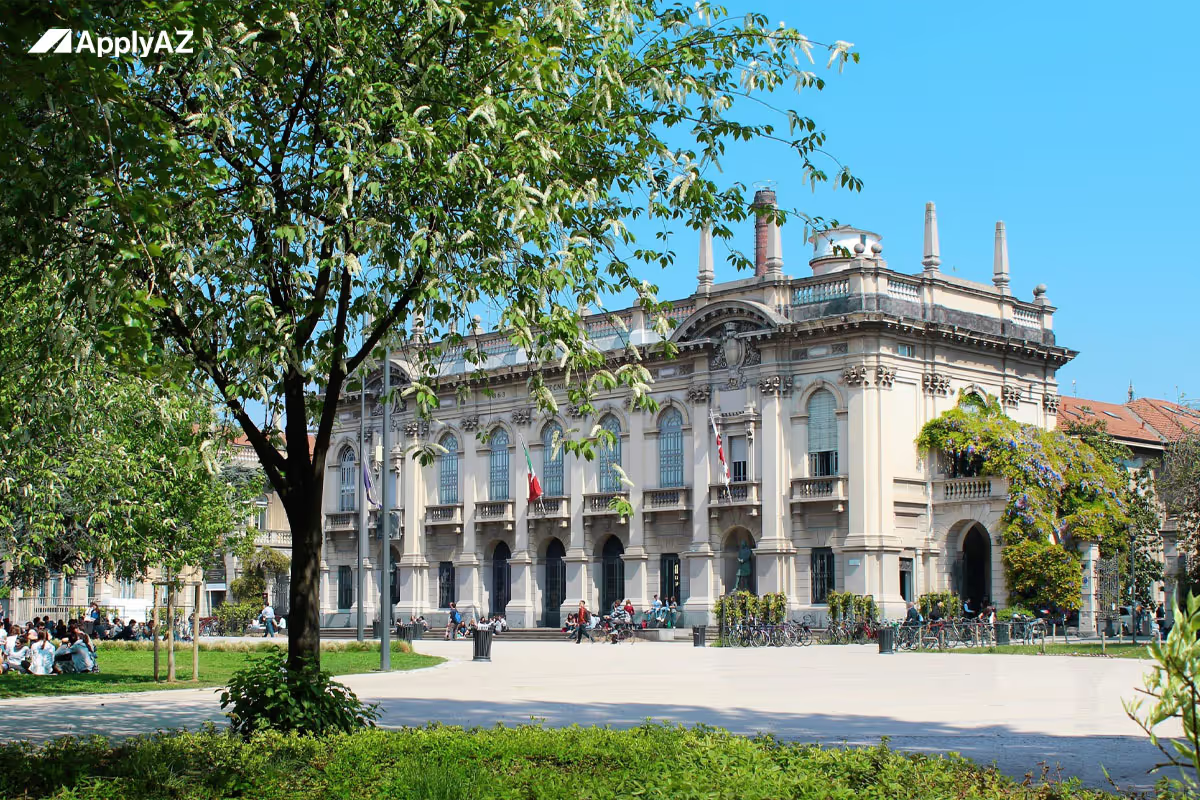
Geoinformatics Engineering is a two-year, 120 ECTS master's degree (interclass LM-32/LM-35) taught in English at Politecnico di Milano's Leonardo campus. It covers satellite and GNSS data, GIS, Earth observation and geospatial computing. Non-EU students with a foreign degree pay the top fee unless awarded a scholarship, so it can be tuition-free for eligible students.
Entry requirements
- A first-level degree (at least three years and 180 ECTS) in a technical or scientific field, recognised in the country that awarded it.
- Automatic admission is possible if your record shows at least 40 ECTS in maths and physics and 10 ECTS in computer engineering; otherwise the Admission Committee assesses your background and may assign compulsory courses.
- A grade average meeting PoliMi's minimum for your country.
- An English certificate recognised by PoliMi, or a university statement that your bachelor's was taught in English.
- A Diploma Supplement, declaration of value or CIMEA statement before enrolment. No entrance test.
About the programme
Geoinformatics Engineering is a two-year master's degree (laurea magistrale) worth 120 ECTS, taught in English at Politecnico di Milano's Milano Leonardo campus. It is an interclass degree between computer systems engineering (LM-32) and environmental engineering (LM-35), run by the School of Civil, Environmental and Land Management Engineering with the School of Industrial and Information Engineering. PoliMi describes it as the first degree of its kind in Italy.
A geoinformatics engineer turns satellite images, GNSS positions and sensor data into usable information for environmental monitoring, land management, infrastructure planning and emergency response. The degree suits graduates in environmental, civil, computer or other engineering and science fields with a good grounding in maths and programming.
What you will study
At enrolment you choose one of two tracks, which also sets your degree class: GEC for students with a computing background (LM-32) or GEO for those from environmental engineering (LM-35). They share most content and differ by 25 ECTS of compulsory courses. Units in the 2026/27 plan include:
- Geospatial Data Analysis and Geographic Information Systems (10 ECTS each)
- Positioning and Location Based Services
- Earth Observation
- Geospatial Processing, and Subsurface Imaging and Detection
- Data and Information Quality
- Computing Infrastructures (GEC) or Computer Architecture and Operating Systems and Software Engineering for Geoinformatics (GEO)
- Electives such as Advanced Geospatial Artificial Intelligence, Photogrammetry and Drone Surveying, Machine Learning, and Space Economy and Earth Observation Business
How the programme is taught
Courses combine lectures, exercises and labs on real or realistic cases, often assessed through project reports. The thesis is worth 15 ECTS and is written and defended in English. Students can also follow the Interdisciplinary Programme in Smart Infrastructures, which includes a workshop with Enel Foundation, and PoliMi's exchange and double degree schemes such as TIME.
Career paths
The regulations list employers across every sector that produces or uses spatial and environmental data. Depending on your track, you can later sit the State Examination for the civil and environmental or the information engineers' register.
- SMEs and IT firms building GIS, territorial databases, logistics and planning tools
- National and local bodies handling mapping, land registry and spatial data infrastructures
- Large companies, such as telecoms, needing in-house geospatial experts
- Firms managing environmental sensor networks
- Research institutes working on big geodata, urban analytics and Earth observation
Fees and scholarships
PoliMi's fee rules treat this group separately: non-EU students in the reserved quota who enter a master's with a bachelor's from abroad pay the maximum annual fee, €3,943.04 for a standard 2026/27 study plan, even with an ISEE parificato. That changes if you hold a scholarship from PoliMi, another institution or the DSU call that PoliMi runs, so this programme can be tuition-free for eligible students.
How to apply from outside the EU
Apply online as a student with a foreign qualification, choosing up to two programmes. For September 2026 entry, engineering calls ran from 1 October to 1 December 2025 and 13 January to 26 February 2026, with outcomes by the end of May; the fee was €50 until 1 December and €150 after. A February 2027 intake call ran from 18 May to 18 June 2026. The committee checks your record and may set compulsory courses. Before enrolment you need a Diploma Supplement, declaration of value or CIMEA statement, then Universitaly pre-enrolment and a type D visa.
How ApplyAZ helps
If this programme fits your goals, ApplyAZ can include it in a shortlist of 20 to 30 English-taught programmes at Italian public universities. We write your CV and a tailored statement of purpose, submit your applications and Universitaly pre-enrolment, file your DSU scholarship application and prepare your visa file, with a named person on each stage. The university decides admission, the region decides the scholarship and the consulate decides the visa. See how ApplyAZ works or check your eligibility.
Questions and answers
Is Geoinformatics Engineering taught in English?
Yes. The degree is offered in English and the thesis is written and defended in English, with an Italian abstract. Italian is not needed for entry, but PoliMi asks all master's students to show Italian B2 before graduating and offers a free course.
Which bachelor's degrees are accepted?
A technical or scientific bachelor's of at least three years and 180 ECTS. With at least 40 ECTS in maths and physics and 10 ECTS in computer engineering you can be admitted automatically; otherwise the committee reviews your record and may add compulsory courses.
Is there an entrance test?
No. Selection is based on your academic record, grade average and documents. You also need an English certificate recognised by PoliMi or proof that your bachelor's was taught in English.
What is the difference between the two tracks?
GEC suits computer science graduates and leads to class LM-32; GEO suits environmental engineering graduates and leads to class LM-35. They differ by 25 ECTS of compulsory courses.
When can I apply for 2027/28?
The 2027/28 windows are not published yet. For September 2026 entry, engineering calls ran from 1 October to 1 December 2025 and from 13 January to 26 February 2026, with a €50 early fee and €150 afterwards.
How much does it cost?
Non-EU students in the reserved quota with a foreign bachelor's pay PoliMi's maximum fee, €3,943.04 for a standard plan in 2026/27, unless they hold a PoliMi, other or DSU scholarship.
Similar programmes
More programmes in this city

They began right where you are

