

Master in Mechanical Engineering at Polytechnic University of Turin
Two-year LM-33 master at Politecnico di Torino whose English-taught programme builds on materials, modelling, design and production, then specialises in energy and design: propulsion systems, machine dynamics and thermal systems.
Master
2 years
Turin
Multiple
Polytechnic University of Turin


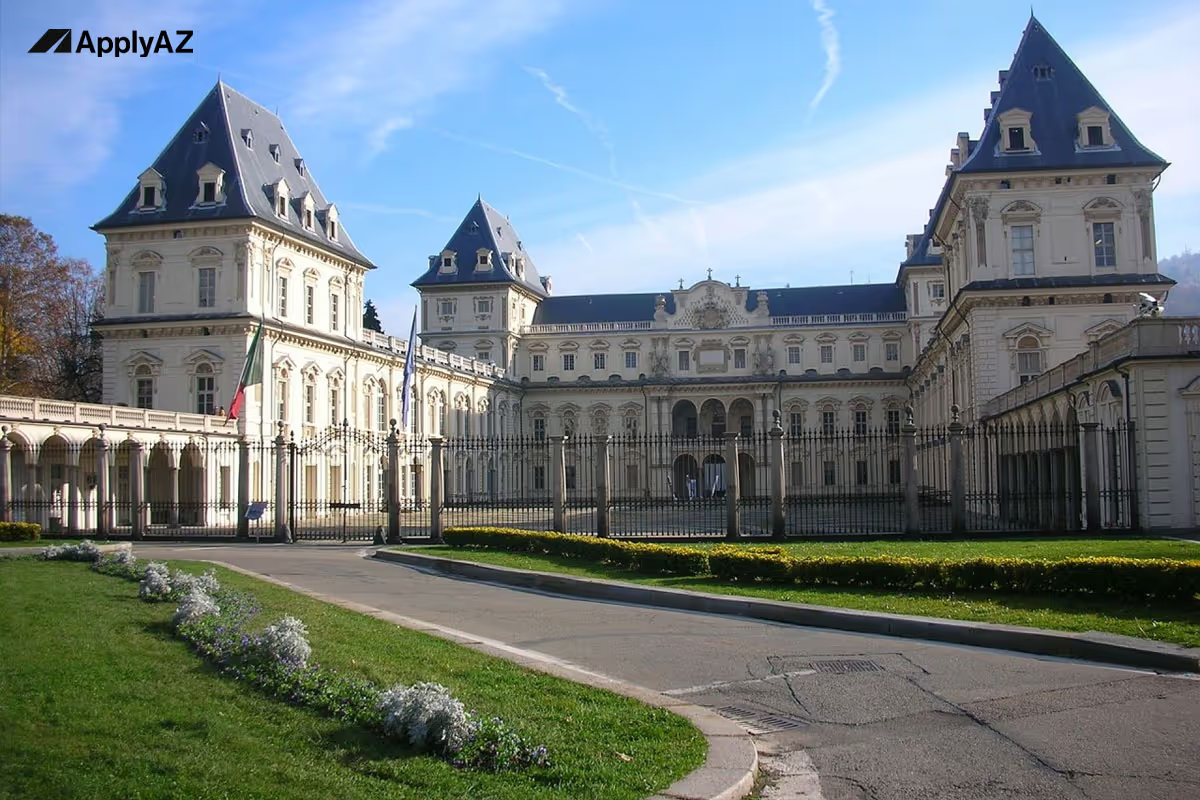
The Master in Mechanical Engineering at Politecnico di Torino is a two-year, 120 ECTS degree in class LM-33 in Turin. Its English-taught programme follows a single specialist pathway on energy and design, alongside seven Italian tracks. Tuition depends on citizenship or residence, with reductions based on family income.
Entry requirements
- A bachelor's degree (EQF level 6) or an equivalent foreign qualification.
- A background in mechanical, aerospace, automotive, industrial, management, energy, biomedical or materials engineering, or a similar field.
- English at B2 level or higher; IELTS 5.5 is the minimum listed for the English programme, which needs no Italian.
- The syllabus of your previous courses is required.
- No entrance test: the university evaluates your documents against the admission requirements.
- A declaration of value or CIMEA statement of comparability for enrolment.
About the programme
Mechanical Engineering is a two-year, 120 ECTS master's degree in class LM-33 at Politecnico di Torino, taught on the main campus in Turin. The degree runs in Italian and English. Its English-taught programme has a single specialist pathway focused on energy and design, while the seven other tracks are taught in Italian. Access is uncapped, subject to an evaluation of your admission requirements.
The degree trains engineers to work on complex industrial design projects, to manage and run sophisticated systems such as production lines and transport infrastructure, and to carry out research and development. You learn to develop projects on your own as well as to work in, and lead, multidisciplinary teams. It suits graduates in mechanical, automotive, aerospace, energy or other industrial engineering fields.
What you will study
The first year builds a broad base across six cultural areas:
- Materials
- Modelling and numerical methods
- Functional and structural design
- Production systems
- Energetics
- Economics and finance
In the second year, the English-taught pathway turns to energy and design, with courses on propulsion systems, the design of machines with a focus on dynamics, and the numerical design of thermal systems. The seven Italian tracks, from automation and additive manufacturing to transport, are not part of the English programme.
How the programme is taught
Teaching combines lectures and practicals with student teams and challenges, and the programme includes company internships. The degree ends with a master's thesis based on a specific project or on research and development work in a company or university, in Italy or abroad. You can spend a semester or the whole second year abroad, and Politecnico has double degree agreements for this degree with partners such as the University of Illinois at Chicago, INSA Lyon and ITBA Buenos Aires, which usually need an extra semester to complete the thesis.
Career paths
Graduates can work as employees or as freelance consultants in design and industrial management, or go on to a second-level master's or a PhD in mechanics in Italy or abroad. The programme page lists these employers:
- Industries involved in the design, production, control and maintenance of mechanical, metallurgical or electromechanical components, equipment and systems
- Manufacturing and processing industries that use mechanical and electromechanical production systems
- Companies in the vehicle production sector
- Companies and public bodies in energy conversion
- Contractors that organise, run and maintain plant and equipment for factories, buildings, handling and transport
- Service and industrial consultancy firms, and public bodies with technical functions
Fees and scholarships
Politecnico di Torino sets tuition by citizenship or residence and offers reductions based on family income, with the exact amounts published in its yearly fee rules. EDISU Piemonte, the regional body for the right to study, runs the scholarship and university housing calls, and international students are eligible to apply. Non-EU applicants whose family lives abroad provide foreign income and asset documents, from which EDISU calculates an equivalent ISEE (ISEE parificato).
How to apply from outside the EU
For Mechanical Engineering you must upload the syllabus of your bachelor's courses. Applications go through Apply@PoliTO, with a €50 non-refundable fee and up to two master's programmes ranked by preference. For 2026/27 the first call closed on 13 February 2026, with results on 15 April, and the second on 20 April 2026, with results on 22 June. The 2027/28 dates were not published in September 2026.
Once admitted, you pre-enrol on Universitaly, which the type D study visa requires, and you need a declaration of value or a CIMEA statement of comparability to enrol.
How ApplyAZ helps
If this programme fits your goals, ApplyAZ can include it in a shortlist of 20 to 30 English-taught programmes at Italian public universities. We write your CV and a tailored statement of purpose, submit your applications and Universitaly pre-enrolment, file your DSU scholarship application and prepare your visa file, with a named person on each stage. The university decides admission, the region decides the scholarship and the consulate decides the visa. See how ApplyAZ works or check your eligibility.
Questions and answers
Is the Master in Mechanical Engineering taught in English?
The degree runs in Italian and English. Its English-taught programme can be followed with English only and has one specialist pathway on energy and design; the seven other tracks are in Italian. You need English at B2 level, with IELTS 5.5 as the listed minimum.
What does the English pathway cover?
After a first year spanning materials, modelling and numerical methods, design, production systems, energetics and economics, the second year covers propulsion systems, machine design with a focus on dynamics, and the numerical design of thermal systems.
What bachelor's background do I need?
A bachelor's degree (EQF level 6) or equivalent, ideally in mechanical, aerospace, automotive, industrial, management, energy, biomedical or materials engineering. There is no entrance test: the university evaluates your record and the syllabus of your courses.
When can I apply for 2027/28?
The 2027/28 calls were not published in September 2026. As a guide, for 2026/27 applications on Apply@PoliTO closed on 13 February 2026 in the first call and on 20 April 2026 in the second, with a €50 fee.
How much are the fees?
Tuition depends on citizenship or residence, with reductions based on family income, as set in the yearly fee rules. EDISU Piemonte, the regional right-to-study body, runs scholarships and housing, and international students can apply.
What jobs do graduates do?
Graduates work in industries that design, produce and maintain mechanical and electromechanical systems, in vehicle production, energy conversion, plant management and industrial consultancy, or as freelance consultants. Some continue to a PhD.
Similar programmes
More programmes in this city

They began right where you are

