

Master in Geology for Energy Resources at University of Perugia
Two-year English-taught LM-74 R master's at the University of Perugia, built with Eni Corporate University, covering sedimentary and structural geology, geophysics, seismic interpretation, geothermics and fluid storage. Entry needs a geology-based degree and certified B2 English.
Master
2 years
Perugia
English
University of Perugia



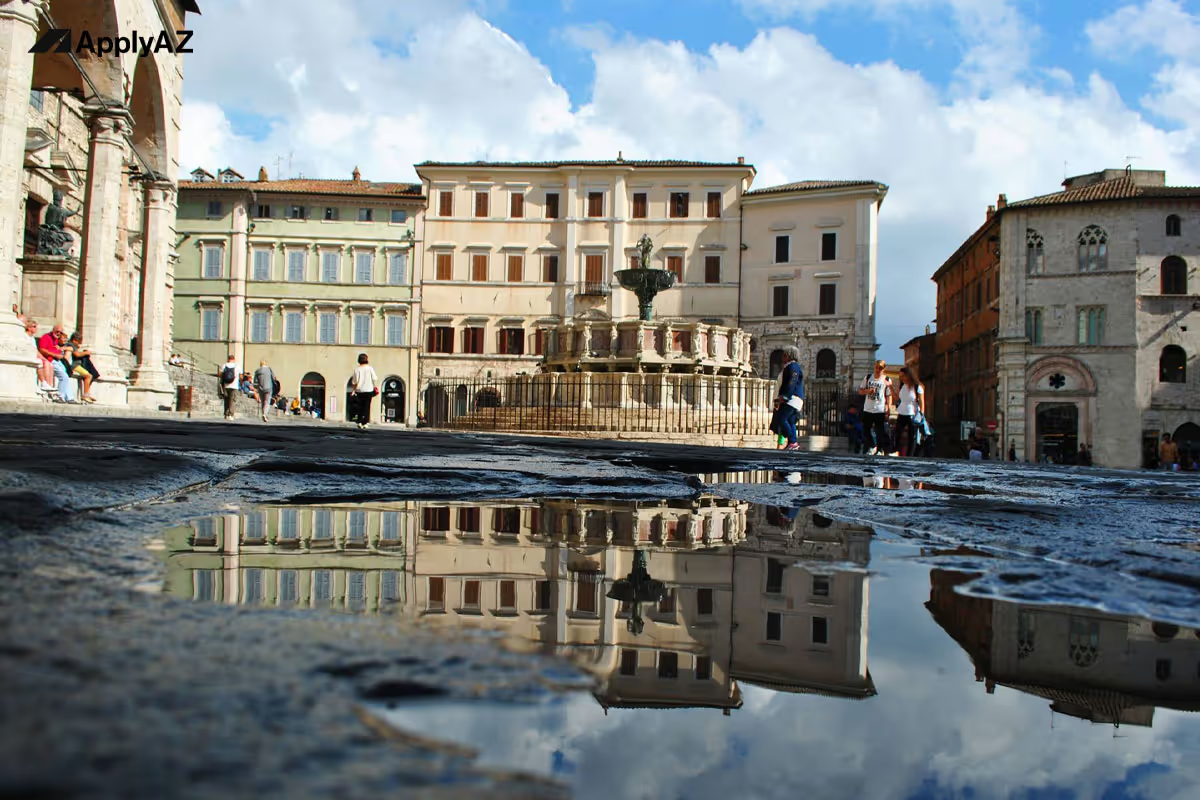
Geology for Energy Resources is a two-year, 120 ECTS master's degree (class LM-74 R) taught in English at the University of Perugia, built with Eni Corporate University. Entry needs a three-year or five-year degree, ideally in geology, with a base in maths, physics and chemistry, plus certified English at B2. Fees follow family income, so it can be tuition-free for eligible students.
Entry requirements
Detailed entry requirements
UniPG's Geology for Energy Resources master asks for a three-year or five-year degree, ideally in geological sciences (class L-34 or a foreign equivalent), with a base in maths, physics and chemistry and good knowledge of the geological sciences, plus certified English at B2. Other degrees are reviewed by a committee. Reviewed 8 October 2026. [1]
Degree requirement
You need a university degree, either a three-year bachelor's or a five-year degree. Access is open, with no fixed number of places, although the department sets a sustainable intake of 65 students. [1]
- Counted as meeting the rule: a bachelor's degree in class L-34 (geological sciences) or an equivalent foreign degree.
- Other degrees: a committee appointed by the degree's coordinating committee reviews your record and may hold an interview. It can set extra credits in earth science subjects (GEOS sectors) that you must earn before you receive clearance to enrol.
For foreign degrees, the committee assesses whether your qualification is suitable under Italian law and international agreements. You need a grounding in mathematics, physics and chemistry and adequate knowledge across the geological sciences. [1]
What this means for your transcript
The 2026/27 regulations set no credit count and no minimum grade: the committee looks at your subjects and course syllabi. As a guide, based on the rule above:
- Usually a fit: a B.Sc. (Honours) in Geology, Applied Geology or Earth Sciences, or a B.Sc. with Geology as a main subject alongside maths, physics or chemistry.
- Check carefully: a B.Sc. in Geophysics, Environmental Science or Physics, or a B.Tech in Petroleum or Mining Engineering. These may cover maths, physics and chemistry but often have fewer geology subjects, so the committee can set extra earth science credits.
- Often short: a B.Tech in Civil, Mechanical or Computer Engineering, or a BCA, B.Com, BBA or BA, which usually lack the geological sciences.
English
You need English at B2 or higher, with a certificate. [1] UniPG's list of accepted English certificates includes: [4]
- IELTS in the 5.5 to 6.5 band
- TOEFL iBT in the 72 to 94 range
- PTE General Level 3, Trinity ISE II or LanguageCert International ESOL B2 Communicator
- the Oxford Test of English at B2, Cambridge IGCSE English or the Gatehouse Awards Level 1 ESOL certificate
A medium of instruction letter and Duolingo results are not accepted. [4] Applicants who do not need a visa and hold no certificate can show B2 in an interview or with another certificate, and can be exempt after at least a year of English-taught secondary school, an English-taught school diploma or an English-taught bachelor's. [1]
Selection
There is no entrance test. Visa applicants are pre-evaluated on the PICA portal, and master's applications can be sent to the committee for an academic review. [2] The committee checks your curricular requirements and individual preparation, with an interview if needed, and the coordinating committee then issues the clearance (nulla osta) that you attach to your enrolment application. [1]
Clearance must be requested at least 30 days before the enrolment deadline set by UniPG's Academic Senate, and interview sessions are held at least twice a year, at the start of lessons and near the enrolment deadline. [1]
2026/27 deadlines
For 2026/27, the visa pre-enrolment call for this degree (2026-VISA-02, shared with Civil Engineering) ran on the PICA portal from 17 April to 30 September 2026 at 12:00, or until the visa places were filled. [2][3] Lessons started on 21 September 2026. [1] The 2027/28 call will set the new dates.
Documents and non-EU steps
The PICA application needs a valid passport, documents for your foreign qualification, any language certificates and a CV. Each candidate can submit one application, for one course. [2]
For a master's, UniPG's list of study documents includes: [4]
- your bachelor's degree, at EQF level 6 and giving access to second-cycle studies in your country
- your official transcript of records, or a Diploma Supplement that shows all the information needed, legalised or apostilled
- your CV and the programme or syllabus of your exams
- an English B2 certificate
- a CIMEA statement of verification and a CIMEA statement of comparability, or accepted alternatives such as a declaration of value
Italian translations are not needed for documents in English, French or Spanish. After a positive pre-evaluation, you pre-enrol on Universitaly and apply for the type D study visa. Enrolment on the SOL portal and the first instalment happen only after you arrive in Italy. [2][4]
Sources and verification
Checked by the ApplyAZ admissions team against the university's official documents listed below. Entry rules can change with each new call, and we re-check them before every application.
- University of Perugia, Department of Physics and Geology. Course regulations, Master's degree in Geology for Energy Resources (LM-74), academic year 2026/2027. Reviewed 8 October 2026.
- University of Perugia. Becoming a UniPG student: admission procedure for international students applying for a visa, 2026 intake. Reviewed 8 October 2026.
- University of Perugia. PICA pre-enrolment procedure for visa-applicant international students, Master's degrees in Civil Engineering and Geology for Energy Resources (call 2026-VISA-02). Reviewed 8 October 2026.
- University of Perugia. International students' pages on language requirements and on the list of study documents (undated). Reviewed 8 October 2026.
- University of Perugia. Tuition fees and scholarships for international students, academic year 2026/2027. Reviewed 8 October 2026.
- University of Perugia. Geology for Energy Resources programme page, 2026/2027 course catalogue (degree class, language, access and course code). Reviewed 8 October 2026.
About the programme
Geology for Energy Resources is a two-year master's degree (laurea magistrale, class LM-74 R, geological sciences and technologies) run by the Department of Physics and Geology of the University of Perugia. It is taught entirely in English in Perugia, with open access (code M0415). [1][6]
The department built the course in close collaboration with Eni Corporate University. [1] It combines classic knowledge of surface and subsurface geological structures with the exploration and sustainable use of energy resources, and suits geology graduates who want to work in the energy sector or its supply chain.
What you will study
The first year covers the geological, geophysical and quantitative base; the second turns to applied subjects linked to energy and the environment. Units in the 2026/27 study plan, including options and recommended electives, cover: [1]
- Reservoir Geology, Sedimentary Geology and Sedimentary Petrography
- Exploration and Applied Geophysics
- Seismic Interpretation and Digital Subsurface Modelling
- Petrophysics and Well Log Interpretation
- Geothermics, and Fluid Storage for Energy Transition
- Applied Hydrogeology and Environmental Geology
- Applied Geochemistry and Fluid Rock Interaction
- GIS, Structural Geology and Integrated Stratigraphy
How the programme is taught
Geological and geophysical field trips (3 CFU) are part of the first year, attendance at field activities and seminars is compulsory, and Eni specialists give professional seminars in Perugia. The degree ends with a thesis worth 24 CFU. Under an agreement between the University of Perugia, Eni and Eni Corporate University, the most deserving students can do internships and prepare their thesis at Eni facilities. [1]
The programme is taught entirely in English. The list of recommended electives also includes a few units taught in Italian, such as Planetology, alongside the English options. [1]
Career paths
According to the 2026/27 course regulations, the degree prepares graduates for: [1]
- energy companies
- environmental and geotechnical consulting firms
- government agencies
- doctoral studies
Fees and scholarships
UniPG fees follow family income (ISEE) and merit, so the programme can be tuition-free for eligible students. Non-EU students whose family income and assets are abroad can instead request a flat tax, set in one of four brackets by country. For 2026/27 the request window runs from 3 August to 20 October 2026, with late requests possible until 1 March 2027. [5]
The regional agency A.Di.S.U. Umbria manages scholarships and housing, and its call is usually published in July. Eligible students can apply, and A.Di.S.U. Umbria decides awards. [5]
How to apply from outside the EU
This degree has its own visa pre-enrolment call on the PICA portal, shared with the master's in Civil Engineering. For 2026/27, call 2026-VISA-02 ran from 17 April to 30 September 2026 at 12:00, or until the visa places were filled. Each candidate could submit one application, for one course. [2][3]
After a positive pre-evaluation we complete Universitaly pre-enrolment, and you apply for a type D study visa. Enrolment on UniPG's SOL portal and the first fee instalment happen only after you arrive in Italy. [2] The 2027/28 call will set the new dates.
How ApplyAZ helps
ApplyAZ is an Italy-based consultancy that works only with public universities. We can include this programme in a shortlist of 20 to 30 English-taught programmes that fit your profile, so your plan never rests on a single application.
For eligible students who start with us, a named person owns each stage, from A to Z:
- We check your transcript against UniPG's entry rules for this programme.
- We write your CV and a tailored statement of purpose.
- We prepare and submit your PICA pre-evaluation application and Universitaly pre-enrolment.
- We help you declare your family income for reduced fees and file your ADiSU Umbria scholarship application at the right time and in the right format.
- We prepare your visa file.
With operations in all 20 Italian regions, we follow each region's scholarship rules and deadlines as they change. The university decides admission, the region decides the scholarship and the consulate decides the visa, so no one can promise an outcome. You pay in milestones, and every service you pay for is either delivered or its fee is refunded (terms apply).
Programmes at Italian public universities can be tuition-free for eligible students. Check if you are eligible and book a one-to-one consultation session with one of our Italy experts, or see how ApplyAZ works.
Questions and answers
What bachelor's degree do I need for Geology for Energy Resources at Perugia?
A three-year or five-year degree. A bachelor's in geological sciences (class L-34) or an equivalent foreign degree meets the rule. Other degrees are reviewed by a committee, which looks for a base in maths, physics and chemistry and knowledge of the geological sciences. [1]
Is there an entrance test?
No. Access is open, with no fixed number of places. Visa applicants are pre-evaluated on the PICA portal, and the degree committee reviews your record, with an interview if needed, before issuing the clearance to enrol. [1][2]
What English level is required? Do I need IELTS?
English at B2, with a certificate. UniPG's accepted list includes IELTS in the 5.5 to 6.5 band and TOEFL iBT 72 to 94, among others. A medium of instruction letter and Duolingo results are not accepted. [1][4]
When is the deadline for non-EU students?
For 2026/27, the visa pre-enrolment call for this degree ran on the PICA portal from 17 April to 30 September 2026 at 12:00, or until the visa places were filled. The 2027/28 call will set the new dates. [3]
I have a B.Sc. in Physics or a B.Tech in Petroleum Engineering. Can I apply?
Possibly. These degrees often cover maths, physics and chemistry but have fewer geology subjects. The committee reviews your record and can set extra earth science credits before it clears you to enrol. Civil, Mechanical or Computer Engineering degrees usually lack the geological sciences. [1]
What is the link with Eni?
The course was built in close collaboration with Eni Corporate University. Eni specialists give seminars and practical modules in Perugia, and under an agreement with Eni the most deserving students can do internships and prepare their thesis at Eni facilities. [1]
How do fees work?
UniPG fees follow family income (ISEE) and merit, so the programme can be tuition-free for eligible students. Non-EU students with family income abroad can request a flat tax in one of four country brackets. A.Di.S.U. Umbria runs the regional scholarship. [5]
What careers does it lead to?
The course regulations name energy companies, environmental and geotechnical consulting firms, government agencies and doctoral research as the main outlets for graduates. [1]
Can someone handle my whole application to Geology for Energy Resources at UniPG?
Yes. ApplyAZ, an Italy-based consultancy that works only with public universities, checks your transcript against UniPG's rules for this programme, handles the application and Universitaly pre-enrolment, helps you file the ADiSU Umbria scholarship application at the right time and in the right format, and prepares your visa file, for eligible students. Start by checking your eligibility.
I'm applying from India. What is the route into Geology for Energy Resources?
A recognised Indian bachelor's such as a B.Sc. in Geology, Applied Geology or Earth Sciences fits the degree rule best, while other degrees are reviewed by a committee that can set extra earth science credits. You also need a B2 English certificate from UniPG's accepted list. The steps are PICA pre-evaluation, the committee's review and Universitaly pre-enrolment. [1] Indian students apply for the type D study visa at the Italian embassy or consulate that covers their state, such as New Delhi, Mumbai or Bengaluru.
Is the route different from Pakistan, Bangladesh or Sri Lanka?
No. The academic rules for Geology for Energy Resources are the same whatever your nationality. Applicants from Pakistan, Bangladesh and Sri Lanka follow the same steps as India: PICA pre-evaluation, the committee's review of your degree and Universitaly pre-enrolment, then a type D study visa from the Italian mission for their country of residence. Read our guide for students in Dhaka.
I live in the UAE, Saudi Arabia, Qatar, Kuwait, Oman or Bahrain. Where do I apply for the visa?
At the Italian embassy or consulate responsible for the country where you legally live, after Universitaly pre-enrolment. The academic rules for Geology for Energy Resources are the same whatever your nationality, and Gulf residents follow the same steps: PICA pre-evaluation, the committee's review of your degree and Universitaly pre-enrolment. Read our guides for Dubai, Riyadh and Doha.
I studied or live in London, New York, Toronto, Vancouver, Singapore or Kuala Lumpur. What is the route?
The academic rules for Geology for Energy Resources are the same whatever your nationality, and your degree is assessed like any other foreign qualification. Non-EU applicants who live abroad follow the same route: PICA pre-evaluation, the committee's review of your degree and Universitaly pre-enrolment, then a type D study visa from the Italian mission for where they live. Read our guides for students in London, New York, Toronto, Vancouver, Singapore and Kuala Lumpur.
More English-taught programmes at this university
Other public universities in this city

They began right where you are

