

Master in Engineering Physics at Ca’ Foscari University of Venice
Two-year English-taught LM-44 R master at Ca' Foscari's Scientific Campus in Venice Mestre joining modern physics with computer and electronic engineering, with paths in quantum materials and technology, quantitative biology, and physics of finance and economics.
Master
2 years
Venice
English
Ca’ Foscari University of Venice


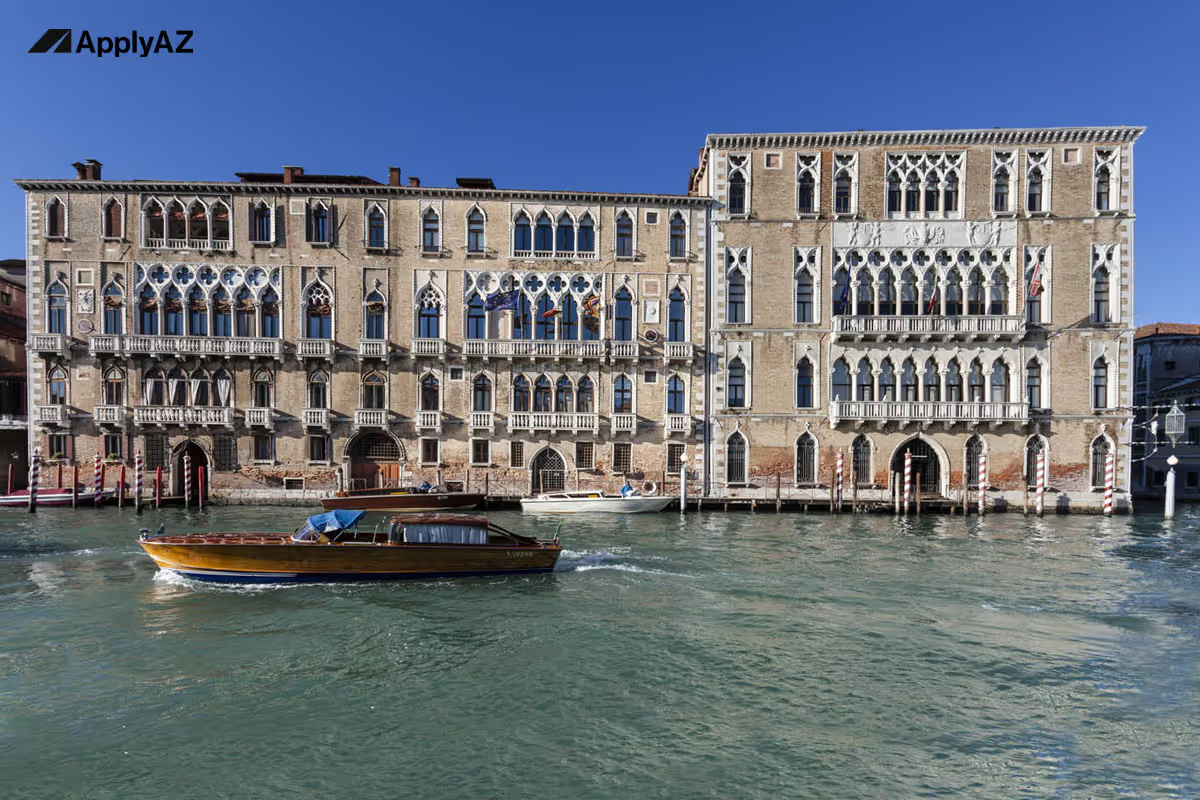
Engineering Physics is a two-year, 120 ECTS master's degree (class LM-44 R) taught in English at Ca' Foscari University of Venice, on its Scientific Campus in Mestre. Entry needs a bachelor's of at least three years with set credits in physics, maths and information engineering or computer science, a review of your CV and motivation letter, and certified English at B2 by enrolment. Non-EU students pay a flat yearly fee set by citizenship.
Entry requirements
Detailed entry requirements
Ca' Foscari's Engineering Physics master asks for a bachelor's of at least three years with set credits in physics, maths and information engineering or computer science, a positive assessment of your CV and studies, a motivation letter written for the programme, and certified English at B2 by enrolment. There is no entrance test. Reviewed 8 October 2026. [1]
Degree and credit rule
With a degree obtained abroad, you need a bachelor's of at least three years, and the Teaching Committee pre-evaluates your studies. [1]
The 2026/27 regulations accept a degree in an Italian class of information engineering (L-8), industrial engineering (L-9), physics (L-30) or mathematics (L-35), or a foreign degree recognised as suitable. Graduates of other degrees need at least 58 CFU across three areas: [1]
- At least 25 CFU in physics: sectors FIS/01 to 07.
- At least 15 CFU in mathematics: sectors MAT/01 to 09.
- At least 18 CFU in information engineering or computer science: sectors ING-INF/01 to 07 and INF/01.
The provisional 2027/28 rules on the international application portal ask every applicant for at least 60 ECTS: 15 in calculus, 25 in physical sciences and 20 in information engineering or computer science, checked by the Teaching Committee from your transcript and CV. [2] Until the 2027/28 regulations are out, we check your transcript against this 60-credit version.
Missing credits must be made up before enrolment, and only by passing single bachelor's-level courses at Ca' Foscari or another university. [1]
What this means for your transcript
Italian CFU and the credits on a foreign transcript are not the same unit: one CFU stands for 25 hours of student work, and the committee looks at your subjects, not just your total. [1] As a guide, based on the rule above:
- Usually a fit: a B.Tech in Engineering Physics, or a B.Sc. in Physics with maths, electronics and computing papers, which tend to cover all three blocks.
- Check carefully: a B.Tech or B.E. in Electronics, Electrical, Computer Science or IT. These usually cover the maths and the information engineering or computing block, but 25 physics credits need more than first-year physics.
- Often short: a BCA, B.Sc. in Computer Science or B.Sc. in Mathematics, which rarely reach 25 physics credits, and a B.Com, BBA or BA.
Assessment
The programme has open access and no entrance test. The Teaching Committee must check your personal preparation, through your CV and studies and a possible interview. It expects knowledge of mathematical analysis, classical physics, quantum and matter physics, electronic engineering, and computer engineering or computer science, at the level of an Italian bachelor's in information engineering, industrial engineering, physics or mathematics. [1]
Graduates of those Italian degree classes with a final mark of at least 85/110 are normally considered prepared. Other applicants are assessed on their CV and studies and may be called for an interview. [1] The application also needs a motivation letter written for this programme. [2]
The university's governing bodies set the number of places for non-EU students living abroad. [1]
English and Italian
Certified English at B2 or above, which you must hold at enrolment. [1] You can apply without a certificate, and Ca' Foscari does not test English during the application. Recognised certificates and exemption categories are set on Ca' Foscari's language pages, and no specific scores are listed for this programme. [2]
Students without Italian citizenship who cannot show Italian at B1 when they enrol take Italian for Foreigners (3 CFU) as part of the study plan. [1]
2026/27 admission rounds
Ca' Foscari sets visa applicants' rounds by citizenship. For 2026/27, citizens of Afghanistan, Azerbaijan, Bangladesh, Ethiopia, Gambia, India, Kyrgyzstan, Nigeria, Pakistan and Uzbekistan could apply in two rounds: [3]
- First round: 17 December 2025 to 14 January 2026, with the application fee paid by 13 January.
- Second round: 4 February to 4 March 2026, with the application fee paid by 3 March.
Visa applicants from most other countries, including Sri Lanka, Nepal, the Gulf states, the UK, the US, Singapore and Malaysia, could also use a third round from 25 March to 15 April 2026 and a fourth from 29 April to 20 May 2026. Applications closed at 1 pm CET on the last day of each round, and only the first two rounds allowed applications for Ca' Foscari's merit-based scholarships. [3]
Master's applicants hear about their first-choice programme about eight weeks after their round closes. [4] The 2027/28 rules on the portal are provisional, and the 2027/28 rounds are not yet published. [2]
Documents and non-EU steps
You apply on Ca' Foscari's online platform, where one application covers up to two programmes. You upload your transcript, CV and motivation letter, with documents not in English or Italian supplied as the original or a verified copy plus a professional translation. [2]
Applicants who pass the pre-evaluation receive a letter of enrolment eligibility, use it for Universitaly pre-enrolment and the visa request, and enrol once the visa is approved. [4]
To enrol you need your study visa and one of these: a CIMEA Statement of Comparability, a declaration of value from the Italian mission abroad, an ARDI Statement of Correspondence with a CIMEA Statement of Verification, or a Diploma Supplement from a country in the European Higher Education Area. Without one of them, enrolment is not possible. For 2026/27 the final enrolment deadline is 18 December 2026. [4]
Sources and verification
Checked by the ApplyAZ admissions team against the university's official documents listed below. Entry rules can change with each new call, and we re-check them before every application.
- Ca' Foscari University of Venice, Department of Molecular Sciences and Nanosystems. Teaching regulations, Master's degree in Engineering Physics (LM-44 R), academic year 2026/27. Reviewed 8 October 2026.
- Ca' Foscari University of Venice. Engineering Physics programme page on the international application portal, provisional rules for academic year 2027/28. Reviewed 8 October 2026.
- Ca' Foscari University of Venice. Admission rounds for non-EU applicants requiring a visa, Groups 1 and 2, academic year 2026/27. Reviewed 8 October 2026.
- Ca' Foscari University of Venice. Admission rounds notice and enrolment procedure for non-EU students who require a visa, academic year 2026/27. Reviewed 8 October 2026.
- Ca' Foscari University of Venice. Tuition fees for non-EU students, academic year 2026/27. Reviewed 8 October 2026.
- Ca' Foscari University of Venice. Engineering Physics recommended study plans for the four paths, 2026 cohort. Reviewed 8 October 2026.
- Ca' Foscari University of Venice. Engineering Physics programme page (campus, language and access). Reviewed 8 October 2026.
About the programme
Engineering Physics is a two-year master's degree in class LM-44-R (Mathematical modelling for engineering), taught entirely in English at Ca' Foscari's Scientific Campus in Venice Mestre, with the Department of Molecular Sciences and Nanosystems. [1][7]
It is worth 120 ECTS, has open admission subject to an assessment of each applicant, and attendance is not compulsory except for laboratories. [1]
The degree combines modern physics with computer and electronic engineering and applies them to quantum technologies and to the physics of complex systems, whether physical, biological or social.
It suits graduates in physics, mathematics, computer science, or information or industrial engineering who want to model and build new technologies, or to move on to international research. [1]
What you will study
You choose one of three paths, after a shared first year of core units. [1][6] Quantum Materials and Technology covers quantum computing, quantum communications and optics, and advanced materials such as superconductors.
Quantitative Biology covers bioinformatics, computational biomolecular design, biomolecular engineering, neuroimaging and bioelectronics, with a joint Physics of the Brain path run with SISSA in Trieste and open only to students selected through a separate call. [1][6]
Physics of Finance and Economics applies complexity science to economics and finance with an eye on sustainability, with units in econometrics, applied probability, financial mathematics, and climate change and finance. Course units in the 2026 study plan include: [6]
- Numerical Methods
- Statistical Mechanics
- Physics of Complex Systems
- Nanotechnology and Nanomaterials
- Advanced Electronics, with a laboratory
- Advanced Computer Science
- Bioelectronics
- Neurochemistry
- Econometrics
How the programme is taught
Alongside lectures and laboratory work, the degree includes a curricular internship at an outside institution, research lab or company, or in Ca' Foscari's own labs, and it ends with a thesis reporting on that internship work. [1] In the 2026 study plan the internship is worth 6 CFU and the thesis 21 CFU. [6] Attendance of at least 80% is compulsory for the laboratory parts of Advanced Electronics and Quantum Optics. [1]
Students can spend one or two semesters at a partner university through exchange programmes. [2] Students without Italian citizenship who cannot show Italian at B1 when they enrol take Italian for Foreigners (3 CFU) as part of the study plan. [1]
Career paths
Graduates can work in technologically advanced sectors, in production (materials, nanotechnology, biology) or in processing (numerical modelling, many-variable systems, cyber security, financial analysis). The regulations name these employers: [1]
- Large Italian and foreign companies in materials engineering, optical and quantum technologies, electronics and telecommunications
- Banks and investment funds in Italy and abroad
- Small and medium-sized firms using innovative systems and technologies
- Strategy and industrial consultancies
- Public and private research centres
- Hospitals and hospital research centres using advanced diagnostics and treatment
- Technology start-ups
The regulations describe the degree as a new professional profile outside the traditional engineering classes, so it does not give access to the Italian state exam for the engineering profession (Section A). [1]
Fees and scholarships
Ca' Foscari sets a yearly flat rate for non-EU master's students according to citizenship.
The rate differs for OECD countries, for countries on the ministry's low human development list and for all other non-EU countries, and it includes the regional tax and stamp duty. [5]
Regional scholarship recipients pay only the regional tax and the stamp duty, so this programme can be tuition-free for eligible students. [5] Applicants in the first two 2026/27 admission rounds could also apply for Ca' Foscari's merit-based scholarships for high-achieving students. [3]
How to apply from outside the EU
The Teaching Committee checks your credits in mathematics, physics and information engineering or computer science, and reads your transcript, CV and a motivation letter written for Engineering Physics. There is no entrance test, but the committee may call you for an interview. [1][2]
Applications go through Ca' Foscari's online application portal, where one application covers up to two programmes, ranked by preference. [2][4]
For 2026/27, visa applicants from India, Pakistan, Bangladesh and seven other countries could apply from 17 December 2025 to 14 January 2026 or from 4 February to 4 March 2026, while visa applicants from most other countries also had rounds until 20 May 2026. [3] The 2027/28 rounds are not yet published. [2]
With a letter of enrolment eligibility, you complete Universitaly pre-enrolment and apply for a type D study visa. For enrolment you need a CIMEA Statement of Comparability, a declaration of value, an ARDI statement with a CIMEA Statement of Verification, or a Diploma Supplement. [4]
How ApplyAZ helps
ApplyAZ is an Italy-based consultancy that works only with public universities. We can include this programme in a shortlist of 20 to 30 English-taught programmes that fit your profile, so your plan never rests on a single application.
For eligible students who start with us, a named person owns each stage, from A to Z:
- We check your transcript against Ca' Foscari's entry rules for this programme.
- We write your CV and a tailored statement of purpose.
- We prepare and submit your online application with your CV and motivation letter, and Universitaly pre-enrolment.
- We help you declare your family income for reduced fees and file your regional DSU scholarship application at the right time and in the right format.
- We prepare your visa file.
With operations in all 20 Italian regions, we follow each region's scholarship rules and deadlines as they change. The university decides admission, the region decides the scholarship and the consulate decides the visa, so no one can promise an outcome. You pay in milestones, and every service you pay for is either delivered or its fee is refunded (terms apply).
Programmes at Italian public universities can be tuition-free for eligible students. Check if you are eligible and book a one-to-one consultation session with one of our Italy experts, or see how ApplyAZ works.
Questions and answers
What bachelor's degree do I need for Engineering Physics at Ca' Foscari?
A bachelor's of at least three years. The provisional 2027/28 rules ask for at least 60 credits: 15 in calculus, 25 in physical sciences and 20 in information engineering or computer science. The 2026/27 regulations also accepted physics, mathematics, or information or industrial engineering degrees directly. [1][2]
Is there an entrance test?
No. Admission is open, and the Teaching Committee assesses your transcript, CV and motivation letter. Graduates of related Italian degree classes with at least 85/110 are normally considered prepared, and others may be called for an interview. [1][2]
What English level is required? Do I need IELTS?
Certified English at B2 or higher, which you must hold by enrolment. You can apply without a certificate, and Ca' Foscari does not test English itself. No specific scores are listed for this programme, so we check which certificate or exemption your file can use. [1][2]
When is the deadline for non-EU students?
For 2026/27, visa applicants from India, Pakistan and Bangladesh had two rounds: 17 December 2025 to 14 January 2026, and 4 February to 4 March 2026. Most other countries also had rounds until 20 May 2026. The 2027/28 rounds are not yet published. [2][3]
I have a B.Tech in Electronics or Computer Science. Can I apply?
Possibly. These degrees usually cover the maths and the information engineering or computing credits, but the rule also asks for 25 physics credits, which needs more than first-year physics. Missing credits must be made up with single bachelor's courses before enrolment. [1][2]
Which paths can I choose?
Three: Quantum Materials and Technology, Quantitative Biology, and Physics of Finance and Economics. Quantitative Biology includes a joint Physics of the Brain path with SISSA in Trieste, open only to students selected through a separate call. [1][6]
How are fees set for non-EU students?
Ca' Foscari sets a flat yearly rate for non-EU master's students by citizenship, with different rates for OECD countries, low human development countries and all other countries. The rate includes the regional tax and stamp duty. Regional scholarship recipients pay only the regional tax and stamp duty, so this programme can be tuition-free for eligible students. [5]
Does the degree qualify me as an engineer in Italy?
No. The regulations describe Engineering Physics as a new professional profile outside the traditional engineering classes, so it does not give access to the Italian state exam for the engineering profession (Section A). [1]
Can someone handle my whole application to Engineering Physics at Ca' Foscari?
Yes. ApplyAZ, an Italy-based consultancy that works only with public universities, checks your transcript against Ca' Foscari's rules for this programme, handles the application and Universitaly pre-enrolment, helps you file the regional DSU scholarship application at the right time and in the right format, and prepares your visa file, for eligible students. Start by checking your eligibility.
I'm applying from India. What is the route into Engineering Physics?
You need a bachelor's of at least three years with enough physics, maths and information engineering or computer science credits. A B.Tech in Engineering Physics, or a B.Sc. in Physics with electronics and computing papers, sits closest. You also need certified English at B2 by enrolment. Indian citizens apply in the first two admission rounds, then follow the eligibility letter and Universitaly pre-enrolment. [1][2][3] Indian students apply for the type D study visa at the Italian embassy or consulate that covers their state, such as New Delhi, Mumbai or Bengaluru.
Is the route different from Pakistan, Bangladesh or Sri Lanka?
No. The academic rules for Engineering Physics are the same whatever your nationality. Applicants from Pakistan, Bangladesh and Sri Lanka follow the same steps as India: the online application, the academic assessment, a letter of enrolment eligibility and Universitaly pre-enrolment, then a type D study visa from the Italian mission for their country of residence. Read our guide for students in Dhaka.
I live in the UAE, Saudi Arabia, Qatar, Kuwait, Oman or Bahrain. Where do I apply for the visa?
At the Italian embassy or consulate responsible for the country where you legally live, after Universitaly pre-enrolment. The academic rules for Engineering Physics are the same whatever your nationality, and Gulf residents follow the same steps: the online application, the academic assessment, a letter of enrolment eligibility and Universitaly pre-enrolment. Read our guides for Dubai, Riyadh and Doha.
I studied or live in London, New York, Toronto, Vancouver, Singapore or Kuala Lumpur. What is the route?
The academic rules for Engineering Physics are the same whatever your nationality, and your degree is assessed like any other foreign qualification. Non-EU applicants who live abroad follow the same route: the online application, the academic assessment, a letter of enrolment eligibility and Universitaly pre-enrolment, then a type D study visa from the Italian mission for where they live. Read our guides for students in London, New York, Toronto, Vancouver, Singapore and Kuala Lumpur.
More English-taught programmes at this university
Other public universities in this city

They began right where you are

