

Master in Cultural Heritage and Creativity for Tourism and Territorial Development at University of Turin
Two-year English-taught master in Biella on cultural heritage, creativity and tourism: exhibition making, film heritage curatorship, sustainable cultural industries and heritage storytelling, with electives on the Alps, fashion and industrial tourism.
Master
2 years
Turin
English
University of Turin



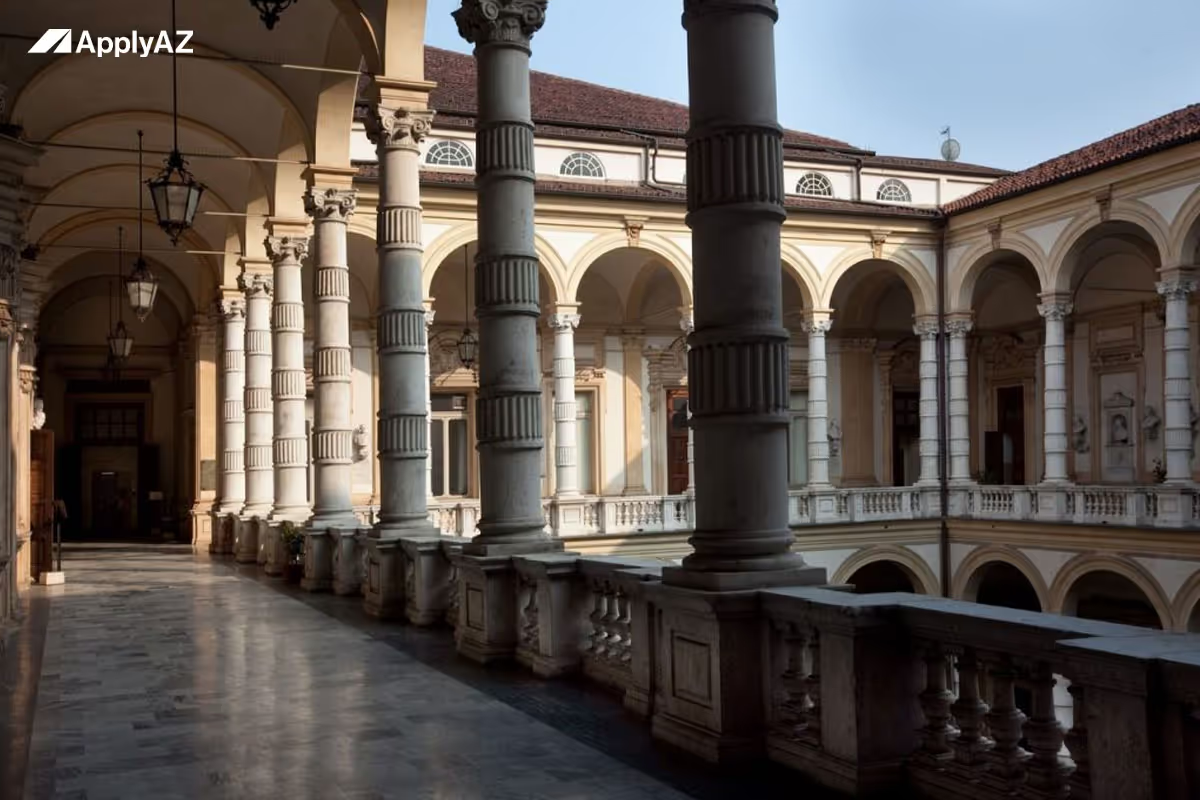
Cultural Heritage and Creativity for Tourism and Territorial Development is a two-year, 120 ECTS master's degree (class LM-49-R) taught in English by the University of Turin in Biella. Admission is by dossier and interview. Students residing abroad pay €500 to €1,500 a year by country, with zero euro tuition for eligible students.
Entry requirements
- A three-year bachelor's degree or an equivalent foreign qualification.
- At least 48 credits spread over at least three areas: history, art history, foreign languages, economics and management, law and social sciences, or territorial subjects such as geography and ecology.
- A dossier with a copy of your degree, a CV in English or Italian, an English certificate if you have one and a cover letter explaining your interest and goals.
- An admission interview that checks your preparation and, if you have no certificate, your English.
- For graduates abroad who are not native Italian speakers, basic Italian that lets you take part in student and local life.
About the programme
Cultural Heritage and Creativity for Tourism and Territorial Development is a two-year master's degree in class LM-49-R, the Italian class for the design and management of tourism systems. It is worth 120 ECTS, taught in English and run by the Department of Historical Studies at the University of Turin's seat in Biella, in Piedmont, rather than in Turin itself.
Access is open, but every applicant goes through a check of their dossier and an interview. The degree joins history, art, film, law, management and environmental studies to look at how heritage and creativity can drive tourism and the development of a territory. It suits graduates in the humanities, languages, economics or social sciences who want to work where culture meets tourism.
What you will study
The first year is a compulsory block of nine courses. In the second year you choose up to 24 ECTS of electives, take one 8 ECTS language course in French or Spanish and write an 18 ECTS thesis. Units in the 2026/27 study plan include:
- Making an Art Exhibition of Modern and Contemporary Art (8 ECTS)
- Film Heritage: Programming and Curatorship (8 ECTS)
- Research, Storytelling, Enhancement of Historical and Cultural Heritage (8 ECTS)
- Sustainability in Cultural Industries (8 ECTS)
- Introduction to Comparative Law and Cultural Development (8 ECTS)
- Environment and Climate: Resources and Threats (8 ECTS)
- Fundamentals of Management (4 ECTS) and English for Cultural Heritage and Tourism (3 ECTS)
- Electives such as Industrial Tourism and Business Culture, Fashion and Creativity, Geographies of Tourism, and a social history of the Alps
How the programme is taught
Beyond lectures, the study plan includes traineeships (a first one of 3 ECTS and a second of up to 8 ECTS), a 3 ECTS workshop in digital curatorial practices and other practical activities. Further electives cover playful design for cultural heritage, energy transition and climate change, and science, technique and work in the industrial age. International students can take Italian for beginners, and the UNITA European university alliance adds short courses and blended intensive programmes.
Career paths
The course pages we could read do not list professional profiles for this degree. What the study plan prepares you for is work in cultural heritage and tourism: curating exhibitions and film programmes, managing cultural organisations with attention to sustainability, researching and telling the story of historical heritage, and developing tourism linked to industry, fashion and the Alpine territory.
The class of the degree, the design and management of tourism systems, points in the same direction: projects that use a territory's culture to attract visitors and support local development. The traineeships are a first step into these settings.
Fees and scholarships
This degree does not appear on UniTo's list of additional contributions. For 2026/27, students residing abroad pay a fixed contribution set by the GDP per capita of their country of residence, €500 to €1,500 a year within the standard length of the degree, plus €156 for regional tax and stamp duty; students from the particularly poor countries on the ministry's list pay the €156 only. EDISU Piemonte scholarship winners have their fees refunded, which means zero euro tuition for eligible students.
How to apply from outside the EU
Prepare your dossier carefully, because it and the interview decide admission. Interviews are held at least once a year, in person or online, and are announced on the course website. Non-EU applicants residing abroad apply on Apply@UniTo, where a €60 fee covers up to two programmes; for 2026/27 the master's call ran from 25 November 2025 to 29 January 2026. Your degree and transcript need proof of authenticity.
Admitted students then complete the Universitaly pre-enrolment (by 15 July 2026 for 2026/27) and apply for a study visa, which the Italian consulate decides.
How ApplyAZ helps
If this programme fits your goals, ApplyAZ can include it in a shortlist of 20 to 30 English-taught programmes at Italian public universities. We write your CV and a tailored statement of purpose, submit your applications and Universitaly pre-enrolment, file your DSU scholarship application and prepare your visa file, with a named person on each stage. The university decides admission, the region decides the scholarship and the consulate decides the visa. See how ApplyAZ works or check your eligibility.
Questions and answers
Is this master's degree taught in English?
Yes. The degree is taught in English in Biella. Graduates abroad who are not native Italian speakers are also expected to have basic Italian, and the study plan offers an Italian course for beginners.
Where is the programme taught?
In Biella, in Piedmont, where the University of Turin has one of its seats, not in Turin itself. The degree is run by the university's Department of Historical Studies.
How does admission work?
Access is open, but you must pass a check: a dossier with your degree, CV, cover letter and any English certificate, followed by an interview on your preparation. If you have no English certificate, the interview also tests your English.
What bachelor's background do I need?
A three-year degree with at least 48 credits across at least three areas, such as history, art history, foreign languages, economics and management, law and social sciences, or geography and ecology.
How much are the fees?
For 2026/27, students residing abroad pay €500 to €1,500 a year depending on their country's GDP per capita, plus €156 in regional tax and stamp duty. EDISU Piemonte scholarship winners have their fees refunded.
When can I apply?
For 2026/27 the call for non-EU applicants residing abroad ran on Apply@UniTo from 25 November 2025 to 29 January 2026. The 2027/28 calendar was not yet published in September 2026.
Similar programmes
More programmes in this city

They began right where you are

