

Master in Comparative International Relations at Ca’ Foscari University of Venice
Two-year international relations master at Ca' Foscari in Venice with two English-taught curricula, European Union Studies and Global Studies, combining history, law, economics, politics and languages, with a 6 ECTS internship.
Master
2 years
Venice
Multiple
Ca’ Foscari University of Venice


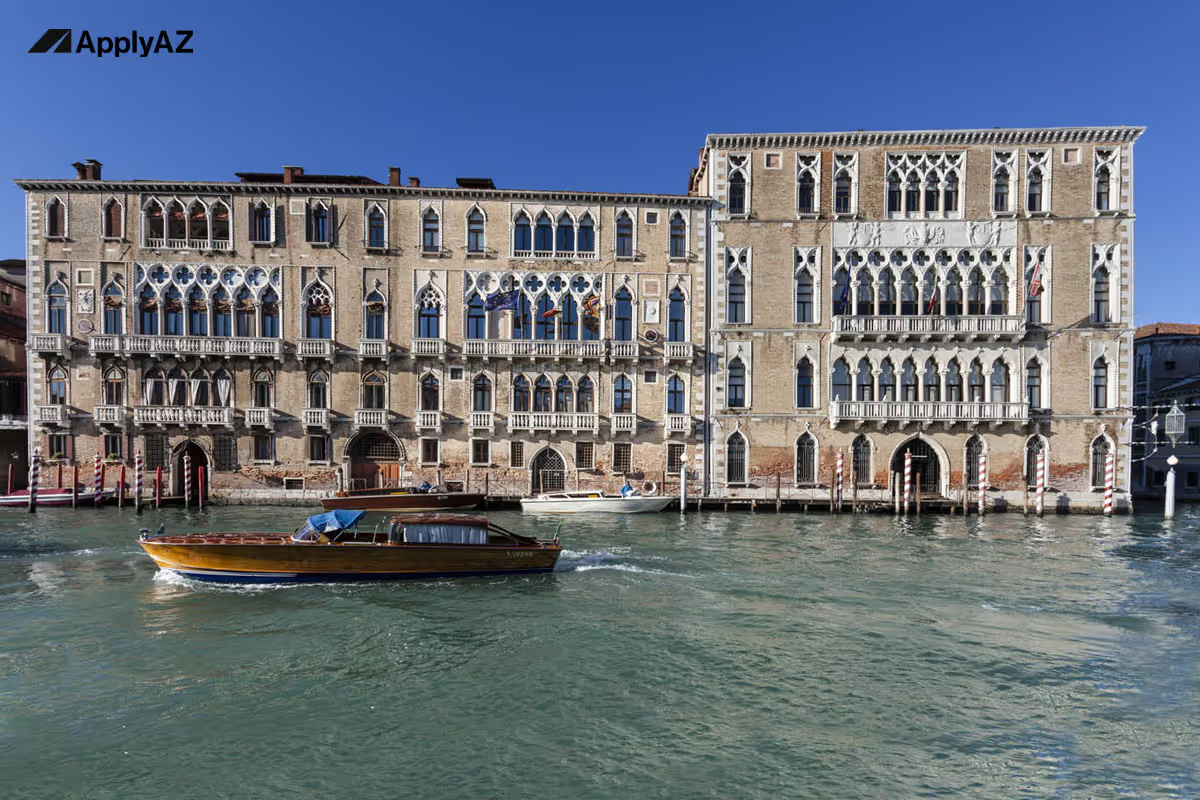
Comparative International Relations is a two-year, 120 ECTS master's degree (class LM-52-R) at Ca' Foscari University of Venice. Two of its curricula, European Union Studies and Global Studies, are taught in English. Admission is on CV, grades and a motivation letter, and non-EU students pay a flat fee by citizenship, with exemption for eligible scholarship applicants.
Entry requirements
Detailed entry requirements
This degree has five curricula. European Union Studies and Global Studies are the English-taught paths; the other regional curricula have their own study-language conditions. The official international listing contains provisional 2027/28 information, while the local admission page gives 2026/27 procedures. Sources were reviewed on 6 October 2026.
International CGPA and the 36-ECTS curriculum requirement
The provisional international listing requires a relevant minimum three-year undergraduate degree and a minimum CGPA of 70%. Grades are quantified using the home institution’s official numerical scale if supplied; otherwise they are proportionally converted to a percentage. Meeting the CGPA condition does not remove subject-credit or language requirements. [1]
Your prior study must contain at least 36 ECTS or equivalent, representing no less than 20% of all coursework. All four subject groups below are mandatory, plus the additional 12 credits. The Teaching Committee evaluates transcript and CV and can require an additional interview if credit coverage or preparation is unclear. [1]
- At least 6 ECTS in law. The detailed local list includes comparative private, constitutional/public, international, EU and comparative public law. [1, 2]
- At least 6 ECTS in economics, including political economics, economic policy or business economics/management. [1, 2]
- At least 6 ECTS in contemporary history, history of Islamic countries, history of Eastern/South-Eastern Asia and/or economic history. [1]
- At least 6 ECTS in the listed international or regional history/institutions subjects: history of economic thought; American history and institutions; history of international relations; African history and institutions; or Asian history and institutions. The university assesses the relevant subject mapping. [1]
- At least 12 additional ECTS across the eligible fields. The detailed local fifth-field list additionally includes private/business/administrative law, finance/applied economics and modern/Eastern European history. The total minimum remains 36 credits. [1, 2]
Second language B1 and personal-preparation assessment
English B2 is required alongside B1 in a second language accepted by the chosen curriculum. For European Union Studies choose French, Portuguese, Spanish or German; for Global Studies choose French, Portuguese, Russian or Spanish. [1, 2]
For the other regional curricula, the admission webpage lists Spanish/Portuguese/French for The Americas; Chinese/French/Japanese/Portuguese/Russian/Spanish for East Asia; and Russian/German/Serbian and Croatian for Eastern Europe. We help you choose the curriculum before arranging second-language evidence. [2]
Accepted second-language evidence includes an official certificate; a third-year examination in a bachelor’s programme; a university exam whose syllabus explicitly states a B1 exit level; five years of secondary-school study in that language; or a language course certifying B1 on completion. [2]
The local webpage generally presumes adequate personal preparation for a candidate with an official second-language certificate and a final degree mark of 90/110. Candidates without both are assessed from their academic CV and records, with an interview possible. This local presumption is distinct from the international listing’s provisional 70% CGPA minimum and does not make every lower local mark an automatic rejection. [1, 2]
Recognised foreign degree and country-specific qualification rules
For admission to a master’s degree, the qualifying award must be equivalent to an Italian bachelor’s degree: at least three years, 180 ECTS or equivalent, issued by an accredited institution and normally permitting further academic study in its home system. The Welcome Unit checks the award’s eligibility before the Teaching Committee assesses academic preparation. Not every qualification called a bachelor’s degree meets these conditions. [1, 3, 4]
Country examples in the official qualification guide include: India, at least a three-year Honours bachelor’s degree, at least a four-year professional bachelor’s degree, or a Pass/General bachelor’s plus a postgraduate bachelor’s or two-year master’s; Pakistan, a three-year Honours bachelor’s, at least a four-year professional bachelor’s, or a two-year Pass bachelor’s plus a two-year postgraduate bachelor’s; China, an academic Benke bachelor’s with both degree and graduation certificates. Transcripts for all years are required. These examples concern recognised award types; the programme-specific CGPA condition is separate. The university assesses other systems and combinations individually. [3]
Ca’ Foscari treats one CFU as one ECTS. For qualifications from education systems outside the Bologna framework, the Teaching Committee assesses course workload and content when comparing credits. We supply your transcript, credit or contact-hour information and any requested syllabi, rather than assuming that a home-university credit equals one ECTS. [2, 3]
English B2: certificates, scores and exemptions
English at CEFR B2 is mandatory by the enrolment deadline for this programme. You can apply while the language certificate is pending, but cannot complete enrolment without accepted evidence or a documented exemption. The international application does not include a university English assessment test. The general university policy separately offers fee-paying CLA courses/tests; those are not a substitute for submitting the required evidence in the application or enrolment tasks. [1, 2, 6]
Recognised certificates must be submitted within five years of achievement, clearly attest the achieved level, and satisfy the four-skill evidence rule. A failed higher-level exam is not automatically accepted as proof of a lower level. The current university table gives the following B2 bands and qualifications; accepted higher CEFR qualifications can also demonstrate the required minimum. [5, 6]
- IELTS: B2 score band 5.5-6.5. TOEFL iBT: B2 band 72-94 on the old scale, or 4-4.5 for examinations taken on or after 21 January 2026. [5]
- PTE Academic: B2 band 59-75; Cambridge First/FCE; Trinity ISE II; Pearson General Level 3; Oxford Test of English B2; LanguageCert International ESOL Level 1; Gatehouse Classic Level 1; and British Council Aptis ESOL General or Advanced at B2. The table also recognises specified Ca’ Foscari CLA certificates at B2.2. [5]
- Exemption routes include an entire school or university qualification taught in English in Italy or abroad; qualifying completed study or at least one college year in a country where English is the medium of instruction; or a full secondary-school exchange year taught in English. We document the exact route. [6]
- Specified Italian foreign-language or linguistic-mediation degrees can also qualify when they include the required three-year English-language study path. A generic degree title or an unsupported statement that you speak English does not establish this exemption. [6]
International application documents and pending graduation
- Valid passport; eligible European applicants may use an identity card. Non-European applicants residing in Italy or the Schengen Area must provide the applicable residence permit or documented renewal/first-request receipt. [3]
- Transcripts covering every undergraduate year, including an official provisional transcript if still studying; a CV; and a motivation letter specifically addressing this programme. We include every additional mandatory task shown in the application. A missing mandatory document leads to immediate rejection. [1, 3]
- We provide your institution’s official CGPA grading scale, which the university highly recommends for accurate comparison. The Teaching Committee may request detailed course descriptions or syllabi. The reviewed checklist does not impose a universal reference-letter requirement. [1, 3]
- If degree or transcript documents are not in English or Italian, we upload the originals or verified copies together with professional English or Italian translations. The translation must display the sworn translator’s signature/stamp or the translation agency’s letterhead. [1, 3]
- Applicants awaiting a final qualification may submit the permitted provisional documents, including their translations, and must provide the final version by the applicable enrolment deadline. An offer may be conditional on graduation, missing subject credits or language evidence. [3, 4]
Application priorities, fee and latest published intake information
International qualifications use the university’s Apply platform regardless of citizenship. A single application may rank up to two programmes: the first choice is assessed first and the second is assessed only if admission to the first is refused. Only one application in one round is allowed for the academic year, and priorities cannot be reordered after submission. The application fee must be settled before submission unless an approved exemption applies. [3, 4]
The current programme listing explicitly labels its 2027/28 admission information provisional, to be confirmed in autumn. At the review date it displays no active application deadline. The central webpage still describes 2026/27 rounds, which opened on 17 December 2025 and depend on applicant category. That opening date, the local Italian-degree evaluation dates and the pending 2027/28 calendar are not interchangeable. We follow the programme’s active category-specific round once published. [1, 4]
The application fee exemption policy covers specified prior Ca’ Foscari students, previous exchange/visiting/free-mover students and applicants with official refugee status within Schengen. Supporting evidence and the prescribed exemption code are due at least seven working days before the round deadline. [4]
Final documents, conditional offers and study-visa applicants
A letter of enrolment eligibility does not itself complete enrolment. Enrolment needs the final bachelor’s diploma and full transcript with required translations, accepted language evidence, any programme-specific conditions and an accepted qualification-comparison document. Alternatives are CIMEA Comparability; a Declaration of Value; an ARDI Statement of Correspondence together with CIMEA Verification; or an eligible international-model Diploma Supplement from an EHEA institution. If more than one award was used to establish entry eligibility, the university requires the corresponding evidence for each. Some documents are optional at initial application but mandatory at final enrolment. [3, 4, 7, 8]
Non-European applicants who require a study visa must obtain university eligibility, complete Universitaly pre-enrolment for the exact accepted programme, follow the visa procedure, and provide the study visa for enrolment. Eligible non-European residents using the European-equivalent route instead provide a valid residence permit allowing university enrolment. Citizenship, residence and permit type determine the procedure; a foreign degree alone does not determine whether a visa is required. [7, 8]
For 2026/27, the visa-dependent enrolment page gives an absolute final deadline of 18 December 2026. The European/equivalent page gives 30 September 2026 for open-access master’s enrolment, extended to 18 December with a late fee. These are enrolment dates for 2026/27, not confirmed application or enrolment deadlines for 2027/28. Scholarship deadlines can be earlier. [7, 8]
Separate 2026/27 evaluation procedure for Italian qualifications
The programme’s admission page gives three requirements-evaluation sessions: 7 April-4 June 2026, with results on 25 June; 6 July-20 August, results on 10 September; and 1 October-17 November, results on 4 December. All applicants with a bachelor’s degree obtained in Italy must submit the relevant evaluation request; foreign qualifications use the international procedure and its distinct deadlines. These are the published 2026 dates. [2]
For the local evaluation, applicants upload a signed degree/examination self-certification, or a signed enrolment/examination self-certification if graduating later; a CV; available language evidence; and any requested syllabi or useful additional documents. Records must identify the university, degree class and title, graduation details or pending status, examinations, subject sectors and credits. Graduands state their weighted average in place of the final degree grade. The application confirmation code identifies evaluation results. [2]
Positive evaluation is required before enrolment. The programme page gives 1 July-30 September 2026 as the ordinary enrolment period and 1 October-18 December as the additional period. Late enrolment carries a surcharge, with an exemption for eligible autumn-session graduates. Missing curricular credits must be obtained before enrolment through suitable bachelor’s-level single courses at Ca’ Foscari or another accredited institution. Credit-recognition requests have a separate procedure and are made concurrently where applicable. [2]
Italian language: curriculum choice and graduation obligation
For an English-taught curriculum, non-Italian students normally earn 3 CFU in Italian before graduation unless they document B1 proficiency or another accepted exemption. This study obligation is separate from the second foreign language B1 required for admission. Non-EU international students choosing an Italian-taught curriculum instead need Italian B2 at enrolment, demonstrated by an accepted certificate, the university’s test or an applicable documented exemption. [2, 9]
Sources and verification
- Ca’ Foscari University of Venice, Apply: Comparative International Relations, provisional 2027/28 information; reviewed 6 October 2026. Publication date is not stated.
- Ca’ Foscari University of Venice, Comparative International Relations: Admission and enrolment, current webpage with 2026/27 procedural dates; reviewed 6 October 2026.
- Ca’ Foscari University of Venice, Entry requirements for applicants with an international qualification, current webpage; reviewed 6 October 2026.
- Ca’ Foscari University of Venice, Preliminary evaluation of international qualifications, last updated 30 September 2026.
- Ca’ Foscari University of Venice, Recognised Certifications, last updated 23 September 2026.
- Ca’ Foscari University of Venice, Master’s Degree Programmes: Language requirements, last updated 23 September 2026.
- Ca’ Foscari University of Venice, Enrolment for non-European students who require a visa, 2026/27 guidance, last updated 23 September 2026.
- Ca’ Foscari University of Venice, Enrolment for European students and equivalent, 2026/27 guidance; reviewed 6 October 2026.
- Ca’ Foscari University of Venice, Italian language competence, last updated 23 September 2026.
About the programme
Comparative International Relations is a two-year master's degree in class LM-52-R (International Relations), taught at Ca' Foscari in Venice.
The degree is Italian and English: of its five curricula, European Union Studies and Global Studies are taught in English, while The Americas, East Asia and Eastern Europe are not English paths.
It carries 120 ECTS, has open access with an assessment of each applicant, and attendance is not compulsory.
The degree trains specialists in international relations through a critical, interdisciplinary and comparative approach grounded in economics, history, law and politics, with advanced study of languages.
It suits graduates in political science, law, economics or history who want an international career and can already work in a second foreign language.
What you will study
Both English curricula share advanced courses in international law, international political economy, the history of international relations, international politics, and political concepts and methods, plus two language courses.
European Union Studies then focuses on European institutions and history, while Global Studies looks at global history, migration and global negotiations. Units in the 2025/26 cohort plans include:
- International Law Advanced Course
- International Political Economy
- European Union Politics and European Union Law (European Union Studies)
- History of European Constitutionalism and European Political History (European Union Studies)
- Global History and Political Ideas and World History (Global Studies)
- Migration and Citizenship (Global Studies)
- Global Negotiations or Global Change and Sustainability (Global Studies)
- Critical Thinking
How the programme is taught
The second year includes 12 ECTS of electives, a 6 ECTS internship and a 24 ECTS thesis. Internships can take place abroad, including through programmes with the Italian foreign ministry, the UN and other international organisations.
Exchanges run through Erasmus+ and the Overseas programme, and the degree lists a double degree with the University of Ljubljana.
Career paths
Graduates work in international organisations, in public and private bodies with an international focus, and in research and communication at study centres and research institutes. Fields named by the university include:
- International organisations and public service
- Public relations and image management
- Journalism
- International marketing
- Research on international relations
Fees and scholarships
For master's degrees in 2026/27, Ca' Foscari charges non-EU students a flat yearly rate that depends on their country, with regional tax and stamp duty included.
Students who qualify for the Veneto regional scholarship on an ISEE parificato (2026/27 ISEE limit €26,306.25) are fully exempt, so this programme can be tuition-free for eligible students.
Applicants with a CGPA of 85% or more can also seek merit aid in the first two admission rounds.
How to apply from outside the EU
Applicants with a foreign qualification use Ca’ Foscari’s international application procedure. The Teaching Committee reviews your transcript, curriculum, grades, CV and programme-specific motivation letter. Applicants must meet the applicable language conditions and every final-enrolment requirement. The detailed entry section distinguishes provisional 2027/28 information from the published 2026/27 dates. [1-8]
How ApplyAZ helps
ApplyAZ is an Italy-based consultancy that works only with public universities. We can include this programme in a shortlist of 20 to 30 English-taught programmes that fit your profile, so your plan never rests on a single application.
For eligible students who start with us, a named person owns each stage, from A to Z:
- We check your transcript against Ca' Foscari's entry rules for this programme.
- We write your CV and a tailored statement of purpose.
- We prepare and submit your application on the Apply platform, motivation letter and Universitaly pre-enrolment.
- We help you declare your family income for reduced fees and file your regional DSU scholarship application at the right time and in the right format.
- We prepare your visa file.
With operations in all 20 Italian regions, we follow each region's scholarship rules and deadlines as they change. The university decides admission, the region decides the scholarship and the consulate decides the visa, so no one can promise an outcome. You pay in milestones, and every service you pay for is either delivered or its fee is refunded (terms apply).
Programmes at Italian public universities can be tuition-free for eligible students. Check if you are eligible and book a one-to-one consultation session with one of our Italy experts, or see how ApplyAZ works.
Questions and answers
What CGPA is required?
The provisional 2027/28 international listing states 70%. The university uses your institution’s official numerical grading scale where supplied. You must also satisfy the 36-ECTS subject distribution, degree-recognition and language conditions.
Which subjects must my degree include?
At least 36 ECTS or equivalent: 6 each in law, economics, the listed contemporary/regional history subjects and international/regional history or institutions, plus 12 additional eligible credits. All groups are mandatory; the international listing also requires at least 20% of your coursework.
Do I need a second foreign language?
Yes, at B1. European Union Studies accepts French, Portuguese, Spanish or German. Global Studies accepts French, Portuguese, Russian or Spanish. English B2 is an additional requirement.
Is there an interview?
The Teaching Committee can request an additional interview when curricular coverage or personal preparation cannot be established from your transcript and CV. The reviewed listing does not impose one fixed interview on every applicant.
Can I apply before obtaining English certification?
Yes, but accepted English B2 evidence or a documented exemption is mandatory by enrolment. The current recognised table includes IELTS B2 at 5.5-6.5, TOEFL iBT 72-94 or the new 4-4.5 band, and PTE Academic 59-75.
Are 2027/28 application dates confirmed?
The reviewed international listing labels its 2027/28 information provisional and displays no active deadline. We follow the published category-specific round when it is available. The local 2026 evaluation sessions are a separate procedure for Italian qualifications.
Can someone handle my whole application to Comparative International Relations at Ca' Foscari?
Yes. ApplyAZ, an Italy-based consultancy that works only with public universities, checks your transcript against Ca' Foscari's rules for this programme, handles the application and Universitaly pre-enrolment, helps you file the regional DSU scholarship application at the right time and in the right format, and prepares your visa file, for eligible students. Start by checking your eligibility.
I'm applying from India. What is the route into Comparative International Relations?
For India, the official qualification guide lists at least a three-year Honours bachelor's, at least a four-year professional bachelor's, or a Pass bachelor's plus a postgraduate bachelor's or two-year master's [3]. You also need a 70% CGPA, at least 36 ECTS across the law, economics and history groups, English B2 and a second language at B1 [1][2]. The steps are an application on the Apply platform, a Teaching Committee evaluation and Universitaly pre-enrolment. Indian students apply for the type D study visa at the Italian embassy or consulate that covers their state, such as New Delhi, Mumbai or Bengaluru.
Is the route different from Pakistan, Bangladesh or Sri Lanka?
No. The academic rules for Comparative International Relations are the same whatever your nationality. Applicants from Pakistan, Bangladesh and Sri Lanka follow the same steps as India: an application on the Apply platform, a Teaching Committee evaluation and Universitaly pre-enrolment, then a type D study visa from the Italian mission for their country of residence. Read our guide for students in Dhaka.
I live in the UAE, Saudi Arabia, Qatar, Kuwait, Oman or Bahrain. Where do I apply for the visa?
At the Italian embassy or consulate responsible for the country where you legally live, after Universitaly pre-enrolment. The academic rules for Comparative International Relations are the same whatever your nationality, and Gulf residents follow the same steps: an application on the Apply platform, a Teaching Committee evaluation and Universitaly pre-enrolment. Read our guides for Dubai, Riyadh and Doha.
I studied or live in London, New York, Toronto, Vancouver, Singapore or Kuala Lumpur. What is the route?
The academic rules for Comparative International Relations are the same whatever your nationality, and your degree is assessed like any other foreign qualification. Non-EU applicants who live abroad follow the same route: an application on the Apply platform, a Teaching Committee evaluation and Universitaly pre-enrolment, then a type D study visa from the Italian mission for where they live. Read our guides for students in London, New York, Toronto, Vancouver, Singapore and Kuala Lumpur.
More English-taught programmes at this university
Other public universities in this city

They began right where you are

