

Bachelor in Maritime Science and Technology at University of Genoa
Three-year English-taught L-28-R bachelor's in maritime science and technology at the University of Genoa, with Deck Officer and Marine Engineer and Electrotechnical Officer curricula and an 18 ECTS professional internship. Access is open and tuition depends on family income.
Bachelor
3 years
Genoa
English
University of Genoa



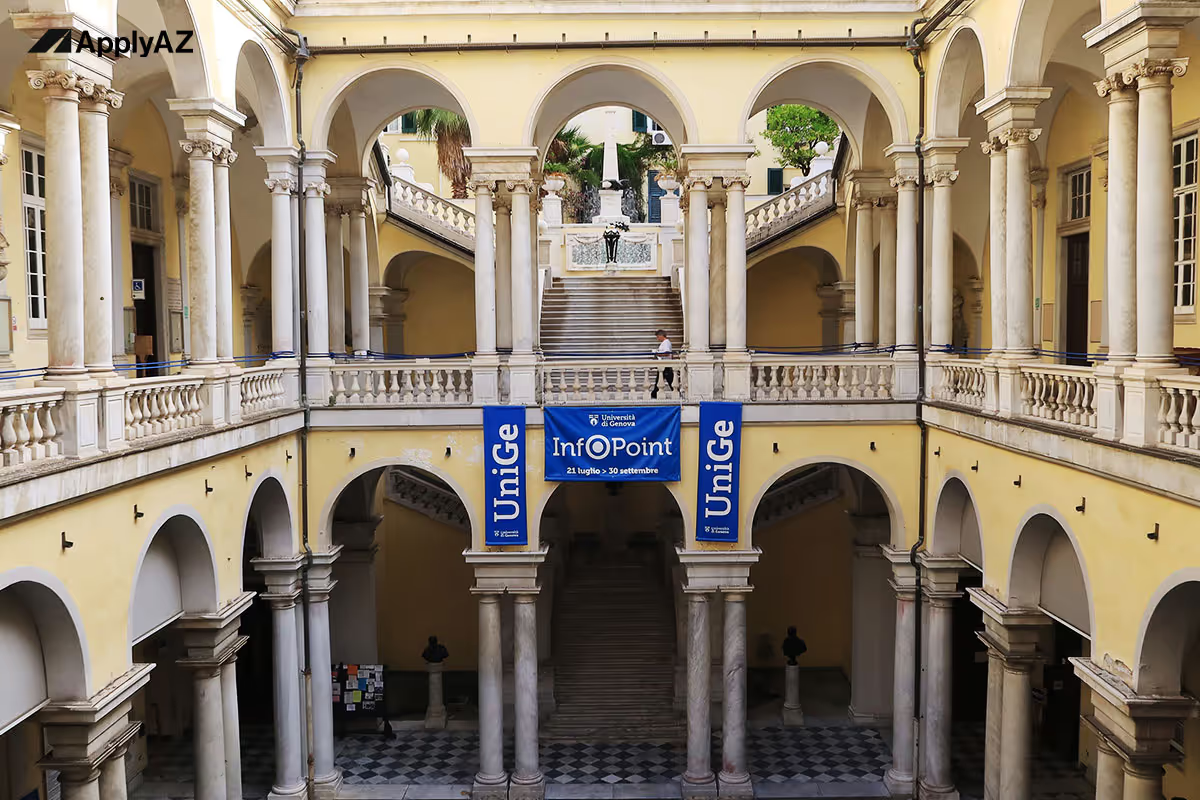
Maritime Science and Technology is a three-year, 180 ECTS bachelor's degree (class L-28-R) taught in English at the University of Genoa, with Deck Officer and Marine Engineer and Electrotechnical Officer curricula. Entry needs a school diploma after 12 years of schooling and English at B2, with non-selective entry tests. Fees follow family income, so it can be tuition-free for eligible students.
Entry requirements
Detailed entry requirements
Genoa's Maritime Science and Technology bachelor asks for a school diploma after at least 12 years of schooling, recognised as suitable for university entry, and English at B2. Access is open: two tests in English check your English and your logic, maths and maritime knowledge, and a low score adds an OFA. Reviewed 8 October 2026. [1]
School-leaving requirement
You need a secondary (high) school diploma, or an equivalent qualification obtained abroad and recognised by the university. [1]
- Length of schooling: at least 12 years in total. If your system has fewer years, you need proof of a foundation year or of passing all first-year or second-year university examinations, depending on the years missing. [2]
- Grades: no minimum grade is set. You enter your final grade and grading scale on UniGeApply. [2]
- Still at school: for 2026/27 the diploma had to be obtained by 15 August 2026. [2]
What this means for your school results
As a guide, based on the rule above:
- Usually a fit: Indian Class 12 from CBSE, ISC or a state board, Pakistani HSSC, Bangladeshi HSC and A levels, where they complete 12 years of schooling.
- Check carefully: modest maths or physics marks. There is no minimum grade, but the entry test covers logic and basic maths, and the first year starts with mathematics, algebra, physics and chemistry.
- Often short: Class 10, Matric, SSC or O levels on their own, which come before 12 years of schooling. These need a foundation year or university examinations first.
English
English at B2 is one of the required competences, and the programme checks it with an English test. [1]
- Exempt from the English test: students with a B2 or higher certificate recognised by the university, or a letter from their school confirming that English was the medium of instruction. The letter counts only if all the years of study leading to your diploma were in English.
- On UniGeApply: for visa applicants, uploading a B2 certificate or medium of instruction proof is optional but recommended. [2]
Initial preparation tests
Two tests, both in English, check your initial preparation: one for English at B2 and one for logical reasoning, basic mathematics, and general, logical-mathematical and maritime knowledge. The procedures and the threshold are set each year in a notice on the programme's web page. [1]
- Below the threshold: you can still enrol, with an OFA. You clear it within the first year by passing at least 6 credits in one first-year basic course, such as Mathematics, Algebra, Physics, Chemistry, Analytics and Optimization Methods, or ICT and AI.
- If the OFA is still open at the deadline for the second-year study plan, you re-enrol in the first year.
A CEnT, TOLC, SAT or ACT result from the last three years is recommended in your UniGeApply file, with no minimum score. [2]
2026/27 deadlines
For 2026/27, visa applicants could submit UniGeApply requests from 26 November 2025 to 20 March 2026, with outcomes due by 22 May 2026. Universitaly visa applications were expected to run from March or April to June 2026. [3]
The 2027/28 calendar is not yet published, and it will set the new dates.
Documents and non-EU steps
Non-EU applicants living abroad with a foreign diploma first request an evaluation on UniGeApply, for up to two programmes. [3]
- Mandatory: your passport, a CV, and your school diploma or, if you are still at school, your final-year transcript, with a school statement of your expected graduation date if possible. [2][3]
- Recommended for visa applicants: a B2 English or medium of instruction certificate, transcripts for the last three years, a CEnT, TOLC, SAT or ACT result, and a motivation letter and recommendation letter. [2]
Documents not in Italian, English, French, Spanish or Portuguese need a translation. The evaluation can take from a few weeks to two months. [2]
After an accepted or conditionally accepted outcome comes the Universitaly visa application, for one university and one programme only, and then pre-enrolment for the same programme on UniGe online services. [3]
Sources and verification
Checked by the ApplyAZ admissions team against the university's official documents listed below. Entry rules can change with each new call, and we re-check them before every application.
- University of Genoa, Polytechnic School, Department of Naval, Electrical, Electronic and Telecommunications Engineering (DITEN). Degree regulations, Bachelor's degree in Maritime Science and Technology (L-28), cohort 2026/2027, with the list of teaching units. Reviewed 8 October 2026.
- University of Genoa. UniGeApply international admissions, selection for academic year 2026/27: students with a foreign qualification, access to bachelor's degrees taught in English. Reviewed 8 October 2026.
- University of Genoa. UniGeApply: application windows, fees and next steps for international applicants, 2026/27 cycle. Reviewed 8 October 2026.
About the programme
Maritime Science and Technology is a three-year bachelor's degree at the University of Genoa in class L-28-R, worth 180 ECTS. Teaching is entirely in English, which the university describes as the official language of the maritime sector. Access is open, without a limited number of places. Two tests in English check your initial preparation, one for B2 English and one for logic, maths and general and maritime knowledge, and a low score adds extra first-year work rather than blocking enrolment. [1]
There are two curricula, built on the international STCW Convention for seafarers:
- Deck Officer: the competences in sections A-II/1 and A-II/2, focused on navigation and ship management.
- Marine Engineer and Electrotechnical Officer: the competences in sections A-III/1, A-III/2 and A-III/6.
What you will study
The early part of the degree raises your mathematical, scientific and logical skills through 45 ECTS of basic activities and 45 ECTS of core activities, so that you can follow the maritime subjects that come next. The plan also includes English, laboratory training and a final thesis written in English. For the 2026/27 cohort the degree uses a blended model: part of the teaching is in person and part online, while examinations are held in person. [1] Courses taught in English have included Automation and Control for Electric Marine Applications in the second year.
The degree includes an 18 ECTS maritime professional internship of 450 hours, managed at the end of the programme and approved by the degree board. Recognised activities include on board service as a cadet or above, an internship with a maritime company, support work in university labs and recognised professional courses. [1] Students with a valid seaman's book can train on board as cadets; others do the internship with companies in the maritime or naval sector.
One point to check early: the programme covers the STCW subjects but is not recognised as an STCW programme by the Italian Maritime Authority, and under Italian law the navigation licence is issued only to Italian citizens with a nautical diploma. If you want to serve as a ship's officer, recognition of this degree for the licence is decided by the maritime authority in your own country.
Career paths
After at least 12 months on board, graduates can prepare for the examinations for marine engineer, electrotechnical officer or deck officer, and after 24 to 36 months as an officer, for management level. Others take technical management roles with maritime companies or continue to master's degrees in engineering, maritime economics or transport and logistics.
Fees and scholarships
Tuition at the University of Genoa depends on family income, declared through an ISEE-U. If your family lives abroad, you obtain an ISEE-U parificato, free of charge, from a CAF affiliated with the university. Fees are paid only after you arrive in Italy. Eligible students can apply for a regional scholarship from ALiSEO, which decides awards each year, so the programme can be tuition-free for eligible students.
How to apply from outside the EU
With a foreign school qualification, we first request an evaluation on UniGeApply, the university's international admissions portal, for up to two programmes. For 2026/27, applicants who needed a visa could apply from 26 November 2025 to 20 March 2026. The 2027/28 dates are not yet published.
You need a school qualification after at least 12 years of schooling and English at B2. For visa applicants, a B2 certificate or proof that English was your medium of instruction is optional on UniGeApply but recommended; without one, you sit the programme's English test. [1][2] We upload your CV, diploma, transcripts for the last three years, a motivation letter and a recommendation letter. CEnT, TOLC, SAT or ACT results are recommended but not required, and no minimum score is set. The evaluation can take from a few weeks to two months.
If you live outside the EU and need a study visa, the university first evaluates your application. After a positive outcome we complete pre-enrolment on Universitaly, and you apply for a type D study visa at the Italian consulate or visa centre.
How ApplyAZ helps
ApplyAZ is an Italy-based consultancy that works only with public universities. We can include this programme in a shortlist of 20 to 30 English-taught programmes that fit your profile, so your plan never rests on a single application.
For eligible students who start with us, a named person owns each stage, from A to Z:
- We check your school results against Genoa's entry rules for this programme.
- We write your CV and a tailored statement of purpose.
- We prepare and submit your UniGeApply evaluation request, Universitaly visa application and UniGe pre-enrolment.
- We help you declare your family income for reduced fees and file your ALiSEO Liguria scholarship application at the right time and in the right format.
- We prepare your visa file.
With operations in all 20 Italian regions, we follow each region's scholarship rules and deadlines as they change. The university decides admission, the region decides the scholarship and the consulate decides the visa, so no one can promise an outcome. You pay in milestones, and every service you pay for is either delivered or its fee is refunded (terms apply).
Programmes at Italian public universities can be tuition-free for eligible students. Check if you are eligible and book a one-to-one consultation session with one of our Italy experts, or see how ApplyAZ works.
Questions and answers
What school results do I need for Maritime Science and Technology at Genoa?
A school diploma recognised for university entry after at least 12 years of schooling, plus English at B2. No minimum grade is set, and you enter your final grade and grading scale in your UniGeApply file. [1][2]
Is there an entrance test?
Access is open. Two tests in English check B2 English and your logic, basic maths, and general and maritime knowledge. Below the threshold you can still enrol with an OFA, cleared by passing 6 credits in a first-year basic course. [1]
What English level do I need? Do I need IELTS?
English at B2. A B2 certificate recognised by the university exempts you from the English test, and so does a medium of instruction letter if all your school years were in English. Without either, you sit the programme's English test. [1]
When is the deadline for non-EU students?
For 2026/27, visa applicants applied on UniGeApply from 26 November 2025 to 20 March 2026, with outcomes due by 22 May 2026. The 2027/28 dates are not yet published. [3]
Can I apply before I finish Class 12?
Yes. You upload your final-year transcript and, if possible, a school statement with your expected graduation date. For 2026/27 the diploma had to be obtained by 15 August 2026. [2]
Which curricula can I choose?
Two: Deck Officer, and Marine Engineer and Electrotechnical Officer. Units include navigation, ship propulsion, ship stability and manoeuvrability, shipboard power systems, electric machines, international maritime law and ship management. [1]
Is there on board training?
The degree includes an 18 ECTS maritime professional internship of 450 hours, approved by the degree board. On board service as a cadet or above counts, as do internships with maritime companies, university lab work and recognised professional courses. [1]
How is the course taught?
In English, with a blended model for the 2026/27 cohort: part of the teaching is in person and part online. Examinations and the final examination are held in person, and the thesis is written in English. [1]
Can someone handle my whole application to Maritime Science and Technology at Genoa?
Yes. ApplyAZ, an Italy-based consultancy that works only with public universities, checks your school results against Genoa's rules for this programme, handles the application and Universitaly pre-enrolment, helps you file the ALiSEO Liguria scholarship application at the right time and in the right format, and prepares your visa file, for eligible students. Start by checking your eligibility.
I'm applying from India. What is the route into Maritime Science and Technology?
Indian Class 12 results from CBSE, ISC or a state board come after 12 years of schooling, which matches the school-length rule, and no minimum grade is set. You need B2 English, shown by a recognised certificate, a medium of instruction letter if all your school years were in English, or the programme's English test. The steps are the UniGeApply evaluation, Universitaly and UniGe pre-enrolment. [1][2] Indian students apply for the type D study visa at the Italian embassy or consulate that covers their state, such as New Delhi, Mumbai or Bengaluru.
Is the route different from Pakistan, Bangladesh or Sri Lanka?
No. The academic rules for Maritime Science and Technology are the same whatever your nationality. Applicants from Pakistan, Bangladesh and Sri Lanka follow the same steps as India: UniGeApply evaluation, Universitaly application and UniGe pre-enrolment, then a type D study visa from the Italian mission for their country of residence. Read our guide for students in Dhaka.
I live in the UAE, Saudi Arabia, Qatar, Kuwait, Oman or Bahrain. Where do I apply for the visa?
At the Italian embassy or consulate responsible for the country where you legally live, after Universitaly pre-enrolment. The academic rules for Maritime Science and Technology are the same whatever your nationality, and Gulf residents follow the same steps: UniGeApply evaluation, Universitaly application and UniGe pre-enrolment. Read our guides for Dubai, Riyadh and Doha.
I studied or live in London, New York, Toronto, Vancouver, Singapore or Kuala Lumpur. What is the route?
The academic rules for Maritime Science and Technology are the same whatever your nationality, and your school results are assessed like any other foreign qualification. Non-EU applicants who live abroad follow the same route: UniGeApply evaluation, Universitaly application and UniGe pre-enrolment, then a type D study visa from the Italian mission for where they live. Read our guides for students in London, New York, Toronto, Vancouver, Singapore and Kuala Lumpur.
More English-taught programmes at this university
Other public universities in this city

They began right where you are

