What is the University of Catania known for, and is it a public university?
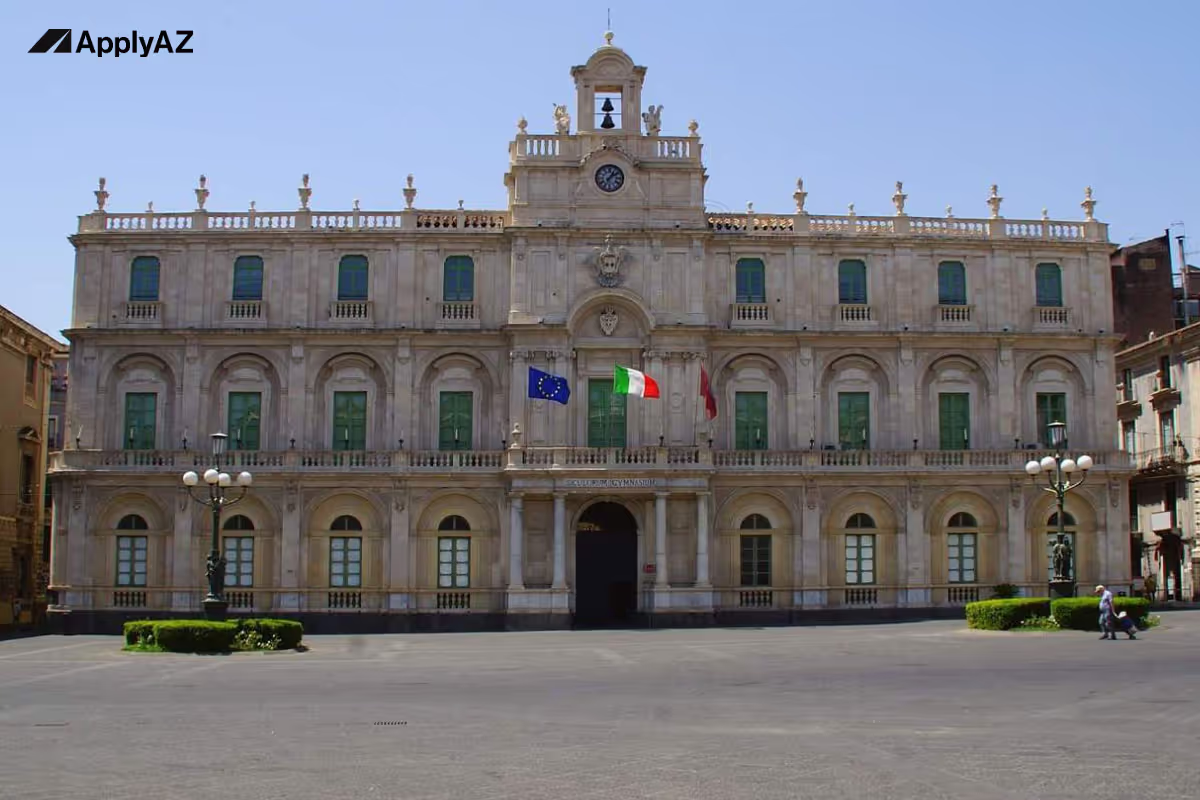
The University of Catania is a public university in Sicily and the oldest on the island: its foundation dates to 1434, and teaching began in 1445. Times Higher Education's 2026 data counts about 30,000 students, about 5% of them international. It offers bachelor's, master's and single-cycle degrees across science, engineering, agriculture, medicine, law, economics and the humanities, with its central seat on Piazza Università in the historic centre of Catania.
Can international students study at the University of Catania in English?
Yes, the University of Catania teaches 10 master's degrees in English for 2026/27, plus Medicine and Surgery in English. The master's are Physics, Chemical Engineering for Industrial Sustainability, Automation Engineering and Control of Complex Systems, Construction Management and Safety, Communications, Electrical and Electronic Engineering, Global Politics and Euro-Mediterranean Relations, Agriculture Science and Technology, and Data Science for Management. There is no English bachelor's.
What are the admission requirements at the University of Catania?
The University of Catania admits non-EU students with a school or university qualification valid for entry in their own country, backed by a declaration of value or a comparability statement. For Italian-taught programmes you must show Italian at B2, through a certificate, a CISIA test score of 40 out of 72, or the university's own exam, held on 7 and 8 July 2026. English-taught master's check your degree and English level in their own calls. Catania publishes no acceptance rate.
How do you apply to the University of Catania, step by step?
You apply to the University of Catania by sending your programme application and documents, then completing Universitaly pre-enrolment once the university approves you. The university's 2026/27 international guide gives 30 July as the Universitaly deadline for visa applicants, and visa procedures usually close by 30 November. The ERSU Catania scholarship call closed on 10 August 2026, so prepare your ISEE parificato alongside your application, not after it.
- Choose your programme and check its admission call and deadlines.
- Apply to the university with your qualification and supporting documents.
- Once approved, pre-enrol on Universitaly by the 30 July deadline.
- Apply for your type D visa and your ERSU Catania scholarship.
- Enrol, get your declaration of value or comparability, and settle in Catania.
How much does the University of Catania cost for international students?
The University of Catania is a very low-cost option for non-EU students who live abroad. Under its 2026/27 rules they pay a flat €150 annual contribution, with no ISEE calculation, plus the €140 regional tax and €16 stamp duty: €306 a year in total. EU citizens not resident in Italy pay the same. Students resident in Italy pay by ISEE instead, with no contribution up to €22,000 and a maximum of €2,150 a year for students on track.
Can you study at the University of Catania with little or no tuition?
Yes, the University of Catania is very affordable if you are a non-EU student resident abroad: its 2026/27 rules set €306 a year in total, whatever your income. For students resident in Italy, tuition is set by family income (ISEE); students from lower-income families can pay little or nothing beyond the regional tax, and a DSU scholarship winner also gets a tuition waiver. Low tuition does not cover living costs, so apply to ERSU Catania on time as well.
Which scholarship covers the University of Catania, and what is it worth?
The main scholarship for University of Catania students is run by ERSU Catania, the regional right-to-study body in Catania. Its 2026/27 call pays €7,171.11 a year to off-site students, €4,190.71 to commuters and €2,890.16 to students living at home, with a 15% increase for an ISEE below half the limit and reductions near the top. First-year students are ranked by ISEE. Applications closed on 10 August 2026, and foreign students apply with an ISEE parificato.
How good is the University of Catania in the rankings, and do they matter?
The University of Catania entered the top 500 of ARWU in 2026, in the 401 to 500 band, and is in the 501 to 600 band of THE 2026 and the 851 to 900 band of QS 2027. In Censis 2026/27 it came last among Italy's large public universities, with 79.2 points, a ranking that weighs services, facilities, scholarships and employability rather than research. So its research standing is stronger than its student services score. Judge the programme and city too.
- QS World University Rankings 2027: 851 to 900 band
- Times Higher Education World University Rankings 2026: 501 to 600 band
- ShanghaiRanking ARWU 2026: 401 to 500 band
- Censis 2026/27: last among Italy's large public universities (score 79.2)
What is student life like in Catania, and what does it cost to live there?
Student life at the University of Catania happens in Sicily's second city, below Mount Etna, with the university's central seat in the historic centre. Costs are modest: the university's 2026/27 guide puts a single room in a private flat at €200 to €350 a month plus €25 to €50 for utilities, and ERSU canteen meals at €0 to €6. It suggests arriving with €1,300 to €1,500 for the first months. ERSU Catania also runs student residences for scholarship winners.
How does the University of Catania compare with other universities in Sicily?
The University of Catania is one of Sicily's three state universities, with Palermo and Messina. In ARWU 2026 Catania is in the 401 to 500 band, ahead of Palermo in the 501 to 600 band and Messina in the 801 to 900 band. In Censis 2026/27 Messina scored 81.5 among large universities against Catania's 79.2, while Palermo sits in the mega-university group. For non-EU students resident abroad, Catania's flat €306 a year is a clear draw.
Is the University of Catania a good choice for you?
The University of Catania is a good choice if you want an English-taught master's in engineering, physics, data science, agriculture or international politics at very low cost, in a lively Sicilian city with modest rents. It suits you less if you need an English-taught bachelor's, or if smooth administration and student services matter most to you, given its last place among large universities in Censis 2026/27. Plan paperwork early and keep copies of everything.
How can ApplyAZ help you apply to Catania, or should you apply alone?
ApplyAZ helps you apply to the University of Catania as part of a shortlist of 20 to 30 English-taught programmes at Italian public universities. We write your CV and a tailored SOP for each, submit every application and your Universitaly pre-enrolment, file your ERSU Catania scholarship and prepare your visa file, with a named person owning each stage. We take no university commissions, and strong, organised students can use our roadmap to apply alone. See how ApplyAZ works or check your eligibility.