

Master in Electrical Engineering for Sustainable Green Energy Transition at University of Catania
Two-year English-taught electrical engineering master's (LM-28) at the University of Catania on the production, distribution and efficient use of electrical energy, from power electronics and drives to smart grids and renewables.
Master
2 years
Catania
English
University of Catania


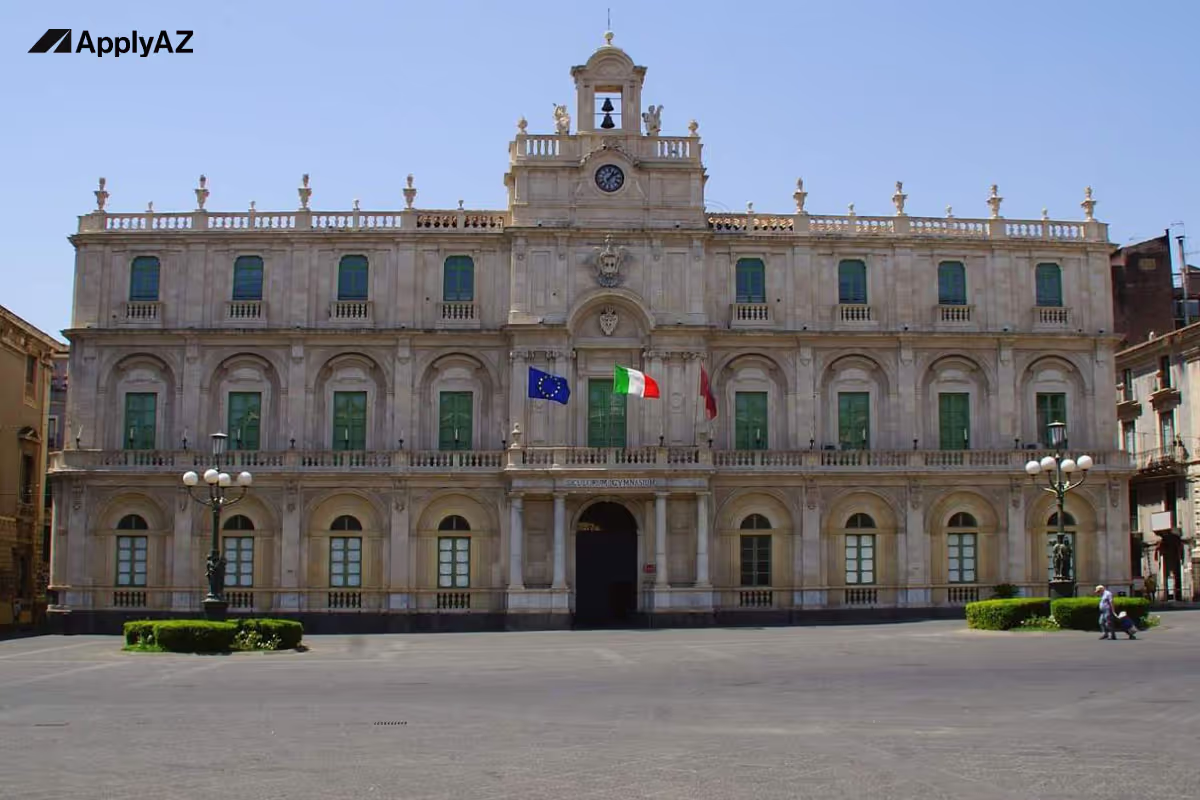
Electrical Engineering for Sustainable Green Energy Transition is a two-year, 120 ECTS master's in electrical engineering (class LM-28) taught in English at the University of Catania, focused on renewable generation, power electronics, smart grids and e-mobility, with a double degree option in Žilina. It can be tuition-free for eligible students.
Entry requirements
- A bachelor's degree or higher, preferably in electrical, electronic or industrial engineering; staff from international organisations with a degree and relevant experience are also considered.
- Adequate knowledge of mathematical and numerical analysis, linear algebra and geometry, physics, chemistry, informatics, and control and systems theory.
- English at B2 level; the 2026/27 call lists IELTS 5.0, TOEFL 60 or Cambridge PET as accepted, and native speakers or holders of an English-taught degree are exempt.
- Selection on your CV, the relevance of your studies, a reference letter and a statement of purpose, with a possible online interview or test.
- Final-year students can apply if they graduate by 31 July; a Declaration of Value or ENIC-NARIC Statement of Comparability is delivered after admission.
About the programme
Electrical Engineering for Sustainable Green Energy Transition is a two-year master's degree in electrical engineering (class LM-28), run by the Department of Electrical, Electronic and Computer Engineering (DIEEI) of the University of Catania. It carries 120 ECTS, is taught in English and is based in Catania, with open admission.
The course trains engineers to handle the production, distribution and efficient use of electrical energy, with particular attention to widening primary energy sources, energy conversion and the control of electrical systems. It suits graduates in electrical, electronic or industrial engineering who want to work on the energy transition.
What you will study
The core subjects are electrotechnics, electrical systems, electric machines and electrical measurements, alongside power electronics and industrial automation. You learn to model components and processes for producing, transmitting and using electricity, and to design electrical plants, converters, machines and drives. Units in the 2026/27 plan include:
- Renewable/Conventional Power Generation, Transmission and HVDC/FACTS
- Fundamentals of Power Electronics and Advanced Power Converters and Control
- Smart Grids and Advanced Power Distribution
- Electrical Drives for E-mobility and Energy Efficiency and Dynamics of Electrical Machines
- Electricity Markets and Economics of Renewable Generations
- Climate Change Impacts on Energy Generation and Demand
- Electric Power Utilization and Safety, Industrial Electromagnetic Compatibility and Systems and Transducers for Energy Harvesting from Renewables
How the programme is taught
In many units a large share of each lesson goes to practical and laboratory work, especially in the design courses, so that theory is tested through experiments. The degree ends with a thesis you carry out on your own under a tutor, on a theoretical or applied topic. The university lists a double degree with the University of Žilina in Slovakia, and teamwork on multidisciplinary system design is part of the training.
Career paths
The official profile corresponds to electrical and industrial automation engineers, able to work in several areas and to join multidisciplinary design teams. The university names these fields and roles:
- Design of industrial and civil electrical plants and systems
- Specialist work on power electronic systems
- Management and optimisation of energy production and distribution
- Development of innovative solutions for alternative energy and sustainability
Fees and scholarships
The 2026/27 call for non-EU applicants living abroad fixed the year's total at €306, covering a €150 university contribution, the €140 regional tax and €16 stamp duty. The best five candidates in each ranking were offered €2,000 a year for two years. Regional scholarships from ERSU Catania, based on merit and family income, mean the degree can be tuition-free for eligible students.
How to apply from outside the EU
This programme accepts a lower English certificate score than most of Catania's English-taught master's (IELTS 5.0 or TOEFL 60 in the 2026/27 call). You apply on the Smartedu portal with a €10 fee, sending your transcript, course syllabus, CV, reference letter and statement of purpose; the board needs 50 out of 100. For 2026/27 the call ran from 10 February to 17 March 2026.
After admission you confirm with €75, pre-enrol on Universitaly and apply for a type D study visa.
How ApplyAZ helps
If this programme fits your goals, ApplyAZ can include it in a shortlist of 20 to 30 English-taught programmes at Italian public universities. We write your CV and a tailored statement of purpose, submit your applications and Universitaly pre-enrolment, file your DSU scholarship application and prepare your visa file, with a named person on each stage. The university decides admission, the region decides the scholarship and the consulate decides the visa. See how ApplyAZ works or check your eligibility.
Questions and answers
Is this electrical engineering master taught in English?
Yes. The University of Catania lists English as the language of the course. Applicants need English at B2 level; the 2026/27 call accepted IELTS 5.0, TOEFL 60 or Cambridge PET, with exemptions for native speakers and English-taught graduates.
Which bachelor's degrees are accepted?
Mainly electrical, electronic or industrial engineering, with a grounding in mathematical and numerical analysis, linear algebra, physics, chemistry, informatics, and control and systems theory. Final-year students can apply if they graduate by 31 July.
Is there an entrance test?
No written test. The board scores your CV, the relevance of your studies, a reference letter and a statement of purpose out of 100, and may add an online interview or test.
What topics does the programme cover?
Renewable and conventional power generation, HVDC transmission, power electronics, smart grids, electrical drives for e-mobility, electricity markets and energy harvesting, with laboratory work in many units.
When can I apply for 2027/28?
The 2027/28 call is not out yet. As a guide, non-EU applicants living abroad applied for 2026/27 between 10 February and 17 March 2026 on the Smartedu portal, with a €10 fee.
How much does it cost?
For 2026/27, non-EU students living abroad paid €306 for the year. The top five in each ranking were offered €2,000 a year for two years, and ERSU Catania runs regional scholarships for eligible students.
Similar programmes
More programmes in this city

They began right where you are

