

Master in Materials Engineering and Nanotechnology at Polytechnic University of Milan
Two-year English-taught master at Politecnico di Milano on materials with controlled properties at the micro and nano scale, with six tracks from surface and polymer engineering to nanomaterials and sustainability.
Master
2 years
Milan
English
Polytechnic University of Milan


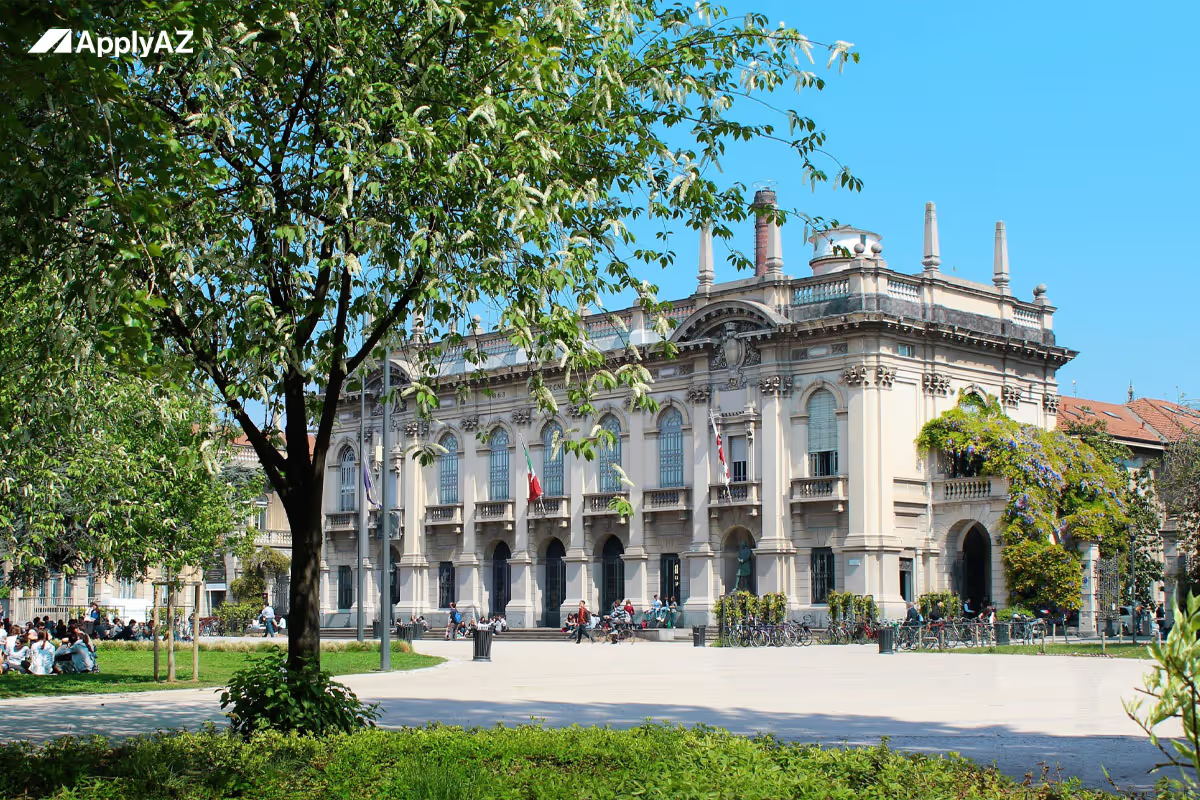
Materials Engineering and Nanotechnology is a two-year, 120 ECTS master's degree (class LM-53) taught in English at Politecnico di Milano's Milano Leonardo campus. After a common first year, students choose one of six tracks, from polymers to nanomaterials and sustainability. Tuition follows the university's yearly fee rules.
Entry requirements
- A bachelor's degree, or an equivalent foreign qualification giving access to EQF level 7, with subjects closely related to materials engineering.
- A grade average that meets the minimum Politecnico di Milano sets for your country.
- An English certificate recognised by the university, or a university statement that your bachelor's was taught entirely in English.
- No written entrance test: your academic record is evaluated.
- A Diploma Supplement, declaration of value or CIMEA statement of comparability before enrolment.
About the programme
Materials Engineering and Nanotechnology is a two-year master's degree (laurea magistrale) in class LM-53, worth 120 ECTS. The School of Industrial and Information Engineering runs it in English at the Milano Leonardo campus in Milan.
According to the degree board, materials engineering and nanotechnology develop materials and products with controlled properties at both the micrometric and the nanometric scale. The degree covers metals, polymers, ceramics, composites and nanostructured materials, and suits graduates in materials, chemical, mechanical or related engineering.
What you will study
The first year is common to all students, with units such as Chemistry of Materials, Instrumental Methods for Materials Analysis, Mathematical Methods for Materials Engineering, Mechanical Behaviour and Failure of Metals, Solid State Physics, and Surface Engineering. In the second year students follow one of six tracks: Surface Engineering, Polymer Engineering, Nanomaterials and Nanotechnology, Engineering Applications, Sustainability Engineering, and Micro and Nano Systems. Second-year units include:
- Corrosion Engineering of Metals and Ceramics
- Functional and Nanostructured Materials
- Mechanical Behaviour and Durability of Polymers
- Polymer Technologies for the Circular Economy (Polymer and Sustainability tracks)
- Nanomaterials for Energy Conversion and Materials for Electronics (Nanomaterials and Nanotechnology)
- Composite Materials for Structural Applications (Engineering Applications)
- Life Cycle Assessment of Materials and Processes (Sustainability Engineering)
- Smart Materials and Metamaterials (Micro and Nano Systems)
How the programme is taught
Some first-year units, such as Principles of Polymer Chemistry and Solid State Physics, also run in an Italian edition, but the English path is complete. The Surface Engineering track lists laboratory units such as the Laboratory of Advanced Organic Coatings and the Laboratory of Plasma Physics. The second year ends with thesis work and the final examination, and the degree website has sections on internships and the master's thesis.
Career paths
The six tracks lead towards materials roles in industry and research, for example in:
- Metals, polymers and composites for mechanical and structural uses
- Coatings, surface treatments and corrosion protection
- Nanomaterials for electronics and energy
- Recycling, circular economy and life cycle assessment
- Materials testing, analysis and research
Fees and scholarships
No special fee applies to this degree: Politecnico di Milano's yearly fee rules cover it, and the 2026/27 details are on the tuition fees page. The university manages the DSU right-to-study scholarship without a separate regional agency. Eligible students can apply, and awards depend on merit and financial need.
How to apply from outside the EU
The common first year assumes chemistry, physics and mechanics of materials, so your bachelor's should be closely related to materials engineering; the Politecnico checks this for every foreign degree.
Holders of a foreign degree apply through the international admissions route. Under the foreign-qualification requirements, your degree must give access to EQF level 7 and meet the grade minimum for your country, and you need an English certificate or an English-taught bachelor's. Once admitted, you complete the Universitaly pre-enrolment and apply for a type D visa, and before enrolment you provide a Diploma Supplement, declaration of value or CIMEA statement.
How ApplyAZ helps
If this programme fits your goals, ApplyAZ can include it in a shortlist of 20 to 30 English-taught programmes at Italian public universities. We write your CV and a tailored statement of purpose, submit your applications and Universitaly pre-enrolment, file your DSU scholarship application and prepare your visa file, with a named person on each stage. The university decides admission, the region decides the scholarship and the consulate decides the visa. See how ApplyAZ works or check your eligibility.
Questions and answers
Is the Master in Materials Engineering and Nanotechnology taught in English?
Yes. The degree is taught in English at the Milano Leonardo campus. A few first-year units also run in an Italian edition, but the English path is complete.
Which tracks can I choose?
Six: Surface Engineering, Polymer Engineering, Nanomaterials and Nanotechnology, Engineering Applications, Sustainability Engineering, and Micro and Nano Systems. The first year is common to all.
What bachelor's background do I need?
A bachelor's closely related to materials engineering, giving access to EQF level 7, with a grade average that meets the Politecnico's minimum for your country.
Is there an entrance test?
No written test is required. Politecnico di Milano evaluates your degree, your grade average and your English certificate.
How much does it cost?
Tuition follows Politecnico di Milano's yearly fee rules, published on its tuition fees page. Students who meet the merit and financial-need conditions can apply for the university's DSU scholarship.
When can I start?
The programme starts in autumn. The 2027/28 application calendar for international applicants was not yet published in September 2026.
Similar programmes
More programmes in this city

They began right where you are

