

Master in High Performance Computing Engineering at Polytechnic University of Milan
Two-year English-taught master at Politecnico di Milano in high performance computing: parallel computing, numerical methods, computer architectures, HPC software and quantum computing, with 40 ECTS of electives.
Master
2 years
Milan
English
Polytechnic University of Milan



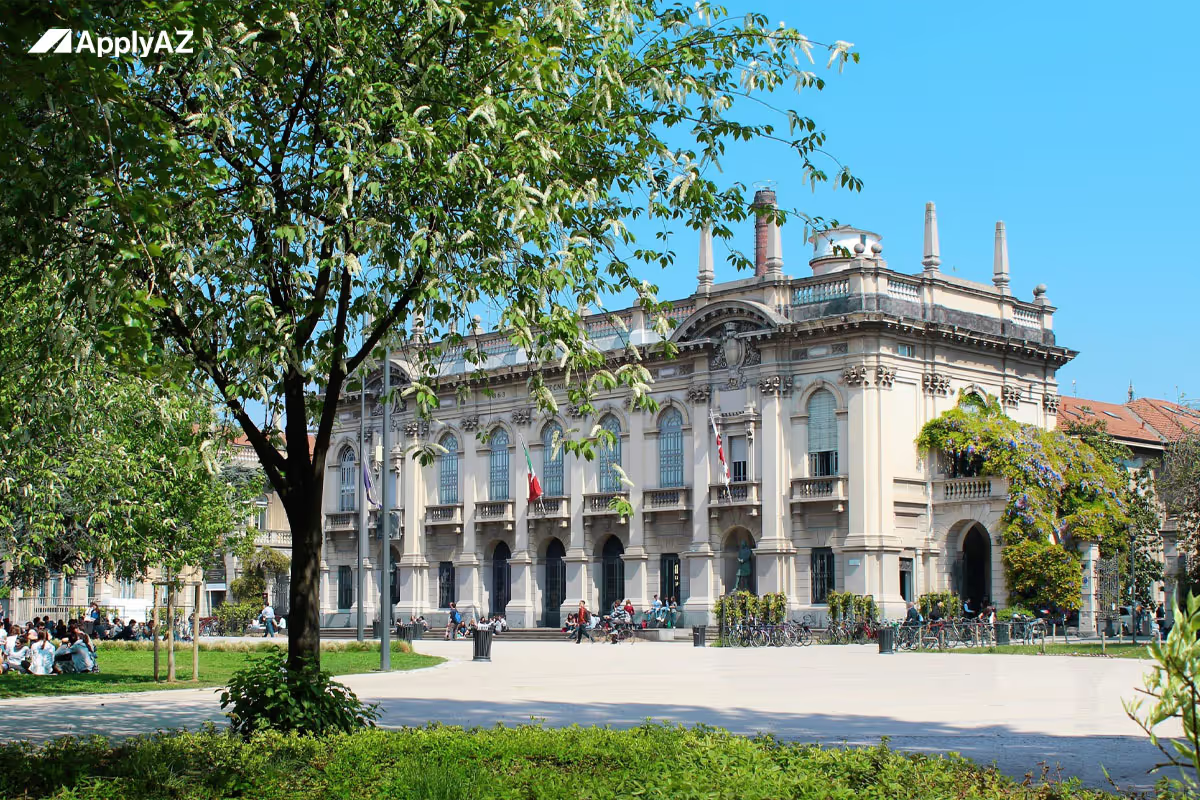
High Performance Computing Engineering is a two-year, 120 ECTS master's degree (class LM-32) taught in English at Politecnico di Milano's Milano Leonardo campus. It combines mathematics, computer science and engineering for supercomputing and quantum computing. Tuition follows the university's yearly fee rules.
Entry requirements
- A bachelor's degree, or an equivalent foreign qualification giving access to EQF level 7, with subjects closely related to computer science, information, industrial or civil and environmental engineering.
- The degree website names bachelor's in civil and environmental, information or industrial engineering or in computer science as reference backgrounds; other candidates are evaluated on their academic record.
- A grade average that meets the minimum Politecnico di Milano sets for your country.
- An English certificate recognised by the university, or a university statement that your bachelor's was taught entirely in English.
- No written entrance test: your academic record is evaluated.
- A Diploma Supplement, declaration of value or CIMEA statement of comparability before enrolment.
About the programme
High Performance Computing Engineering is a two-year master's degree (laurea magistrale) in class LM-32, computer systems engineering, worth 120 ECTS. It is run by the School of Industrial and Information Engineering at the Milano Leonardo campus and taught in English.
The degree trains engineers who tackle complex problems by combining mathematics, computer science and engineering. Graduates design and optimise computational solutions across the whole supercomputing pipeline, from mathematical modelling to high-performance software for parallel and distributed architectures, including quantum computing systems. It suits graduates in computer science, computer or mathematical engineering and related fields.
What you will study
The first year builds the core in numerical methods, parallel programming and computer systems. Units in the 2026/27 course list include:
- Parallel Computing
- Advanced Methods for Scientific Computing
- Numerical Linear Algebra and Numerical Methods for Partial Differential Equations
- Advanced Computer Architectures and Computing Infrastructures
- Software Engineering for HPC
- Quantum Physics and Quantum Computing
- Systems and Methods for Big and Unstructured Data
- Applied Statistics
Electives then let students apply HPC to a field, with options such as Code Transformation and Optimization, Distributed Systems, Machine Learning, Applied CFD for Industrial Engineering, Fintech and Molecular Modeling of Materials.
How the programme is taught
The degree website states that 40 ECTS are elective credits, so students can shape their own specialisation. The second year ends with the thesis and final exam. A few electives are taught in Italian; the core units are in English.
Career paths
The degree website places graduates in aerospace, bioinformatics, energy, finance, environmental sustainability and pharmaceuticals, sectors where the power of supercomputing and quantum computing drives innovation. Application areas it lists include:
- Climate and earth sciences
- Manufacturing and materials science
- Health and pharmaceuticals
- Finance
- Aerospace
- Artificial intelligence and data science
Fees and scholarships
High Performance Computing Engineering follows Politecnico di Milano's general fee rules, with no fee of its own; see the tuition fees page for 2026/27. The university runs the DSU scholarship itself, and students who meet the merit and financial-need conditions can apply.
How to apply from outside the EU
The degree website names bachelor's in civil and environmental, information or industrial engineering or in computer science as the reference backgrounds, and evaluates other candidates on their academic record. Strong mathematics and programming help.
Foreign graduates apply through the international admissions route. The foreign-qualification requirements ask for a degree giving access to EQF level 7, the minimum grade average for your country and an English certificate or English-taught bachelor's. After admission you do the Universitaly pre-enrolment and request a type D visa, and before enrolment you provide a Diploma Supplement, declaration of value or CIMEA statement.
How ApplyAZ helps
If this programme fits your goals, ApplyAZ can include it in a shortlist of 20 to 30 English-taught programmes at Italian public universities. We write your CV and a tailored statement of purpose, submit your applications and Universitaly pre-enrolment, file your DSU scholarship application and prepare your visa file, with a named person on each stage. The university decides admission, the region decides the scholarship and the consulate decides the visa. See how ApplyAZ works or check your eligibility.
Questions and answers
Is the Master in High Performance Computing Engineering taught in English?
Yes. The degree is taught in English at the Milano Leonardo campus. A few electives are offered in Italian, but the core units are in English.
What bachelor's background do I need?
The degree website names civil and environmental, information or industrial engineering or computer science as reference backgrounds. Other candidates are evaluated on their academic record.
What are the core subjects?
Parallel computing, scientific computing and numerical methods, computer architectures and infrastructures, software engineering for HPC, and quantum physics and quantum computing.
How much choice is there?
According to the degree website, 40 ECTS are elective, with options ranging from machine learning and distributed systems to computational fluid dynamics, fintech and molecular modelling.
How much does it cost?
Tuition follows Politecnico di Milano's yearly fee rules, published on its tuition fees page. Students who meet the merit and financial-need conditions can apply for the university's DSU scholarship.
What careers does it lead to?
The degree website lists aerospace, bioinformatics, energy, finance, environmental sustainability and pharmaceuticals, plus climate science, materials, and artificial intelligence and data science.
Similar programmes
More programmes in this city

They began right where you are

