

Bachelor in Engineering Science at Polytechnic University of Milan
Three-year English-taught L-9 bachelor's at Politecnico di Milano that joins science and engineering: a shared core, elective direction courses, a third-year focus area from 17 options and a capstone project.
Bachelor
3 years
Milan
English
Polytechnic University of Milan



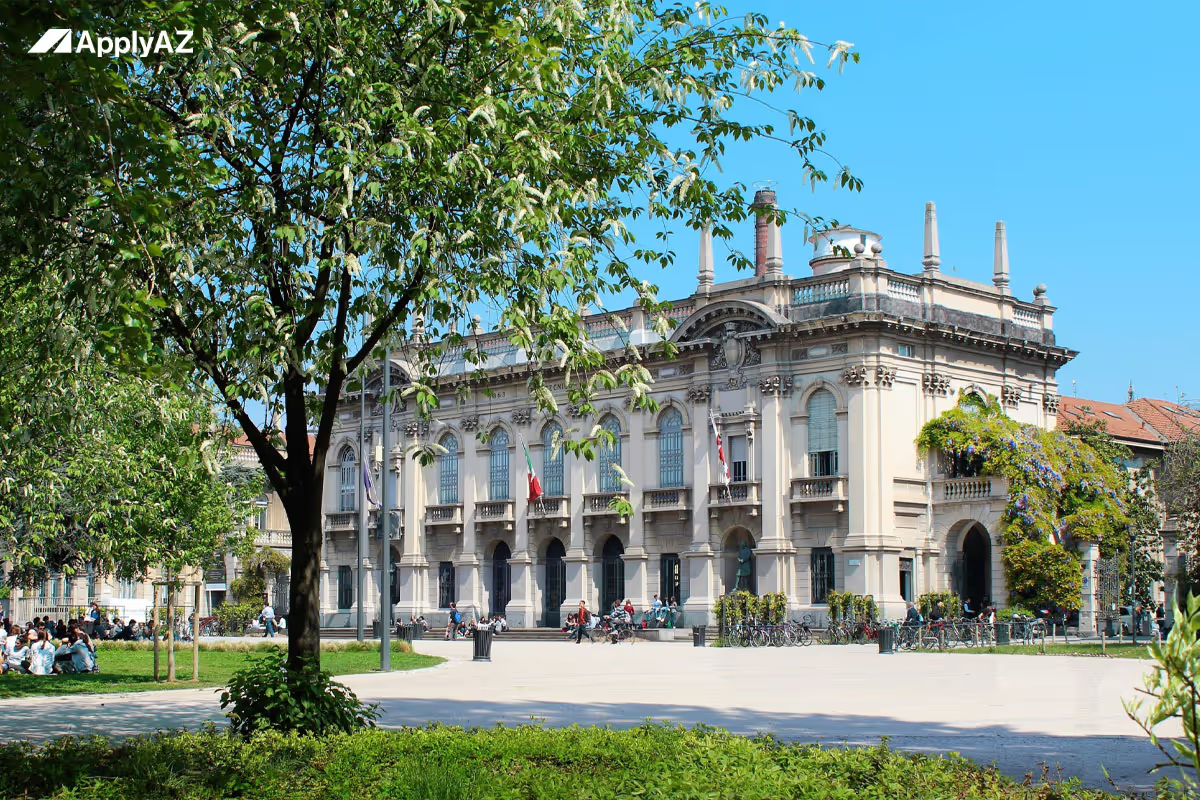
Engineering Science is a three-year, 180 ECTS bachelor's degree (class L-9) taught entirely in English at Politecnico di Milano, first offered in 2026/27. It builds a broad science and engineering base before you choose a focus area. Fees follow family income, so it can be tuition-free for eligible students.
Entry requirements
- A secondary school diploma from a four or five-year system, or an equivalent foreign qualification (EQF level 4) recognised as suitable.
- Report cards from your last three school years and your diploma (or proof of final-year enrolment), uploaded when you register for the test and checked by the International Students Office.
- An admission test: TOL or TOLC-I (in Italian), or CEnT-S or SAT (in English).
- English before enrolment: a certificate accepted by PoliMi, a school qualification taught in English, or citizenship of an English-speaking country.
- Italian is not needed to start, but you must reach B2 before graduating.
About the programme
Engineering Science is a three-year bachelor's degree (laurea, class L-9, industrial engineering) worth 180 ECTS and taught entirely in English. It opened in 2026/27 and is run jointly by the School of Industrial and Information Engineering and the School of Civil, Environmental and Land Management Engineering, with classes on the Milano Leonardo and Milano Bovisa campuses.
Instead of committing to one branch of engineering on day one, you study the principles that all branches share and treat maths and physics as working tools rather than hurdles. It suits curious students who enjoy science, like modelling real problems and want time to find the engineering field that fits them.
What you will study
The degree is built in three layers. The CORE area, mostly in the first two years, is compulsory for everyone. The DIRECTION area, across years two and three, lets you try electives such as solid mechanics, fluid mechanics, fundamentals of electronics, or systems and control methods. In the FOCUS area of year three you pick one of 17 planned domains, from Aerospace and Autonomous Systems to Biomedical Technologies, Computing Systems, Energy, Physics and Telecommunications. Core units include:
- Mathematical Analysis and Linear Algebra I and II (9 ECTS each)
- Fundamentals of Computer Science (9 ECTS)
- Mechanics: Physics and Engineering, and Thermal Physics and Engineering
- Chemistry and Materials Science
- Digital Modelling and Engineering Drawing
- Fundamentals of Management Engineering (9 ECTS)
- Electromagnetism and Circuit Theory, Probability and Statistics for Engineering, and Scientific Computing and Machine Learning
How the programme is taught
Teaching mixes lectures with guided exercises, experimental and computational labs, and group projects, supported by review sessions and self-assessment. First-year students take a short Exploring Engineering unit, and each student gets an academic tutor from the faculty. The degree ends with an interdisciplinary capstone project, which can be done with research groups or industrial partners, and study periods abroad count towards your plan through PoliMi's exchange agreements.
Career paths
The degree is designed mainly as a route to a master's in engineering or applied science, at PoliMi or elsewhere. Graduates who go straight to work start in technical and analytical support roles in manufacturing firms, consulting companies, research and development centres, tech start-ups and public bodies. After the State Examination you can join Section B of the Italian Register of Engineers.
- Support for technology analysis and feasibility studies
- Product and process innovation
- Data analysis for digitalisation and performance evaluation
- Numerical modelling and design support
- Technical and organisational consulting
Fees and scholarships
Engineering Science has no fee of its own: PoliMi charges every bachelor's student by family income. For 2026/27 a standard year cost €157.04 with an ISEE up to €22,000 and at most €3,943.04 for a standard study plan, and families with income abroad use the Equalised ISEEU (ISEE parificato). PoliMi also runs the Lombardy DSU scholarship itself, with a call each June, so this programme can be tuition-free for eligible students.
How to apply from outside the EU
Non-EU applicants living abroad compete for reserved places through the same test route as other candidates. For 2026/27 you registered in PoliMi's Online Services, uploaded your school reports and diploma for checking, and sat the TOL (€35 fee) or sent a CEnT-S or SAT score. Standard TOL sessions ran from 1 February to 31 May 2026, and enrolment phases ran from mid June to early September.
Once admitted, you pre-enrol on Universitaly and apply for a type D study visa. The 2027/28 call has not been published yet.
How ApplyAZ helps
If this programme fits your goals, ApplyAZ can include it in a shortlist of 20 to 30 English-taught programmes at Italian public universities. We write your CV and a tailored statement of purpose, submit your applications and Universitaly pre-enrolment, file your DSU scholarship application and prepare your visa file, with a named person on each stage. The university decides admission, the region decides the scholarship and the consulate decides the visa. See how ApplyAZ works or check your eligibility.
Questions and answers
Is Engineering Science taught fully in English?
Yes. All teaching, exams and the final capstone are in English. You need to prove English before enrolment, and you must also reach Italian B2 before you graduate, which PoliMi counts as met if you score 30 or more on the TOL or TOLC-I.
Which entrance test do I need?
You can take PoliMi's TOL or the CISIA TOLC-I, both in Italian, or send a CEnT-S or SAT score, both in English.
Do I have to choose a specialisation at the start?
No. Everyone follows a common core first, then tries elective direction courses, and only in year three picks a focus area from 17 planned options such as Aerospace, Energy, Computing Systems or Biomedical Technologies.
When can I apply for 2027/28?
The 2027/28 call is not published yet. For 2026/27, standard TOL sessions ran from 1 February to 31 May 2026 and enrolment phases ran from mid June to early September 2026.
How much does it cost?
Fees depend on family income. For 2026/27 a standard year ranged from €157.04 with an ISEE up to €22,000 to a maximum of €3,943.04. Eligible students can also apply for the DSU scholarship that PoliMi runs itself.
What can I do after this degree?
The degree is designed mainly as a route to a master's in engineering or applied science. Graduates can also start in technical and analytical support roles in industry, consulting, research centres or start-ups, and can join Section B of the Italian Register of Engineers after the State Examination.
Similar programmes
More programmes in this city

They began right where you are

