

Master in Biology of Extreme Environments at University of Naples Federico II
Two-year English-taught LM-6 biology master's at Federico II in Naples on life in extreme environments and space, with Biological Resources and Astrobiology curricula, fieldwork and laboratory training.
Master
2 years
Naples
English
University of Naples Federico II



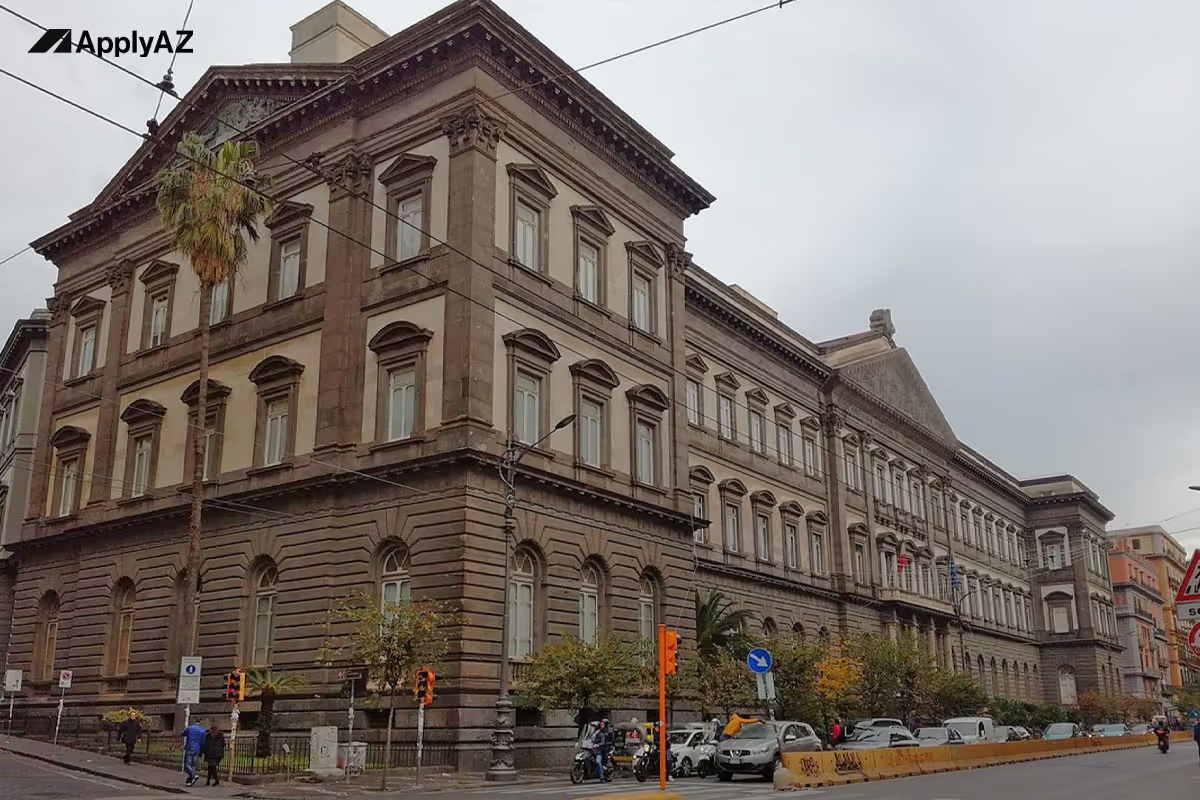
Biology of Extreme Environments is a two-year, 120 ECTS master's degree (class LM-6) taught in English by the Department of Biology of the University of Naples Federico II, with curricula in Biological Resources and Astrobiology. Admission is open after a check of your background, and it can be tuition-free for eligible students.
Entry requirements
- A bachelor's degree of at least three years in biology, biotechnology or natural sciences (Italian classes L-13, L-32 or L-2), or an equivalent foreign degree.
- Graduates in other fields need at least 30 CFU in biological subjects plus 6 CFU each in maths or computing, physics and chemistry; other backgrounds are assessed case by case.
- Basic knowledge of biology and microbiology, ecology, general, organic and inorganic chemistry, and biochemistry.
- English at B2 level, shown by an internationally recognised certificate, or checked through an interview or placement test.
- Non-EU applicants submit their diploma, detailed transcript, passport, CV and a signed form for recognition of their foreign degree.
About the programme
Biology of Extreme Environments (BIOEXTREME) is a two-year master's degree (laurea magistrale, class LM-6) worth 120 ECTS, taught in English by the Department of Biology of the University of Naples Federico II at the Monte Sant'Angelo campus. The university describes it as the first programme of its kind in Italy and Europe.
It trains biologists in the genetic, biochemical and biological processes of extreme environments, including space: how these settings shape planetary habitability, drive biogeochemical cycles and offer new biotechnological resources. It suits graduates in biology, biotechnology or natural sciences with an interest in microbiology, ecology or astrobiology.
What you will study
The degree offers two curricula: Biological Resources, focused on the sustainable use of resources found in extreme environments, and Astrobiology, focused on the search for life in the universe and space exploration. Courses listed by the department for 2025/26 include:
- Microbiology of Extreme Environments and Applied Microbiology of Extremophiles
- Introduction to Earth System Sciences and Ecology of Extreme Environments
- Biochemistry and Molecular Adaptation to Extreme Environments
- Biodiversity and Primary Productivity in Extreme Environments
- Discovery and Applications of Extremophilic Enzymes, and Chemistry of Biopolymers and Metabolites from Extreme Environments
- Astrobiology units such as Emergence of Life and Exobiology, Astrochemistry and Prebiotic Process, Astrophysics of Life, and Astrobotany
- Physiology and Nutrition in Space Conditions, and Extreme Environments and Public Health
- Omics Data Analysis
How the programme is taught
The course is strongly interdisciplinary and combines theory with fieldwork and laboratory activities, backed by training in advanced data analysis. The university reports support from national and international companies, research institutes and space agencies, including the International Society for Extremophiles, the Earth-Life Science Institute, the Italian Space Agency and the NASA Astrobiology programme. A tutoring commission supports students throughout their studies.
Career paths
Graduates are prepared for research on biological processes in extreme and extraterrestrial environments, and for scientific and technological innovation using their resources. The department points to roles in:
- Public and private research centres
- National and international space agencies
- Biotechnology and biomedical companies
- Firms exploring polar, geothermal and extraterrestrial environments
Fees and scholarships
Federico II links university contributions to family income. For 2026/27, its fee simulator places foreign students from non-EU countries among the categories fully exempt from contributions, with a regional tax of €130, €151 or €173 (by ISEE band) and €16 stamp duty still payable. Enrolled students may also apply to ADISURC, Campania's scholarship body. This master's can be tuition-free for eligible students.
How to apply from outside the EU
The process has two steps. First, for admission, you fill in the course's online form and upload one PDF with your diploma, detailed transcript, passport, CV, English certificate and a signed form for recognition of your foreign degree; the coordinator then issues a pre-acceptance letter. Second, you use that letter to pre-enrol on Universitaly and apply for a study visa. For 2026/27, pre-enrolment opened on 1 March, the Universitaly deadline was 15 June and non-EU students could enrol until 10 July 2026.
How ApplyAZ helps
If this programme fits your goals, ApplyAZ can include it in a shortlist of 20 to 30 English-taught programmes at Italian public universities. We write your CV and a tailored statement of purpose, submit your applications and Universitaly pre-enrolment, file your DSU scholarship application and prepare your visa file, with a named person on each stage. The university decides admission, the region decides the scholarship and the consulate decides the visa. See how ApplyAZ works or check your eligibility.
Questions and answers
Is Biology of Extreme Environments taught in English?
Yes. The master's is taught in English at B2 level. Without an internationally recognised certificate, your English is checked through an interview or a placement test.
Which bachelor's degrees are accepted?
Biology, biotechnology or natural sciences degrees of at least three years, or equivalents. Other graduates need at least 30 CFU in biological subjects plus some maths or computing, physics and chemistry, and are assessed case by case.
What are the two curricula?
Biological Resources focuses on the sustainable use of resources in extreme environments. Astrobiology focuses on the search for life in the universe and space exploration.
When can I apply for 2027/28?
The 2027/28 dates are not published yet. For 2026/27, pre-enrolment opened on 1 March, the Universitaly deadline for non-EU applicants was 15 June and enrolment closed on 10 July 2026.
How much does it cost?
Federico II's 2026/27 fee simulator lists non-EU foreign students among those exempt from contributions, leaving a regional tax of €130 to €173 and €16 stamp duty. ADISURC scholarships are open to eligible students.
What jobs can graduates do?
The department points to research centres, national and international space agencies, biotechnology and biomedical companies, and firms exploring polar, geothermal and extraterrestrial environments.
Similar programmes
More programmes in this city

They began right where you are

