

Master in Astrophysics and Space Physics at University of Milan-Bicocca
Two-year English-taught LM-58 master at the University of Milano-Bicocca in astrophysics and cosmology, with in-house telescope sessions, simulations, gravitational-wave astrophysics and a 45 ECTS thesis. Entry needs maths and physics credits and English at B2.
Master
2 years
Milan
English
University of Milan-Bicocca



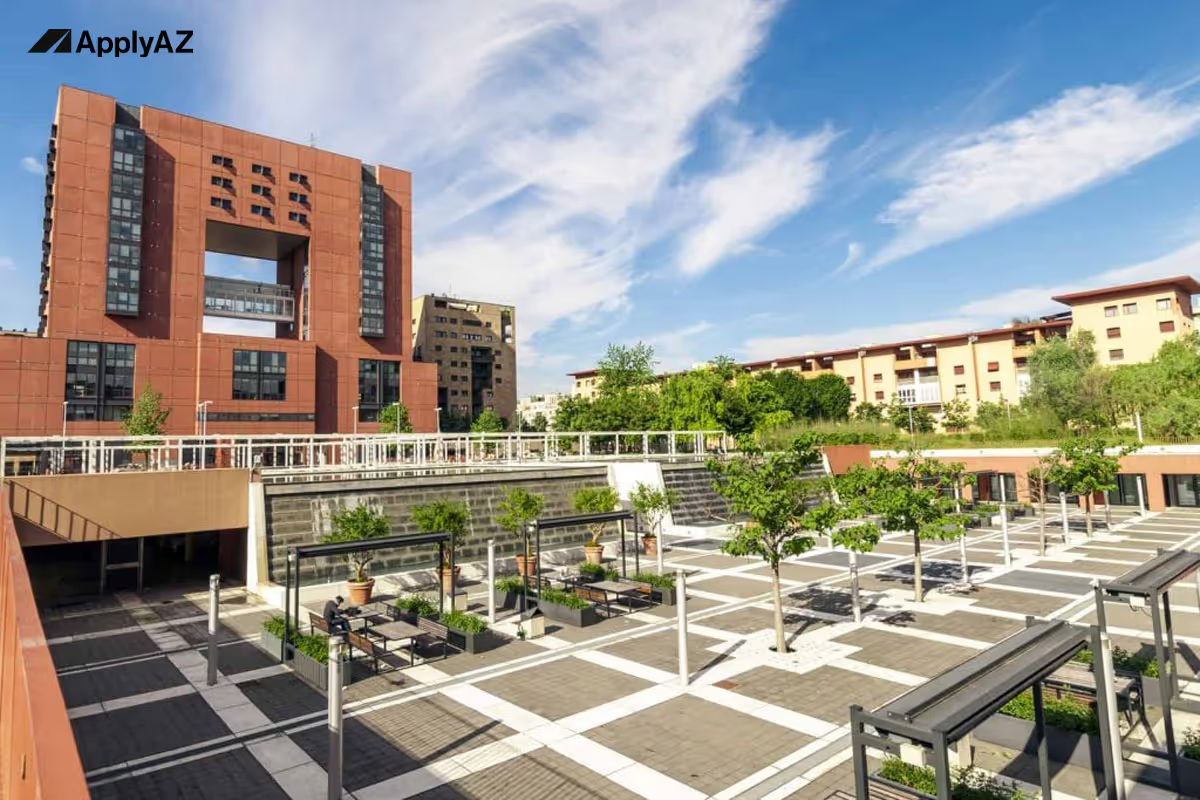
Astrophysics and Space Physics is a two-year, 120 ECTS master's degree (class LM-58) taught in English at the University of Milano-Bicocca in Milan. Entry needs a bachelor's of at least three years with 18 credits in maths and 18 in physics, plus English at B2 and an interview unless your physics grades exempt you. Fees follow family income, or country of residence for international students, so it can be tuition-free for eligible students.
Entry requirements
Detailed entry requirements
Milano-Bicocca's Astrophysics and Space Physics master asks for a bachelor's degree of at least three years with at least 18 credits in mathematics and 18 in physics, or an Italian physics degree, plus basic quantum mechanics and atomic physics. You also need English at B2 and an admission interview, unless a physics, astrophysics or astronomy degree with a strong final mark exempts you. Reviewed 8 October 2026. [1]
Degree and credit requirements
You need a bachelor's degree of at least three years, or a three-year university diploma, with basic knowledge of mathematics (differential calculus, analytical mechanics and geometry), classical physics, both theoretical and experimental, and quantum mechanics. [1][4]
- Physics degrees: an Italian degree in class L-30 (physical sciences and technologies) meets the curricular requirement directly.
- Other degrees: at least 18 credits in mathematics (sectors MAT/01 to MAT/09) and at least 18 credits in physics (sectors FIS/01 to FIS/08). For a foreign degree this is 18 ECTS in each, and the admission committee evaluates credit equivalence between universities if needed.
Basic knowledge of quantum mechanics and atomic physics is required. If your transcript does not show it, it is checked at the interview through oral questions on a published list of topics. It can also come from single courses with passed exams. [1][4]
What this means for your transcript
The committee looks at the subjects you passed, not only your degree title. As a guide, based on the rule above:
- Usually a fit: a B.Sc. in Physics, or a B.Sc. with Physics and Mathematics as main subjects, which normally covers calculus, mechanics, electromagnetism and quantum mechanics.
- Check carefully: a B.Tech or B.E. in Engineering Physics, Electronics, Electrical or Mechanical Engineering, or a B.Sc. in Mathematics. These often reach 18 credits in maths and 18 in physics but may not include quantum mechanics and atomic physics, which the interview then checks.
- Often short: a BCA, B.Com, BBA or BA, or a B.Sc. in Chemistry or Computer Science with only one or two physics papers.
The interview-exemption mark for foreign degrees is 3 out of 4 or equivalent. If your transcript shows a 10-point CGPA or percentages, we check where your grade sits before you apply. [4]
English
English at CEFR level B2 is required. [1][2] On the university's list of accepted certificates, B2 starts at IELTS 5.5, TOEFL iBT 72, PTE Academic 59 or a Cambridge English score of 160, and certificates must be no more than 5 years old when you submit them. [7]
Applicants with a foreign qualification do not need a separate certificate if their previous degree was taught entirely in English or they are native English speakers from the countries the portal lists, such as the United States, the United Kingdom, Australia, New Zealand, Ireland and South Africa. For 2026/27, visa applicants had to hold their English certificate by 31 July 2026 or by the course's own deadline. [2]
Admission interview
An evaluation committee first checks the curricular requirements, then assesses your personal preparation through an admission interview. The committee can also suggest a suitable academic path so that you follow the degree with profit. [1][4]
- No interview: a three-year B.Sc. or equivalent in Physics, Astrophysics or Astronomy with a final mark of at least 3 out of 4, or equivalent, if you meet all the curricular requirements. For Italian degrees, class L-30 with at least 90/110.
- Interview: everyone else who meets the curricular requirements. The September 2026 interviews were held online.
2026/27 deadlines
For 2026/27, applicants with a foreign qualification applied on apply@unimib. Non-EU applicants living abroad could use two windows: 7 November 2025 to 16 January 2026, and 16 March to 16 April 2026. Two later windows, closing on 15 June and 7 September 2026, were only for EU citizens and non-EU citizens living in Italy. [2]
Visa applicants had to complete Universitaly pre-enrolment by 31 July 2026 and obtain their bachelor's degree by 31 August 2026, so that their visa documents were ready in time. Visa holders had to arrive in Italy by 31 January 2027, and original documents were verified by 28 February 2027. The next call sets the 2027/28 dates. [2]
Applicants with Italian qualifications followed separate windows from 13 April 2026 and could graduate up to 31 December 2026. [1]
Documents and non-EU steps
On apply@unimib you upload your entry documents in English or Italian. If your institution does not issue a suitable transcript, you need official translations and verified copies of the originals, and you bring your original documents to the university. A deposit is paid when you accept the offer. [2][5]
Receipts of your requests for a CIMEA statement of verification and a statement of comparability must be presented before the window you chose closes; the verification request does not block the admission process. Requests to add documents must also be made before the window closes, so an application sent on the last day leaves no room to add anything. [2]
Sources and verification
Checked by the ApplyAZ admissions team against the university's official documents listed below. Entry rules can change with each new call, and we re-check them before every application.
- University of Milano-Bicocca. Admission to the Master's degree programme in Astrophysics and Space Physics (F5803Q, class LM-58), academic year 2026/2027. Reviewed 8 October 2026.
- University of Milano-Bicocca, admissions portal for applicants with foreign qualifications (apply@unimib). Astrophysics and Space Physics programme listing, and admission calls and deadlines for 2026/27. Reviewed 8 October 2026.
- University of Milano-Bicocca, Astrophysics and Space Physics programme page (degree class, language, department, location and description). Reviewed 8 October 2026.
- University of Milano-Bicocca, Astrophysics and Space Physics e-learning pages: admission requirements, study plan, first-year courses for 2026/27 and final exam regulations. Reviewed 8 October 2026.
- University of Milano-Bicocca. Contribution guide, academic year 2026/27, with course areas and country groups, and the portal's fees and funding page. Reviewed 8 October 2026.
- University of Milano-Bicocca. Exemption guide, academic year 2026/27. Reviewed 8 October 2026.
- University of Milano-Bicocca. English language certifications accepted by the University, approved by the Academic Senate on 5 November 2025. Reviewed 8 October 2026.
About the programme
Astrophysics and Space Physics is a two-year, 120 ECTS master's degree (laurea magistrale, class LM-58) taught in English at the University of Milano-Bicocca. It is run by the Department of Physics Giuseppe Occhialini on the university's campus in Milan, at Piazza dell'Ateneo Nuovo. It is a full-time programme with open access, subject to a check of your entry requirements. [2][3]
The degree covers the theoretical, observational and instrumental sides of astrophysics and cosmology. It includes hands-on sessions at the department's in-house optical telescope, analysis of observations from instruments at major facilities, high-performance numerical simulations of complex astrophysical systems and advanced classes in gravitational-wave astrophysics. It prepares graduates for research careers in academia and in the private and public sectors, and gives a foundation for doctoral study. [3]
What you will study
The first-year course pages for 2026/27 include: [4]
- Stellar Astrophysics and Relativistic Astrophysics
- General Relativity
- Introduction to Cosmology, and Modern Cosmology and Galaxy Formation
- Introduction to Galaxies, and Dynamics of Stellar Systems
- Radiative Processes
- Astronomical Instrumentation, Laboratory of Data Acquisition and Experimental Cosmology
- Astrostatistics and Machine Learning, and Numerical Astrophysics
- Astrophysics of Gravitational Waves, Cosmic Rays and Cosmic Structure Formation
Every student receives a statutory study plan with the mandatory activities, then submits their own plan of optional and elective activities in set windows during the year. [4]
The master's thesis
The thesis is worth 45 ECTS. It is an original research contribution carried out under a supervisor and typically takes at least eight months from assignment. You can apply for a thesis assignment once you have at least 40 CFU, and at least eight months before your expected graduation. The research can be carried out within the astrophysics group's large international collaborations, and the thesis is written in English. A thesis period abroad, for example through Erasmus, must be extended to meet the eight-month rule. [3][4]
Fees and scholarships
Astrophysics and Space Physics is in contribution Area B. For 2026/27, international students with a foreign qualification and foreign residence paid a fixed university tuition fee set by country group, not by family income, and Group 1 includes India, Pakistan, Bangladesh and Sri Lanka. A deposit is paid on the international portal when you accept your offer and is deducted from later instalments. [5]
Students who receive a DSU regional scholarship get a 100% or 50% reduction of the university tuition fee, depending on the type of scholarship, so this programme can be tuition-free for eligible students. [6]
How to apply from outside the EU
Applicants with a foreign qualification apply only through the university's international portal, apply@unimib. For 2026/27, non-EU applicants living abroad could apply from 7 November 2025 to 16 January 2026 or from 16 March to 16 April 2026; later windows were only for EU citizens and non-EU citizens living in Italy. The next call sets the 2027/28 dates. [1][2]
Visa applicants also had to complete Universitaly pre-enrolment by 31 July 2026 and hold their bachelor's degree by 31 August 2026. Receipts of the CIMEA statement of verification and statement of comparability requests had to be presented before the chosen window closed. [2]
How ApplyAZ helps
ApplyAZ is an Italy-based consultancy that works only with public universities. We can include this programme in a shortlist of 20 to 30 English-taught programmes that fit your profile, so your plan never rests on a single application.
For eligible students who start with us, a named person owns each stage, from A to Z:
- We check your transcript against Milano-Bicocca's entry rules for this programme.
- We write your CV and a tailored statement of purpose.
- We prepare and submit your apply@unimib application with your transcript and English certificate, and Universitaly pre-enrolment.
- We help you declare your family income for reduced fees and file your regional DSU scholarship application at the right time and in the right format.
- We prepare your visa file.
With operations in all 20 Italian regions, we follow each region's scholarship rules and deadlines as they change. The university decides admission, the region decides the scholarship and the consulate decides the visa, so no one can promise an outcome. You pay in milestones, and every service you pay for is either delivered or its fee is refunded (terms apply).
Programmes at Italian public universities can be tuition-free for eligible students. Check if you are eligible and book a one-to-one consultation session with one of our Italy experts, or see how ApplyAZ works.
Questions and answers
What bachelor's degree do I need for Astrophysics and Space Physics at Milano-Bicocca?
A bachelor's of at least three years. An Italian physics degree (class L-30) qualifies directly; other degrees need at least 18 credits in mathematics and 18 in physics, plus basic quantum mechanics and atomic physics, which the interview can check. [1][4]
Is there an entrance exam?
There is no written test. An evaluation committee checks your credits, then holds an admission interview. Physics, Astrophysics or Astronomy graduates with a final mark of at least 3 out of 4, or 90/110 in Italy, are exempt if they meet all the requirements. [1][4]
What English level is required? Do I need IELTS?
English at CEFR B2. On the university's list, B2 starts at IELTS 5.5, TOEFL iBT 72 or PTE Academic 59, with certificates no more than 5 years old. You do not need one if your previous degree was taught entirely in English or you are a native speaker. [2][7]
When is the deadline for non-EU students?
For 2026/27, non-EU applicants living abroad applied on apply@unimib from 7 November 2025 to 16 January 2026 or from 16 March to 16 April 2026, and completed Universitaly pre-enrolment by 31 July 2026. The next call sets the 2027/28 dates. [2]
Can I apply before I graduate?
Yes, if you graduate in time. For 2026/27, applicants with a foreign qualification needed their bachelor's degree by 31 August 2026, a date set so that visa documents are ready. Applicants with Italian qualifications had until 31 December 2026. [1][2]
I have a B.Tech in Electronics or a B.Sc. in Mathematics. Can I apply?
Possibly. You need at least 18 credits in maths and 18 in physics. Many engineering and maths degrees reach the maths block but are lighter in physics or lack quantum mechanics and atomic physics, which the interview then checks against a published list of topics. [1][4]
How long is the thesis?
The thesis is worth 45 ECTS and typically takes at least eight months from assignment. It is an original research project, written in English, and can be carried out within the astrophysics group's large international collaborations. [3][4]
What will I study?
Theoretical, observational and instrumental astrophysics and cosmology, with sessions at the in-house optical telescope, analysis of data from major facilities, numerical simulations and gravitational-wave astrophysics. First-year units include stellar astrophysics, general relativity, cosmology and astrostatistics. [3][4]
Can someone handle my whole application to Astrophysics and Space Physics at Milano-Bicocca?
Yes. ApplyAZ, an Italy-based consultancy that works only with public universities, checks your transcript against Milano-Bicocca's rules for this programme, handles the application and Universitaly pre-enrolment, helps you file the regional DSU scholarship application at the right time and in the right format, and prepares your visa file, for eligible students. Start by checking your eligibility.
I'm applying from India. What is the route into Astrophysics and Space Physics?
A recognised Indian bachelor's of at least three years, such as a B.Sc. in Physics, can fit if it has at least 18 credits in maths and 18 in physics, with basic quantum mechanics. Physics graduates with at least 3 out of 4 can skip the interview. You also need English at B2. The steps are the apply@unimib application, the committee review and Universitaly pre-enrolment. [1][2][4] Indian students apply for the type D study visa at the Italian embassy or consulate that covers their state, such as New Delhi, Mumbai or Bengaluru.
Is the route different from Pakistan, Bangladesh or Sri Lanka?
No. The academic rules for Astrophysics and Space Physics are the same whatever your nationality. Applicants from Pakistan, Bangladesh and Sri Lanka follow the same steps as India: apply@unimib application, the committee review and any admission interview, and Universitaly pre-enrolment, then a type D study visa from the Italian mission for their country of residence. Read our guide for students in Dhaka.
I live in the UAE, Saudi Arabia, Qatar, Kuwait, Oman or Bahrain. Where do I apply for the visa?
At the Italian embassy or consulate responsible for the country where you legally live, after Universitaly pre-enrolment. The academic rules for Astrophysics and Space Physics are the same whatever your nationality, and Gulf residents follow the same steps: apply@unimib application, the committee review and any admission interview, and Universitaly pre-enrolment. Read our guides for Dubai, Riyadh and Doha.
I studied or live in London, New York, Toronto, Vancouver, Singapore or Kuala Lumpur. What is the route?
The academic rules for Astrophysics and Space Physics are the same whatever your nationality, and your degree is assessed like any other foreign qualification. Non-EU applicants who live abroad follow the same route: apply@unimib application, the committee review and any admission interview, and Universitaly pre-enrolment, then a type D study visa from the Italian mission for where they live. Read our guides for students in London, New York, Toronto, Vancouver, Singapore and Kuala Lumpur.
More English-taught programmes at this university
Other public universities in this city

They began right where you are

