

Bachelor in Interaction Design at Polytechnic University of Milan
Three-year English-taught design bachelor at Politecnico di Milano's Lecco campus, covering UX, interface design, programming, electronics and prototyping in studio-based teaching.
Bachelor
3 years
Milan
English
Polytechnic University of Milan



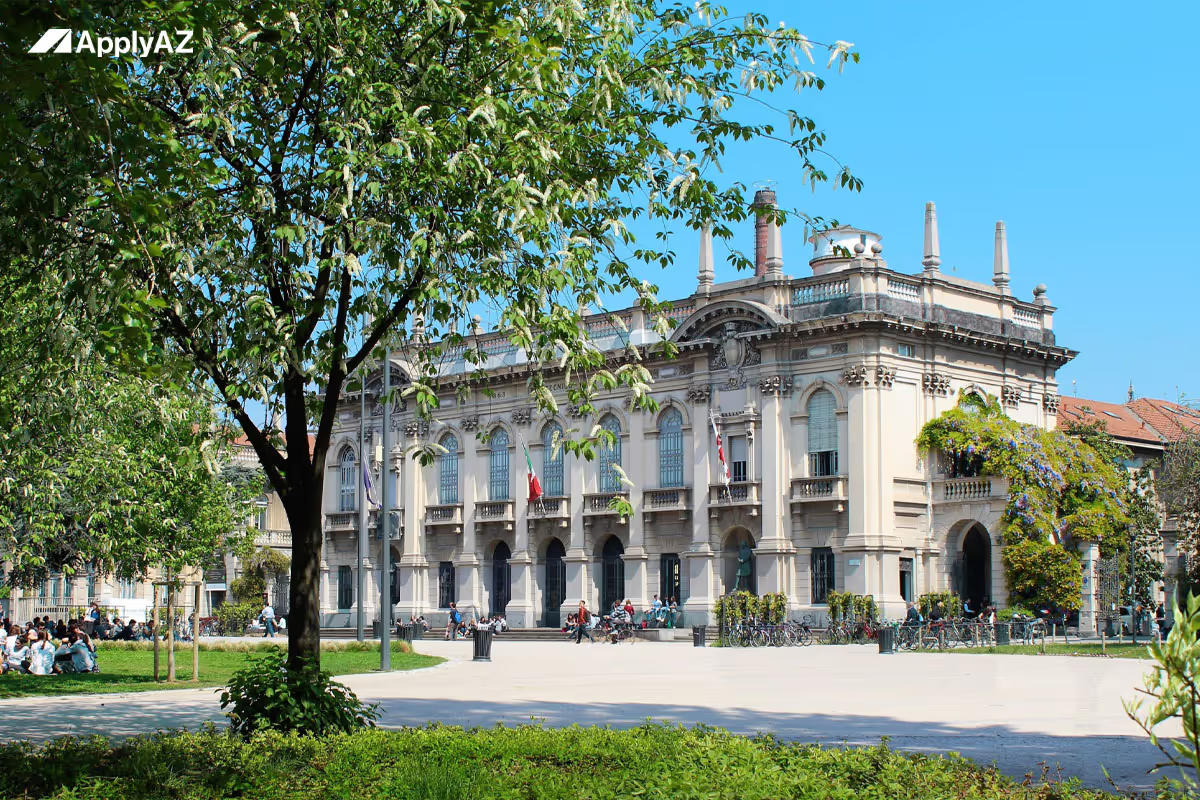
Interaction Design is a three-year, 180 ECTS bachelor's degree (class L-4) taught entirely in English at Politecnico di Milano's Lecco campus. It combines design studios with programming, electronics and prototyping. Entry is through the TOLD test, and tuition follows the university's yearly fee rules.
Entry requirements
Detailed entry requirements
Interaction Design is the English-taught undergraduate design route. For 2026/27 it requires the TOLD in English, a suitable school qualification, English evidence before enrolment and a ranking position within the available places. The Italian and English TOLD procedures have different score scales.
School qualification and test access
- Candidates who have completed upper secondary school may take the test. The published 2026/27 procedure also allows final-year school students obtaining their diploma in the preceding school year. A foreign qualification must satisfy the university’s recognition and enrolment-document rules.
- The English TOLD is taken in person in university computer rooms. For the 2026 cycle, it could be taken once within the published English-test window of 14 March to 24 May. Those dates had passed by this review.
English TOLD content and ranking thresholds
- The English test has 60 multiple-choice questions over 70 minutes. Its sections are geometry and representation, reasoning, verbal comprehension, design/art history and general culture. It does not include the additional TENG section of the Italian TOLD.
- For Italian/equivalent applicants, the ranking threshold is 27/90. For the reserved international places, it is 18/90. These thresholds are specific to the English test, not the Italian test’s 100-point scale.
- Every applicant must also meet the minimum correct-answer counts in each section: general culture 5, geometry/representation 2, art/design history 2, reasoning 1 and verbal comprehension 1. Missing a section minimum excludes the applicant from ranking even if the overall score is high.
- Correct answers receive 1 point, unanswered questions 0 and incorrect answers −0.25 before the section weighting. Ranking depends on the weighted score, available places and programme preferences.
Language evidence and Italian after enrolment
- English proficiency must be demonstrated before enrolment through an accepted certificate or a permitted citizenship/English-medium school-qualification route. Taking the entrance test in English does not remove this separate evidence requirement.
- Italian is not an entry requirement for this English-taught route, but B2 Italian must be obtained before degree completion. Students without accepted Italian evidence receive the corresponding additional educational obligation, OFA.
- Test registration, ranking acceptance and final enrolment are separate steps, and we track each one. A qualifying TOLD score does not itself verify the school qualification, language evidence or completion of enrolment within the assigned deadline.
Sources and verification
- Politecnico di Milano. Design admissions: Interaction Design test language and English/Italian provisions. 2026/27; reviewed 6 October 2026.
- Politecnico di Milano. Design: Who can take the test. 2026/27; reviewed 6 October 2026.
- Politecnico di Milano. Design: Test content and preparation. 2026/27; reviewed 6 October 2026.
- Politecnico di Milano. Design: Scores and rankings. 2026/27; reviewed 6 October 2026.
About the programme
Interaction Design is a three-year bachelor's degree in class L-4 Industrial Design, worth 180 ECTS and taught entirely in English by the School of Design at Politecnico di Milano's Lecco campus. It focuses on the design of digital interfaces, products and environments that integrate electronics and computing power.
The degree combines the design process and user research with programming, electronics and prototyping, and adds humanities and business subjects. It suits school leavers who want to shape how people use apps, connected objects and interactive spaces, and who enjoy both making and coding.
What you will study
The first year covers the fundamentals of design, programming, electronics and prototyping. The second year adds data analysis, front-end development and sustainability, with attention to accessibility and social impact. The third year centres on complex projects, ethics and economic sustainability. Course units include:
- Basics of Programming
- Architecture of Embedded and Connected Systems
- Theories of Interaction Design
- UX Design Studio and User Interface Design Studio
- VR/AR Design Studio
- Front-End Development
- Statistics and Data Analysis
- Ethics for Interaction Design
How the programme is taught
Learning is studio-based in every year. In the third year the Interaction Design Studio is worth 12 ECTS, a workshop of 6 ECTS includes a traineeship, and the thesis is worth 6 ECTS. For the final exam you present the work from the third-year studio, such as a poster, prototype or video, together with a portfolio.
You can spend a semester abroad on Erasmus+ in the second year, or in the second semester of the third year, at one of about 150 European partner universities, and bilateral agreements cover around 60 universities outside the EU. A small number of students (up to 6) are selected for MEDes, the Master of European Design programme run with six European partner schools.
Career paths
The regulations describe graduates as interaction designers able to develop physical and digital interfaces. They work as freelancers or in design and architecture studios, design companies, and firms that produce goods and services, including consumer electronics and entertainment.
- Interaction designer
- User experience designer
- User interface designer
- Information architect
- Interactive product designer
The master's in Digital and Interaction Design is the natural next step at Politecnico di Milano.
Fees and scholarships
Politecnico di Milano sets tuition through its own yearly fee rules, published on its tuition fees page; we check the 2026/27 figures there. Students who meet the merit and financial-need conditions can apply for the DSU scholarship, which the Politecnico runs itself and awards.
How to apply from outside the EU
Entry is through TOLD (Test Of Learning Design), taken in English: 60 multiple-choice questions in 70 minutes on geometry, logic, verbal comprehension, design history and general knowledge, held between March and May. For 2026/27 the degree had 50 places, 10 of them reserved for non-EU students.
You need a secondary school qualification at EQF level 4 and an English B2 certificate. Once you are admitted, we complete the Universitaly pre-enrolment, and you apply for a type D study visa. We check the 2027/28 dates on the international prospective students page.
How ApplyAZ helps
ApplyAZ is an Italy-based consultancy that works only with public universities. We can include this programme in a shortlist of 20 to 30 English-taught programmes that fit your profile, so your plan never rests on a single application.
For eligible students who start with us, a named person owns each stage, from A to Z:
- We check your school results against PoliMi's entry rules for this programme.
- We write your CV and a tailored statement of purpose.
- We prepare and submit your TOLD test registration, ranking preferences, enrolment and Universitaly pre-enrolment.
- We help you declare your family income for reduced fees and file your Politecnico di Milano DSU scholarship application at the right time and in the right format.
- We prepare your visa file.
With operations in all 20 Italian regions, we follow each region's scholarship rules and deadlines as they change. The university decides admission, the region decides the scholarship and the consulate decides the visa, so no one can promise an outcome. You pay in milestones, and every service you pay for is either delivered or its fee is refunded (terms apply).
Programmes at Italian public universities can be tuition-free for eligible students. Check if you are eligible and book a one-to-one consultation session with one of our Italy experts, or see how ApplyAZ works.
Questions and answers
Which test is required?
The TOLD in English, taken in person.
How long is the English TOLD?
60 questions in 70 minutes.
What score is needed for ranking?
27/90 for Italian/equivalent applicants or 18/90 for reserved international places, plus every section minimum.
Does a high total compensate for a failed section?
No. Every specified section minimum must be met.
Must I prove English before enrolment?
Yes, through an accepted certificate or permitted exemption route.
Is Italian required to apply?
It is not an entry requirement for this English route, but B2 Italian is required before degree completion.
Can someone handle my whole application to Interaction Design at PoliMi?
Yes. ApplyAZ, an Italy-based consultancy that works only with public universities, checks your school results against PoliMi's rules for this programme, handles the application and Universitaly pre-enrolment, helps you file the Politecnico di Milano DSU scholarship application at the right time and in the right format, and prepares your visa file, for eligible students. Start by checking your eligibility.
I'm applying from India. What is the route into Interaction Design?
You can take the English TOLD once you have completed upper secondary school, or in your final school year under the published procedure, and your foreign qualification must meet the university's recognition rules [2]. For the reserved international places you need at least 18 out of 90 plus every section minimum to be ranked [4], and you prove English before enrolment [1]. The steps are TOLD registration, the ranking and Universitaly pre-enrolment. Indian students apply for the type D study visa at the Italian embassy or consulate that covers their state, such as New Delhi, Mumbai or Bengaluru.
Is the route different from Pakistan, Bangladesh or Sri Lanka?
No. The academic rules for Interaction Design are the same whatever your nationality. Applicants from Pakistan, Bangladesh and Sri Lanka follow the same steps as India: the English TOLD, a place in the ranking and Universitaly pre-enrolment, then a type D study visa from the Italian mission for their country of residence. Read our guide for students in Dhaka.
I live in the UAE, Saudi Arabia, Qatar, Kuwait, Oman or Bahrain. Where do I apply for the visa?
At the Italian embassy or consulate responsible for the country where you legally live, after Universitaly pre-enrolment. The academic rules for Interaction Design are the same whatever your nationality, and Gulf residents follow the same steps: the English TOLD, a place in the ranking and Universitaly pre-enrolment. Read our guides for Dubai, Riyadh and Doha.
I studied or live in London, New York, Toronto, Vancouver, Singapore or Kuala Lumpur. What is the route?
The academic rules for Interaction Design are the same whatever your nationality, and your school results are assessed like any other foreign qualification. Non-EU applicants who live abroad follow the same route: the English TOLD, a place in the ranking and Universitaly pre-enrolment, then a type D study visa from the Italian mission for where they live. Read our guides for students in London, New York, Toronto, Vancouver, Singapore and Kuala Lumpur.
More English-taught programmes at this university
Other public universities in this city

They began right where you are

