

Bachelor in Electrical Engineering and Information Technology at University of Naples Federico II
Three-year English-taught L-8 bachelor's at Federico II in Naples, combining information, electrical and biomedical engineering, with a final semester of chosen subjects from computer engineering to data science.
Bachelor
3 years
Naples
English
University of Naples Federico II



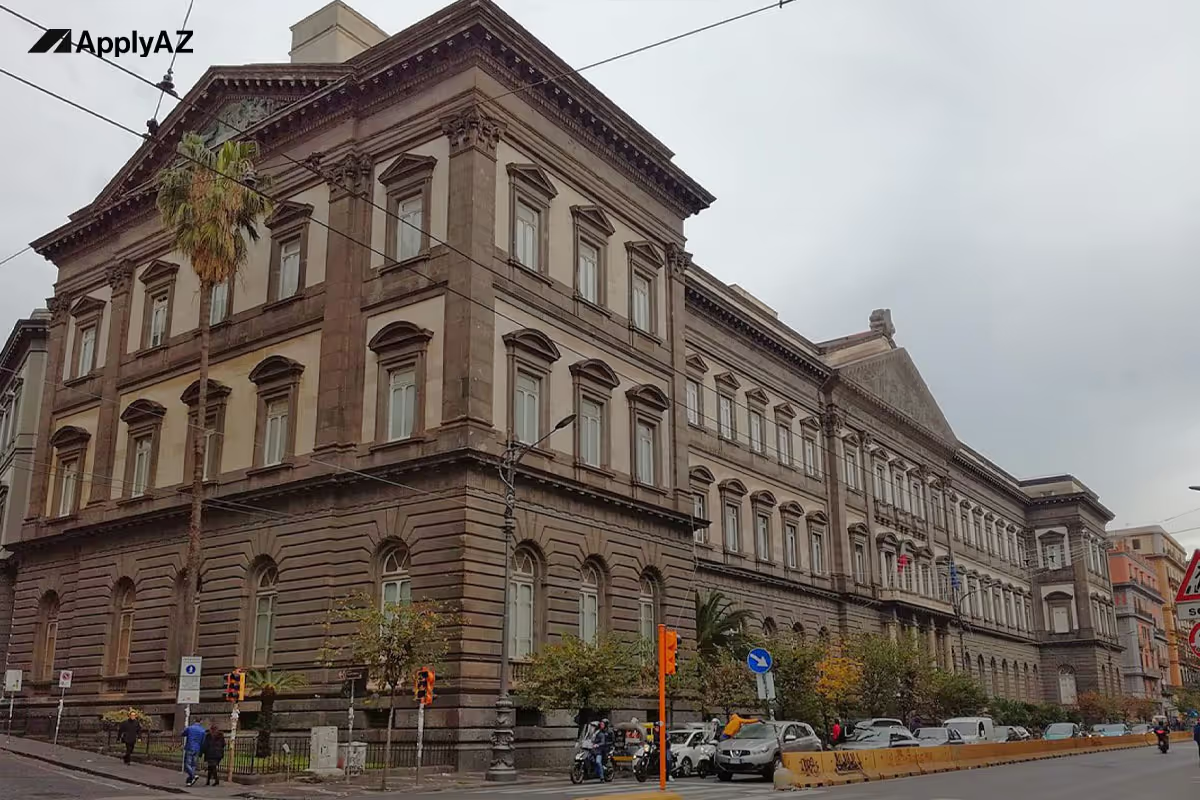
Electrical Engineering and Information Technology is a three-year, 180 ECTS bachelor's degree (class L-8) taught in English at the University of Naples Federico II, covering computing, electronics, telecommunications, electrical and biomedical engineering. Entry needs a CISIA test or the SAT, and the degree can be tuition-free for eligible students.
Entry requirements
- A secondary school diploma after at least 12 years of pre-university education, with a declaration of value from the Italian embassy or consulate, or a CIMEA statement.
- A certificate of English at B2 level (CEFR) or higher.
- The CISIA CEnT-S test with at least 9 out of 45 across mathematics, reasoning on texts and data, chemistry and physics (biology is not counted).
- For 2026/27, the TOLC-I (at least 15 points in the relevant sections) or the SAT (at least 320 out of 1600) were also accepted.
- A weak mathematics score brings an additional learning requirement (OFA) of 6 credits in maths, to clear in the first year.
About the programme
Electrical Engineering and Information Technology (EEIT) is a three-year bachelor's degree (laurea, class L-8) worth 180 ECTS, taught in English by the Department of Electrical Engineering and Information Technology (DIETI) at Via Claudio 21 in Naples. It opened in 2026/27 as part of Federico II's international catalogue, and its first lessons began on 14 September 2026.
The degree gives a broad, interdisciplinary grounding in information engineering, electrical engineering and bioengineering. It suits school leavers with solid maths and science who want to keep their options open across computing, electronics, telecommunications and energy.
What you will study
Five semesters are devoted to core subjects in mathematics, physics and the foundations of information technology and electrical engineering. The last semester lets you focus on a sector through two curricular choices, 18 credits of electives and a short dissertation. Course units in the published plan include:
- Calculus I (12 ECTS), Calculus II, and Geometry and Linear Algebra
- Fundamentals of Computer Engineering (12 ECTS) and Object-Oriented Programming
- Physics I (mechanics and thermodynamics) and Physics II (electromagnetism)
- Systems Theory, Signals Theory and Mathematical Methods for Engineers
- Foundations of Electrical Engineering and Electromagnetic Fields
- Electronics, Basics of Measurements and Basics of Biomedical Engineering
- Curricular choices such as Operating Systems, Computer Networks, FPGA Devices for Digital Circuits Design, Digital Transmission, Nonlinear Circuits and Scientific Data Mining
How the programme is taught
All listed course units are taught in person, mostly as lectures, with a language skills unit in year one and seminars in year two. Classes run in two terms, starting in early September and early March.
Career paths
The department expects graduates to work as junior engineers in energy, electronics, automation, telecommunications and IT companies; as software developers, systems analysts or technical specialists; as research and development assistants; or as project assistants and technical consultants in engineering teams. Many continue to a master's degree in electrical engineering, computer engineering, telecommunications, electronics, automation and robotics, bioengineering or data science.
Fees and scholarships
The EEIT website states that non-EU international students pay only the compulsory regional tax and €16 stamp duty, and asks applicants to confirm with the engineering student office. Federico II's 2026/27 fee simulator also lists non-EU foreign students among those fully exempt from contributions, with the regional tax set at €130, €151 or €173 by ISEE band. ADISURC grants regional scholarships once you have enrolled. The degree can be tuition-free for eligible students.
How to apply from outside the EU
Non-EU applicants who need a visa first apply for pre-admission on Universitaly, uploading their passport, school certificate, declaration of value or CIMEA statement, B2 English certificate and an English TOLC-I result (at least 10 out of 50). The degree coordinator reviews the file and issues a pre-admission letter. For 2026/27 this phase was expected to run from January to 31 May 2026. With the letter you apply for a study visa, then complete final enrolment in person in Naples between July and the end of October.
How ApplyAZ helps
If this programme fits your goals, ApplyAZ can include it in a shortlist of 20 to 30 English-taught programmes at Italian public universities. We write your CV and a tailored statement of purpose, submit your applications and Universitaly pre-enrolment, file your DSU scholarship application and prepare your visa file, with a named person on each stage. The university decides admission, the region decides the scholarship and the consulate decides the visa. See how ApplyAZ works or check your eligibility.
Questions and answers
Is the EEIT bachelor taught in English?
Yes. Electrical Engineering and Information Technology is taught in English, and all applicants, EU and non-EU, need an English certificate at B2 level or higher.
Which entrance test do I need?
The CISIA CEnT-S test, with at least 9 out of 45 excluding biology. For 2026/27 the TOLC-I (15 points or more) or the SAT (320 out of 1600 or more) were accepted instead.
What subjects does the degree cover?
Maths, physics, computer engineering, programming, signals and systems, electrical engineering, electromagnetic fields, electronics, measurements and biomedical engineering, followed by a final semester of chosen subjects such as networks, telecommunications or data science.
When can I apply for 2027/28?
The 2027/28 dates are not published yet. For 2026/27, non-EU pre-admission on Universitaly was expected to open in January and close on 31 May 2026, with final enrolment in Naples from July to October.
How much does it cost?
The course website says non-EU students pay only the regional tax and €16 stamp duty, and Federico II's 2026/27 fee simulator lists non-EU foreign students as exempt from contributions. ADISURC scholarships are open to eligible students.
What can I do after this bachelor's?
Graduates can work as junior engineers, software developers, systems analysts or R&D assistants, or continue to a master's in fields such as computer engineering, telecommunications, electronics, automation and robotics, bioengineering or data science.
Similar programmes
More programmes in this city

They began right where you are

