

Bachelor in Biology for One-Health at University of Naples Federico II
Three-year English-taught L-13 biology bachelor's at Federico II in Naples built on the One-Health model, with 75 places (30 for non-EU students), laboratory work, an internship and an experimental thesis.
Bachelor
3 years
Naples
English
University of Naples Federico II


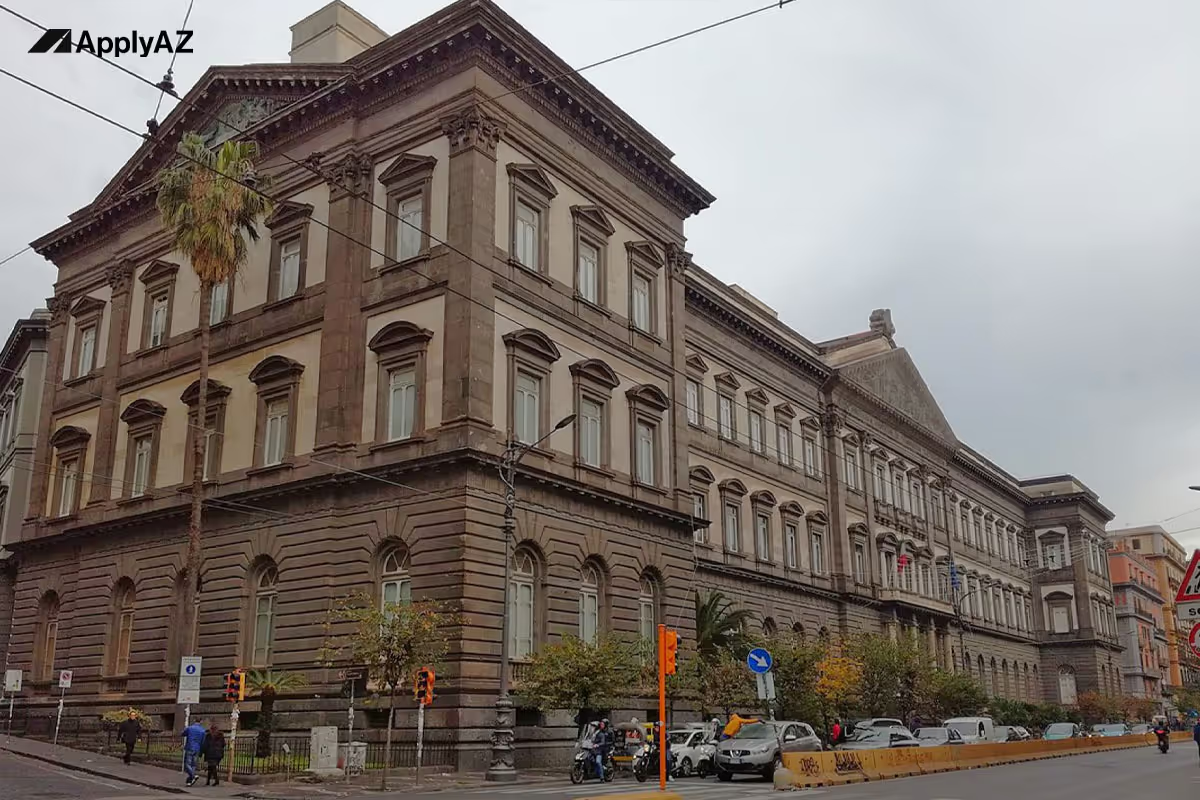
Biology for One-Health is a three-year, 180 ECTS bachelor's degree (class L-13) taught in English by the Department of Biology of the University of Naples Federico II, linking human, animal and ecosystem health. It has 75 places, 30 of them for non-EU students, and can be tuition-free for eligible students.
Entry requirements
- A secondary school diploma, or a foreign qualification recognised as equivalent, with basic knowledge of maths, physics and the natural sciences.
- A certificate of English at B2 level or higher.
- The compulsory CISIA CENT self-assessment test, taken online in TOLC@HOME mode; weak results bring additional learning requirements (OFA) for the first year.
- Non-EU applicants living abroad are selected by the Course Coordination Committee, with an online interview.
- EU and Italian applicants are ranked by the order of their application and their secondary school grade.
About the programme
Biology for One-Health is a three-year bachelor's degree (laurea, class L-13) worth 180 ECTS, taught in English by the Department of Biology of the University of Naples Federico II at the Monte Sant'Angelo campus, Via Cinthia. It is a limited-access course with 75 places: 30 for non-EU students and 45 for EU and Italian students.
The One-Health model treats the health of people, animals and ecosystems as one system. The degree trains biologists who can apply that holistic view to threats such as diseases spread by climate change, land use, closer contact with animals, and global travel and trade. It suits school leavers who enjoy biology and want a science degree with a strong public health and environmental angle.
What you will study
Teaching is organised in annual courses: 17 core courses, two courses of your choice worth 12 credits, an internship and an experimental thesis. The plan builds from the scientific basics to specialised biology with a One-Health focus:
- Principles of mathematics, biomathematics, physics, statistics and chemistry
- Core disciplines of the biological area needed to train a biologist
- Human health from a biological perspective
- Conservation, protection and restoration of ecosystems
- Main investigative and field techniques, with modern laboratory analysis
- Two elective courses (12 credits)
- An experimental thesis on methods and data processing, using One-Health case studies
How the programme is taught
Teaching is in person. The course can offer synchronous distance learning on Teams for no more than 20% of activities, and some courses use seminars, classroom exercises and language or computer laboratories. Internships with organisations that have an agreement with the university are optional and count as elective credits, and Erasmus study periods abroad are available.
Career paths
After the state exam, graduates can join section B of the Italian register of biologists and work as junior biologists in technical roles in biochemical and environmental control laboratories. The department points out that the most common next step is an English-taught master's degree, of which there are about 30 across Italy.
Fees and scholarships
Federico II calculates contributions from family income. In its 2026/27 fee simulator, foreign students who are citizens of non-EU countries appear among the categories fully exempt from contributions; the regional tax (€130, €151 or €173 by ISEE band) and €16 stamp duty remain. Once enrolled, students can apply to ADISURC, the Campania scholarship body. This degree can be tuition-free for eligible students.
How to apply from outside the EU
Non-EU applicants living abroad apply through Universitaly, choosing Federico II and this degree. The Course Coordination Committee selects them directly, and for 2026/27 it held online interviews in June 2026; successful candidates receive a pre-acceptance letter to request a study visa. Participation in the selection is free. Before enrolling you also need the B2 certificate and the CENT self-assessment test. EU and Italian applicants follow a separate call on Segrepass, which for 2026/27 ran from 16 July to 31 August 2026.
How ApplyAZ helps
If this programme fits your goals, ApplyAZ can include it in a shortlist of 20 to 30 English-taught programmes at Italian public universities. We write your CV and a tailored statement of purpose, submit your applications and Universitaly pre-enrolment, file your DSU scholarship application and prepare your visa file, with a named person on each stage. The university decides admission, the region decides the scholarship and the consulate decides the visa. See how ApplyAZ works or check your eligibility.
Questions and answers
Is Biology for One-Health taught in English?
Yes. The whole bachelor's is taught in English, and you need a certificate of English at B2 level or higher to enrol.
How many places are there for non-EU students?
The degree has 75 places: 30 for non-EU students and 45 for EU and Italian students.
How are non-EU applicants selected?
Non-EU applicants living abroad apply on Universitaly and are selected by the Course Coordination Committee, which held online interviews in June for 2026/27. All students must also take the CISIA CENT self-assessment test before enrolling.
When can I apply for 2027/28?
The 2027/28 dates are not published yet. For 2026/27, non-EU applications went through Universitaly with interviews in June 2026, while the EU and Italian call ran from 16 July to 31 August 2026.
How much does it cost?
Federico II's 2026/27 fee simulator lists non-EU foreign students among those exempt from contributions, leaving a regional tax of €130 to €173 and €16 stamp duty. The selection is free, and ADISURC scholarships are open to eligible students.
What can I do after graduating?
You can sit the state exam for the junior section of the register of biologists and work in biochemical or environmental control laboratories, or continue to one of the English-taught master's degrees in Italy.
Similar programmes
More programmes in this city

They began right where you are

