

Master in The Ancient Mediterranean World: History, Archaeology and Art at University of Pavia
Two-year English-taught master at the University of Pavia on the history, archaeology and art of the ancient Mediterranean and Near East, with Archaeology and Ancient History curricula, excavations and museum work.
Master
2 years
Pavia
English
University of Pavia



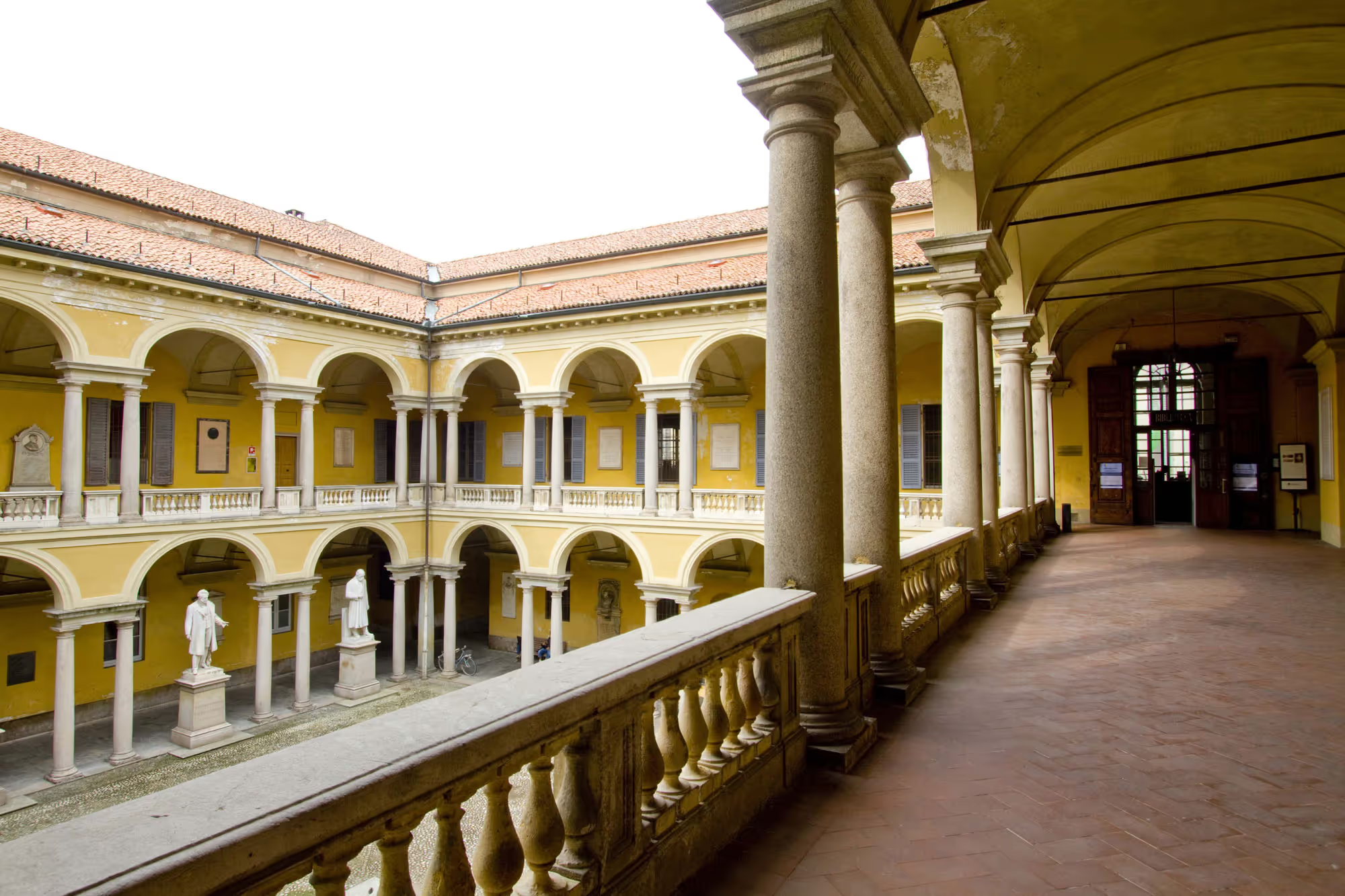
The Ancient Mediterranean World: History, Archaeology and Art is a two-year, 120 ECTS master's degree (class LM-2-R) taught in English at the University of Pavia. Entry needs a three-year degree with a relevant humanities background, preferably classics or ancient history, plus English at B2 and a short admission interview. Fees follow family income, so it can be tuition-free for eligible students.
Entry requirements
Detailed entry requirements
Pavia's Ancient Mediterranean World master asks for a three-year degree with a relevant humanities background, with foreign degrees judged on their content (preferably classics or ancient history), a basic historical culture and English at B2. Applicants with a foreign degree have a short admission interview, which is not selective. Reviewed 8 October 2026. [1]
Degree requirements
You need a three-year university degree, or another Italian or foreign qualification the university recognises as suitable, plus an adequate basic historical culture, preferably of the ancient world. [1]
- Italian degree classes accepted: L-1 Cultural Heritage, L-5 Philosophy, L-6 Geography, L-10 Letters, L-15 Tourism, L-42 History and L-43 Heritage Conservation Technologies, or the matching older classes.
- Foreign degrees: the curricular requirements are judged on the content of your original course, preferably historical and literary studies of antiquity (classics).
- Missing subjects: any gaps must be filled before enrolment, during your bachelor's with extra exams or, after graduating, through single courses.
The course website describes the expected background as a bachelor's in the humanities or social sciences, preferably in classics, ancient history, or archaeology and cultural heritage. [2]
What this means for your transcript
The board looks at what you studied, not only at your degree title. As a guide, based on the rule above:
- Usually a fit: a BA in History, Archaeology or Classics with substantial ancient history, including a BA in Ancient History, Culture and Archaeology.
- Check carefully: a BA in English, Philosophy, Geography, Tourism or Political Science, or a BA with history as one of several subjects. These can fit if your transcript shows solid ancient history or archaeology.
- Often short: a B.Tech, B.E., BCA, B.Sc., B.Com or BBA, which rarely give the historical background the board looks for.
Holders of foreign degrees also have an admission interview. It is not selective, but it can lead to support tutors or preparatory courses before enrolment. [1][2]
English
Applicants who are not native English speakers and did not graduate from a degree taught in English need English at CEFR level B2, shown by one of: [1][2]
- a B2 certificate from a recognised body, such as IELTS 5.5, TOEFL iBT 77, PTE Academic 59 or Cambridge English: First
- at least 24 credits of English language courses in your bachelor's
- a certificate from the University Language Centre
The course website lists only native speakers as exempt, so we check how your degree's language of teaching is documented. [2]
Admission interview
There is no written test. The admission interview is not selective but indicative: it checks your preparation, and candidates with serious gaps can be given support tutors and, if needed, preparatory courses before enrolment. Candidates from abroad may take it by videoconference. [1]
All applicants with a foreign degree take the interview once found eligible. It lasts at most 15 to 20 minutes and covers your motivation and your familiarity with the history, art history and archaeology of the ancient Mediterranean, or with world history and archaeology and their theory and methods. [2]
Only University of Pavia humanities graduates in classes L-1, L-5 or L-10 with at least 90/110 who meet the English requirement are admitted without an interview. [1]
2027/28 deadlines
Pavia's 2027/28 calendar for programmes without a cap on places lists these calls: [4]
- First call: 12 to 18 November 2026, results on 18 December 2026.
- Second call: 12 to 20 January 2027, results on 25 February 2027.
- Third call: 12 to 22 March 2027, results on 30 April 2027. It opens to non-EU applicants living abroad only if places remain.
- Fourth and fifth calls: June and September 2027, for EU applicants and non-EU applicants living in Italy only.
Admitted students from the first three calls enrol and pay the first instalment from 17 to 24 May 2027, and non-EU applicants living abroad complete the Universitaly visa application by 24 May 2027. [4] For comparison, the 2026/27 first call ran from 12 to 20 November 2025. [5]
Documents and non-EU steps
Applicants with a foreign degree apply on the university's online portal with an identity document and their bachelor's degree diploma, issued in English, Spanish or French or officially translated into Italian. [5]
The university sets a number of places each year for non-EU students living outside Italy. [1] After admission, non-EU applicants living abroad complete Universitaly pre-enrolment for the study visa, uploading their passport, a photo, the bachelor's degree and the admission or conditional offer letter. A declaration of value, CIMEA statement or ARDI certificate can be added if available. [6]
Sources and verification
Checked by the ApplyAZ admissions team against the university's official documents listed below. Entry rules can change with each new call, and we re-check them before every application.
- University of Pavia, Department of Humanities. Course regulations, Master's degree in The Ancient Mediterranean World: History, Archaeology and Art (class LM-2), 2026/2027 entering class, with study plan. Reviewed 8 October 2026.
- University of Pavia, The Ancient Mediterranean World course website. Access requirements, admission interview and list of accepted English certificates, undated. Reviewed 8 October 2026.
- University of Pavia, The Ancient Mediterranean World programme page (language, department, curricula, fieldwork and partners), 2026/27. Reviewed 8 October 2026.
- University of Pavia. Application calendar 2027/2028, non-restricted access degree programmes. Reviewed 8 October 2026.
- University of Pavia. How to apply to master's degree programmes and enrolment instructions for applicants with a foreign degree, 2026/27 application calendar. Reviewed 8 October 2026.
- University of Pavia, application portal. Information on pre-enrolment and visa application, academic year 2026/2027. Reviewed 8 October 2026.
- University of Pavia. Fees regulation, academic year 2026/2027, including flat-rate brackets for non-EU students. Reviewed 8 October 2026.
- University of Pavia. Annual degree programme report (SUA-CdS), The Ancient Mediterranean World, 2026/27: professional profile and career outlets. Reviewed 8 October 2026.
About the programme
The Ancient Mediterranean World: History, Archaeology and Art is a two-year master's degree in class LM-2-R (Archaeology), taught entirely in English by the Department of Humanities in Pavia. [1][3] It studies the Mediterranean cultural network from the second millennium BC to late antiquity, bringing East and West together and reading written sources alongside material and artistic culture. [3]
It suits graduates in classics, history, archaeology or cultural heritage who want hands-on training in Mediterranean archaeology and history in a research setting.
What you will study
Students choose the Archaeology or the Ancient History curriculum in the second year. The first year (58 ECTS) is shared and covers the Near East, Greece and Rome. In the second year you take three 6 ECTS units from your curriculum's list, such as Etruscan and Pre-Roman Italy or Egypt After the Pharaohs, plus 12 ECTS of free electives and the thesis. First-year units include: [1]
- Ancient Western Asia: History and Civilizations
- Archaeology and Art History of Ancient Western Asia
- Greek Archaeology and Art
- Greek History and Civilization
- Roman Archaeology and Art
- Rome from the Origins to the Rise of the Empire
- The Roman Empire and Its Aftermath
- Reconstructing the Past: Methods and Tools
The 4 ECTS Field Archaeology Training and Material Culture Laboratory completes the first year, done as fieldwork, a museum placement or repository cataloguing. Students with a qualification from outside Italy take the 6 ECTS Learning Italian course unless they show Italian at B1 or are otherwise exempt. [1]
How the programme is taught
Study trips and fieldwork are central. Faculty run excavation campaigns and museum laboratories in Cappadocia (Turkey) and in several regions of Italy, and the programme lists study trips to two UNESCO World Heritage sites, Villa Adriana at Tivoli and Dos dell'Arca in Valcamonica. It also lists agreements with the Institute for the Study of the Ancient World at New York University, the Egyptian Museum in Turin, the Soprintendenza of Piedmont and Villa Adriana and Villa d'Este at Tivoli. [3]
Attendance is strongly recommended, and at least 75% attendance is compulsory for the Italian language course. Exams are held in English, and the 32 ECTS master's thesis is written and defended in English. [1]
Career paths
The university lists these outcomes for graduates: [8]
- Professional archaeologist in the public or private sector, in fieldwork, topography, data management and heritage promotion
- Archaeological service companies and heritage research organisations
- Curatorial and professional roles in museums, foundations and cultural institutions
- Scientific communication and archaeological consultancy for forensic or urban planning work
- Specialisation schools and PhD programmes in archaeology, history, art history or cultural heritage
State archaeologist posts in Italy require a specialisation diploma or doctorate. [8]
Fees and scholarships
Non-EU students choose between two fee routes. The flat rate depends on citizenship and subject area. Countries fall into three brackets, and bracket 1, the lowest, includes India, Pakistan, Bangladesh, Sri Lanka and Nepal. The flat rate stays fixed for the normal length of the degree plus one year. [7]
The income-based route uses an equivalent ISEE calculated from your family's income and assets abroad, and we help you declare them. With an ISEE up to €32,000, this programme can be tuition-free for eligible students for the normal length of the degree plus one year. The regional tax and stamp duty still apply. [7]
Submitting your family's income documents, or applying for benefits to EDiSU Pavia, the regional body for the right to university study, takes you off the flat rate. [7] EDiSU decides scholarship awards.
How to apply from outside the EU
Applicants with a foreign degree apply on Pavia's portal, apply.unipv.eu, with an identity document and their bachelor's diploma (in English, Spanish or French, or officially translated into Italian). Eligible applicants then have a short admission interview. [2][5]
For 2027/28 the first call runs from 12 to 18 November 2026 and the second from 12 to 20 January 2027. A March 2027 call opens to non-EU applicants living abroad only if places remain, and the university sets a number of places for them each year, so we apply in the early calls. [1][4]
After admission we complete the Universitaly pre-enrolment and visa request, due by 24 May 2027 for non-EU applicants living abroad, and you apply for a type D study visa at the Italian consulate, which decides the visa. A declaration of value, CIMEA statement or ARDI certificate can be added to the pre-enrolment if you already have one. [4][6]
Compare related master's programmes
If you are exploring cultural heritage and conservation, compare the curriculum and entry requirements on these programme pages before choosing your shortlist.
- Master in Science for the Conservation-Restoration of Cultural Heritage at University of Bologna
- Master in Science and Technology for the Conservation of Cultural Heritage at Sapienza University of Rome
How ApplyAZ helps
ApplyAZ is an Italy-based consultancy that works only with public universities. We can include this programme in a shortlist of 20 to 30 English-taught programmes that fit your profile, so your plan never rests on a single application.
For eligible students who start with us, a named person owns each stage, from A to Z:
- We check your transcript against Pavia's entry rules for this programme.
- We write your CV and a tailored statement of purpose.
- We prepare and submit your online application, supporting documents and Universitaly pre-enrolment.
- We help you declare your family income for reduced fees and file your regional DSU scholarship application at the right time and in the right format.
- We prepare your visa file.
With operations in all 20 Italian regions, we follow each region's scholarship rules and deadlines as they change. The university decides admission, the region decides the scholarship and the consulate decides the visa, so no one can promise an outcome. You pay in milestones, and every service you pay for is either delivered or its fee is refunded (terms apply).
Programmes at Italian public universities can be tuition-free for eligible students. Check if you are eligible and book a one-to-one consultation session with one of our Italy experts, or see how ApplyAZ works.
Questions and answers
Is The Ancient Mediterranean World master taught in English?
Yes. The regulations state that it is taught in English, exams are held in English, and the thesis is written and defended in English. Students with a qualification from outside Italy also take a 6 ECTS Learning Italian course in the first year unless exempt. [1]
What bachelor's degree do I need for The Ancient Mediterranean World at Pavia?
A three-year degree. Italian applicants need a degree in cultural heritage, philosophy, geography, letters, tourism, history or heritage conservation. For foreign degrees, the board looks at the content of your studies, preferably classics or ancient history, and asks for a basic historical culture. [1][2]
Is there an entrance exam?
No written test. Applicants with a foreign degree have a short admission interview of up to 15 to 20 minutes, which can be by videoconference, on your motivation and your knowledge of ancient history, art history and archaeology. The regulations describe it as not selective. [1][2]
What English level is required? Do I need IELTS?
English at B2. Accepted proof includes IELTS 5.5, TOEFL iBT 77, PTE Academic 59 or Cambridge First, 24 credits of English in your bachelor's, or a University Language Centre certificate. The regulations exempt native speakers and graduates of English-taught degrees, and we check whether this applies to you. [1][2]
When is the deadline for non-EU students?
For 2027/28, non-EU applicants living abroad can apply from 12 to 18 November 2026 or 12 to 20 January 2027. A March 2027 call opens to them only if places remain, and the Universitaly visa application closes on 24 May 2027. [4]
I have a BA in English or Political Science. Can I apply?
Possibly. For foreign degrees the board looks at what you studied, preferring classics and ancient history, and asks for a basic historical culture, preferably of the ancient world. A BA in History or Archaeology often fits, while an English or Political Science BA with little ancient history needs careful checking. [1]
Does the programme include fieldwork?
Yes. Faculty run excavation campaigns and museum laboratories in Cappadocia in Turkey and in several regions of Italy. The study plan includes a 4 ECTS Field Archaeology Training and Material Culture Laboratory, done as fieldwork, a museum placement or repository cataloguing. [1][3]
How do the fees work?
Non-EU students choose a flat rate set by citizenship bracket, with India, Pakistan, Bangladesh, Sri Lanka and Nepal in the lowest bracket, or the income-based route. With an equivalent ISEE up to €32,000 the programme can be tuition-free for eligible students, but the regional tax and stamp duty apply. [7]
Can someone handle my whole application to The Ancient Mediterranean World at Pavia?
Yes. ApplyAZ, an Italy-based consultancy that works only with public universities, checks your transcript against Pavia's rules for this programme, handles the application and Universitaly pre-enrolment, helps you file the regional DSU scholarship application at the right time and in the right format, and prepares your visa file, for eligible students. Start by checking your eligibility.
I'm applying from India. What is the route into The Ancient Mediterranean World?
A recognised three-year Indian BA in History or Archaeology with solid ancient history can meet the background rule, which prefers classics and ancient history. You also need English at B2, for example IELTS 5.5. The steps are the online application, a short admission interview, admission and Universitaly pre-enrolment. [1][2] Indian students apply for the type D study visa at the Italian embassy or consulate that covers their state, such as New Delhi, Mumbai or Bengaluru.
Is the route different from Pakistan, Bangladesh or Sri Lanka?
No. The academic rules for The Ancient Mediterranean World are the same whatever your nationality. Applicants from Pakistan, Bangladesh and Sri Lanka follow the same steps as India: online application, a short admission interview, admission and Universitaly pre-enrolment, then a type D study visa from the Italian mission for their country of residence. Read our guide for students in Dhaka.
I live in the UAE, Saudi Arabia, Qatar, Kuwait, Oman or Bahrain. Where do I apply for the visa?
At the Italian embassy or consulate responsible for the country where you legally live, after Universitaly pre-enrolment. The academic rules for The Ancient Mediterranean World are the same whatever your nationality, and Gulf residents follow the same steps: online application, a short admission interview, admission and Universitaly pre-enrolment. Read our guides for Dubai, Riyadh and Doha.
I studied or live in London, New York, Toronto, Vancouver, Singapore or Kuala Lumpur. What is the route?
The academic rules for The Ancient Mediterranean World are the same whatever your nationality, and your degree is assessed like any other foreign qualification. Non-EU applicants who live abroad follow the same route: online application, a short admission interview, admission and Universitaly pre-enrolment, then a type D study visa from the Italian mission for where they live. Read our guides for students in London, New York, Toronto, Vancouver, Singapore and Kuala Lumpur.
More English-taught programmes at this university
Other public universities in this city

They began right where you are

