

Master in International Business and Entrepreneurship at University of Pavia
Two-year English-taught LM-77-R master's at the University of Pavia in international management, entrepreneurship and innovation, with International, Digital and Sustainable Management curricula and 16 joint degree partners. Entry needs business, economics and quantitative credits and English at B2.
Master
2 years
Pavia
English
University of Pavia



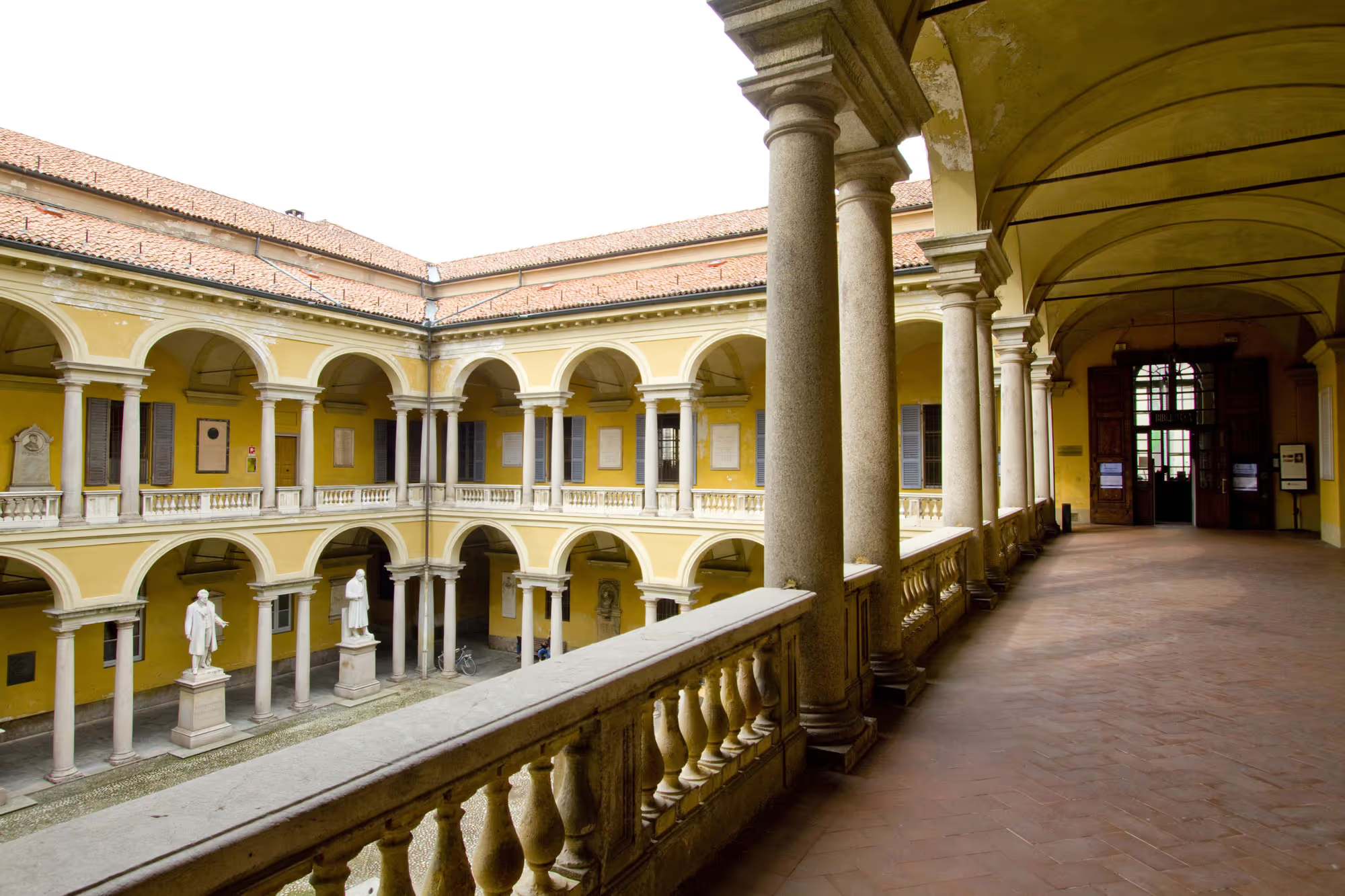
International Business and Entrepreneurship (MIBE) is a two-year, 120 ECTS master's degree (class LM-77-R) taught in English at the University of Pavia, with International, Digital or Sustainable Management curricula. Entry needs a bachelor's with 24 business, 12 economics and 12 quantitative credits, plus English at B2. Non-EU students can have fees set by family income, so it can be tuition-free for eligible students.
Entry requirements
Detailed entry requirements
Pavia's MIBE asks for a three-year bachelor's or recognised foreign equivalent with at least 24 credits in business and management, 12 in economics and 12 in statistics, maths or econometrics, plus English at B2 and a selection score of at least 33 points for one of the limited non-EU places. Reviewed 8 October 2026. [1]
Degree and credit requirements
You need a bachelor's degree or a foreign degree recognised as equivalent to an Italian first-cycle degree. The course website asks for a three-year bachelor's in business, management or economics. [1][2] Your degree must include at least: [1]
- 24 CFU in business and management subjects.
- 12 CFU in economics.
- 12 CFU in statistics, mathematics or econometrics.
- 5 CFU in English, or other proof of English at B2 (see below).
A shortfall of up to 10% (6 CFU) is tolerated across one or more subject groups, but not for English. If your foreign degree cannot be measured directly in Italian credits and subject codes, the committee converts your curriculum to check it is in line with these minimums. Applicants who lack credits can take single courses to make them up before applying. [1]
What this means for your transcript
Italian CFU and the credits on a foreign transcript are not the same unit: one CFU stands for about 25 hours of student work, and the committee looks at your subjects, not just your total. [1] The course website states that a vocational title, such as an Indian Bachelor of Business Administration or Bachelor of Commerce, is unsuitable for an Italian master's degree. [2] As a guide, based on the rules above:
- Usually a fit: a three-year academic bachelor's in business economics, management or economics whose transcript shows the 24 business, 12 economics and 12 quantitative credits.
- Check carefully: a B.A. or B.Sc. in Economics or Statistics usually covers economics and quantitative methods but can fall short on the 24 business and management credits.
- Often short: a B.Com or BBA from India, which the course website calls a vocational title, and a B.Tech, B.E. or BCA, which usually lack the business and economics credits.
English
You need English at B2. The requirement is met by 5 CFU of English in your degree, by an international certificate at B2 or higher such as the First Certificate in English, or by a bachelor's taught entirely in English. The 10% credit tolerance does not apply to English. [1][2]
The call lists the accepted certificates, and we check which proof your file can use. A valid B2 certificate also earns 2 points in the selection if you do not need it to meet the minimum requirement. [1][3]
Selection and places
Access is limited, and the Department Council sets a separate number of places for non-EU applicants living abroad each year: 40 for 2026/27. [1][2] The 2026/27 non-EU call does not describe a written exam. Instead, the admission committee scores your application, and the minimum score for admission is 33 points: [2][3]
- Grade average: up to 30 points, from 30 for a weighted average of 29/30 or higher down to 0 below 19/30. Foreign grades are converted from your home country's grading system.
- Regular academic career: 4 points, for non-EU students who have completed 80% of their bachelor's exams, or who graduated no more than two years before applying.
- English certificate at B2 or higher: 2 points, if you do not need it for the minimum requirement.
- Bachelor's taught entirely in English: 1 point, not awarded if English is an official language of your home country.
- International study: 3 points for at least 24 ECTS taken at a university in another country.
- GMAT or GRE: 1 to 4 points. A GMAT score above 550 gives eligibility automatically if you meet the minimum entry requirements.
The committee may hold an interview, and a negative interview means you cannot enrol. [1]
2026/27 deadlines
For 2026/27, non-EU applicants living abroad applied from 9 February to 9 April 2026 for 40 places. Results were emailed from 2 March 2026, and enrolment opened on 9 March 2026. The 2027/28 call was not yet published when we reviewed the programme website. [2]
Documents and non-EU steps
The online application includes your bachelor's transcript showing exams, marks and credits or study hours, a passport copy, a spreadsheet of your exams grouped by subject area, your CV, and an English certificate and GMAT certificate if you have them. The application fee must be paid before the committee evaluates your file. [2]
Admitted non-EU applicants living abroad then complete Universitaly pre-enrolment and apply for a type D study visa. [2]
Sources and verification
Checked by the ApplyAZ admissions team against the university's official documents listed below. Entry rules can change with each new call, and we re-check them before every application.
- University of Pavia, Department of Economics and Management. Course regulations, Master's degree in International Business and Entrepreneurship (LM-77), 2026/27 entering class. Reviewed 8 October 2026.
- University of Pavia, MIBE course website: entry requirements and how to apply for non-EU students, academic year 2026/27. Reviewed 8 October 2026.
- University of Pavia, MIBE criteria for the evaluation of applicants' qualifications, selection for academic year 2026/27. Reviewed 8 October 2026.
About the programme
International Business and Entrepreneurship, known as MIBE, is a two-year master's degree in class LM-77-R, taught entirely in English by the Department of Economics and Management in Pavia. It is worth 120 ECTS and has restricted access: the university sets the number of places each year, with a separate quota for non-EU students. [1]
The degree prepares professionals for an increasingly international economy and for entrepreneurship and innovation, through managerial, economic, legal and quantitative courses. It suits business, management and economics graduates who want to work in international companies, start their own venture or lead digital change inside a firm.
What you will study
You choose one of three curricula when you submit your study plan: International Management, Digital Management or Sustainable Management. Each has its own first-year units. All three share Economics of Innovation and Industrial Dynamics in the second year, 12 ECTS of electives or an internship, and a 24 ECTS thesis. [1]
- International Management: International Business and Management, Innovation Management, International Entrepreneurship and Agile Marketing, Firm Valuation and Capital Market Instruments, International Economics and Policy, Capital Markets and EU Company Law, and Statistical Learning, then Sustainable Performance Management in the second year.
- Digital Management: Transformative Innovation, Managing International Growth, Information Systems for Managers, Energy and Environmental Economics, Innovation and Technology Law, and Statistical Learning, then Corporate Finance and a choice such as Digital Marketing in the second year.
- Sustainable Management: Sustainable Performance Management, Sustainability Reporting, Governance and Ethics, Circular Entrepreneurship, Energy and Environmental Economics, Financial Markets and Sustainability, Sustainable Development Law, and Sustainable Corporate Finance and ESG Metrics, then Digital Product Innovation and Artificial Intelligence in the second year.
Students with a foreign qualification also take a 3 ECTS course in Italian Language for Foreign Students unless they are exempt, for example with an Italian B1 certificate. [1]
How the programme is taught
An internship in Italy or abroad normally counts for 6 ECTS, or 12 in special, justified cases such as double degree students. The 2026/27 regulations list joint degree agreements with 16 partner universities in Germany, Finland, Switzerland, France, Hungary, Belgium, the United Kingdom, the United States, China and Brazil, including Lancaster University Management School and Stevens Institute of Technology. Study periods abroad normally last 3 to 10 months, extendable to 12. The degree ends with a 24 ECTS written thesis, defended in English. [1]
Career paths
The university groups graduate roles by profile:
- Entrepreneur, innovation manager, product or project manager, management consultant
- Export manager or marketing manager in a foreign subsidiary
- Analyst of international market scenarios and trends
- Information systems or digital transformation manager
- Digital and social media marketing specialist
- Data scientist or data analyst
It adds that graduates can work in almost any sector, in small and large, for-profit and non-profit organisations.
Fees and scholarships
Business degrees are in Pavia's humanities fee area. The 2026/27 flat rate for non-EU students with a study visa is €390 a year in bracket 1, which includes countries like India, Pakistan and Sri Lanka, €1,020 in bracket 2 and €3,550 in bracket 3, fixed at enrolment. The other option is an income-based fee from an equivalent ISEE, with an exemption up to €32,000, so this programme can be tuition-free for eligible students; the regional tax and €16 stamp duty remain. You need that route for an EDiSU Pavia scholarship.
How to apply from outside the EU
MIBE runs its own call instead of the university-wide calendar. For 2026/27, non-EU applicants living abroad applied on apply.unipv.eu from 9 February to 9 April 2026 for 40 places, with results emailed from 2 March 2026. The committee scores your grade average, regular academic progress, English certificate, any English-taught bachelor, international study and any GMAT or GRE, and you need at least 33 points. [2][3]
Admitted students then pre-enrol on Universitaly and apply for a type D study visa, which the consulate decides. The 2027/28 call was not yet published when we reviewed the programme website. [2]
How ApplyAZ helps
ApplyAZ is an Italy-based consultancy that works only with public universities. We can include this programme in a shortlist of 20 to 30 English-taught programmes that fit your profile, so your plan never rests on a single application.
For eligible students who start with us, a named person owns each stage, from A to Z:
- We check your transcript against Pavia's entry rules for this programme.
- We write your CV and a tailored statement of purpose.
- We prepare and submit your application on Pavia's portal, with the subject-area exam file, and your Universitaly pre-enrolment.
- We help you declare your family income for reduced fees and file your regional DSU scholarship application at the right time and in the right format.
- We prepare your visa file.
With operations in all 20 Italian regions, we follow each region's scholarship rules and deadlines as they change. The university decides admission, the region decides the scholarship and the consulate decides the visa, so no one can promise an outcome. You pay in milestones, and every service you pay for is either delivered or its fee is refunded (terms apply).
Programmes at Italian public universities can be tuition-free for eligible students. Check if you are eligible and book a one-to-one consultation session with one of our Italy experts, or see how ApplyAZ works.
Questions and answers
What bachelor's degree do I need for MIBE at Pavia?
A three-year bachelor's in business, management or economics, or a recognised foreign equivalent, with at least 24 credits in business and management, 12 in economics and 12 in statistics, maths or econometrics. A shortfall of up to 6 credits is tolerated, except for English. [1][2]
I have a B.Com or BBA from India. Can I apply?
The course website says a vocational title, such as an Indian Bachelor of Business Administration or Bachelor of Commerce, is unsuitable for an Italian master's degree. A three-year academic degree in economics or business economics with management courses is a closer match, and we review your transcript against the credit blocks first. [2]
Is there an entrance exam?
The 2026/27 non-EU call does not describe a written exam. The committee scores your grade average, academic progress, English, international study and any GMAT or GRE, and you need at least 33 points. A GMAT above 550 gives eligibility automatically if you meet the minimum requirements. [2][3]
What English level is required? Do I need IELTS?
Not necessarily. You need English at B2, shown by 5 credits of English in your degree, an international certificate at B2 or higher, or a bachelor's taught entirely in English. The call lists the accepted certificates, and we check which proof your file can use. [1][2]
How many places are there for non-EU students, and when is the deadline?
For 2026/27 there were 40 places for non-EU applicants living abroad, with one window from 9 February to 9 April 2026 and results emailed from 2 March. The 2027/28 call is not yet published. [2]
Which curricula can I choose?
Three: International Management, Digital Management and Sustainable Management. Each has its own first-year units, and all three share Economics of Innovation and Industrial Dynamics in the second year, 12 ECTS of electives or an internship, and a 24 ECTS thesis. [1]
Can I earn a double degree?
Yes, if you are selected for one. The 2026/27 regulations list joint degree agreements with 16 partners, including Lancaster University Management School, Stevens Institute of Technology, IAE Lyon, the University of Vaasa and South-Western University of Finance and Economics in China. [1]
Can someone handle my whole application to MIBE at Pavia?
Yes. ApplyAZ, an Italy-based consultancy that works only with public universities, checks your transcript against Pavia's rules for this programme, handles the application and Universitaly pre-enrolment, helps you file the regional DSU scholarship application at the right time and in the right format, and prepares your visa file, for eligible students. Start by checking your eligibility.
I'm applying from India. What is the route into MIBE?
You need a three-year academic bachelor's with at least 24 credits in business and management, 12 in economics and 12 in statistics, maths or econometrics, plus English at B2. The course website calls vocational titles, such as an Indian BBA or B.Com, unsuitable for an Italian master's. The steps are the online application, the committee's scoring and Universitaly pre-enrolment. [1][2] Indian students apply for the type D study visa at the Italian embassy or consulate that covers their state, such as New Delhi, Mumbai or Bengaluru.
Is the route different from Pakistan, Bangladesh or Sri Lanka?
No. The academic rules for MIBE are the same whatever your nationality. Applicants from Pakistan, Bangladesh and Sri Lanka follow the same steps as India: online application, committee evaluation and Universitaly pre-enrolment, then a type D study visa from the Italian mission for their country of residence. Read our guide for students in Dhaka.
I live in the UAE, Saudi Arabia, Qatar, Kuwait, Oman or Bahrain. Where do I apply for the visa?
At the Italian embassy or consulate responsible for the country where you legally live, after Universitaly pre-enrolment. The academic rules for MIBE are the same whatever your nationality, and Gulf residents follow the same steps: online application, committee evaluation and Universitaly pre-enrolment. Read our guides for Dubai, Riyadh and Doha.
I'm applying from the UK, US, Canada, Singapore or Malaysia. Is anything different?
The academic rules are identical. Non-EU applicants who live abroad, including citizens of these countries, follow the same route: online application, committee evaluation and Universitaly pre-enrolment, then a type D study visa. Read our guides for London, New York, Singapore and Kuala Lumpur.
More English-taught programmes at this university
Other public universities in this city

They began right where you are

