

Master in Environmental Engineering at University of Pavia
Two-year environmental engineering master at the University of Pavia with an English-taught REACH curriculum on resilience to climate change: climate dynamics, groundwater, hydrological modelling, flood hydraulics and satellite data analysis.
Master
2 years
Pavia
Multiple
University of Pavia



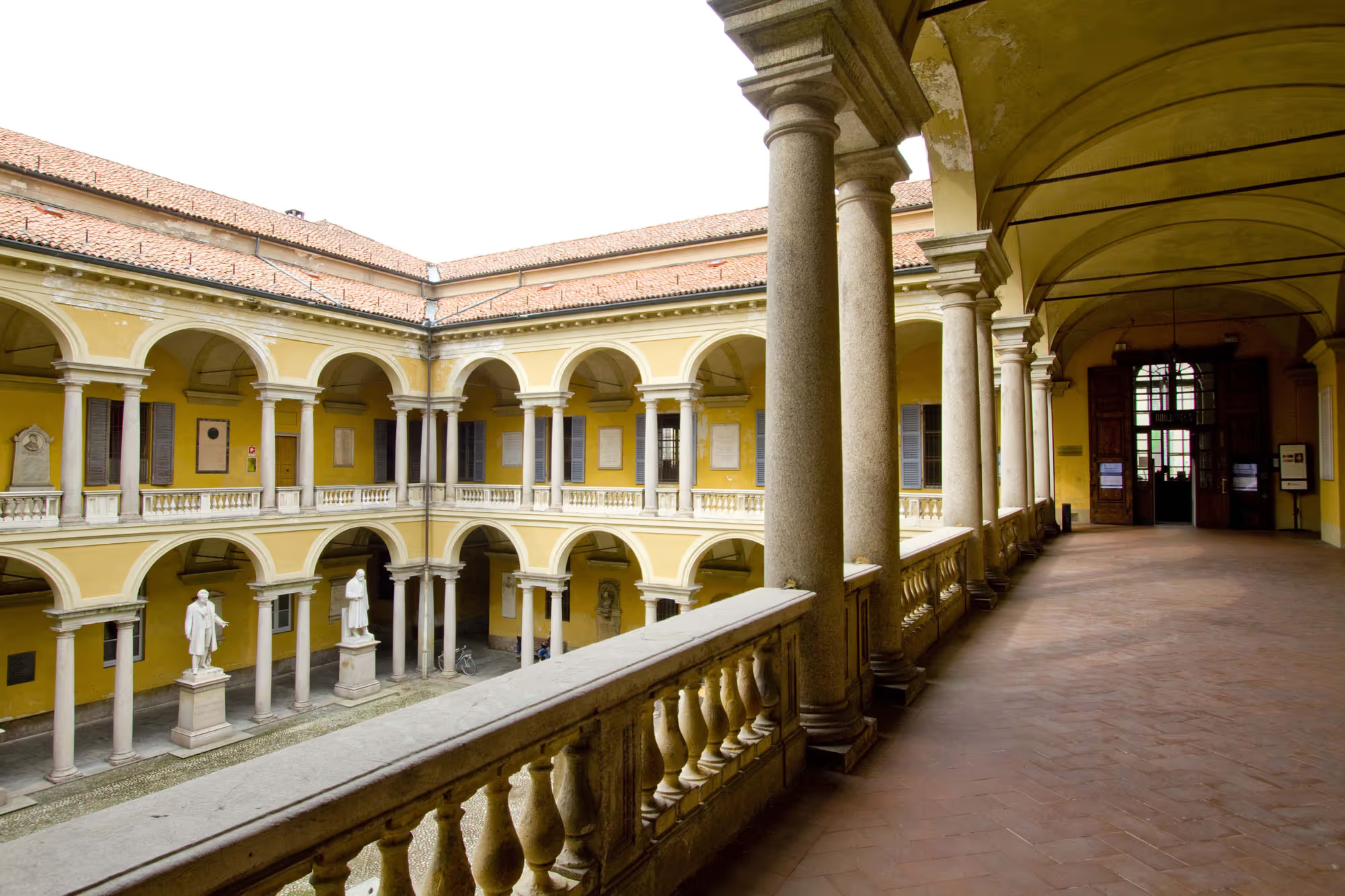
The Master in Environmental Engineering at the University of Pavia is a two-year, 120 ECTS degree (class LM-35-R) whose REACH curriculum, Resilience to Climate Change Effects, is taught in English. It covers climate dynamics, water resources, flood hydraulics and satellite data. Non-EU students pay a flat rate by country or an income-based fee.
Entry requirements
- A bachelor's degree in engineering, with at least 90 ECTS in the sectors set in the regulations: 30 in basic subjects (mathematics, physics, chemistry) and 60 in environmental and civil engineering subjects.
- A strong background in maths, physics, chemistry and geology, as the application portal states.
- English at B2 level of the CEFR.
- A check of personal preparation: graduates at or above 90/110 on the Italian scale are exempt; others sit a test in September or October or in January or February.
- An application on apply.unipv.eu with at least one academic reference and the €35 fee.
About the programme
Environmental Engineering (Ingegneria per l'Ambiente e il Territorio) is a two-year master's degree in class LM-35-R, run by the Department of Civil Engineering and Architecture in Pavia, with open access. The degree is officially bilingual and has four curricula. One of them, REACH (Resilience to Climate Change Effects), is the English-taught curriculum: the degree regulations provide for a specific curriculum in English, and the university's application portal lists English as its study language. REACH is the route for students who do not speak Italian.
REACH trains engineers to analyse the effects of climate change on water resources, environmental protection and soil conservation, build models that support decisions, and plan and design responses. It suits civil and environmental engineering graduates with a solid grounding in maths, hydraulics and geology.
What you will study
The REACH curriculum is almost entirely compulsory. The first year combines climate science, groundwater and numerical methods with satellite data; the second year moves to climate impacts on ecosystems, river hydraulics and environmental planning, with 6 ECTS of free choice such as Design of Hydraulic Structures or Fluvial Protection Works. Units in the study plan include:
- Climate Dynamics and Changes
- Groundwater Resources
- Hydrological Modeling and Hydraulic Infrastructures
- Satellite Data Analysis
- Sustainable Management of Water Resources in Agriculture
- Contamination and Remediation Technologies for Soils and Groundwater
- Climate Change Impacts on Water Ecosystems
- Fluvial Hydraulics and Flood Propagation
How the programme is taught
Alongside the climate and water units, the first year includes Continuum Mechanics and Numerical Methods in Engineering Sciences, and the second year Environmental Planning and Assessment. The degree ends with a 21 ECTS thesis. The regulations do not include internships or double degree programmes.
Career paths
The university lists these outlets for environmental engineers, several of which match the climate focus of REACH:
- Engineering firms and independent practice: planning, design, project management and environmental impact assessment
- Construction and infrastructure companies for water systems, hydroelectric plants, wastewater treatment and waste management
- Utilities and management agencies such as water consortia and treatment plants
- Public administration planning offices and environmental protection agencies
- International public bodies that manage natural and urban areas
- Insurance and consulting companies that assess climate risk
Fees and scholarships
REACH is in the science fee area. For 2026/27, non-EU students with a study visa can pay a flat rate by citizenship: €390 a year in bracket 1, which covers countries like India, Nigeria and Bangladesh, or €1,520 and €4,550 in brackets 2 and 3. The other route is an equivalent ISEE: up to €32,000 the all-inclusive fee is zero, which means zero euro tuition for eligible students, while the regional tax and €16 stamp duty still apply. The ISEE route is needed for an EDiSU Pavia scholarship.
How to apply from outside the EU
REACH has its own entry on apply.unipv.eu: upload scanned degree documents in English, French, Italian or Spanish, give at least one academic reference and pay €35 per programme. Non-EU seats are capped for each call. For 2026/27 the first call ran from 12 to 20 November 2025 and later calls opened to non-EU applicants abroad only if seats remained.
After admission you complete Universitaly pre-enrolment and apply for a type D study visa, which the consulate decides. The 2027/28 calendar was not published in September 2026.
How ApplyAZ helps
If this programme fits your goals, ApplyAZ can include it in a shortlist of 20 to 30 English-taught programmes at Italian public universities. We write your CV and a tailored statement of purpose, submit your applications and Universitaly pre-enrolment, file your DSU scholarship application and prepare your visa file, with a named person on each stage. The university decides admission, the region decides the scholarship and the consulate decides the visa. See how ApplyAZ works or check your eligibility.
Questions and answers
Is the whole degree taught in English?
No, the degree is bilingual. Its REACH curriculum, Resilience to Climate Change Effects, is the English-taught route, and the application portal lists English as its study language. You need English at B2 level.
What does the REACH curriculum cover?
Climate dynamics, groundwater resources, hydrological modelling, satellite data analysis, soil and groundwater remediation, climate impacts on water ecosystems, and river hydraulics and flood propagation, ending with a 21 ECTS thesis.
What bachelor's background do I need?
A bachelor's degree in engineering with at least 90 ECTS in the required sectors: 30 in mathematics, physics and chemistry and 60 in environmental and civil engineering subjects, plus a good grounding in geology.
Is there an entrance test?
Graduates whose final grade is at least 90/110 on the Italian scale are exempt. Others take a test of their preparation, held in September or October and in January or February.
How much are the fees?
Non-EU students with a study visa pay a flat rate by citizenship, from €390 a year for 2026/27, or an income-based fee. With an equivalent ISEE up to €32,000 the all-inclusive fee is zero, and EDiSU Pavia offers regional scholarships.
What jobs do graduates do?
The university lists engineering firms, water and waste infrastructure companies, utilities, public planning offices, environmental protection agencies, international public bodies, and insurance and consulting firms that assess climate risk.
Similar programmes
More programmes in this city

They began right where you are

