

Master in Robotics Engineering at University of Genoa
Two-year English-taught LM-32 master's in Genoa covering robot programming, control, AI, perception and human-robot interaction, run to the EMARO and JEMARO standard with a full-semester thesis.
Master
2 years
Genoa
English
University of Genoa



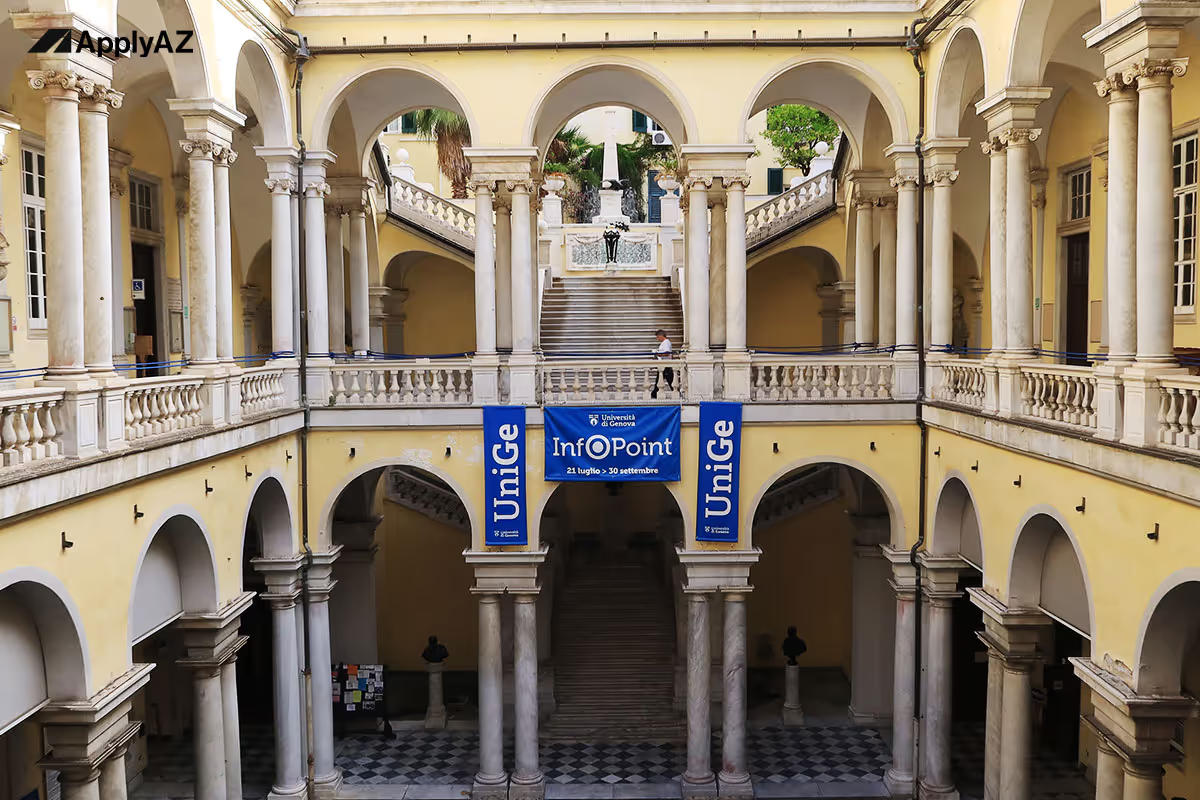
Robotics Engineering is a two-year, 120 ECTS master's degree (LM-32) taught fully in English at the University of Genoa, built on the EMARO and JEMARO robotics model. Admission rests on your academic record and a cover letter, and fees follow family income, so it can be tuition-free for eligible students.
Entry requirements
- A bachelor's degree of at least 180 ECTS (three years), or an equivalent foreign degree, relevant to robotics.
- English at B2 level or higher, or a medium-of-instruction (MOI) certificate.
- A cover letter written on the programme's own template.
- A committee reviews your grades, class rank, the relevance of your degree, the quality of your university and your CV; reference letters are optional.
- For the 2026/27 non-EU pre-selection: a minimum CGPA of 70% (60% for Algeria, Morocco and Tunisia), with no remote interview.
About the programme
Robotics Engineering is a two-year master's degree (laurea magistrale, class LM-32) worth 120 ECTS, taught completely in English at the University of Genoa. It is run by DIBRIS with the Department of Mechanical Engineering, Energy, Management and Transport, and all teaching and lab work takes place in person in Genoa.
The degree is linked to two international programmes, the European Master on Advanced Robotics (EMARO) and the Japan-Europe Master on Advanced Robotics (JEMARO). Robotics Engineering students complete the whole degree at UniGe but share classes, activities and workload with EMARO and JEMARO students. It suits engineering or computing graduates who want a demanding, lab-heavy path into robotics, AI and automation.
What you will study
The first year strengthens the engineering base and brings different skills together, and the second year goes deep into industrial and service robotics, autonomous robots and AI, and human-robot interaction. Units in the 2026/27 list include:
- Robotics Fundamentals, Robot Dynamics and Control, and Embedded Systems
- Advanced and Robot Programming, and Software and Cognitive Architectures for Robots
- Artificial Intelligence for Robotics and Machine Learning for Robotics
- Computer Vision and Signal Processing in Robotics
- Mobile Robots, Cooperative Robotics and Marine Robotics
- Social Robotics, Biomedical Robotics and Psychology of Perception and Action
- Experimental Robotics Laboratory, Research Track 1 and 2, and Research Methodology
- The master's thesis, which fills a full semester
How the programme is taught
The course follows the EMARO and JEMARO idea of learning by reflecting on doing: theory is interleaved with lab-based practical and experimental work, performance is assessed continuously, and exam sessions are synced with semesters. A group project course in the first year puts you in research-oriented teams. Students can apply for scholarships to write their thesis in China or Japan, and, depending on performance and available places, may enter EMARO in the second year to finish their studies abroad.
Career paths
The programme prepares professionals in robotics, artificial intelligence, mechatronics and automation, and also opens PhD routes in autonomous robotics, smart manufacturing and AI. Application domains named by the university include:
- Factory automation and Industry 4.0
- Intelligent transport: autonomous cars, railways, ships and space vehicles
- Ambient intelligence, smart cities and the Internet of Things
- Human-robot interaction and software-based systems
Fees and scholarships
Fees at UniGe are income-based. For 2026/27, a full-time first-year student with an ISEE-U of €13,000 or less pays only stamp duty and regional tax, and the highest university contribution for scientific-technical degrees is €3,300. Non-EU students with family abroad submit an ISEE-U parificato through an affiliated CAF. ALiSEO Liguria runs the regional scholarship, so this degree can be tuition-free for eligible students.
How to apply from outside the EU
Robotics Engineering asks for a motivation letter on its own template, and in 2026/27 the minimum CGPA for non-EU applicants was 70% (60% for Algeria, Morocco and Tunisia), with no remote interview. The course reports more than 1,100 applications from abroad a year in recent years.
Applications go through UniGeApply: for 2026/27 the visa applicants' session closed on 20 March 2026, with a €30 fee for up to two courses. After acceptance you pre-enrol on Universitaly, complete pre-enrolment at UniGe and apply for a type D study visa. Dates for 2027/28 are pending.
How ApplyAZ helps
If this programme fits your goals, ApplyAZ can include it in a shortlist of 20 to 30 English-taught programmes at Italian public universities. We write your CV and a tailored statement of purpose, submit your applications and Universitaly pre-enrolment, file your DSU scholarship application and prepare your visa file, with a named person on each stage. The university decides admission, the region decides the scholarship and the consulate decides the visa. See how ApplyAZ works or check your eligibility.
Questions and answers
Is Robotics Engineering taught in English?
Yes. All teaching and lab activities are in English, and the committee checks English at B2 level or higher. Italian is not needed for admission.
Do I study abroad as part of EMARO?
No, Robotics Engineering students complete the whole degree in Genoa. Depending on performance and available places, some can enter EMARO in the second year and finish their studies abroad.
Is there an entrance exam?
No. A committee assesses your grades, class rank, degree relevance, university, English level, CV and a cover letter on the course template. Reference letters are optional.
What grade do I need?
For the 2026/27 non-EU pre-selection the minimum CGPA was 70%, or 60% for applicants from Algeria, Morocco and Tunisia, with no remote interview.
When is the deadline for 2027/28?
Not published yet. For 2026/27, the UniGeApply session for visa applicants ran from 26 November 2025 to 20 March 2026, and the fee was €30 for up to two applications.
What careers does it lead to?
Robotics, AI, mechatronics and automation roles in areas such as factory automation, autonomous vehicles, smart cities and human-robot interaction, or a PhD in autonomous robotics, smart manufacturing or AI.
Similar programmes
More programmes in this city

They began right where you are

