

Master in Geosciences for Sustainable Development at University of Pavia
Two-year LM-74-R master's at the University of Pavia whose English curriculum, Geosciences for Energy, Mineral and Water Resources, covers groundwater, mineral deposits, raw materials, remote sensing and rock mechanics, with a traineeship. Entry needs 33 geology credits, English at B2 and an interview.
Master
2 years
Pavia
Multiple
University of Pavia



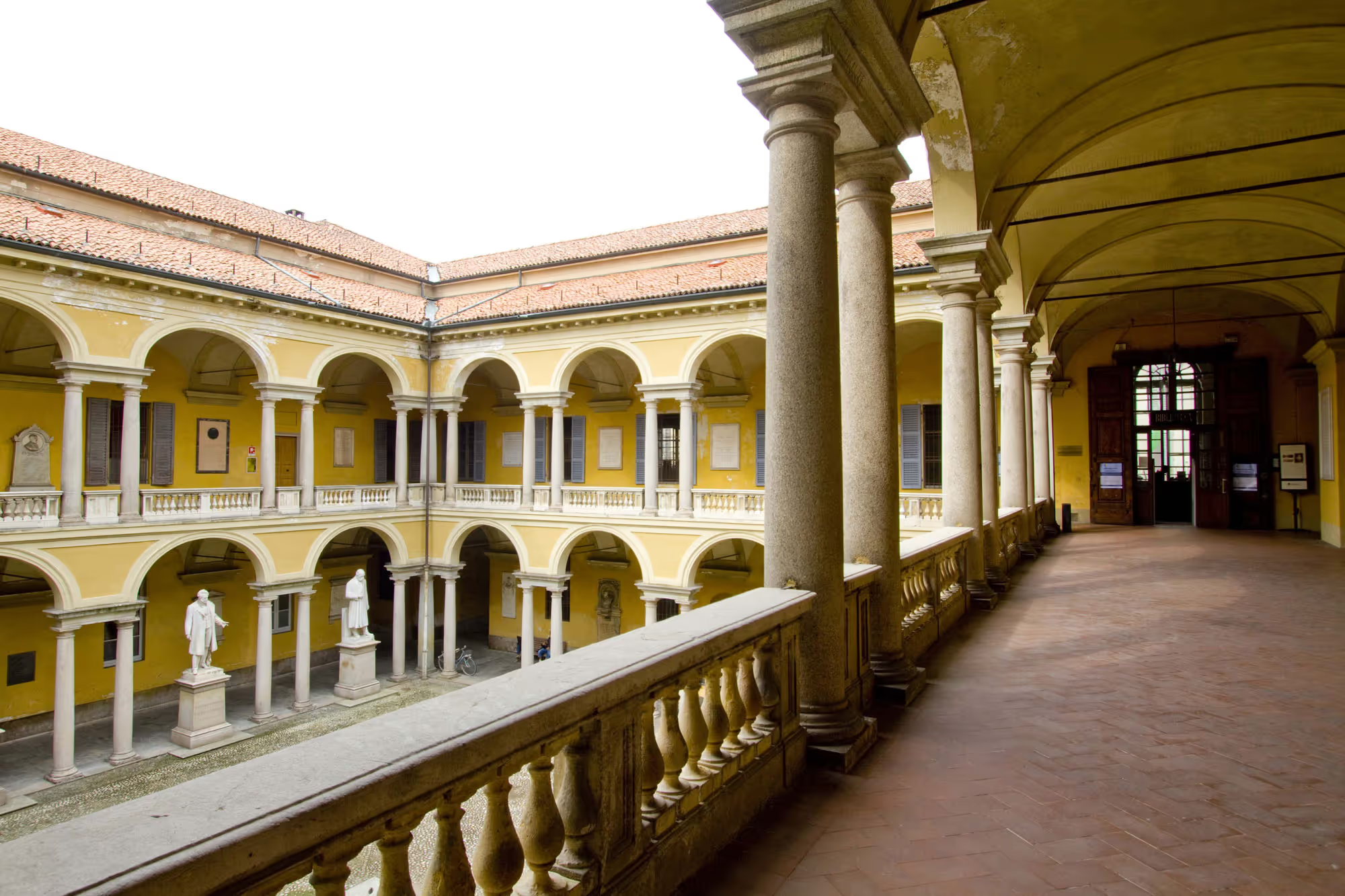
Geosciences for Sustainable Development is a two-year, 120 ECTS master's degree (class LM-74-R) at the University of Pavia in Pavia, whose Geosciences for Energy, Mineral and Water Resources curriculum is taught in English. Entry needs a geology or earth sciences degree, or at least 33 credits in geology subjects, English at B2 and an admission interview. With income-based fees, it can be tuition-free for eligible students.
Entry requirements
Detailed entry requirements
Pavia's Geosciences for Sustainable Development master asks for a bachelor's in geological or earth sciences, or another degree with at least 33 credits in geology subjects, English at B2 for the English curriculum, and an admission interview with a committee that checks your background and preparation. Reviewed 8 October 2026. [1]
Degree and credit rule
You need a bachelor's degree, a three-year university diploma or a foreign qualification the university recognises as suitable, and you must meet one of these curricular requirements: [1]
- Degree class: a degree in Geological Sciences (Italian class L-34) or Earth Sciences (old class 16).
- Credits: a degree in another class that includes at least 33 CFU in geology (GEO) subject areas.
The course website adds that degrees in geological, earth or natural sciences fit, that 33 ECTS or an equivalent number of hours in geology courses are needed, and that your background should cover mathematics, physics, chemistry, terrestrial physics, geomorphology, structural geology, stratigraphy and sedimentology, palaeontology, mineralogy and petrology, and cartography. [2]
What this means for your transcript
Italian CFU and the credits on a foreign transcript are not the same unit, and the rule also accepts an equivalent number of hours. The committee looks at the geology content of your courses, not just your total. As a guide, based on the rule above:
- Usually a fit: a B.Sc. or B.Sc. (Honours) in Geology or Applied Geology, which normally covers structural geology, stratigraphy, mineralogy and petrology in depth.
- Check carefully: a B.Sc. with Geology as one of three main subjects, or a B.Sc. in Earth Science, Environmental Science or Geography, where the geology content may or may not reach 33 credits.
- Check carefully: a B.Tech or B.E. in Civil, Mining or Petroleum Engineering, which may include engineering geology but often lacks mineralogy, petrology and stratigraphy.
- Often short: a B.Sc. in Physics, Chemistry or Mathematics without geology, and a B.Tech in Computer Science, BCA, B.Com, BBA or BA.
Graduates who do not meet the curricular requirements can make them up through individual courses set by the committee. [1]
English
The English curriculum needs English at CEFR level B2 or higher, written and oral. The regulations and course website list these certificates as B2: [1][2]
- BEC Vantage, FCE or ILEC Pass;
- IELTS 5.5 to 6.5 (Academic);
- TOEFL iBT 72 to 95;
- Trinity College ISE II or GESE 7, 8 or 9;
- TrackTest English Test B2, Pearson JETSET Level 5 or LCCI EfB Level 3.
Other certificates are assessed case by case. Graduates of universities in Australia, Ireland, New Zealand, the UK, the USA and other countries on the university's list are exempt. Others can instead give an official declaration from their university that their degree was taught fully in English. A certificate is not compulsory: without one, the committee assesses your English at the admission interview. [1][2]
The Italian curriculum is different: non-EU applicants need Italian at B2, through a certificate or the CISIA Italian test. [2][3]
Admission interview
There is no written test. A committee appointed each year reviews your file and checks your requirements and preparation in an oral interview in English, held online for applicants who graduated abroad, with details sent by email. It covers: [1][2][4]
- hydrogeology;
- geographic information systems (GIS);
- sedimentology;
- mineralogy and petrology;
- English, if you did not provide a B2 certificate.
2027/28 calls and deadlines
Pavia's application portal lists these calls for the English curriculum in 2027/28, with classes starting on 14 September 2027: [4]
- First call: 12 to 18 November 2026, 23:59 CET, for EU and non-EU applicants, with results on 18 December 2026. Early application is recommended for non-EU candidates who need a visa.
- Second call: 12 to 20 January 2027, 23:59 CET, for EU and non-EU applicants, depending on seats left after the first call.
- Third call: 12 to 22 March 2027, opened to non-EU applicants living abroad only if seats remain.
- Later calls: from 6 June 2027 and from 1 September 2027; the last is for EU applicants and non-EU applicants living in Italy.
For comparison, in 2026/27 non-EU applicants living abroad could apply from 12 to 20 November 2025 and 12 to 20 January 2026, and in the March and June 2026 windows only if places remained. [3]
Documents and non-EU steps
The online application needs: [3][4]
- your passport, preferably valid for at least two more years, or an ID card;
- a CV in English in Europass format;
- your bachelor's degree certificate, if already awarded;
- your transcript of records, or Diploma Supplement, listing the exams taken;
- an official document from your university or department describing the subjects of your course;
- proof of English at B2, if you have it.
Degree documents must be issued in English, Spanish or French or officially translated into Italian. The Admission Office evaluates your foreign qualification. [3]
You can also apply while finishing a relevant degree if you hold at least 150 credits by the application deadline. In that case you can enrol only after passing the evaluation. [1]
After admission, you submit Universitaly pre-enrolment, without which enrolment cannot be confirmed, and apply for a type D study visa. For enrolment, your degree must be legalised by the Italian embassy or consulate, apostilled, or accompanied by a CIMEA statement of verification. Degrees from countries outside the Lisbon Recognition Convention also need a declaration of value, a CIMEA statement of comparability or a Diploma Supplement. [3]
Students with a non-Italian qualification include a 3 CFU Italian Language for Foreign Students course in their study plan, unless they show Italian at B1 or above. [1]
Sources and verification
Checked by the ApplyAZ admissions team against the university's official documents listed below. Entry rules can change with each new call, and we re-check them before every application.
- University of Pavia, Department of Earth and Environmental Sciences. Academic regulations, Master's degree in Geosciences for Sustainable Development (LM-74), enrolment cohort 2026/2027, with study plan. Reviewed 8 October 2026.
- University of Pavia, Geosciences for Sustainable Development programme page and course website: access requirements, application and enrolment, and admission interview, academic year 2026/2027. Reviewed 8 October 2026.
- University of Pavia. How to apply to master's degree programmes, and information for non-EU students after admission, academic year 2026/2027. Reviewed 8 October 2026.
- University of Pavia, international application portal. Geosciences for Energy, Mineral and Water Resources course page and application calendar for non-restricted access programmes, academic year 2027/2028. Reviewed 8 October 2026.
- University of Pavia. Fees for non-EU prospective students, academic year 2026/2027. Reviewed 8 October 2026.
About the programme
Geosciences for Sustainable Development (Geoscienze per lo Sviluppo Sostenibile) is a two-year, 120 ECTS master's degree in class LM-74-R, run by the Department of Earth and Environmental Sciences in Pavia. It has no national limit on student numbers, but places for non-EU students who need a visa are limited. [1][2][3]
The degree has two curricula: an Italian one on land management and environmental protection, and Geosciences for Energy, Mineral and Water Resources, which is taught entirely in English and is the route for international students. Non-EU students who choose the Italian curriculum need Italian at B2. [1][2]
The degree trains professionals to tackle environmental and territorial challenges with an interdisciplinary approach linked to the UN 2030 Agenda. The English curriculum focuses on the sustainable management of natural resources through geological analysis, monitoring technologies and modelling.
It suits geology and earth science graduates interested in water, raw materials and energy.
What you will study
The first year covers sedimentology, mineral deposits, groundwater and remote sensing; the second year adds geochemistry, raw materials and a traineeship. Units in the English curriculum study plan include:
- Basin Analysis and Applied Sedimentology
- Petrogenetic Processes and Implications for Mineral Deposits
- Groundwater Resources
- Remote Sensing for Mineral Resources
- Rock Mechanics: Fundamentals, Field and Digital Techniques
- Gemmology
- Geochemistry for Environmental Assessment and Remediation
- Use and Sustainability of Raw Materials
You also choose three of Applied and Exploration Geophysics, Geological Modelling, Geopedology, New Energy Scenarios and Subsurface Geological Exploration, plus 12 elective credits, with suggestions such as Engineering Geology, Landslide Hazard and Risk, and Geochronology, Thermochronology and Exposure Dating. Students with a non-Italian qualification also take a 3 ECTS Italian Language for Foreign Students course, unless they show Italian at B1 or above. [1]
How the programme is taught
Teaching includes field trips to geological sites such as volcanoes and mountain belts, and the department usually covers more than half of field trip costs.
The second year includes a 9 ECTS traineeship, which can take place in the department's laboratories, and an 18 ECTS final exam: a thesis written and discussed in English. Through the LM+ programme, selected students spend two semesters from the second year training at partner organisations or companies, with their expenses reimbursed. [1]
Career paths
Graduates develop analytical, modelling and process management skills, including GIS and remote sensing. The employers the university lists are:
- Professional firms and geological consultancies
- Civil engineering companies
- Local and regional authorities
- Energy companies and extractive industries
- Environmental remediation companies
- Public and private research bodies and universities
- Ministries and insurance companies
Fees and scholarships
Non-EU students choose between two fee routes.
The flat rate depends on citizenship and subject area, across three brackets, and it stays fixed for the normal length of the degree plus one year. [5] Bracket 1 includes countries like India, Nepal, Nigeria and Pakistan.
The income-based route uses an equivalent ISEE calculated from your family's income and assets abroad.
With an ISEE of €32,000 or less, students are exempt from the all-inclusive fee, so this programme can be tuition-free for eligible students; the regional tax and stamp duty still apply.
You need the income-based route to apply to EDiSU Pavia, the regional right-to-study body, whose scholarship can include a college place, one meal a day and a cash grant. EDiSU decides awards on merit and income. [5]
How to apply from outside the EU
Applicants with a foreign degree apply on Pavia's portal, apply.unipv.eu, choosing the English curriculum, Geosciences for Energy, Mineral and Water Resources. The application needs your passport or ID card, a Europass CV in English, your transcript or Diploma Supplement, an official description of your course subjects, your degree certificate if already awarded, and proof of English at B2. If you have no English certificate, the committee assesses your English instead. [2][3][4]
Seats for non-EU students who need a visa are limited. For 2027/28, the portal lists a first call from 12 to 18 November 2026, with results by 18 December 2026, and a second call from 12 to 20 January 2027, both open to EU and non-EU applicants. A third call, from 12 to 22 March 2027, opens to non-EU applicants living abroad only if seats remain, so we apply in the first two calls. Classes start on 14 September 2027. [4]
After admission we complete the Universitaly pre-enrolment, and you apply for a type D study visa at the Italian consulate, which decides the visa. For 2026/27, pre-enrolment for the first three calls closed on 25 May 2026; the 2027/28 date is not yet published. [3]
On enrolment your degree must be legalised, apostilled or verified by CIMEA, and degrees from countries outside the Lisbon Recognition Convention also need a declaration of value, a CIMEA statement of comparability or a Diploma Supplement. [3]
How ApplyAZ helps
ApplyAZ is an Italy-based consultancy that works only with public universities. We can include this programme in a shortlist of 20 to 30 English-taught programmes that fit your profile, so your plan never rests on a single application.
For eligible students who start with us, a named person owns each stage, from A to Z:
- We check your transcript against Pavia's entry rules for this programme.
- We write your CV and a tailored statement of purpose.
- We prepare and submit your online application on Pavia's portal and Universitaly pre-enrolment.
- We help you declare your family income for reduced fees and file your regional DSU scholarship application at the right time and in the right format.
- We prepare your visa file.
With operations in all 20 Italian regions, we follow each region's scholarship rules and deadlines as they change. The university decides admission, the region decides the scholarship and the consulate decides the visa, so no one can promise an outcome. You pay in milestones, and every service you pay for is either delivered or its fee is refunded (terms apply).
Programmes at Italian public universities can be tuition-free for eligible students. Check if you are eligible and book a one-to-one consultation session with one of our Italy experts, or see how ApplyAZ works.
Questions and answers
What bachelor's degree do I need for the Geosciences master at Pavia?
A degree in Geological Sciences or Earth Sciences, or another degree with at least 33 credits in geology subjects. The course website lists geological, earth or natural sciences, with a background in maths, physics, chemistry, geomorphology, structural geology, stratigraphy, mineralogy and petrology, palaeontology and cartography. [1][2]
Is there an entrance exam?
No written test. A committee reviews your file and interviews you in English, online if you graduated abroad, on hydrogeology, GIS, sedimentology, and mineralogy and petrology, and checks that you meet the entry requirements. It also assesses your English if you have no B2 certificate. [1][2]
What English level is required? Do I need IELTS?
English at B2 for the English curriculum. Listed certificates include IELTS 5.5 to 6.5, TOEFL iBT 72 to 95 and FCE, or an official statement that your degree was taught fully in English. A certificate is not compulsory: without one, the committee assesses your English at the interview. [1][2]
When is the deadline for non-EU students?
For 2027/28, the first call runs from 12 to 18 November 2026 and the second from 12 to 20 January 2027, both open to non-EU applicants. A March 2027 call opens to non-EU applicants abroad only if seats remain, and non-EU seats are limited, so we aim for the first call. [4]
Can I apply before I graduate?
Yes. The regulations allow conditional enrolment if you are finishing a relevant degree and have at least 150 credits by the application deadline. You can enrol only after passing the evaluation. [1]
I have a B.Tech in Civil or Mining Engineering. Can I apply?
Possibly. You need at least 33 credits, or equivalent hours, in geology subjects. Civil and Mining degrees may include engineering geology but often lack mineralogy, petrology and stratigraphy. Missing requirements can be made up through individual courses set by the committee. [1][2]
Is the Geosciences master taught in English?
Only the Geosciences for Energy, Mineral and Water Resources curriculum is taught in English, and its thesis is written and discussed in English. The other curriculum is taught in Italian, and non-EU students need Italian at B2 for it. [1][2]
Does the degree include an internship?
Yes. The second year includes a 9 ECTS traineeship, which can take place in the department's laboratories. Through the LM+ programme, selected students spend two semesters from the second year training at partner organisations or companies, with expenses reimbursed. [1]
Can someone handle my whole application to Geosciences for Sustainable Development at Pavia?
Yes. ApplyAZ, an Italy-based consultancy that works only with public universities, checks your transcript against Pavia's rules for this programme, handles the application and Universitaly pre-enrolment, helps you file the regional DSU scholarship application at the right time and in the right format, and prepares your visa file, for eligible students. Start by checking your eligibility.
I'm applying from India. What is the route into Geosciences for Sustainable Development?
A recognised Indian bachelor's in Geology or Applied Geology is the closest match, and other science or engineering degrees need at least 33 credits, or equivalent hours, in geology subjects. You also need English at B2, shown by a certificate or at the interview. The steps are the online application, an online admission interview and Universitaly pre-enrolment. [1][2] Indian students apply for the type D study visa at the Italian embassy or consulate that covers their state, such as New Delhi, Mumbai or Bengaluru.
Is the route different from Pakistan, Bangladesh or Sri Lanka?
No. The academic rules for Geosciences for Sustainable Development are the same whatever your nationality. Applicants from Pakistan, Bangladesh and Sri Lanka follow the same steps as India: online application, an online admission interview and Universitaly pre-enrolment, then a type D study visa from the Italian mission for their country of residence. Read our guide for students in Dhaka.
I live in the UAE, Saudi Arabia, Qatar, Kuwait, Oman or Bahrain. Where do I apply for the visa?
At the Italian embassy or consulate responsible for the country where you legally live, after Universitaly pre-enrolment. The academic rules for Geosciences for Sustainable Development are the same whatever your nationality, and Gulf residents follow the same steps: online application, an online admission interview and Universitaly pre-enrolment. Read our guides for Dubai, Riyadh and Doha.
I studied or live in London, New York, Toronto, Vancouver, Singapore or Kuala Lumpur. What is the route?
The academic rules for Geosciences for Sustainable Development are the same whatever your nationality, and your degree is assessed like any other foreign qualification. Non-EU applicants who live abroad follow the same route: online application, an online admission interview and Universitaly pre-enrolment, then a type D study visa from the Italian mission for where they live. Read our guides for students in London, New York, Toronto, Vancouver, Singapore and Kuala Lumpur.
More English-taught programmes at this university
Other public universities in this city

They began right where you are

