

Master in Environmental Engineering for the Green Transition at Ca’ Foscari University of Venice
New English-taught environmental engineering master at Ca' Foscari's science campus in Venice Mestre, covering water, wastewater, geology and remote sensing, with second-year pathways in environment and health, climate and risk, or environmental intelligence.
Master
2 years
Venice
English
Ca’ Foscari University of Venice


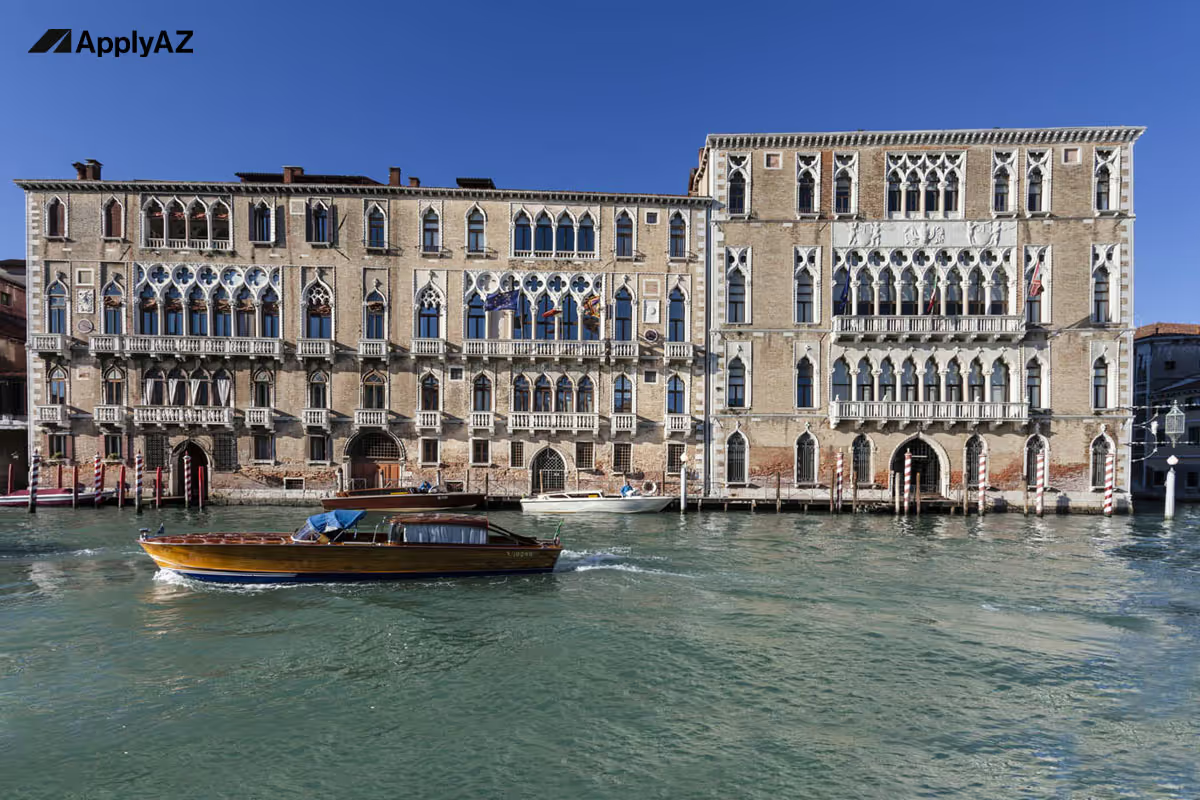
Environmental Engineering for the Green Transition is a two-year, 120 ECTS master's degree (class LM-35-R) taught entirely in English at Ca' Foscari's Scientific Campus in Venice Mestre. It started with the 2026/27 cohort. Non-EU students pay a flat yearly fee by citizenship, and students eligible for the Veneto regional scholarship are exempt from fees.
Entry requirements
- A bachelor's degree of at least three years, with a minimum CGPA between 70% and 77% depending on the country where you studied.
- A degree in civil and environmental or industrial engineering usually meets the curricular requirements; otherwise you need at least 60 ECTS in the required fields, including at least 21 in mathematics, physics, computer science or statistics and at least 16 in civil and environmental engineering.
- English at B2 level, shown with a recognised certificate; it is mandatory for enrolment.
- A motivation letter written for this programme, assessed by the Teaching Committee with your CV and transcript.
- At enrolment, your degree certificate and transcript with an official translation, plus a CIMEA Statement of Comparability, a declaration of value, an ARDI statement with CIMEA verification, or a Diploma Supplement.
About the programme
Environmental Engineering for the Green Transition is a two-year master's degree in class LM-35-R (Environmental engineering), taught entirely in English at Ca' Foscari's Scientific Campus in Venice Mestre. It carries 120 ECTS, admission is open subject to an assessment of each applicant, and attendance is not compulsory. The first cohort enrolled in 2026/27.
The degree trains engineers to tackle the ecological transition with a multidisciplinary and international approach. It combines a solid base in the environmental engineering sciences with specialist work on health, climate and digital tools. It suits graduates in civil, environmental or industrial engineering, or in the earth and environmental sciences with enough engineering and mathematics credits.
What you will study
The first year covers water resources management, waste and wastewater treatment, and advanced topographic and cartographic tools. In the second year you choose one of three thematic pathways: Environment and Health, Climate and Risk, or Environmental Intelligence. Units in the 2026/27 first-year timetable include:
- Hydrology
- Water Resources Engineering
- Wastewater Treatment Plants
- Remote Sensing
- Environmental Geology
- Environmental Impacts Analysis
- Chemical Sensors for the Environmental Monitoring
- Advanced Programming with Data
How the programme is taught
Everything, from lectures to workshops, is in English. Alongside coursework the degree includes a curricular internship, which can take place in Italy or abroad, and ends with a final thesis. Students can spend a semester at one of Ca' Foscari's partner universities through Erasmus+ or the Overseas programme, and the Career Service helps with CVs and internships. Non-Italian students earn 3 ECTS in Italian before graduating.
Career paths
The university sees graduates working as sustainability engineers for companies, public authorities and international organisations, applying digital twins, artificial intelligence and environmental modelling, or continuing to a PhD, particularly on climate change. The roles it names include:
- Environmental design of engineering solutions that protect the environment
- Management of renewable and non-renewable natural resources
- Design and management of risk monitoring and mitigation systems
- Environmental consulting, helping businesses and institutions comply with European directives
- Research and innovation in technologies for the ecological transition
Fees and scholarships
Ca' Foscari sets a flat yearly fee for non-EU students according to citizenship. For master's degrees in 2026/27 it is €1,300 for most countries, including countries like India, €700 for countries on the ministry's low human development list and €2,300 for OECD countries, with the €192 regional tax and €16 stamp duty included. International students can apply for the Veneto regional scholarship with an ISEE parificato; those who meet its limits are exempt from fees, so there is zero euro tuition for eligible students.
How to apply from outside the EU
You apply on apply.unive.it with your transcript, CV, English certificate and a motivation letter written for this degree. The Teaching Committee checks your engineering and mathematics credits and a CGPA of 70% to 77% depending on your country; there is no entrance test. One €30 fee covers up to two ranked programmes. For 2026/27 the portal opened on 17 December 2025 with rounds by citizenship; the 2027/28 rounds will be confirmed in the autumn.
With an eligibility letter you complete Universitaly pre-enrolment and apply for a type D study visa. To enrol you need a CIMEA Statement of Comparability, a declaration of value, an ARDI statement with CIMEA verification, or a Diploma Supplement.
How ApplyAZ helps
If this programme fits your goals, ApplyAZ can include it in a shortlist of 20 to 30 English-taught programmes at Italian public universities. We write your CV and a tailored statement of purpose, submit your applications and Universitaly pre-enrolment, file your DSU scholarship application and prepare your visa file, with a named person on each stage. The university decides admission, the region decides the scholarship and the consulate decides the visa. See how ApplyAZ works or check your eligibility.
Questions and answers
Is the Master in Environmental Engineering for the Green Transition taught in English?
Yes. Lectures, workshops and internships are all in English at the Scientific Campus in Venice Mestre. You need certified English at B2 level to enrol, and non-Italian students earn 3 ECTS in Italian before graduating.
Which pathways can I choose?
In the second year you choose Environment and Health, Climate and Risk, or Environmental Intelligence. The first year is shared and covers hydrology, water resources, wastewater treatment, remote sensing and environmental geology.
What bachelor's background do I need?
A civil and environmental or industrial engineering degree usually fits. Other graduates need at least 60 ECTS in the required fields, with 21 in mathematics, physics, computer science or statistics and 16 in civil and environmental engineering, plus a CGPA of 70% to 77% by country.
Is there an entrance test?
No. Admission is open, and the Teaching Committee assesses your transcript, CV and a motivation letter written for this programme.
How much are the fees?
For 2026/27 non-EU master's students pay €1,300 a year from most countries, €700 from low human development countries and €2,300 from OECD countries. Students eligible for the Veneto regional scholarship are exempt from fees.
What jobs do graduates do?
The university names environmental design, natural resource management, risk monitoring and mitigation, environmental consulting on European directives, and research and innovation, in companies, public authorities and international organisations.
Similar programmes
More programmes in this city

They began right where you are

