

Master in Electronic Engineering at University of Pavia
Two-year English-taught LM-29 master's at the University of Pavia with tracks in Microelectronics, Photonics, and Space Communication and Sensing, ending with a 24 ECTS thesis. Entry needs 81 subject credits and English at B2.
Master
2 years
Pavia
English
University of Pavia



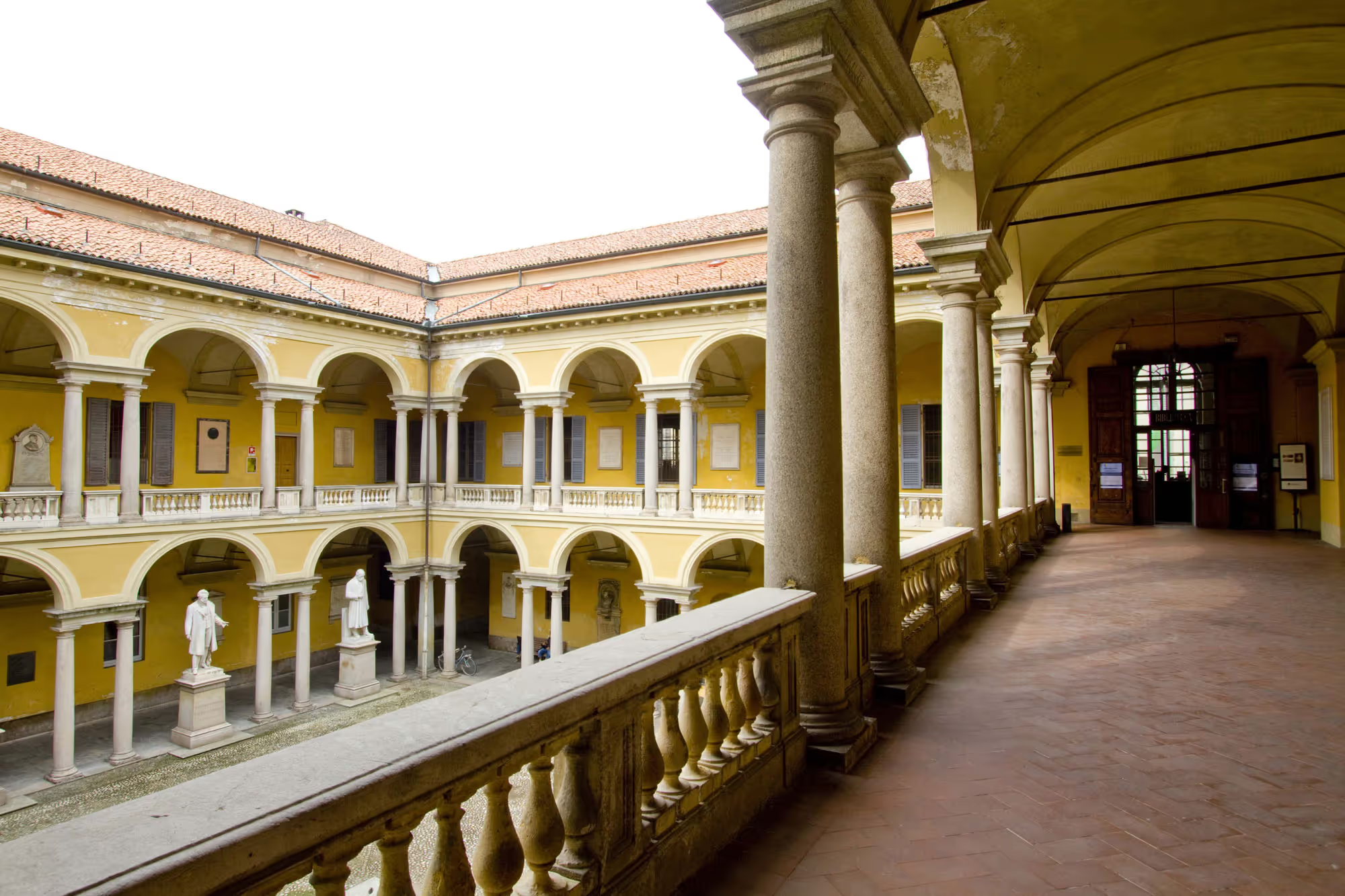
Electronic Engineering is a two-year, 120 ECTS master's degree (class LM-29) taught in English at the University of Pavia, with tracks in Microelectronics, Photonics, and Space Communication and Sensing. Entry needs a bachelor's with at least 81 credits in maths, basic sciences and listed engineering subjects, plus English at B2. Fees can follow family income, so it can be tuition-free for eligible students.
Entry requirements
Detailed entry requirements
Pavia's Electronic Engineering master asks for a bachelor's degree or recognised foreign equivalent with at least 81 CFU in set subject areas, English at B2 and a positive check of your personal preparation by a committee. Reviewed 8 October 2026. [1]
The 81-credit rule
You need a first-cycle (bachelor's) degree, a three-year university diploma or a foreign qualification recognised under Italian law. Across your previous university studies you must have at least 81 CFU in two groups. [1]
- At least 36 CFU in basic subjects: mathematics, statistics, physics, chemistry and computer science (sectors MATH-02/A to MATH-06/A, STAT-01/B, PHYS-01/A, PHYS-03/A, CHEM-06/A, INFO-01/A and ING-INF/05).
- At least 45 CFU in specific engineering sectors: electronics, electromagnetic fields, telecommunications, automation, computer engineering and computer science, electrical engineering, electrical machines and drives, electrical and electronic measurements, bioengineering, management engineering, applied mechanics, manufacturing and other listed industrial engineering sectors (sectors IINF-01/A to IINF-05/A, INFO-01/A, IIET-01/A, IIND-08/A, IMIS-01/B, IBIO-01/A, IEGE-01/A, IIND-02/A, IIND-04/A and IIND-05/A).
For graduates of foreign universities, a committee appointed by the degree board assesses whether your studies meet these requirements. [1]
What this means for your transcript
Italian CFU and the credits on a foreign transcript are not the same unit: one CFU stands for about 25 hours of student work, and the committee looks at your subjects, not just your total. As a guide, based on the rule above:
- Usually a fit: a B.Tech or B.E. in Electronics and Communication, Electronics and Instrumentation, or Electrical and Electronics Engineering, where maths and physics cover the basic block and electronics, electromagnetics, communications and measurement cover the specific block.
- Check carefully: a B.Tech in Computer Science, IT, Electrical, Instrumentation and Control, Biomedical or Mechatronics Engineering. Computing, electrical, control and measurement subjects count towards the specific block, but the committee also checks your grounding in engineering for a degree centred on electronics.
- Often short: a BCA or a B.Sc. in Physics or Maths. These usually cover the 36 basic credits but have few engineering subjects, so the preparation check is harder to meet.
If your record does not fully match but you have a strong academic background, the committee can still admit you and add up to 12 CFU of courses to your study plan, or set single examinations to pass before you enrol. [1]
English
English at CEFR level B2 or higher. Certificates accepted automatically include: [1]
- IELTS: 5.5
- TOEFL iBT: 77
- PTE Academic: 59
- Cambridge English First or Business Vantage: 160
- Oxford Test of English B2: 111
- TOEIC: 785 in Listening and Reading plus 310 in Speaking and Writing
You need no certificate if you passed a 3 CFU English examination or an examination taught in English during your degree, or if your degree comes from an institution where teaching is in English, with documents to prove it. Without a certificate, the committee may check your English itself. Partial certificates, such as speaking and listening only, are not valid. [1]
Personal preparation check
The committee checks that you have a solid grounding in engineering basics and good knowledge of advanced engineering subjects. There is no national entrance test. [1]
- Italian degrees: a final mark of 92/110 or above exempts you. Others sit an assessment in September to October or January to February.
- Foreign degrees: the committee assesses you case by case from the documents you submit and may hold an interview.
2026/27 application windows
For 2026/27, applications for master's programmes without restricted access ran in five windows. Non-EU applicants living abroad could use: [2]
- 12 to 20 November 2025
- 12 to 20 January 2026
- 10 to 18 March 2026, only if places were still available
- 5 to 11 June 2026, only if places were still available
The window from 1 to 8 September 2026 was only for EU citizens and non-EU applicants living in Italy. The 2027/28 calendar is not yet published, and it will set the new dates. [2]
Documents and non-EU steps
The online application needs an identity document and your bachelor's diploma, issued in English, Spanish or French or officially translated into Italian. The Admission Office evaluates foreign qualifications. [2]
Students still finishing a degree can request the committee's review if they have an approved study plan, and can sit the preparation assessment once they hold at least 150 CFU. Conditional enrolment lets you attend first-semester lessons, but you sit examinations only after you graduate, within the university's deadline. [1]
Students with a non-Italian qualification must include a 3 CFU Italian Language for Foreign Students course in their study plan, unless they show Italian at B1 or above. [1]
Sources and verification
Checked by the ApplyAZ admissions team against the university's official documents listed below. Entry rules can change with each new call, and we re-check them before every application.
- University of Pavia, Faculty of Engineering, Department of Electrical, Computer and Biomedical Engineering. Course regulations, Second-cycle degree in Electronic Engineering (LM-29), academic year 2026/2027, with study plans. Reviewed 8 October 2026.
- University of Pavia. How to apply to master's degree programmes: application windows, fee and documents, academic year 2026/27. Reviewed 8 October 2026.
- University of Pavia, Electronic Engineering programme page (degree class, language, duration, access, tracks and department). Reviewed 8 October 2026.
- University of Pavia. Fees regulation, academic year 2026/2027, and fee rules for non-EU students. Reviewed 8 October 2026.
About the programme
Electronic Engineering is a two-year master's degree in class LM-29, taught in English by the Department of Electrical, Computer and Biomedical Engineering in Pavia. It is worth 120 ECTS and has non-restricted access, with a limited quota of seats for non-EU students who need a visa.
The university aims to train electronic engineers with a high professional profile who are ready for the job market and able to promote innovation. It suits electronics, telecommunications or electrical engineering graduates who want to specialise in chips, optics or space systems.
What you will study
All students take Advanced Mathematical and Numerical Methods for Engineers and Microwaves, then follow one of three tracks: Microelectronics, Photonics, or Space Communication and Sensing. Units in the 2026 teaching regulations include:
- Analog Integrated Circuits (Microelectronics)
- RF Microelectronics (Microelectronics)
- Digital IC Design (Microelectronics)
- Optoelectronic Devices (Photonics)
- Quantum Electronics and Nonlinear Optics (Photonics)
- Integrated Photonic Circuits (Photonics)
- Satellite Data Analysis (Space Communication and Sensing)
- Antennas and Propagation (Space Communication and Sensing)
How the programme is taught
The second year includes 12 ECTS of free-choice courses and a master thesis worth 24 ECTS, developed under faculty guidance and discussed in public. The standard study plan does not include internships. Students with a non-Italian qualification also take a 3 ECTS Italian Language for Foreign Students course, unless they show Italian at B1 or above. [1] Several major semiconductor multinationals, including STMicroelectronics and Infineon Technologies, run microelectronics design centres in Pavia.
Career paths
The university lists these employment sectors for graduates:
- Manufacturers of electronic components, devices and systems
- Microelectronics and optoelectronics companies
- Telecommunications and remote sensing
- Industrial instrumentation and measurement equipment
- Public and private service companies that need technical and managerial skills
Fees and scholarships
Non-EU students choose between two fee routes. The flat rate depends on citizenship and subject area, and for 2026/27 the lowest bracket includes India, Pakistan, Bangladesh, Sri Lanka, Nepal and Nigeria. It stays fixed for the normal length of the degree plus one year. [4]
The income-based route uses an equivalent ISEE calculated from your family's income and assets abroad. With an ISEE up to €32,000 students are exempt from the all-inclusive fee, so this programme can be tuition-free for eligible students; the regional tax and stamp duty still apply. You need this route to apply to EDiSU Pavia, the regional right-to-study body, whose scholarship can include a college place, one meal a day and a cash grant. EDiSU decides awards on merit and income.
How to apply from outside the EU
We apply on apply.unipv.eu with your identity document and your bachelor's diploma, issued in English, Spanish or French or officially translated into Italian. [2] Seats for non-EU students who need a visa are limited, so we apply early. For 2026/27, non-EU applicants living abroad could apply from 12 to 20 November 2025 and 12 to 20 January 2026, then from 10 to 18 March and 5 to 11 June 2026 only if places remained. The 2027/28 calendar is not yet published and will set the new dates. [2]
After admission we complete the Universitaly pre-enrolment, and you apply for a type D study visa at the Italian consulate, which decides the visa. On enrolment your degree must be legalised, apostilled or verified by CIMEA, and degrees from countries outside the Lisbon Recognition Convention also need a declaration of value, a CIMEA statement of comparability or a Diploma Supplement.
How ApplyAZ helps
ApplyAZ is an Italy-based consultancy that works only with public universities. We can include this programme in a shortlist of 20 to 30 English-taught programmes that fit your profile, so your plan never rests on a single application.
For eligible students who start with us, a named person owns each stage, from A to Z:
- We check your transcript against Pavia's entry rules for this programme.
- We write your CV and a tailored statement of purpose.
- We prepare and submit your online application with your transcript and English proof, and Universitaly pre-enrolment.
- We help you declare your family income for reduced fees and file your regional DSU scholarship application at the right time and in the right format.
- We prepare your visa file.
With operations in all 20 Italian regions, we follow each region's scholarship rules and deadlines as they change. The university decides admission, the region decides the scholarship and the consulate decides the visa, so no one can promise an outcome. You pay in milestones, and every service you pay for is either delivered or its fee is refunded (terms apply).
Programmes at Italian public universities can be tuition-free for eligible students. Check if you are eligible and book a one-to-one consultation session with one of our Italy experts, or see how ApplyAZ works.
Questions and answers
What bachelor's degree do I need for Pavia's Electronic Engineering master?
A bachelor's or recognised foreign equivalent with at least 81 CFU: 36 in maths, statistics, physics, chemistry or computer science, and 45 in listed engineering sectors such as electronics, electromagnetic fields, telecommunications, automation and computing. A committee reviews foreign degrees. [1]
Is there an entrance exam?
No national test. A committee checks your preparation. Italian graduates with 92/110 or above are exempt and others sit an assessment. For a foreign degree, the committee assesses you case by case from your documents and may hold an interview. [1]
What English level is required? Do I need IELTS?
English at CEFR B2. Accepted certificates include IELTS 5.5, TOEFL iBT 77, PTE Academic 59 and Cambridge First 160. You need no certificate if your degree was taught in English or included an English examination, with documents to prove it. [1]
When is the deadline for non-EU students?
For 2026/27, non-EU applicants living abroad could apply from 12 to 20 November 2025 and 12 to 20 January 2026, then in March and June only if places remained. The 2027/28 calendar is not yet published. [2]
Can I apply before I graduate?
Yes. You can request the credit review with an approved study plan and sit the preparation assessment once you hold 150 CFU. Conditional enrolment lets you attend first-semester lessons, and you sit examinations after you graduate within the university's deadline. [1]
I have a B.Tech in Computer Science or Electrical Engineering. Can I apply?
Possibly. Maths and physics usually cover the 36 basic credits, and computing, electrical, control and measurement subjects all count towards the 45 specific credits. The committee also checks your engineering preparation and can add up to 12 CFU to your plan if your record does not fully match. [1]
Which tracks are available?
Three: Microelectronics, Photonics, and Space Communication and Sensing. All students take Advanced Mathematical and Numerical Methods for Engineers and Microwaves, then follow their track, with 12 ECTS of free-choice courses and a 24 ECTS thesis. [1][3]
How are tuition fees set for non-EU students?
For 2026/27, non-EU students could choose a flat rate set by citizenship, with the lowest bracket covering countries such as India, Pakistan or Bangladesh, or an income-based fee. With an equivalent ISEE up to €32,000 the all-inclusive fee is waived, so the programme can be tuition-free for eligible students. [4]
Can someone handle my whole application to Electronic Engineering at Pavia?
Yes. ApplyAZ, an Italy-based consultancy that works only with public universities, checks your transcript against Pavia's rules for this programme, handles the application and Universitaly pre-enrolment, helps you file the regional DSU scholarship application at the right time and in the right format, and prepares your visa file, for eligible students. Start by checking your eligibility.
I'm applying from India. What is the route into Electronic Engineering?
A recognised Indian bachelor's, such as a B.Tech or B.E. in Electronics and Communication or Electrical and Electronics Engineering, can meet the rule if it has 36 credits in maths and basic sciences and 45 in the listed electronics, communications, computing and related engineering areas. You also need English at B2. The steps are the online application, the committee's review of your credits and preparation, and Universitaly pre-enrolment. [1][2] Indian students apply for the type D study visa at the Italian embassy or consulate that covers their state, such as New Delhi, Mumbai or Bengaluru.
Is the route different from Pakistan, Bangladesh or Sri Lanka?
No. The academic rules for Electronic Engineering are the same whatever your nationality. Applicants from Pakistan, Bangladesh and Sri Lanka follow the same steps as India: online application, the committee's review of your credits and preparation, and Universitaly pre-enrolment, then a type D study visa from the Italian mission for their country of residence. Read our guide for students in Dhaka.
I live in the UAE, Saudi Arabia, Qatar, Kuwait, Oman or Bahrain. Where do I apply for the visa?
At the Italian embassy or consulate responsible for the country where you legally live, after Universitaly pre-enrolment. The academic rules for Electronic Engineering are the same whatever your nationality, and Gulf residents follow the same steps: online application, the committee's review of your credits and preparation, and Universitaly pre-enrolment. Read our guides for Dubai, Riyadh and Doha.
I studied or live in London, New York, Toronto, Vancouver, Singapore or Kuala Lumpur. What is the route?
The academic rules for Electronic Engineering are the same whatever your nationality, and your degree is assessed like any other foreign qualification. Non-EU applicants who live abroad follow the same route: online application, the committee's review of your credits and preparation, and Universitaly pre-enrolment, then a type D study visa from the Italian mission for where they live. Read our guides for students in London, New York, Toronto, Vancouver, Singapore and Kuala Lumpur.
More English-taught programmes at this university
Other public universities in this city

They began right where you are

