

Master in Conservation Science and Technology for Cultural Heritage at Ca’ Foscari University of Venice
English-taught two-year master at Ca' Foscari in Venice Mestre that trains conservation scientists in chemistry, physics, biology and geology applied to heritage, with laboratory courses, fieldwork, internships and a double degree with Tashkent Institute of Chemical Technology.
Master
2 years
Venice
English
Ca’ Foscari University of Venice


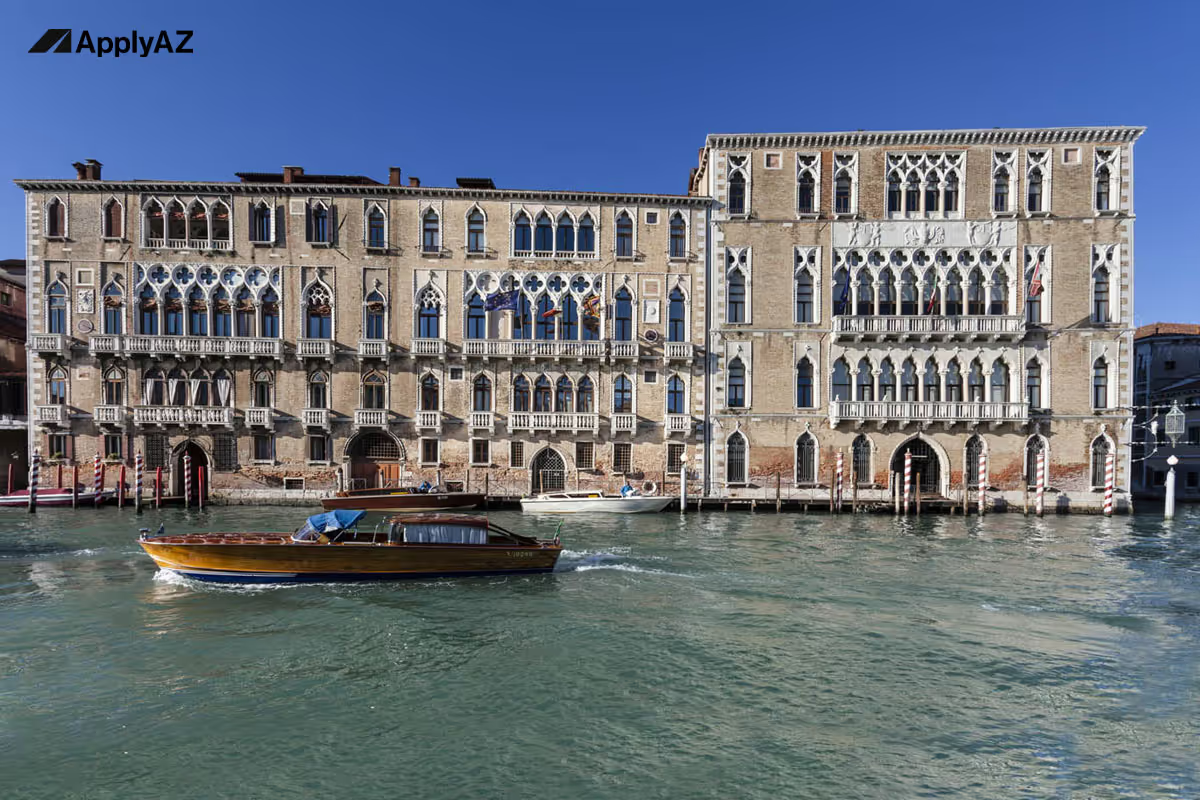
Conservation Science and Technology for Cultural Heritage is a two-year, 120 ECTS master's degree (class LM-11-R) taught entirely in English at Ca' Foscari's Scientific Campus in Venice Mestre. It trains conservation scientists in the diagnosis and preservation of cultural heritage. Non-EU students pay a flat fee by citizenship; eligible regional scholarship applicants are exempt.
Entry requirements
- A bachelor's degree of at least three years, or an equivalent foreign qualification.
- At least 48 ECTS: at least 24 in biology, chemistry, electronics, geography, informatics, mathematics or physics, and 24 more in fields such as archaeology, anthropology, cultural heritage, architecture, history, law or statistics.
- English at B2 level, shown with a recognised certificate; the university does not run its own English test.
- A motivation letter written for this programme, assessed by the Teaching Committee with your CV and transcript; the committee may add an interview.
- At enrolment, your degree certificate and transcript with an official translation, plus a CIMEA Statement of Comparability, a declaration of value, an ARDI statement with CIMEA verification, or a Diploma Supplement.
About the programme
Conservation Science and Technology for Cultural Heritage is a two-year master's degree in class LM-11-R (Conservation and restoration of the cultural heritage), taught entirely in English at Ca' Foscari's Scientific Campus in Venice Mestre and run by the Department of Environmental Sciences, Informatics and Statistics. It carries 120 ECTS, has open admission subject to an assessment of each applicant, and attendance is not compulsory except for laboratories.
The degree trains conservation scientists who can study, diagnose and conserve cultural heritage and oversee the key stages of conservation in different settings. It suits graduates in chemistry, physics, biology, geology or materials, and graduates in heritage or archaeology who have a solid science base.
What you will study
Chemistry, physics, biology, computer science and geology are all applied to heritage. The first year covers the main areas where conservation scientists work, advances in diagnostics and new preservation methods; the second year brings advanced work joining the sciences and humanities, together with internships and thesis research. Units in the 2026/27 first-year timetable include:
- Scientific Strategies in Conservation Science
- Advanced Materials for Heritage Preservation, with laboratory
- Analytical Chemistry in Heritage Science, with laboratory
- Physical and Chemical Methods for Heritage Investigation, with laboratory
- Geophysics and Climate Impact in Heritage Preservation
- Statistics and Experimental Design
- Process Management for Cultural Heritage
How the programme is taught
Teaching relies on well-equipped laboratories, and the university says the degree is the only one in Italy with an advanced laboratory for the conservation of modern and contemporary art. Fieldwork and internships use real case studies in architecture, archaeology and art history, with placements at museums, libraries, heritage authorities and companies. The thesis is a research project, often run with national or international research institutes or private companies. A double degree is offered with Tashkent Institute of Chemical Technology.
Career paths
Graduates work for heritage authorities, museums, libraries and archives, for public or private conservation and restoration companies, and for research institutes. Roles named by the university include:
- Conservation scientist
- Diagnostics expert in conservation research
- Designer of experimental protocols
- Museum technician or restorer
- Cultural consultant
- Restoration technology development
Graduates can also go on to a PhD, such as the National PhD in Heritage Science, a second-level master or a specialisation school.
Fees and scholarships
For 2026/27 non-EU master's students pay a flat fee set by citizenship: €700 for countries on the ministry's low human development list, €1,300 for most others, including countries like India, and €2,300 for OECD countries, with the €192 regional tax and €16 stamp duty included. International students can apply for the Veneto regional scholarship with an ISEE parificato, and those who meet its limits are exempt from fees: zero euro tuition for eligible students.
How to apply from outside the EU
Applications go through apply.unive.it, where you upload your transcript, CV and a motivation letter written for this degree. The Teaching Committee checks your 48 ECTS across scientific and heritage fields; missing credits can be made up with single bachelor's-level courses before enrolment. There is no entrance test, and a €30 fee covers two ranked choices. The 2026/27 portal opened on 17 December 2025; 2027/28 rounds are pending.
After an eligibility letter come Universitaly pre-enrolment and a type D study visa. Enrolment requires a CIMEA Statement of Comparability, a declaration of value, an ARDI statement with CIMEA verification, or a Diploma Supplement.
How ApplyAZ helps
If this programme fits your goals, ApplyAZ can include it in a shortlist of 20 to 30 English-taught programmes at Italian public universities. We write your CV and a tailored statement of purpose, submit your applications and Universitaly pre-enrolment, file your DSU scholarship application and prepare your visa file, with a named person on each stage. The university decides admission, the region decides the scholarship and the consulate decides the visa. See how ApplyAZ works or check your eligibility.
Questions and answers
Is the Master in Conservation Science and Technology for Cultural Heritage taught in English?
Yes. The whole degree is taught in English at the Scientific Campus in Venice Mestre. You need certified English at B2 level to enrol, and non-Italian students earn 3 ECTS in Italian before graduating unless they already have B1.
What bachelor's background do I need?
At least 48 ECTS: 24 in biology, chemistry, electronics, geography, informatics, mathematics or physics, and 24 more in fields such as archaeology, anthropology, cultural heritage, architecture, history, law or statistics.
Is there an entrance test?
No. Admission is open, and the Teaching Committee assesses your transcript, CV and motivation letter. It can add an interview if it needs to check your preparation.
What is special about the laboratories?
The university says it is the only degree in Italy with an advanced laboratory dedicated to the conservation of modern and contemporary art. Several first-year units combine lectures with laboratory work.
How much are the fees?
For 2026/27 non-EU master's students pay a flat €1,300 a year for most countries, €700 for low human development countries or €2,300 for OECD countries. Students eligible for the Veneto regional scholarship are exempt from fees.
What careers does it lead to?
Graduates work as conservation scientists, diagnostics experts, museum technicians, restorers and cultural consultants for heritage authorities, museums, archives, restoration companies and research institutes. Some continue to a PhD such as the National PhD in Heritage Science.
Similar programmes
More programmes in this city

They began right where you are

