

Master in Computer Science at University of Genoa
Two-year English-taught LM-18 master's at the University of Genoa with pathways in AI and data analytics or reliable and secure software. Entry needs 90 ECTS in computing, maths, physics or statistics, a 75% CGPA, an interview and B2 English.
Master
2 years
Genoa
English
University of Genoa



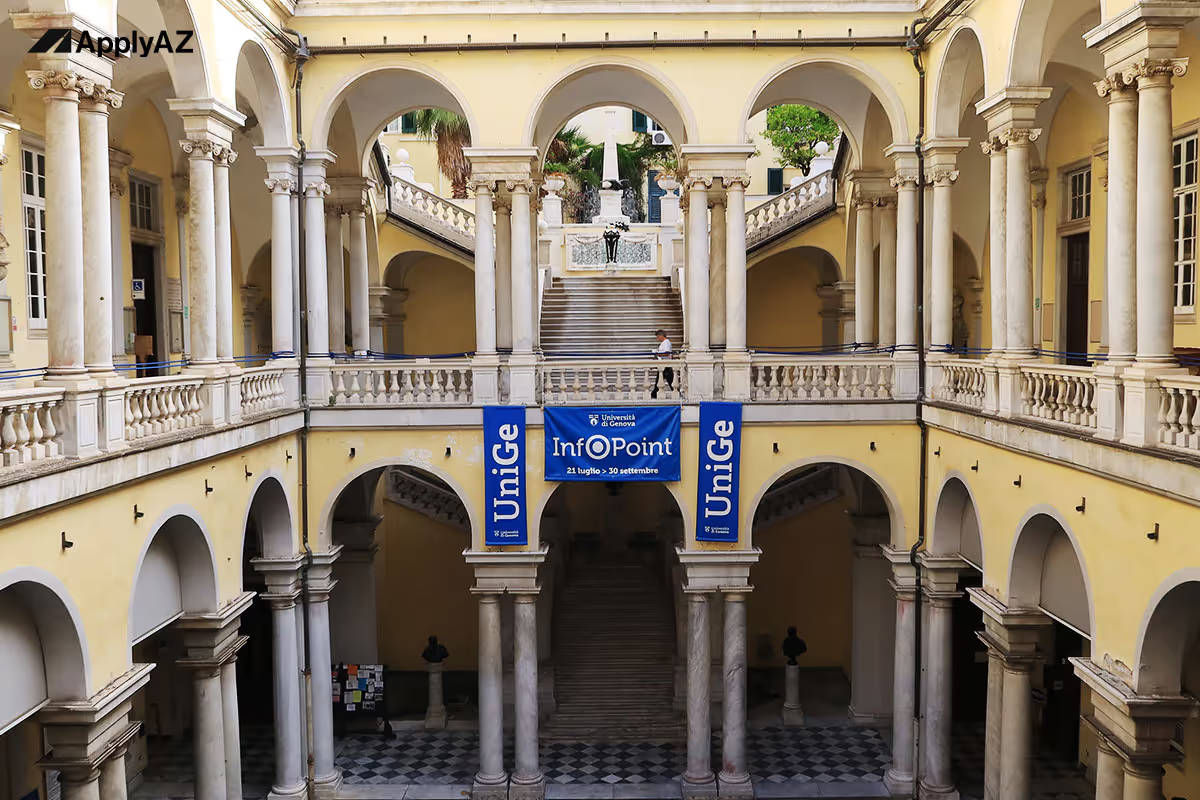
Computer Science is a two-year, 120 ECTS master's degree (class LM-18) taught in English at the University of Genoa, with pathways in AI and data analytics or reliable and secure software. Entry needs a bachelor's with at least 90 ECTS in computing, maths, physics or statistics, a 75% CGPA, an interview and English at B2. Fees follow family income, so it can be tuition-free for eligible students.
Entry requirements
Detailed entry requirements
Genoa's Computer Science master asks for a bachelor's degree with at least 90 ECTS in computing, information engineering, maths, physics or statistics, English at B2, and a maths and computing assessment made of a preliminary test and an interview. Visa applicants in 2026/27 also needed a CGPA of 75%. Reviewed 8 October 2026. [1]
The 90-credit rule
You need a bachelor's degree that includes at least 90 ECTS in these subject areas: [1]
- Computer science: sector INF/01.
- Information engineering: telecommunications, automation, computer engineering and biomedical information engineering (ING-INF/03, 04, 05 and 06).
- Physics: FIS/01, 02, 03 and 07.
- Mathematics: MAT/01, 02, 03, 05, 06, 07, 08 and 09.
- Statistics: SECS-S/01 and 02.
For degrees obtained abroad, equivalence is assessed from your degree certificate and transcript of records. [1]
Grade average
For 2026/27, the selection for non-EU visa applicants set a minimum CGPA of 75%. [2] From 2027/28 the degree regulations make this a general rule: your final weighted average must reach 75% of the top mark in your grading system, which is 22.5/30 for Italian degrees. [1]
What this means for your transcript
Italian ECTS and the credits on a foreign transcript are not the same unit, and Genoa looks at your subjects, not just your total. As a guide, based on the rule above:
- Usually a fit: a B.Tech or B.E. in Computer Science, IT or Electronics and Communication, a BCA with solid maths, or a B.Sc. in Computer Science, Mathematics, Physics or Statistics.
- Check carefully: a B.Tech in Electrical or Mechanical Engineering, or a mixed B.Sc. where chemistry or biology takes a large share, since only computing, information engineering, maths, physics and statistics count towards the 90 credits.
- Often short: a B.Com, BBA or BA, where few subjects fall in these areas.
On a 10-point scale, 75% of the top mark is a CGPA of 7.5. [1][2]
English
English at CEFR level B2 or higher. You can show it in one of these ways: [1]
- A certificate at the level set on the university's list of recognised certificates.
- A bachelor's degree taught in English, shown by an official document or a letter from your university.
- A bachelor's degree that included a B2 English exam, shown on your official exam list or syllabus.
- Passing the B2 test run by the School of Mathematical, Physical and Natural Sciences.
The regulations do not list specific test scores. In pre-assessment, a B2 certificate or a medium of instruction certificate is accepted. [2] If your degree is from outside Italy and you cannot show Italian, your study plan includes an Italian as a Foreign Language unit. [1]
Assessment test and interview
Admission depends on passing an assessment in mathematics and computer science: a preliminary test followed by an interview, both on the basic knowledge needed for the programme. [1] In the 2026/27 visa applicant selection, the interview or test took place remotely during pre-selection, and a further test was set after arrival in Italy. That test does not block enrolment and can be repeated until passed. [2]
2026/27 deadlines
For 2026/27, non-EU visa applicants applied on UniGeApply from 26 November 2025 to 20 March 2026, and outcomes were due by 22 May 2026. [3] Applicants still finishing their bachelor's had to graduate by 15 August 2026. [2] The 2027/28 dates are not yet published, and the next call sets them.
Documents and non-EU steps
The UniGeApply pre-assessment asks for: [2]
- Your CV.
- Your bachelor's degree certificate, final or provisional.
- Your transcript of records.
- Your English B2 or medium of instruction certificate.
- If you have not graduated yet, a letter from your university with your expected degree date and your CGPA up to the latest semester.
You can be assessed for up to two courses. For 2026/27, non-EU applicants uploaded their passport with the application. [2][3] After a positive outcome you apply for the visa on Universitaly, where you choose one university and one course, and then pre-enrol at UniGe for the same course. [3] Each year the degree board sets the number of places reserved for non-EU applicants who need a visa. [1]
Sources and verification
Checked by the ApplyAZ admissions team against the university's official documents listed below. Entry rules can change with each new call, and we re-check them before every application.
- University of Genoa, School of Mathematical, Physical and Natural Sciences, Department of Informatics, Bioengineering, Robotics and Systems Engineering. Degree regulations, Master's degree in Computer Science (LM-18), cohort 2026 to 2028. Reviewed 8 October 2026.
- University of Genoa. Pre-assessment procedure for English-taught master's degrees, non-EU students living abroad, with the visa applicant selection table, 2026/27 cycle. Reviewed 8 October 2026.
- University of Genoa. UniGeApply: application windows, fees and next steps for international applicants, 2026/27 cycle. Reviewed 8 October 2026.
About the programme
Computer Science is a two-year master's degree (laurea magistrale, class LM-18) worth 120 ECTS, taught in English and in person in Genoa. It is run by DIBRIS, the Department of Informatics, Bioengineering, Robotics and Systems Engineering, at the Valletta Puggia site, under course code 11964 (previously 10852).
The degree is built for graduates in computer science, but students from other science and engineering areas can join if their degree includes at least 90 ECTS in computing, information engineering, maths, physics or statistics. It suits applicants who want to specialise in artificial intelligence, data or high-quality software.
What you will study
You follow one of two pathways. Artificial Intelligence and Data Analytics (AIDA) covers managing, analysing and visualising large volumes of data. Reliable and Secure Software Systems (RESSY) covers designing, verifying and running dependable, secure and distributed software. Units offered in 2026/27 include:
- Machine Learning, Deep Learning and Natural Language Processing
- Sequential Prediction and Reinforcement Learning, and Trustworthy Artificial Intelligence
- Advanced Data Management, Data Visualization and the Data-Centric Studio
- High Performance Computing, Distributed Computing, and Virtualization and Cloud Computing
- Decentralized Systems and Internet of Things
- AI-Augmented Software Engineering, Formal Methods, and Software Quality and Automated Testing
- Binary Analysis and Secure Coding
- Artificial Intelligence and the Law, a Capstone Project and the final dissertation
How the programme is taught
Traditional lectures sit alongside laboratory work and project development, carried out with industry where possible, plus seminars and short courses on current topics throughout the year. The course page stresses team-based, multidisciplinary work and close contact with lecturers and staff, and notes that students come from all over the world. An Italian language unit for international students is also on offer.
Career paths
Depending on the pathway, the course page lists roles such as senior data scientist, business intelligence analyst, AI engineer, cybersecurity manager, technical leader or project manager in industry or research centres. Graduates can also go on to a PhD.
Fees and scholarships
Tuition at UniGe is income-based. The university contribution is worked out from your ISEE-U, which students with family income abroad obtain as an ISEE-U parificato. In 2026/27, families with an ISEE-U of €13,000 or less paid no contribution. ALiSEO scholarship winners are exempt from the contribution and the regional tax, so this programme can be tuition-free for eligible students.
How to apply from outside the EU
Computer Science assesses your maths and computing knowledge through a preliminary test and an interview during UniGeApply pre-assessment. For 2026/27 it asked for a CGPA of at least 75%, and its selection table also listed a further, repeatable test after arrival in Italy.
Applications open on UniGeApply, where one application covers up to two courses. For 2026/27 the visa applicant window ran from 26 November 2025 to 20 March 2026. The 2027/28 dates are not yet published. Accepted students then apply on Universitaly, pre-enrol with UniGe and request a type D study visa, uploading their legalised degree and a declaration of value, CIMEA statement or Diploma Supplement after arrival.
How ApplyAZ helps
ApplyAZ is an Italy-based consultancy that works only with public universities. We can include this programme in a shortlist of 20 to 30 English-taught programmes that fit your profile, so your plan never rests on a single application.
For eligible students who start with us, a named person owns each stage, from A to Z:
- We check your transcript against Genoa's entry rules for this programme.
- We write your CV and a tailored statement of purpose.
- We prepare and submit your UniGeApply pre-assessment, Universitaly visa application and UniGe pre-enrolment.
- We help you declare your family income for reduced fees and file your ALiSEO Liguria scholarship application at the right time and in the right format.
- We prepare your visa file.
With operations in all 20 Italian regions, we follow each region's scholarship rules and deadlines as they change. The university decides admission, the region decides the scholarship and the consulate decides the visa, so no one can promise an outcome. You pay in milestones, and every service you pay for is either delivered or its fee is refunded (terms apply).
Programmes at Italian public universities can be tuition-free for eligible students. Check if you are eligible and book a one-to-one consultation session with one of our Italy experts, or see how ApplyAZ works.
Questions and answers
What bachelor's degree do I need for Genoa's Computer Science master?
A bachelor's degree with at least 90 ECTS in computer science, information engineering, maths, physics or statistics. Degrees from abroad are assessed on the certificate and transcript. From 2027/28 your weighted average must also reach 75% of the top mark. [1]
Is there an entrance exam?
Yes. You pass an assessment in maths and computer science: a preliminary test, then an interview. In 2026/27 visa applicants did it remotely during pre-selection, and a further test after arrival could be repeated until passed. [1][2]
What English level is required? Do I need IELTS?
English at B2. You can prove it with a certificate from the university's recognised list, a bachelor's taught in English, a bachelor's that included a B2 English exam, or the School's own B2 test. No specific IELTS score is listed, so we check which proof your file can use. [1]
What CGPA do I need?
For 2026/27 the visa applicant selection asked for a minimum CGPA of 75%. From 2027/28 the regulations set a weighted average of at least 75% of your grading scale's top mark for all applicants, such as 7.5 on a 10-point scale. [1][2]
When is the deadline for non-EU students?
For 2026/27, visa applicants applied on UniGeApply from 26 November 2025 to 20 March 2026, with outcomes by 22 May 2026. The 2027/28 dates are not yet published. [3]
Can I apply before I graduate?
Yes. You apply with a letter from your university giving your expected degree date and your CGPA up to the latest semester. For 2026/27 the degree had to be awarded by 15 August 2026. [2]
I have a BCA or a B.Com. Can I apply?
A BCA is mostly computing and can meet the 90-credit rule if its computing and maths units add up, so we check your transcript. A B.Com is often short, because few of its subjects count as computing, maths, physics or statistics. [1]
Which pathways can I choose?
Two: Artificial Intelligence and Data Analytics, or Reliable and Secure Software Systems. Both share core topics such as machine learning, distributed systems, and cloud and high-performance computing. [1]
Can someone handle my whole application to Computer Science at Genoa?
Yes. ApplyAZ, an Italy-based consultancy that works only with public universities, checks your transcript against Genoa's rules for this programme, handles the application and Universitaly pre-enrolment, helps you file the ALiSEO Liguria scholarship application at the right time and in the right format, and prepares your visa file, for eligible students. Start by checking your eligibility.
I'm applying from India. What is the route into Computer Science?
A recognised Indian bachelor's such as a B.Tech, B.E., BCA or B.Sc. in Computer Science, Maths or Physics can meet the 90-credit rule if computing, maths, physics or statistics make up about half of it. You also need English at B2 and, in 2026/27, a CGPA of 75%. The steps are UniGeApply pre-assessment with an interview, Universitaly and UniGe pre-enrolment. [1] Indian students apply for the type D study visa at the Italian embassy or consulate that covers their state, such as New Delhi, Mumbai or Bengaluru.
Is the route different from Pakistan, Bangladesh or Sri Lanka?
No. The academic rules for Computer Science are the same whatever your nationality. Applicants from Pakistan, Bangladesh and Sri Lanka follow the same steps as India: UniGeApply pre-assessment with an interview, Universitaly application and UniGe pre-enrolment, then a type D study visa from the Italian mission for their country of residence. Read our guide for students in Dhaka.
I live in the UAE, Saudi Arabia, Qatar, Kuwait, Oman or Bahrain. Where do I apply for the visa?
At the Italian embassy or consulate responsible for the country where you legally live, after Universitaly pre-enrolment. The academic rules for Computer Science are the same whatever your nationality, and Gulf residents follow the same steps: UniGeApply pre-assessment with an interview, Universitaly application and UniGe pre-enrolment. Read our guides for Dubai, Riyadh and Doha.
I studied or live in London, New York, Toronto, Vancouver, Singapore or Kuala Lumpur. What is the route?
The academic rules for Computer Science are the same whatever your nationality, and your degree is assessed like any other foreign qualification. Non-EU applicants who live abroad follow the same route: UniGeApply pre-assessment with an interview, Universitaly application and UniGe pre-enrolment, then a type D study visa from the Italian mission for where they live. Read our guides for students in London, New York, Toronto, Vancouver, Singapore and Kuala Lumpur.
More English-taught programmes at this university
Other public universities in this city

They began right where you are

