

Bachelor in Social Sciences for Global Challenges at University of Pavia
Three-year English-taught L-16-R bachelor at the University of Pavia that combines political science, law, economics, statistics and anthropology to analyse global challenges, with a compulsory internship. Entry needs 12 years of schooling, English at B2 and a non-selective test.
Bachelor
3 years
Pavia
English
University of Pavia



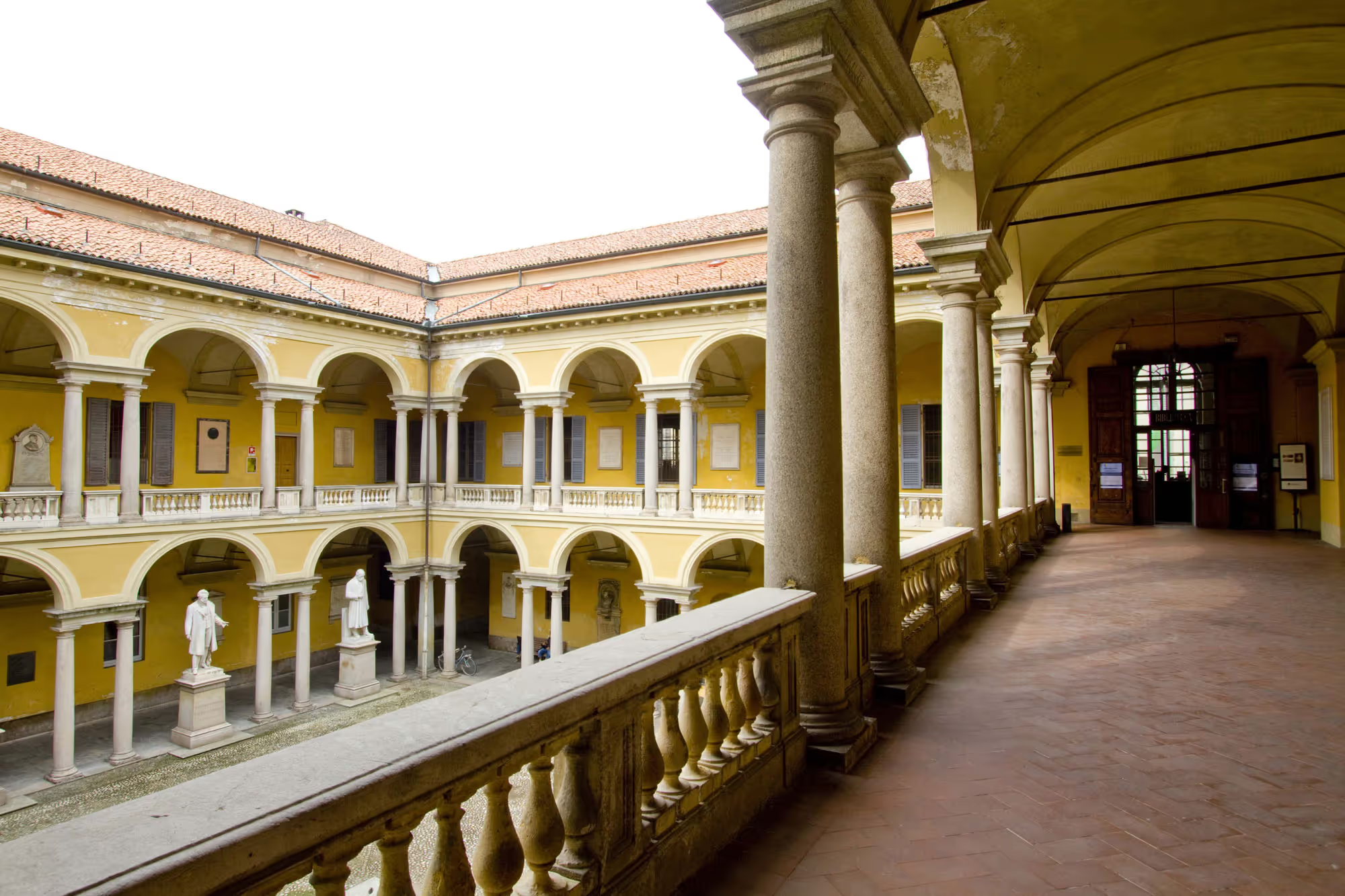
Social Sciences for Global Challenges is a three-year, 180 ECTS bachelor's degree (class L-16-R) taught in English at the University of Pavia. Entry needs a secondary school diploma after at least 12 years of schooling, English at B2 and a non-selective entrance test. Non-EU students can choose fees based on family income, so it can be tuition-free for eligible students.
Entry requirements
Detailed entry requirements
Pavia's Social Sciences for Global Challenges bachelor has open access: you need a secondary school diploma awarded after at least 12 years of schooling, English at B2 and a mandatory but non-selective entrance test, while seats for non-EU applicants living abroad are limited. Reviewed 8 October 2026. [1]
School-leaving requirement
You need a secondary school diploma, or a qualification obtained abroad that the university's offices recognise as suitable. [1] For a foreign qualification this means a diploma awarded after at least 12 years of documented education, plus proof that you passed your country's national university entrance test if one is required there. [2] The regulations set no minimum grade. [1]
What this means for your school results
As a guide, based on the rule above:
- Usually a fit: Class 12 or Higher Secondary results after 12 years of schooling, such as CBSE, ISC or a state board in India, the HSC in Pakistan or Bangladesh, or A levels completed after 12 years.
- Check carefully: a school system where university entry depends on a national entrance exam. You must upload proof that you passed it.
- Often short: a school system that ends after 11 years, or Class 10 or O level results on their own, because they do not reach 12 years of schooling.
No school subjects are required, but the entrance test checks general knowledge, especially in history and politics, and logical-mathematical skills. [1]
English
The degree is taught in English. [5] You need English at CEFR B2 or higher, shown by a recognised certificate or by a secondary school programme taught entirely in English. [1] A single period taught in English within your schooling is not sufficient. [2]
Accepted certificates include: [2]
- IELTS from 5.5 or TOEFL iBT from 72;
- Cambridge Advanced (CAE) or Proficiency (CPE), BEC Vantage or Trinity ISE II;
- PTE Academic 59 to 75, PTE General B2 or Oxford Test of English B2 (111 to 140);
- IGCSE English as a Second Language at grade A to C, or IGCSE English First Language at grade C to E;
- LanguageCert International ESOL B2 Communicator, GateHouse Awards Classic B2 or Aptis ESOL B2.
Entrance test and seats
There is no selective admission exam. Every new student takes a mandatory, non-selective entrance test that checks general knowledge, especially in history and politics, and logical-mathematical skills. There are at least two sessions, one in September and one in October. [1]
If you fail the test or do not take it, the programme sets additional first-year obligations. These count as met once you pass at least 9 credits of first-year exams. If they are not met by 30 September of your first year, you are enrolled as a repeating student. [1]
Seats for non-EU applicants living abroad are limited. For 2026/27 the later calls were closed to them because the allocated seats were filled. [3]
2026/27 and 2027/28 deadlines
For 2026/27, the first call ran from 12 to 20 November 2025, with results by 19 December 2025. Further calls followed in January, March and June 2026, but non-EU applicants living abroad were considered only if places remained, and a fifth call in September 2026 was only for EU applicants and non-EU residents in Italy. Admitted applicants from the first and second calls enrolled from 18 to 25 May 2026. [2]
The 2027/28 calls are published. The first call runs from 12 to 18 November 2026 and the second from 12 to 20 January 2027, both closing at 23:59 Central European Time. A third call from 12 to 22 March 2027 opens to non-EU applicants living abroad only if seats remain. Studies start on 14 September 2027. [3]
Documents and non-EU steps
You apply on the university's international application portal. Upload only these documents: [2][3]
- your passport or identity card, preferably valid for at least two more years;
- your school diploma, awarded after at least 12 years of documented education, with your transcript;
- proof that you passed your national university entrance test, if your country requires one;
- a B2 English certificate, or an official school document stating that your diploma was taught entirely in English.
Documents are accepted in English, French, Italian or Spanish, as scans of the originals, and incomplete applications are not considered. [2][3]
Students with a school qualification from outside Italy must include the 6 ECTS course Italian Language for Foreign Students in their study plan, unless they show Italian at A2 or above or qualify for another listed exemption. [1]
Sources and verification
Checked by the ApplyAZ admissions team against the university's official documents listed below. Entry rules can change with each new call, and we re-check them before every application.
- University of Pavia, Department of Political and Social Sciences. Degree programme regulations, Bachelor's degree in Social Sciences for Global Challenges (class L-16), enrolment cohort 2026/2027. Reviewed 8 October 2026.
- University of Pavia, Social Sciences for Global Challenges. Enrolment instructions for applicants with a qualification obtained outside Italy, undated (calls from November 2025 to September 2026). Reviewed 8 October 2026.
- University of Pavia, international application portal. Social Sciences for Global Challenges intakes for academic years 2026/2027 and 2027/2028. Reviewed 8 October 2026.
- University of Pavia. Fees regulation, academic year 2026/2027. Reviewed 8 October 2026.
- University of Pavia, Social Sciences for Global Challenges programme page (degree class, language, access and career outlook). Reviewed 8 October 2026.
About the programme
Social Sciences for Global Challenges is a three-year bachelor's degree in class L-16-R (Administration), taught entirely in English by the Department of Political and Social Sciences in Pavia. [5] It is worth 180 ECTS and has non-restricted access, although seats for non-EU applicants who need a visa are limited.
The degree gives students the tools of social science and administration to understand the causes and evolution of political, economic, demographic, climate and health challenges, and the organisational skills to work in public administrations and national and international organisations. It suits school leavers who want an interdisciplinary degree with data skills and a foreign language rather than a single-discipline course.
What you will study
The first year builds foundations in history, political science, economics, sociology, anthropology and data analysis. The second and third years add public and comparative law, maths and European policy, with electives in Arabic, Chinese, French, German, Japanese or Spanish, environmental economics, medical anthropology and global health statistics. Core units in the 2026/27 study plan include:
- Contemporary History: Collective Trauma and Memory
- Political Science and Global Governance
- Principles of Economics for Global Challenges
- Data Driven Approach in Social Sciences
- Sociological Theory and Social Problems
- Comparative Public Law and Global Health
- Public Law, Emergency Communication and Privacy
- Law and Policies: European Green Deal and Global Challenges
How the programme is taught
A compulsory internship of 150 hours (6 ECTS) is scheduled in the third year, and students may start it in the second year. It can take place in Italy or abroad if the project is agreed with a reference professor beforehand. An Erasmus+ traineeship, documented relevant work or a study period abroad of at least three months can be recognised in its place. [1] The degree ends with a final exam worth 6 ECTS: the discussion of a paper of about 30 pages, written in English. [1]
Students with a school qualification from outside Italy also take a 6 ECTS course in Italian for foreign students, unless they show Italian at A2 or above. [1]
Career paths
The university trains graduates for organisations that deal with global challenges such as climate change, biodiversity, health, growing inequalities, migration and population ageing. The settings it names are:
- International organisations
- Public administrations
- Third-sector and non-profit organisations
- Service providers and social enterprises
Graduates can also continue to a master's degree in Italy or abroad.
Fees and scholarships
Non-EU students choose between two fee routes. The flat rate depends on citizenship and subject area. Political and social sciences sit in the humanities fee area, and countries like India, Bangladesh, Nepal, Nigeria and Pakistan are in the lowest bracket. It stays fixed for the normal length of the degree plus one year. [4]
The income-based route uses an equivalent ISEE calculated from your family's income and assets abroad. With an ISEE of €32,000 or less, students are exempt from the all-inclusive fee, so this programme can be tuition-free for eligible students. [4] You need this route to apply to EDiSU Pavia, the regional right-to-study body, whose scholarship can include a college place, one meal a day and a cash grant. EDiSU decides awards on merit and income.
How to apply from outside the EU
We apply on apply.unipv.eu with your passport, a secondary school diploma awarded after at least 12 years of schooling, proof of your national university entrance test if your country requires one, and a B2 English certificate. [2] Seats for non-EU students living abroad are limited: for 2026/27 the later calls were closed to them because the allocated seats were filled. [3] For 2027/28, the first call runs from 12 to 18 November 2026 and the second from 12 to 20 January 2027, and a March 2027 call opens to non-EU applicants abroad only if seats remain. [3]
After admission we complete the Universitaly pre-enrolment, and you apply for a study visa at the Italian consulate, which decides the visa. For 2026/27, admitted applicants from the first and second calls enrolled from 18 to 25 May 2026. [2] On enrolment your diploma must be legalised, apostilled or verified by CIMEA, and diplomas from countries outside the Lisbon Recognition Convention also need a declaration of value or a CIMEA statement of comparability.
How ApplyAZ helps
ApplyAZ is an Italy-based consultancy that works only with public universities. We can include this programme in a shortlist of 20 to 30 English-taught programmes that fit your profile, so your plan never rests on a single application.
For eligible students who start with us, a named person owns each stage, from A to Z:
- We check your school results against Pavia's entry rules for this programme.
- We write your CV and a tailored statement of purpose.
- We prepare and submit your online application with your school diploma and English certificate, enrolment and Universitaly pre-enrolment.
- We help you declare your family income for reduced fees and file your regional DSU scholarship application at the right time and in the right format.
- We prepare your visa file.
With operations in all 20 Italian regions, we follow each region's scholarship rules and deadlines as they change. The university decides admission, the region decides the scholarship and the consulate decides the visa, so no one can promise an outcome. You pay in milestones, and every service you pay for is either delivered or its fee is refunded (terms apply).
Programmes at Italian public universities can be tuition-free for eligible students. Check if you are eligible and book a one-to-one consultation session with one of our Italy experts, or see how ApplyAZ works.
Questions and answers
What school qualification do I need for Pavia's Social Sciences for Global Challenges?
A secondary school diploma awarded after at least 12 years of documented education, plus proof that you passed your national university entrance test if your country requires one. Access is open and the regulations set no minimum grade. [1][2]
Is there an entrance exam?
There is a mandatory test, but it is non-selective. It checks general knowledge, especially history and politics, and logical-mathematical skills, with sessions in September and October. If you fail or miss it, you must pass at least 9 first-year credits by 30 September of year one. [1]
What English level is required? Do I need IELTS?
English at B2. IELTS from 5.5 or TOEFL iBT from 72 are accepted, among other certificates such as Cambridge Advanced, PTE Academic 59 to 75 and the Oxford Test of English. A school programme taught entirely in English also counts, but a single period in English does not. [2]
When is the deadline for non-EU students?
For 2027/28, the first call runs from 12 to 18 November 2026 and the second from 12 to 20 January 2027. A March 2027 call opens to non-EU applicants abroad only if seats remain. In 2026/27, non-EU seats filled before the later calls. [3]
I studied Commerce or Science in Class 12. Can I apply?
Yes, if your Class 12 came after 12 years of schooling. The regulations name no required school subjects, but the entrance test checks general knowledge in history and politics and logical-mathematical skills, so those areas are worth revising. [1]
How do fees work for non-EU students?
You choose a flat rate by citizenship, with India, Pakistan, Bangladesh and Nepal in the lowest bracket, or a fee based on family income. With an ISEE of €32,000 or less, the all-inclusive fee is waived, so the degree can be tuition-free for eligible students. [4]
Do I need to speak Italian?
Teaching is in English. Students with a school qualification from outside Italy must still include a 6 ECTS Italian course for foreign students in their study plan, unless they show Italian at A2 or above or qualify for another listed exemption. [1]
What careers does it lead to?
The university prepares graduates to work in public administrations and in national and international organisations. A compulsory 150-hour internship adds work experience, and graduates can go on to a master's degree in Italy or abroad. [5][1]
Can someone handle my whole application to Social Sciences for Global Challenges at Pavia?
Yes. ApplyAZ, an Italy-based consultancy that works only with public universities, checks your school results against Pavia's rules for this programme, handles the application and Universitaly pre-enrolment, helps you file the regional DSU scholarship application at the right time and in the right format, and prepares your visa file, for eligible students. Start by checking your eligibility.
I'm applying from India. What is the route into Social Sciences for Global Challenges?
Class 12 results from CBSE, ISC or a state board, awarded after 12 years of schooling, match the school-leaving rule, and the regulations set no minimum grade. You also need English at B2, for example IELTS from 5.5 or TOEFL iBT from 72. The steps are the online application in the first or second call, enrolment and Universitaly pre-enrolment. [1][2] Indian students apply for the type D study visa at the Italian embassy or consulate that covers their state, such as New Delhi, Mumbai or Bengaluru.
Is the route different from Pakistan, Bangladesh or Sri Lanka?
No. The academic rules for Social Sciences for Global Challenges are the same whatever your nationality. Applicants from Pakistan, Bangladesh and Sri Lanka follow the same steps as India: online application in the first or second call, enrolment and Universitaly pre-enrolment, then a type D study visa from the Italian mission for their country of residence. Read our guide for students in Dhaka.
I live in the UAE, Saudi Arabia, Qatar, Kuwait, Oman or Bahrain. Where do I apply for the visa?
At the Italian embassy or consulate responsible for the country where you legally live, after Universitaly pre-enrolment. The academic rules for Social Sciences for Global Challenges are the same whatever your nationality, and Gulf residents follow the same steps: online application in the first or second call, enrolment and Universitaly pre-enrolment. Read our guides for Dubai, Riyadh and Doha.
I studied or live in London, New York, Toronto, Vancouver, Singapore or Kuala Lumpur. What is the route?
The academic rules for Social Sciences for Global Challenges are the same whatever your nationality, and your school results are assessed like any other foreign qualification. Non-EU applicants who live abroad follow the same route: online application in the first or second call, enrolment and Universitaly pre-enrolment, then a type D study visa from the Italian mission for where they live. Read our guides for students in London, New York, Toronto, Vancouver, Singapore and Kuala Lumpur.
More English-taught programmes at this university
Other public universities in this city

They began right where you are

