

Bachelor in International, European and Comparative Legal Studies at University of Macerata
Three-year English-taught law bachelor's (L-14) at the University of Macerata in EU, international, comparative and transnational business law, with a 6-credit internship. Entry needs 12 years of schooling, B2 English and the IECoLS entry test.
Bachelor
3 years
Macerata
English
University of Macerata


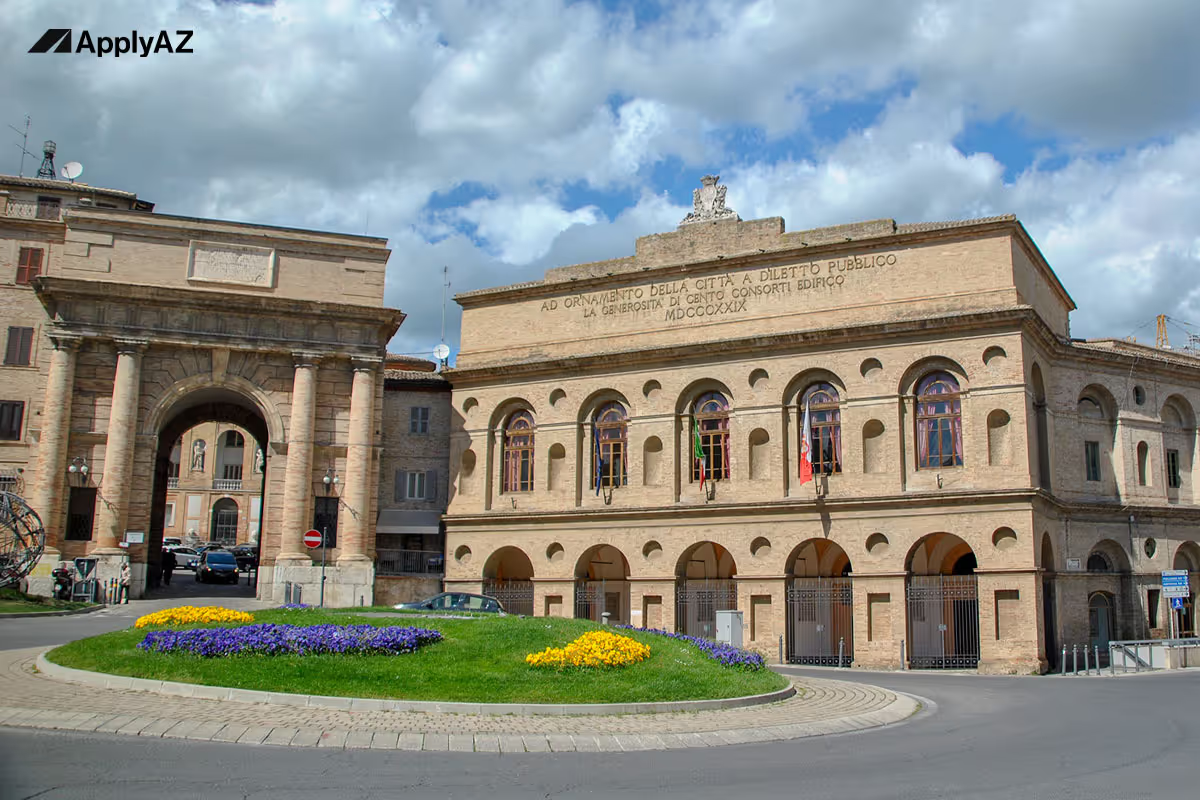
IECoLS (International, European and Comparative Legal Studies) is a three-year, 180 ECTS law bachelor's degree (class L-14) taught in English at the University of Macerata. Entry needs a high school diploma after 12 years of schooling, English at B2 and the IECoLS entry test, with six pre-admission rounds for 2027/28. Fees follow the student's country group, so the degree can be tuition-free for eligible students.
Entry requirements
Detailed entry requirements
IECoLS at UniMC asks for a high school diploma after at least 12 years of schooling, English at B2, a motivation letter and at least one reference, plus the IECoLS entry test or an equivalent CISIA TOLC score. Reviewed 8 October 2026. [1]
School-leaving requirement
You need a high school diploma obtained after at least 12 years of schooling. [1]
If your qualification took fewer than 12 years, you also need previous university studies, a post-secondary qualification or a foundation course certificate. [2]
The admission pages do not set required school subjects or a minimum grade. [1]
What this means for your school results
The rule is about the length of your schooling, not your subjects. As a guide, based on the rule above:
- Usually a fit: Class 12 from CBSE, CISCE (ISC) or an Indian state board, Pakistan's HSSC or FSc, Bangladesh's HSC, and Sri Lankan or British A levels, as these come after at least 12 years of schooling.
- Check carefully: a polytechnic diploma taken after Class 10 instead of Class 12, or a school system where the final certificate comes after 11 years.
- Often short: leaving school after Class 10 or O levels. You would also need university study, a post-secondary qualification or a foundation course first.
English
English at CEFR level B2. You can prove it with a valid certificate at B2 or higher, a letter from your school confirming you studied in English, or citizenship of an English-speaking country. Duolingo and EF SET results are not accepted. [1]
Without proof, you take a free online test run by UniMC's Language Centre. It can be taken only once, and failing it fails the pre-admission evaluation. Students who enrol must still submit an internationally recognised certificate of at least B2 by the end of their first year. [1]
IECoLS entry test
Since 2025/26, enrolment requires the IECoLS-Entry Test: 15 multiple-choice questions on three short texts in 60 minutes, held in person at the Department of Law. The pass mark is 9 out of 15. [1]
Two CISIA results count instead: an English TOLC-E taken between February 2024 and October 2025 with at least 3/13 in Logic and 5/10 in Reading comprehension, or a TOLC CEnT-S with an overall score of at least 60%. [1]
A lower score still lets you enrol, with an additional learning requirement: short workshops in fundamental logic (4 hours) and reading comprehension for legal studies (6 hours), with compulsory attendance and an online self-assessment. [3]
2027/28 pre-admission rounds
For 2027/28, pre-admission runs in six rounds on UniMC's application portal, each closing at 23:59:59 CET: [1]
- 3 to 30 November 2026
- 1 December 2026 to 8 January 2027
- 11 January to 1 February 2027
- 2 February to 1 March 2027
- 2 to 31 March 2027
- 1 to 30 April 2027
Classes start on 13 September 2027. [1]
Documents and non-EU steps
The application needs your school-leaving documents (unofficial English or Italian translations are accepted at this stage), proof of English, an original motivation letter and at least one reference. [1][2]
- After UniMC validates your pre-admission, you complete Universitaly pre-enrolment, which the Ministry usually opens around spring. [2]
- You then apply for a type D study visa and, after arrival, apply for a residence permit within 8 days and enrol online. [2]
- At enrolment you need your diploma legalised or with an Apostille, a Declaration of Value or a CIMEA statement, and an official Italian translation unless your documents are in English. [2]
- The main enrolment window runs from 19 June to 31 October, with an extra fee after that. [2]
Sources and verification
Checked by the ApplyAZ admissions team against the university's official documents listed below. Entry rules can change with each new call, and we re-check them before every application.
- University of Macerata. IECoLS International, European and Comparative Legal Studies, course page on the UniMC pre-admission portal, academic year 2027/28. Reviewed 8 October 2026.
- University of Macerata. Enrolment of international students who need a visa and hold a foreign qualification, academic year 2027/28. Reviewed 8 October 2026.
- University of Macerata, Department of Law. IECoLS How to enrol: entry test, English requirement and additional learning requirements, from academic year 2025/26. Reviewed 8 October 2026.
- University of Macerata, Department of Law. Study plan, Bachelor's degree in International, European and Comparative Legal Studies (L-14), academic year 2026/27. Reviewed 8 October 2026.
- University of Macerata. IECoLS programme page (language of teaching, degree class and admission route), undated. Reviewed 8 October 2026.
About the programme
International, European and Comparative Legal Studies (IECoLS) is a three-year bachelor's degree in class L-14 (legal services), run by the Department of Law at the University of Macerata. It is taught in English, carries 180 ECTS and is taught in person in Macerata, a university town in the Marche region.
The degree gives a full theoretical training in law seen from international, European and comparative angles, combined with practical skills built through internships. It suits school leavers who want a legal career with an international dimension in business, trade or public administration, or who plan to continue to a master's degree in Italy or abroad.
What you will study
The first year lays the foundations of law and economics. The second year covers the main branches of public, private and business law in their European and international form. In the third year you take three core units, choose two electives from six, and complete an internship and an oral final exam.
- Roman Law, History of Western Legal Tradition and Legal Theory
- Foundations of Private Law, Fundamental Rights and Comparative Legal Systems
- European Union Law (9 ECTS) and International Law (8 ECTS)
- Transnational Business Law and Transnational Civil Litigation and Arbitration Law
- Criminal Procedure and New Technologies, Comparative Contract Law and Global Governance and Political Institutions
- Electives such as Data Protection, Privacy and Internet Law, EU Food Law, Environmental Law, Maritime Law Evolving and Conflict of Laws
How the programme is taught
An internship worth 6 ECTS is compulsory and can be done from the second year. The 2026/27 study plan also leaves 13 ECTS for further elective activities. The final exam is an oral report on a topic agreed with a lecturer, with parts in Italian and a foreign language.
Career paths
The course site describes three main profiles, and graduates can also move on to a two-year master's degree.
- International legal operator in banks, financial and insurance companies and SMEs, giving legal advice and supporting international relations and litigation
- Foreign trade referent at chambers of commerce and trade associations, helping firms find foreign partners and EU funding
- Public administration official in national administrations, European institutions or international organisations
Fees and scholarships
UniMC sets fees for international students by country group, with lower fees for students from developing and non-OECD countries and merit conditions from the second year. ERDIS Marche, the regional agency, awards scholarships to non-EU students who meet its merit and income rules, and UniMC runs its own scholarships for first-year international students.
How to apply from outside the EU
We apply for pre-admission on UniMC's DreamApply portal with your diploma, English proof, motivation letter, reference and entry test result. For 2027/28 there are six rounds, from 3 November 2026 to 30 April 2027. Classes start on 13 September 2027.
Once you are admitted, we complete Universitaly pre-enrolment when the Ministry opens it in spring, and you apply for a type D study visa and enrol in Macerata with a legalised diploma (officially translated into Italian unless it is in English) and a declaration of value or CIMEA statement.
How ApplyAZ helps
ApplyAZ is an Italy-based consultancy that works only with public universities. We can include this programme in a shortlist of 20 to 30 English-taught programmes that fit your profile, so your plan never rests on a single application.
For eligible students who start with us, a named person owns each stage, from A to Z:
- We check your school results against UniMC's entry rules for this programme.
- We write your CV and a tailored statement of purpose.
- We prepare and submit your pre-admission application on UniMC's portal, motivation letter and Universitaly pre-enrolment.
- We help you declare your family income for reduced fees and file your ERDIS Marche scholarship application at the right time and in the right format.
- We prepare your visa file.
With operations in all 20 Italian regions, we follow each region's scholarship rules and deadlines as they change. The university decides admission, the region decides the scholarship and the consulate decides the visa, so no one can promise an outcome. You pay in milestones, and every service you pay for is either delivered or its fee is refunded (terms apply).
Programmes at Italian public universities can be tuition-free for eligible students. Check if you are eligible and book a one-to-one consultation session with one of our Italy experts, or see how ApplyAZ works.
Questions and answers
What school results do I need for IECoLS at Macerata?
A high school diploma after at least 12 years of schooling. The admission pages set no required subjects or minimum grades. If your schooling took fewer than 12 years, you also need university study, a post-secondary qualification or a foundation course. [1][2]
Is there an entrance test?
Yes. The IECoLS-Entry Test has 15 multiple-choice questions on three short texts in 60 minutes, with a pass mark of 9. A TOLC CEnT-S score of at least 60% counts instead. A lower score still allows enrolment, with an additional learning requirement. [1]
What English level is required? Do I need IELTS?
English at CEFR B2. A valid certificate, a school letter confirming English-medium studies or citizenship of an English-speaking country works, but Duolingo and EF SET do not. Otherwise you take a free online UniMC test once, and failing it ends the application. [1]
When is the deadline for non-EU students for 2027/28?
There are six pre-admission rounds. The first runs from 3 to 30 November 2026 and the last from 1 to 30 April 2027, each closing at 23:59:59 CET. Classes start on 13 September 2027. [1]
I studied under CBSE or a state board. Can I apply?
A Class 12 certificate from CBSE, CISCE or a state board comes after 12 years of schooling, which is what the rule asks for. If your school taught in English, a school letter confirming it can serve as B2 proof. You still need the entry test. [1]
Is IECoLS taught entirely in English?
Yes. IECoLS is UniMC's English-taught law bachelor's in class L-14, run by the Department of Law in Macerata. You can also earn 3 credits for language progress, for example by reaching B1 in Italian. [4][5]
What will I study?
Year 1 covers legal foundations and economics. Year 2 covers EU, international, administrative, business, labour and criminal law. Year 3 has three core units, two electives from six, 13 credits of further activities, a 6-credit internship and a final exam. [4]
How do fees work for international students?
UniMC sets fees by country group, with lower fees for students from developing and non-OECD countries and a merit requirement from the second year. [1] ERDIS Marche scholarships mean the degree can be tuition-free for eligible students.
Can someone handle my whole application to IECoLS at UniMC?
Yes. ApplyAZ, an Italy-based consultancy that works only with public universities, checks your school results against UniMC's rules for this programme, handles the application and Universitaly pre-enrolment, helps you file the ERDIS Marche scholarship application at the right time and in the right format, and prepares your visa file, for eligible students. Start by checking your eligibility.
I'm applying from India. What is the route into IECoLS?
A Class 12 certificate from CBSE, CISCE or a state board comes after 12 years of schooling, which is what the rule asks for. You also need English at B2, a motivation letter, a reference and the IECoLS entry test or an equivalent TOLC score. The steps are UniMC pre-admission in one of six rounds, then Universitaly pre-enrolment. [1][2] Indian students apply for the type D study visa at the Italian embassy or consulate that covers their state, such as New Delhi, Mumbai or Bengaluru.
Is the route different from Pakistan, Bangladesh or Sri Lanka?
No. The academic rules for IECoLS are the same whatever your nationality. Applicants from Pakistan, Bangladesh and Sri Lanka follow the same steps as India: online pre-admission with UniMC and Universitaly pre-enrolment, then a type D study visa from the Italian mission for their country of residence. Read our guide for students in Dhaka.
I live in the UAE, Saudi Arabia, Qatar, Kuwait, Oman or Bahrain. Where do I apply for the visa?
At the Italian embassy or consulate responsible for the country where you legally live, after Universitaly pre-enrolment. The academic rules for IECoLS are the same whatever your nationality, and Gulf residents follow the same steps: online pre-admission with UniMC and Universitaly pre-enrolment. Read our guides for Dubai, Riyadh and Doha.
I studied or live in London, New York, Toronto, Vancouver, Singapore or Kuala Lumpur. What is the route?
The academic rules for IECoLS are the same whatever your nationality, and your school results are assessed like any other foreign qualification. Non-EU applicants who live abroad follow the same route: online pre-admission with UniMC and Universitaly pre-enrolment, then a type D study visa from the Italian mission for where they live. Read our guides for students in London, New York, Toronto, Vancouver, Singapore and Kuala Lumpur.
More English-taught programmes at this university
Other public universities in this city

They began right where you are

